Teen nutrition · October 29, 2026
Swap some meat and dairy protein for beans and bread: in 790 Spanish teenagers it made no difference to how fit they were
Animal protein is often sold as the better fuel for growing, active bodies. Researchers in Murcia modelled what happens on paper when teenagers get more of their protein from plants instead, and ran the numbers against sprints, jumps, grip and a bleep test. The headline answer was a flat line. The food-by-food results are where it gets interesting, and shakier.
Ask a coach what a growing athlete should eat and you will often hear about eggs, milk, chicken and fish. Animal proteins carry a fuller set of essential amino acids and are easier to digest, so the thinking goes that they build muscle and performance better than protein from beans, grains or nuts. Most of the evidence on that question comes from adults. A study published in Frontiers in Nutrition on 28 October, by researchers in Spain, Chile, Ecuador, Korea and Andorra, looked at teenagers instead.
The team used the Eating Healthy and Daily Life Activities (EHDLA) study, run in all three secondary schools of the Valle de Ricote, a rural valley in Murcia in south-east Spain. After exclusions, 790 adolescents aged 12 to 17 had both a food questionnaire and a full fitness test: a 20-metre shuttle run (the 'bleep test') for stamina, handgrip strength, a standing long jump, a 4 x 10 metre shuttle sprint for speed and agility, and a sit-and-reach for flexibility. Their 45-item food frequency questionnaire covered the past year, and each food was sorted by its main protein source.
These teenagers ate plenty of protein: a median of about 111 grams a day, or 1.9 grams per kilogram of body weight, roughly double the usual recommendation for their age. About three quarters of it came from animal foods. The researchers then used a statistical method called isocaloric substitution, which asks what fitness would look like if 5% of a teenager's daily calories shifted from animal protein to plant protein while total calories, fat and carbohydrate stayed the same. At this group's median intake, 5% of energy works out to roughly 30 grams of protein a day, a big shift on paper.
The answer was nothing measurable. After adjusting for age, sex, family affluence, sleep, physical activity, screen and sitting time, body mass index and total energy, none of the six fitness outcomes moved in either direction, and the confidence intervals sat comfortably across zero. The result held when the group was split by activity level and by whether protein intake was adequate.
The team also broke protein down by food. Swapping egg protein for plant protein went with a shorter jump and a slower sprint; swapping oily fish went with a slower sprint; swapping cereal protein for animal protein went with a faster sprint, and swapping root-vegetable protein (mostly potatoes) for animal protein went with lower overall fitness. Those findings sound like a menu, but the authors are clear they are not. They ran 78 food-level comparisons, and once the numbers were corrected for testing so many at once, none of them held up. For some foods a 5% energy swap is also bigger than anything a teenager would actually eat.
The limits matter. This was a single snapshot, so it shows associations, not effects, and nobody changed their diet. Protein was estimated from a questionnaire with standard portion sizes, not weighed, and the study had no data on training history or past sport. The sample came from one valley in Spain. What it does suggest is that for teenagers who already eat enough protein, where it comes from may matter less for fitness than the overall diet, which leaves room for families who want more beans and grains on the plate.
Isocaloric substitution of plant-based for animal-based protein and physical fitness in adolescents: a cross-sectional study from the EHDLA study (Frontiers in Nutrition, 2026)
790
Adolescents aged 12 to 17 analysed (55% girls, median age 14), from the three secondary schools of the Valle de Ricote, Murcia
1.93 g/kg
Median estimated protein intake per kg of body weight a day (about 111 g); 1.44 g/kg from animal foods, 0.48 g/kg from plants
12.7% vs 4.3%
Median share of daily energy from animal protein versus plant protein
0 of 6
Fitness outcomes linked to swapping 5% of energy from animal to plant protein, fully adjusted (all p > 0.05)
+0.02
Change in the overall fitness z-score for that swap, fully adjusted (95% CI −0.19 to 0.24, p = 0.84)
0 of 78
Food-level swaps (eggs, oily fish, cereals, potatoes and others) still significant after correcting for multiple testing
Cross-sectional secondary analysis of the EHDLA study. Diet from a validated 45-item food frequency questionnaire (past year, standard portions, French REGAL food-composition tables); fitness from the ALPHA-Fit battery (20 m shuttle run, handgrip, standing long jump, 4 x 10 m shuttle run, sit-and-reach) and an overall age- and sex-standardised score. Robust linear regression partition models with protein, carbohydrate and fat as % of energy plus total energy; adjusted for age, sex, Family Affluence Scale, sleep, physical activity and sedentary behaviour (Youth Activity Profile), and BMI. Food-level results before correction: egg to plant protein, long jump β −0.55 (95% CI −1.06 to −0.06) and 4 x 10 m β 0.58 (0.12 to 1.04); oily fish to plant, 4 x 10 m β 0.33 (0.01 to 0.65); root vegetables to animal, overall fitness β −1.23 (−2.17 to −0.29); cereals to animal, 4 x 10 m β −0.53 (−0.89 to −0.17); none survived Benjamini–Hochberg correction. No external funding; one author was employed by the Fit Generation Research Institute.
- The usual protein recommendation for teenagers is around 0.8 to 1.0 grams per kilogram of body weight a day. Teen athletes in hard training may benefit from 1.2 to 2.0. The median teenager in this study was already near the top of the athletes' range, on paper at least.
- Potatoes count as a protein source in diet studies. They're low in protein per bite, but eaten often enough they add up, which is why 'root vegetables' appears among the plant protein groups here.
- In the 4 x 10 metre shuttle run, a lower time is better, so a positive result means slower. The authors flipped its sign before building the overall fitness score so that higher always meant fitter.
- Isocaloric substitution studies don't change anyone's diet. They compare people whose diets already differ and estimate, with statistics, what a swap would look like if everything else stayed the same.
- Isocaloric substitution of plant-based for animal-based protein and physical fitness in adolescents: a cross-sectional study from the EHDLA studyFrontiers in Nutrition · The study, published 28 October 2026 (CC BY); figures from the abstract, methods, results, Tables 1 and 2, discussion and limitations
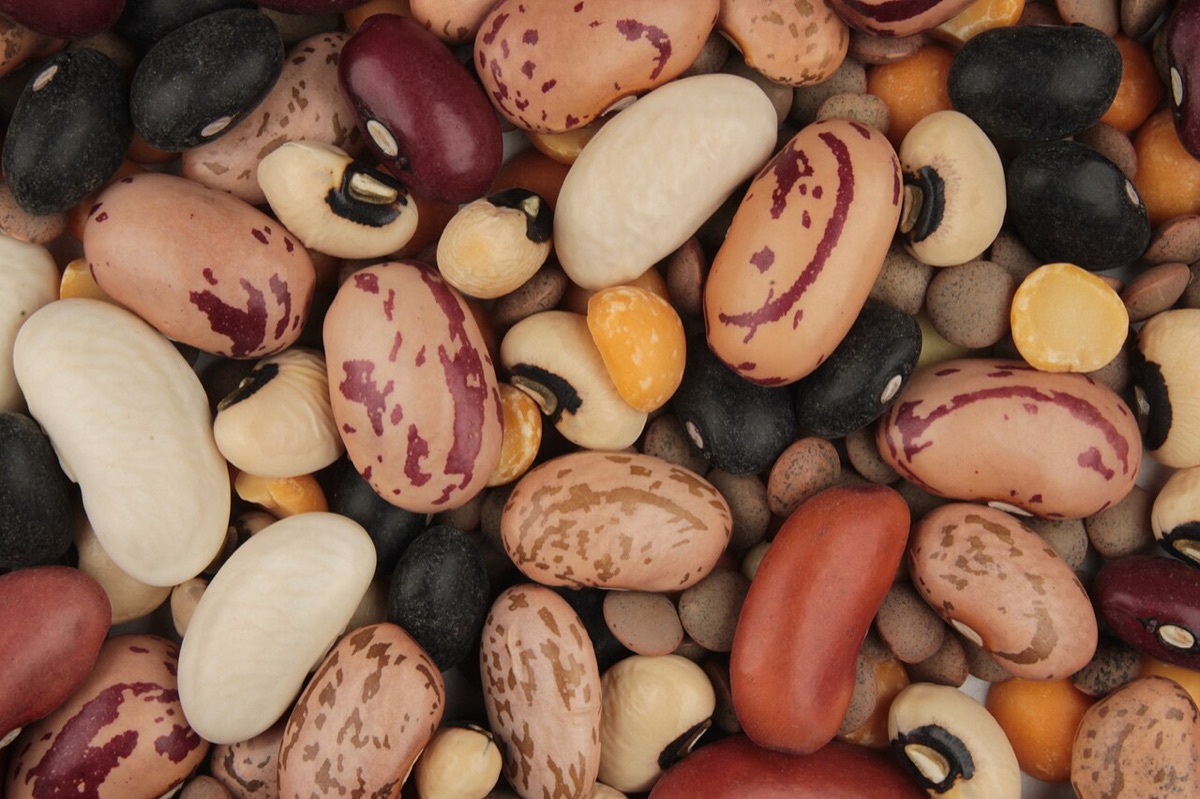
- Mixture of beans (small red, cannellini, pinto, roman, red kidney, black), peas (blackeye, yellow split), and pardina lentils 10Wikimedia Commons · The image, CC0
General information, not medical advice. This survey shows links, not cause and effect, and can't say that changing where your child's protein comes from will change their fitness. For a teenager with a medical condition, an eating disorder, heavy training or a restricted diet, talk to your doctor or a registered dietitian before making big changes.
Analysis by NutroPractic from the sources listed. Written for general readers; it does not replace advice from your own doctor.
From our articles
Our guides on this subject
Plain-language guides on nutrition and wellness, backed by research.
Indian kitchen
Dal and pulses in an Indian kitchen: protein, soaking, gas and blood sugar
A katori of dal gives about 6 to 10 g of protein, depending on how much raw dal goes in. What India's food tables and the ICMR-NIN 2024 guidelines say about rice with dal, how much soaking, sprouting and pressure cooking cut phytate and the sugars behind the gas, the GI of chana dal and rajma, raw rajma safety, and a worked plate for diabetes.
25 Oct 2026
Everyday eating
Eating well on a tight food budget: what the cost studies found, and the cheapest protein and fibre per dollar
Healthier diets cost about $1.48 a person a day more, according to a meta-analysis of 27 studies. What the USDA's Thrifty Food Plan costs in 2026, our price check of protein and fibre per dollar at September 2026 prices, why frozen and tinned vegetables are not second best, and a batch-cooked stew at $1.40 a serving.
20 Oct 2026
Weight-loss medicines
Eating on Ozempic, Wegovy or Mounjaro: protein first, so the weight you lose isn't your muscle
GLP-1 medicines shrink your appetite, and with it often your protein. In the big trials a quarter to more than a third of the weight lost was lean mass. What the 2025 joint nutrition advisory recommends, the arithmetic for your own target, and four small plates that get there.
8 Oct 2026
Newsfeed for your website
Want this feed on your website?
Add it to any site with one copy-and-paste snippet. No sign-up, and it updates itself every hour.
Start with a virtual consultation
Tell Dr. Triveni what you want to change. You will leave with a clear next step, whether you are in Toronto, London, New York or Chennai.