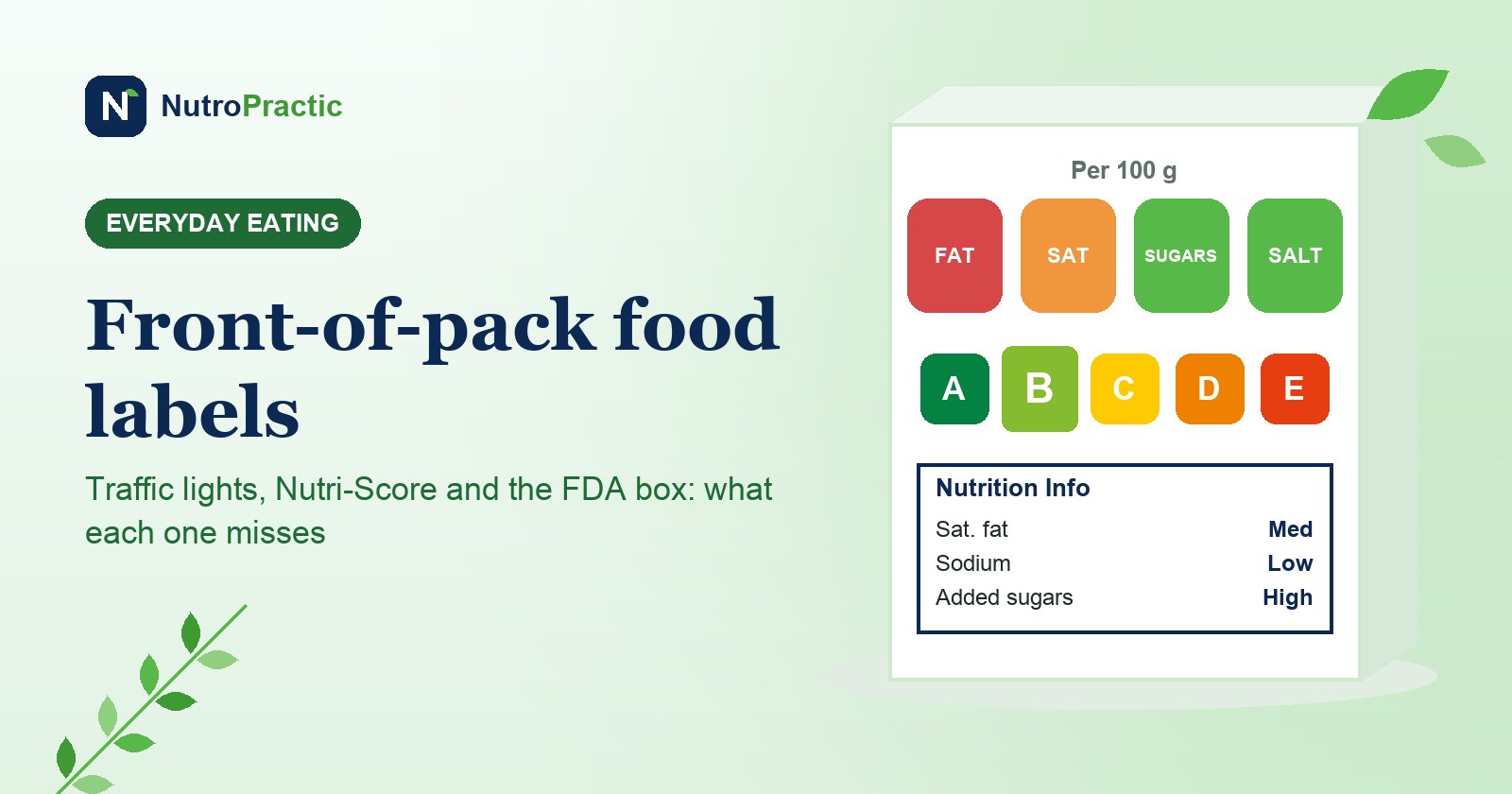
Pick up the same jar of hazelnut spread in London, Paris, Toronto and Chicago and the front of the pack tells you four different stories. In London it wears three red lights and a green one. In Paris it carries a dark orange E. In Toronto, since January 2026, it should carry a black magnifying glass that says "High in". In Chicago it says nothing at all, for now.
Front-of-pack labels exist because almost nobody reads the Nutrition Facts panel in the aisle. Each country has picked a different shortcut, and each shortcut is built on choices about which nutrients count, per how much food, and where the lines go. Those choices decide what the label sees and what it misses. Here is how the main schemes work, what the shopping studies found, and a worked read of three real products under all of them.
The schemes at a glance
- UK traffic lights (2013, voluntary): red, amber or green for fat, saturates, sugars and salt, plus energy and the percentage of an adult's reference intake. Recommended by the UK health departments in June 2013 and used by most large supermarkets.
- Nutri-Score (France 2017, voluntary): one letter from A (dark green) to E (dark orange), from a points score that weighs the bad (energy, sugars, saturated fat, salt) against the good (fibre, protein, fruit, vegetables and legumes). Also used in Belgium, Switzerland, Germany, Luxembourg, the Netherlands and Spain. The algorithm was revised in 2023.
- Canada's "High in" symbol (mandatory since 1 January 2026): a black-and-white magnifying glass on foods at or above a threshold for saturated fat, sugars or sodium. No symbol means the food is under all three lines, not that it is healthy.
- US "healthy" claim (final rule December 2024): not a label everyone carries but a word a company may print only if the food meets FDA criteria. Voluntary; full compliance by 25 February 2028.
- US Nutrition Info box (proposed January 2025): a black-and-white box rating saturated fat, sodium and added sugars as Low, Med or High per serving. Still a proposal in October 2026.
- India (pending): FSSAI floated a star rating in 2022 and has since moved towards warning labels; the Supreme Court reserved its order on the timeline on 28 September 2026.
UK traffic lights: where the colours change
The colours come from fixed cut-offs, set out in the UK government's guide for businesses (updated November 2016). For food, per 100 g:
- Fat: green at 3 g or less, red above 17.5 g
- Saturates: green at 1.5 g or less, red above 5 g
- Sugars (total): green at 5 g or less, red above 22.5 g
- Salt: green at 0.3 g or less, red above 1.5 g
- Anything in between is amber.
Drinks use half the food cut-offs per 100 ml (red above 11.25 g of sugars, for example). There is one extra rule: for a portion bigger than 100 g (or 150 ml for drinks), a nutrient also turns red if one portion carries more than 30% of the adult reference intake (more than 21 g fat, 6 g saturates, 27 g sugars or 1.8 g salt). That stops a 400 g ready meal from looking green just because each 100 g is moderate.
Read a pack against those numbers and you can predict the colours yourself. A breakfast cereal with 1.1 g of salt per 100 g is amber; at 1.6 g it would be red. A yoghurt with 9 g of sugars per 100 g is amber even if most of that sugar is the milk's own lactose, because the UK scheme counts total sugars, not added sugars.
Nutri-Score: one letter, and what changed in 2023
Nutri-Score adds up points. Energy, sugars, saturated fat and salt earn "unfavourable" points; fibre, protein and the share of fruit, vegetables and legumes earn "favourable" ones. The final score is the first minus the second, and the score sets the letter. It was designed to compare foods within a category, such as one breakfast cereal against another, rather than to say whether a food belongs in your diet.
The scientific committee from the seven countries revised the algorithm in 2023, and the new scores began appearing from 2024, with companies given time to relabel. For foods, sugar and salt are scored more strictly, wholegrain and high-fibre products are separated better from refined ones, oils low in saturated fat (olive, rapeseed, walnut) can now reach B, and red meat gets fewer points for its protein.
The bigger shake-up was for drinks. In the committee's 2023 beverage report:
- Water is still the only drink that can get an A. A drink now needs 2 points or fewer for B; 3 to 6 is C; 7 to 9 is D; 10 or more is E.
- Any drink containing non-nutritive sweeteners gets 4 extra unfavourable points. That alone pushes a zero-sugar cola from B to C.
- Milk and milk drinks moved into the drinks algorithm. In the French product data the committee modelled, whole milk went from 94% of products rated B to 87% rated C, and sweetened milk drinks from 88% rated B to 47% rated E.
- Colas with sweeteners went from a split of B (30%) and C (49%) to 79% C. Colas with sugar were E before and after.
Not every company liked the result. In September 2024 Danone said it would remove Nutri-Score from its drinkable yoghurts and plant-based drinks after products such as drinkable Actimel dropped to D, while the spoonable versions kept better grades.
The US: a "healthy" claim now, a front-of-pack box maybe later
The new "healthy" rule
The FDA announced its new definition of "healthy" on 19 December 2024 (published 27 December). Its start date was pushed from 25 February to 28 April 2025 under the new administration's regulatory freeze; the compliance date stayed at 25 February 2028. The old 1994 rule capped total fat, which kept salmon, nuts and olive oil off the list while sugary low-fat cereals qualified. The new one asks for a real amount of a food group and then caps added sugars, saturated fat and sodium per serving. For a single food:
- Grains: at least ¾ oz whole-grain equivalent; added sugars up to 5 g; sodium up to 230 mg; saturated fat up to 1 g
- Dairy: at least ⅔ cup equivalent; added sugars up to 2.5 g; sodium up to 230 mg; saturated fat up to 2 g
- Vegetables or fruit: at least ½ cup equivalent; added sugars up to 1 g; sodium up to 230 mg; saturated fat up to 1 g
- Seafood, nuts and seeds: at least 1 oz equivalent; added sugars up to 1 g; sodium up to 230 mg; saturated fat up to 1 g, not counting the fat that is naturally in the fish or nuts
- Oils: no added sugar or sodium, and saturated fat no more than 20% of total fat
Plain fruit, vegetables, nuts, fish and water qualify automatically. FDA's own examples of foods that no longer qualify: white bread made from fortified refined flour, heavily sweetened yoghurt and heavily sweetened cereal. Remember it is a claim, not a score: most foods will never carry the word either way, and the absence of "healthy" on a pack tells you nothing.
The proposed Nutrition Info box
On 14 January 2025 the FDA proposed requiring a small black-and-white box on the front of most packaged foods. It would list saturated fat, sodium and added sugars, each with its % Daily Value per serving and a word:
- Low: 5% DV or less
- Med: between 6% and 19% DV
- High: 20% DV or more
Those are the cut-offs the FDA has long told shoppers to use when reading % DV. In the agency's study of nearly 10,000 US adults, this black-and-white version with % DV did best of the formats tested, and with it 95% of participants picked the healthiest of three products and 92% the least healthy. The FDA estimated relabelling would cost the industry about $105 million a year over ten years.
Comments closed on 15 July 2025. The FDA's regulatory agenda, current as of July 2026, gives December 2026 as the goal for a final rule, and the trade press reports the agency may rework it. If it is finalised, larger companies would have three years to comply and smaller ones four, so you would not see it widely before about 2030.
A worked read of three real labels
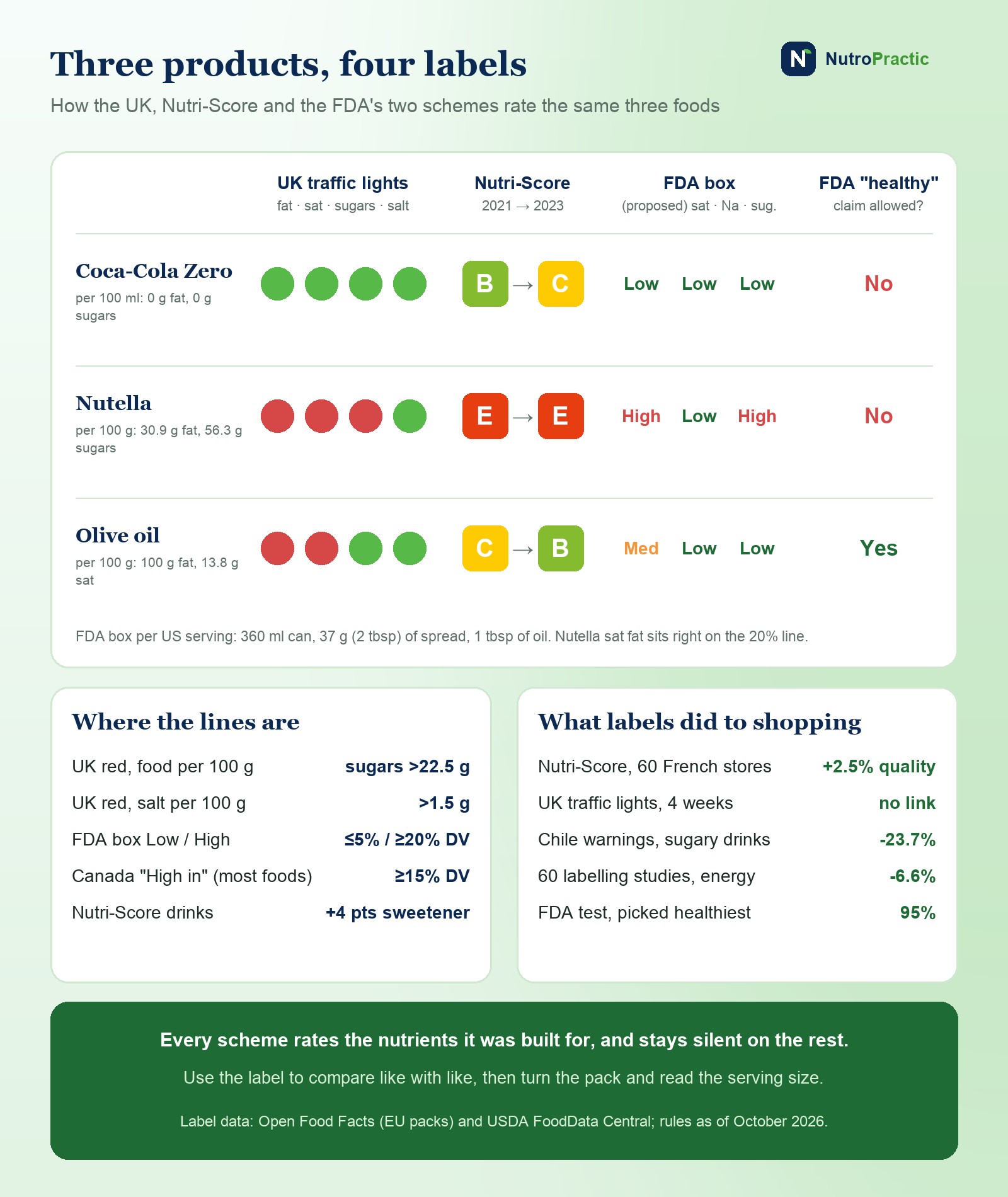
We took the declared nutrition of three products shoppers know in every country we write for, and ran each through the rules above. Figures for the cola and the spread are from their European labels via Open Food Facts; the olive oil is the USDA FoodData Central entry for olive oil. The Nutri-Score grades are the ones Open Food Facts computes with the official algorithms.
1. Coca-Cola Zero Sugar
Per 100 ml: 0 g fat, 0 g saturates, 0 g sugars, 0.02 g salt; sweetened with aspartame, acesulfame K and steviol glycosides.
- UK traffic lights: four greens. Everything is under the drink cut-offs (sugars at 2.5 g or less, salt at 0.3 g or less).
- Nutri-Score: 1 point under the old drinks algorithm, so B. Under the 2023 one, 0 points for energy, sugars, saturated fat and salt, plus 4 for the sweeteners, gives 4 points: C.
- FDA box: a 12 fl oz (360 ml) can has 0 g saturated fat, about 36 mg sodium (2% DV) and 0 g added sugars: Low, Low, Low.
- FDA "healthy": no. It contains no food group.
So the same can is the best-looking product in the aisle under the UK and proposed US schemes, and a middling C under Nutri-Score. The disagreement is a judgement about sweeteners, which only Nutri-Score makes. Our article on sweeteners after the WHO advice covers what the evidence can and can't say about them.
2. Nutella
Per 100 g: 30.9 g fat, 10.6 g saturates, 56.3 g sugars, 0.107 g salt.
- UK traffic lights: red, red, red, green. Fat is above 17.5 g, saturates above 5 g and sugars far above 22.5 g; salt is under 0.3 g.
- Nutri-Score: E under both algorithms (26 points under the old one, 31 under the new; E starts at 19 for foods).
- FDA box: the US serving is 2 tablespoons, 37 g. Saturated fat: 10.6 × 0.37 = 3.9 g, declared as 4 g, which is 20% DV: High, right on the line. Sodium: about 16 mg, 1% DV: Low. Added sugars: of the 20.8 g of sugars in 37 g, a few grams are lactose from the skimmed milk powder (8.7% of the recipe); our estimate is about 19 g added, 38% DV: High.
- FDA "healthy": no, by a wide margin on added sugars.
Every scheme agrees here. The interesting detail is the saturated fat: half a gram less per serving and the US box would read Med. Serving-based labels make exact recipe and serving choices matter.
3. Olive oil
Per 100 g: 100 g fat, 13.8 g saturates, 0 g sugars, 0 g salt.
- UK traffic lights: red, red, green, green. Per 100 g, any oil is red for fat, and 13.8 g of saturates is well above the 5 g line.
- Nutri-Score: C under the old algorithm, B since 2023, when oils low in saturated fat were given their own, kinder thresholds.
- FDA box: one tablespoon (about 14 g) has about 2 g saturated fat, 10% DV: Med; sodium and added sugars are zero: Low, Low.
- FDA "healthy": yes. Saturated fat is 13.8% of the total fat, under the 20% limit for oils.
Here the schemes split hard. The UK label shows olive oil with two reds, the same as many biscuits, because it rates 100 g of a food that people use a tablespoon at a time. Nutri-Score and the US "healthy" rule look at what kind of fat it is, and score it well. Trials of olive oil against other fats are covered in our cooking oils article.
Do the labels change what people buy?
Less than the lab studies suggest, but not nothing.
- Nutri-Score in real shops: in a French field trial, researchers put 1.9 million labels on 1,266 products in four categories across 60 supermarkets and analysed 1.67 million purchases (Dubois and colleagues, Journal of the Academy of Marketing Science, 2021). Nutri-Score did best of the four labels tested: purchases of products in the healthiest third of their category rose 14%, and the nutritional quality of the labelled basket improved by about 2.5%. The effects were on average 17 times smaller than in comparable lab studies.
- UK traffic lights: one retailer's sales of 6 ready meals and 12 sandwiches, four weeks before and after the lights went on in 2007, showed no link between how healthy a product was and how its sales changed (Sacks, Rayner and Swinburn, Health Promotion International, 2009). It was a small, short study, and its own authors said so.
- Warning labels in Chile: after Chile's 2016 law (black "high in" octagons plus limits on marketing to children and sales in schools), purchases of sugary drinks that carried a warning fell 23.7% by volume against what earlier trends predicted (Taillie and colleagues, PLOS Medicine, 2020). Because labels came with marketing limits, the study can't separate the label's share.
- All labels together: a meta-analysis of 60 studies with about 2 million observations found labelling cut energy intake by 6.6% and total fat by 10.6%, raised vegetable intake by 13.5%, and led companies to cut sodium by 8.9% and artificial trans fat by 64.3% (Shangguan and colleagues, American Journal of Preventive Medicine, 2019).
That last point may matter most. Companies reformulate to avoid a red light, an E or a "High in" symbol, and reformulation changes the food for everyone, including people who never look at the label.
What each one misses
- Traffic lights count total sugars, so plain milk and fruit yoghurt are judged on their natural sugar. They have nothing for fibre, wholegrain or fruit and vegetables, so a wholegrain cracker and a white one can look the same. They rate per 100 g, which makes oils, nuts and cheese look worse than the amount you eat. And they are voluntary.
- Nutri-Score is designed to rank products within a category, but people read it across categories, and a diet cola and whole milk both end up as C. It says nothing about additives or how processed a food is: an ultra-processed breakfast bar can score better than a plain cheese. Our ultra-processed foods article covers why that matters.
- The FDA box only looks at three things to limit. It has no word for fibre, protein, potassium or whole grains, and it is per serving, so a company that picks a small serving size looks better. It also isn't law yet.
- The "healthy" claim is something a company chooses to put on the pack. A food that would qualify may simply not bother, so you can't read anything into its absence.
- "High in" warnings (Canada, Chile, and what India is moving towards) are blunt by design: either the symbol is there or it isn't. A product just under every threshold carries no symbol at all, and nothing rewards fibre or whole foods.
India: from stars to warnings
FSSAI's September 2022 draft proposed an "Indian Nutrition Rating" of half a star to five stars, modelled on Australia's Health Star Rating. Public health groups argued that stars would work as a badge of approval on packaged snacks, and the star rating never came into use. In a Supreme Court case brought by the Kerala-based group 3S and Our Health Society, FSSAI has since said it would bring in warning labels in one phase, modelled on Canada's, for products high in added sugar, fat or salt, with a separate notice for non-caloric sweeteners. It asked for about four months to finalise the rules and a year of voluntary compliance after that. On 28 September 2026 the bench questioned why a voluntary year was needed and reserved its order. Reports differ on whether one high nutrient or two would trigger the warning, so watch for the final text.
Until then, Indian packs carry only the back-of-pack table (per 100 g, and per serve for many products). The traffic-light cut-offs above are a quick way to read it: above 22.5 g of sugars or 1.5 g of salt per 100 g is high by the UK's standard, which is as good a yardstick as any. Note that Indian labels list sodium in mg, not salt: multiply by 2.5 to get salt (600 mg sodium = 1.5 g salt).
A 30-second read, whatever the pack says
1. Use the front label to compare like with like: two cereals, two yoghurts, two pasta sauces. That's the job it was built for.
2. Turn the pack over and check the serving size against what you actually eat. Two servings of a Med become a High.
3. Look at sugar and salt per 100 g. Above 22.5 g sugars or 1.5 g salt is high; under 5 g and 0.3 g is low.
4. Find the fibre. Labels mostly ignore it. For breads and cereals, 6 g per 100 g or more is a good sign.
5. Read the first three ingredients. If sugar, refined flour or oil leads the list, the front label's verdict is probably about right, whatever the colour.
If salt is your main concern, our free sodium counter adds up a day of foods for you, and the salt and blood pressure article explains how much cutting it helps.
A front-of-pack label answers one question about one product. It can't tell you whether your week of eating adds up.
Labels help you compare two products; they don't plan a week of meals. In a virtual consultation, Dr. Triveni can go through what you actually buy and eat, and build a lifestyle plan around it that fits your kitchen and budget.
Book a consultationThis article is general information, not medical advice. Regulatory details are as of October 2026 and may change; the US Nutrition Info box and India's warning labels are still proposals.
Sources
Department of Health, Food Standards Agency and devolved administrations, Guide to creating a front of pack (FoP) nutrition label for pre-packed products sold through retail outlets (updated November 2016). Nutri-Score Scientific Committee, Update of the Nutri-Score algorithm for beverages: second update report (2023). Santé publique France, Nutri-Score 2023 update. FoodNavigator, Why is Danone removing Nutri-Score? (13 September 2024).
US FDA, Use of the "healthy" claim on food labeling; Food Labeling: Nutrient Content Claims; Definition of Term "Healthy", 89 FR 106064 (27 December 2024); Covington, FDA delays effective date for "healthy" final rule (February 2025). US FDA, Food Labeling: Front-of-Package Nutrition Information, proposed rule, 90 FR (16 January 2025); Front-of-package nutrition labeling; Foods program regulations under development (current as of 9 July 2026). Health Canada, front-of-package nutrition symbol regulations (Canada Gazette Part II, July 2022; compliance 1 January 2026).
USDA Foreign Agricultural Service, India: FSSAI publishes draft notification on front-of-pack labeling (2022). FoodOS360, FSSAI front-of-pack warning labels: Supreme Court reserves order (September 2026); LawBeat, Front-of-pack labelling to be rolled out in single phase: FSSAI tells Supreme Court.
Dubois P. et al., Effects of front-of-pack labels on the nutritional quality of supermarket food purchases: evidence from a large-scale randomized controlled trial, J Acad Mark Sci 49(1):119-138 (2021). Sacks G., Rayner M., Swinburn B., Impact of front-of-pack 'traffic-light' nutrition labelling on consumer food purchases in the UK, Health Promot Int 24(4):344-352 (2009). Taillie L.S. et al., An evaluation of Chile's Law of Food Labeling and Advertising on sugar-sweetened beverage purchases from 2015 to 2017, PLOS Med 17(2):e1003015 (2020). Shangguan S. et al., A meta-analysis of food labeling effects on consumer diet behaviors and industry practices, Am J Prev Med 56(2):300-314 (2019).
Product data: Open Food Facts, Coca-Cola Zero Sugar 330 ml and Nutella (accessed 26 October 2026); USDA FoodData Central, olive oil (SR Legacy). Nutella added sugar per serving is our estimate from the recipe's 8.7% skimmed milk powder.