Few kitchen questions start more arguments. Olive oil is praised, seed oils are called toxic, butter and ghee are said to be back, and coconut oil had its moment as a superfood. Most of the loud claims rest on one study, or on a mechanism that sounds convincing in a short video. The good news is that cooking oils have been tested in real trials for sixty years, with heart attacks and deaths as the outcome, not just blood tests.
Here is what those trials compared, where the seed-oil argument comes from, what butter, ghee and coconut oil do to LDL cholesterol, what smoke points really tell you, and how mustard and rice bran oil fit in for Indian kitchens.
Why the type of fat matters
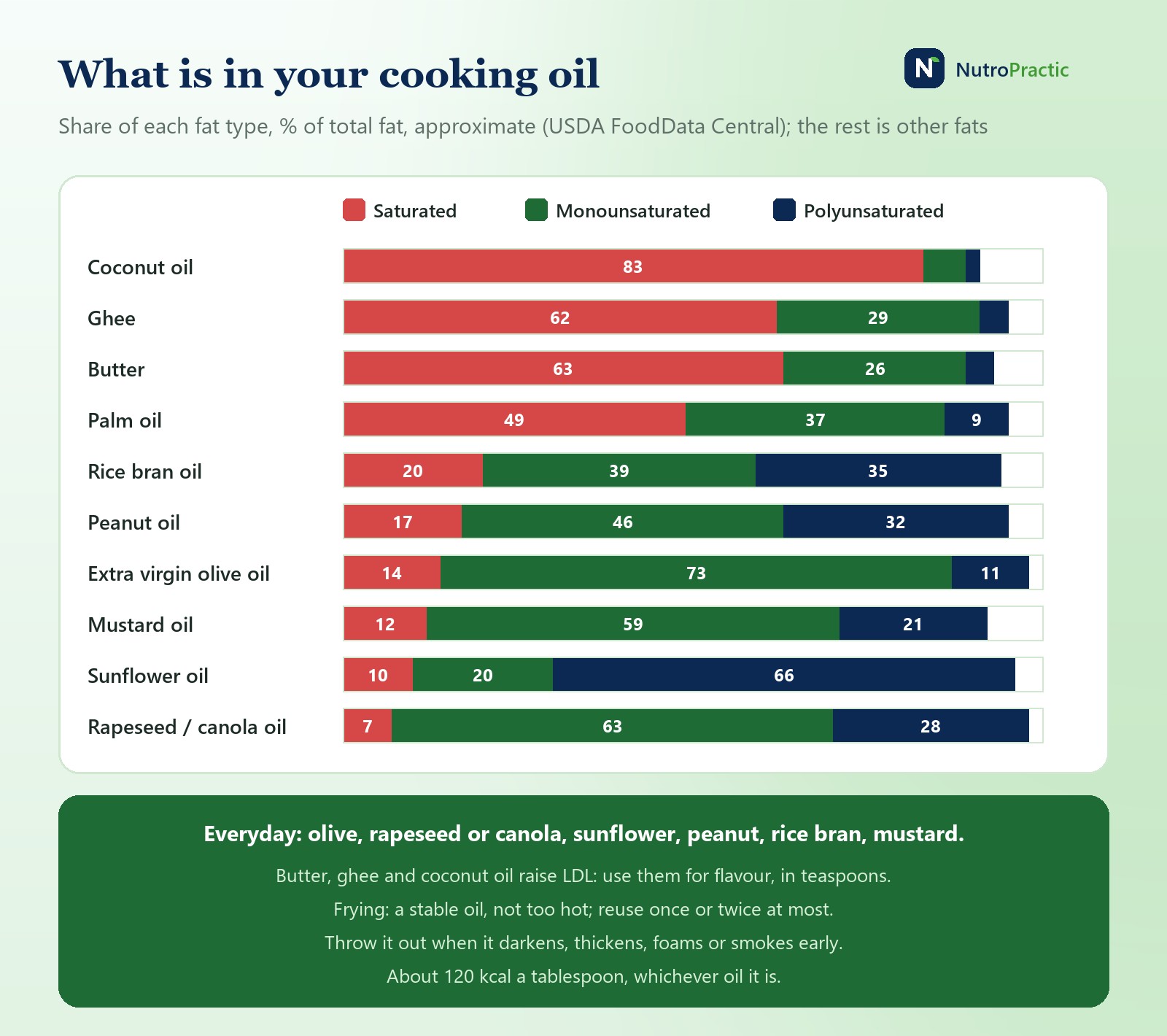
Every oil is a mix of three kinds of fat. Saturated fat (high in butter, ghee, coconut and palm oil) raises LDL cholesterol, the particle that builds plaque in arteries. Monounsaturated fat (high in olive, rapeseed or canola, peanut and high-oleic sunflower oil) is roughly neutral to slightly helpful for LDL. Polyunsaturated fat (high in sunflower, soybean, corn and safflower oil, with omega-3 in rapeseed, flaxseed and walnut oil) lowers LDL. The idea that a 'good' oil is one type of fat and a 'bad' oil another is too simple, but the balance matters, and it is what most of the trials were about.
PREDIMED: the olive oil trial
The best-known oil trial ran in Spain from 2003. PREDIMED gave 7,447 people at high risk of heart disease one of three diets: a Mediterranean diet with about a litre of extra virgin olive oil a week for the household, a Mediterranean diet with a daily handful of nuts, or advice to eat a lower-fat diet. After about five years, the olive oil group had about 30% fewer heart attacks, strokes and cardiovascular deaths than the low-fat group. Because some sites did not randomise properly, the paper was withdrawn and republished in 2018 with corrected analyses; the result held.
Two cautions. The comparison was against a low-fat diet that people didn't follow very well, not against other oils. And the olive oil came with a whole Mediterranean pattern: vegetables, legumes, fish, less processed meat. What PREDIMED shows is that a diet rich in extra virgin olive oil is good for the heart, and that fat-phobia isn't needed. It doesn't show that olive oil beats every other unsaturated oil.
The seed oil argument: Sydney and Minnesota
Seed oils (sunflower, soybean, corn, safflower, rapeseed, cottonseed) are the target of a big online campaign that blames them for heart disease, inflammation and weight gain. The serious part of the argument rests on two old trials whose data were recovered by Christopher Ramsden and colleagues at the US National Institutes of Health.
In the Sydney Diet Heart Study (1966 to 1973), 458 men who had already had a heart attack were told to replace saturated fat with safflower oil and a safflower margarine. The recovered data, published in the BMJ in 2013, showed more deaths in the safflower group: 17.6% against 11.8%. In the Minnesota Coronary Experiment (1968 to 1973), 9,423 people in mental hospitals and a nursing home were given either a diet high in corn oil or a typical diet. Cholesterol fell, but deaths did not; the 2016 BMJ paper found that the more cholesterol fell, the higher the risk of death.
Those findings deserve to be taken seriously, and they have been. Their weaknesses are just as real. The Sydney margarine almost certainly contained artificial trans fat, which we now know is harmful. In Minnesota, the average person stayed on the diet for only about a year, many were very ill, and causes of death were missing. And the oil groups were given almost no omega-3, only omega-6.
Other evidence points the other way. A 2017 American Heart Association advisory pooled the four best-run trials that replaced saturated fat with polyunsaturated oils and found about 30% less heart disease. A Cochrane review in 2020 found that cutting saturated fat lowered cardiovascular events by 17%, with the benefit coming when it was replaced by polyunsaturated fat. In 30 cohort studies pooled by Marklund and colleagues (2019, 68,659 people), those with the most linoleic acid (the main omega-6 in seed oils) in their blood had less heart disease and lower cardiovascular death, not more. And the claim that omega-6 fires up inflammation has not held up in feeding trials: raising linoleic acid intake did not raise inflammation markers in the blood.
The fair summary: seed oils are not poison. Used in home cooking in place of butter, ghee or palm oil, they lower LDL, and the larger body of evidence links them to less heart disease. What does deserve suspicion is where most people meet them: deep-fried and ultra-processed foods, often fried in oil that has been reused many times. That is a problem of the food, not the oil in your bottle.
Butter, ghee and coconut oil
Saturated fat raises LDL, and these three are the most saturated fats in most kitchens. Butter and ghee are about 60 to 65% saturated; coconut oil is over 80%.
Coconut oil. A 2020 meta-analysis in Circulation (Neelakantan and colleagues, 16 trials) found that coconut oil raised LDL by about 10 mg/dL compared with non-tropical vegetable oils. It also raised HDL a little, but HDL raised by diet hasn't been shown to protect the heart. There was no benefit for weight, blood sugar or inflammation. The 'MCT' claims come from studies of a purified MCT oil, which is not the same thing as coconut oil.
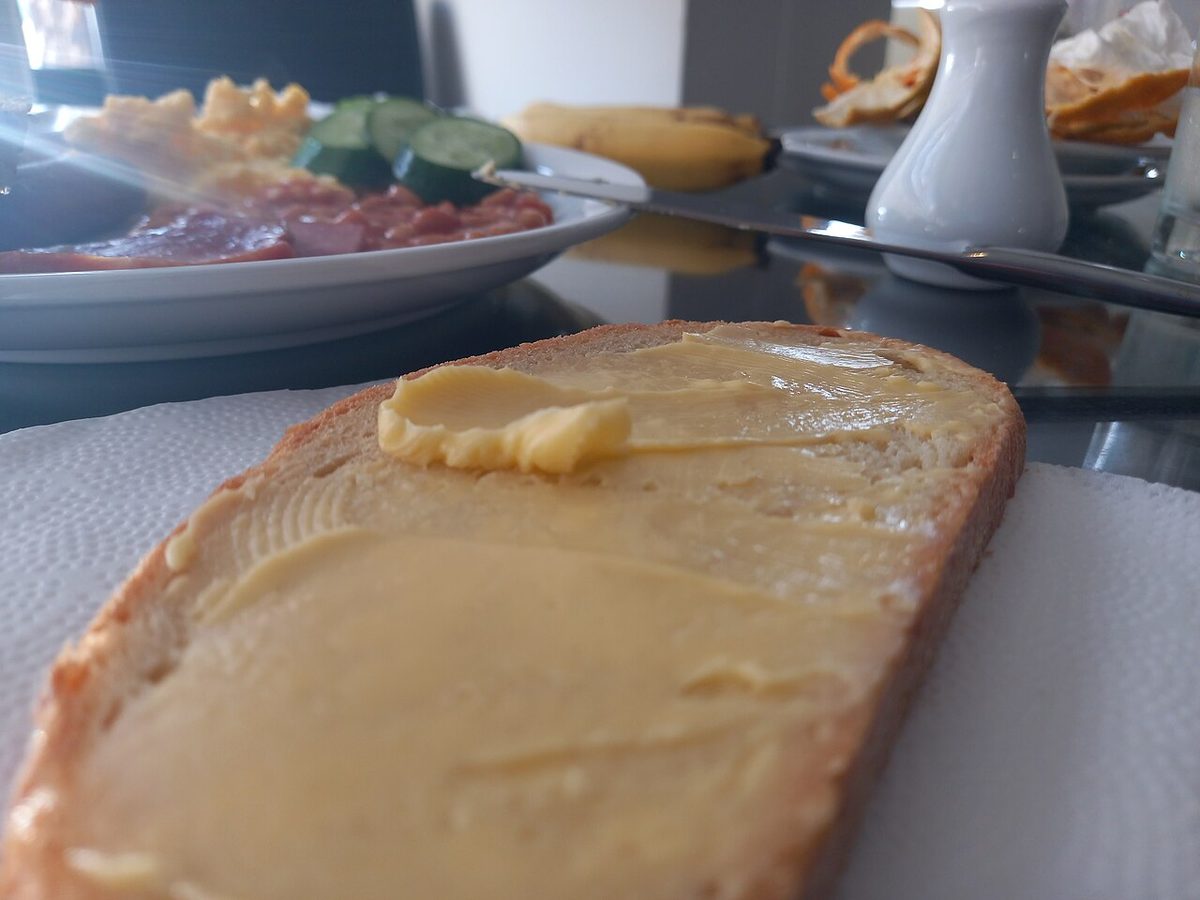
Butter. In a UK trial (Khaw, 2018, 94 adults), 50 g a day of butter for four weeks raised LDL clearly more than the same amount of olive oil. Coconut oil raised it less than butter in that trial, which made headlines, but the larger meta-analysis is the better guide.
Ghee is butter with the water and milk solids cooked off, so it is even richer in fat per spoon and has about the same saturated share. There are few good trials of ghee itself. It also forms some oxidised cholesterol when heated for a long time. Ghee has a real place in Indian cooking, for flavour and tradition, and a teaspoon on dal or a roti is not the problem. Several spoons a day, every day, for frying everything, is a different matter, especially for anyone with high LDL or diabetes. Our LDL article covers what else moves LDL.
The oil in your bottle matters less than how often it goes into a deep fryer, and how many times it is used there.
Smoke points, frying and reusing oil
A smoke point is the temperature at which an oil starts to smoke. It is widely quoted and only partly useful. What matters more for health is how stable the oil is when heated: how quickly it breaks down into polar compounds and aldehydes. Oils rich in monounsaturated fat and natural antioxidants hold up better than very polyunsaturated ones. In an Australian lab test (De Alzaa and colleagues, 2018), extra virgin olive oil heated to 180 to 240 °C formed fewer harmful polar compounds than several oils with higher smoke points. So the old rule that you can't cook with extra virgin olive oil is wrong: it is fine for sautéing, roasting and shallow frying. Home stir-frying and sautéing rarely get near the smoke point of any common oil.
Reusing frying oil is where the real harm is. Every heating breaks the oil down further, and it builds up polar compounds, aldehydes and some trans fat. India's food regulator FSSAI bans the use of oil whose total polar compounds exceed 25%, bans topping it up with fresh oil, and advises reheating oil no more than about three times. Several European countries set similar limits. At home: strain oil after frying, store it covered and away from light, use it for one or two more fries at most, and throw it out if it has darkened, thickened, smells sharp, foams, or smokes at a lower heat than before. Don't pour reused deep-frying oil into everyday cooking.
For Indian kitchens: mustard, rice bran and groundnut oil
Mustard oil is the traditional oil of north and east India. It is high in monounsaturated fat and has about 10% omega-3 (ALA), more than most cooking oils. It also has erucic acid, which caused heart muscle damage in rat studies in the 1970s; the US FDA does not allow expressed mustard oil to be sold as a cooking oil for that reason, and the EU sets limits. Human evidence of harm is missing, and in a case-control study in Delhi and Bangalore (Rastogi, 2004) mustard oil users had lower heart disease risk than sunflower oil users. Used in normal amounts as part of a varied diet, it is a reasonable choice; rotating it with another oil keeps erucic acid intake low.
Rice bran oil is popular for frying because it is mild and stable. It contains gamma-oryzanol, and in trials it lowered LDL modestly, by around 7 mg/dL in a 2016 meta-analysis. Groundnut (peanut) oil and sesame oil are mostly unsaturated and fine everyday choices. Palm oil, common in Indian snacks, biscuits and in vanaspati blends, is about half saturated and raises LDL more than the others. Vanaspati (hydrogenated vegetable fat) used to be a major source of trans fat; FSSAI capped trans fat in oils and fats at 2% in 2022, but older stocks and street food can still carry it, so keep it out of the home kitchen.
A practical tip used in many Indian homes, and supported by nutrition advice from ICMR-NIN: use two or more oils across the week, for example mustard or groundnut for cooking and rice bran or sunflower for frying, so you get a mix of fats.
What to buy and how to use it
For everyday cooking: extra virgin olive oil, rapeseed or canola oil, sunflower or high-oleic sunflower, peanut, rice bran or mustard oil. All are mostly unsaturated. Olive and rapeseed have the strongest evidence and are the easiest defaults; rapeseed and mustard add omega-3.
For flavour: butter, ghee and coconut oil, in teaspoons rather than ladles, and not as the main cooking fat if your LDL is high.
For frying: a stable oil (olive, high-oleic sunflower, rice bran, peanut), not too hot, and not reused more than once or twice. Fry less often; bake, grill or air-fry instead.
Amount still matters. Every oil has about 120 calories a tablespoon. For most adults, four to six teaspoons (20 to 30 g) of added oil a day is plenty, roughly the range in Indian dietary advice. Measure with a spoon for a week, not straight from the bottle, and you will probably find you use more than you think.
Look past the bottle. For most people, the biggest change is not which oil they buy but how much fried and ultra-processed food they eat, and how much of their fat comes from fish, nuts, seeds and olives instead.
High LDL, a family history of heart disease, or a kitchen where everything is fried in the same oil? Dr. Triveni builds heart health and anti-inflammatory plans around the food you actually cook, in a virtual consultation.
Book a consultationThis article is general information, not medical advice. If you have high cholesterol, heart disease or diabetes, discuss changes in your diet with your doctor or dietitian, and don't stop prescribed medicines because of a change in cooking oil.
Sources
Estruch R. et al., Primary prevention of cardiovascular disease with a Mediterranean diet supplemented with extra-virgin olive oil or nuts, N Engl J Med 378:e34 (2018, republished). Ramsden C.E. et al., Use of dietary linoleic acid for secondary prevention of coronary heart disease and death: evaluation of recovered data from the Sydney Diet Heart Study, BMJ 346:e8707 (2013). Ramsden C.E. et al., Re-evaluation of the traditional diet-heart hypothesis: analysis of recovered data from the Minnesota Coronary Experiment (1968-73), BMJ 353:i1246 (2016). Harvard T.H. Chan School of Public Health, Research review: old data on dietary fats in context with current recommendations (2016).
Sacks F.M. et al., Dietary fats and cardiovascular disease: a presidential advisory from the American Heart Association, Circulation 136:e1-e23 (2017). Hooper L. et al., Reduction in saturated fat intake for cardiovascular disease, Cochrane Database Syst Rev (2020). Marklund M. et al., Biomarkers of dietary omega-6 fatty acids and incident cardiovascular disease and mortality, Circulation 139:2422-2436 (2019). Johnson G.H., Fritsche K., Effect of dietary linoleic acid on markers of inflammation in healthy persons: a systematic review of randomized controlled trials, J Acad Nutr Diet 112(7):1029-1041 (2012).
Neelakantan N., Seah J.Y.H., van Dam R.M., The effect of coconut oil consumption on cardiovascular risk factors: a systematic review and meta-analysis of clinical trials, Circulation 141(10):803-814 (2020). Khaw K.-T. et al., Randomised trial of coconut oil, olive oil or butter on blood lipids and other cardiovascular risk factors in healthy men and women, BMJ Open 8:e020167 (2018). US Department of Agriculture, FoodData Central (fatty acid profiles of oils, butter and ghee).
De Alzaa F., Guillaume C., Ravetti L., Evaluation of chemical and physical changes in different commercial oils during heating, Acta Scientific Nutritional Health 2(6):2-11 (2018). Food Safety and Standards Authority of India, Repurpose Used Cooking Oil (RUCO) and the 25% total polar compounds limit. US FDA, Import Alert 26-04 (expressed mustard oil not permitted as a vegetable oil). EFSA CONTAM Panel, Erucic acid in feed and food, EFSA Journal 14(11):4593 (2016). Rastogi T. et al., Diet and risk of ischemic heart disease in India, Am J Clin Nutr 79(4):582-592 (2004). Jolfaie N.R. et al., The effect of rice bran oil on lipid profile: a systematic review and meta-analysis, Lipids 51(5):535-545 (2016). ICMR-National Institute of Nutrition, Dietary Guidelines for Indians (2024).