About one adult in ten has chronic constipation by the strict medical definition, and far more have it some of the time. Women are affected about twice as often as men. The usual advice, "eat more fibre and drink more water", is not wrong, but it is vague: which fibre, how much, and for how long?
In the last few years the question has finally been tested food against food. Kiwifruit has been put up against psyllium, prunes against psyllium, and all three against each other, and in 2025 British dietitians published the first guideline built specifically on diet trials for constipation. Here is what they found, with the doses that were used, so you can try it properly.
What counts as constipation
Doctors use the Rome IV criteria. For at least the last three months, with symptoms that began six months or more ago, two or more of these in over a quarter of bowel movements: straining, hard or lumpy stools, a feeling of not emptying fully or of a blockage, needing to help it out by hand, or fewer than three bowel movements a week. Pooled across 45 studies and 275,260 adults, about 10% of people meet that definition (Barberio and colleagues, 2021).
Trials count complete spontaneous bowel movements (CSBM) a week: ones that happen without a laxative and leave you feeling empty. Trials often count one extra a week as a response.
Kiwifruit vs psyllium: the 2023 international trial
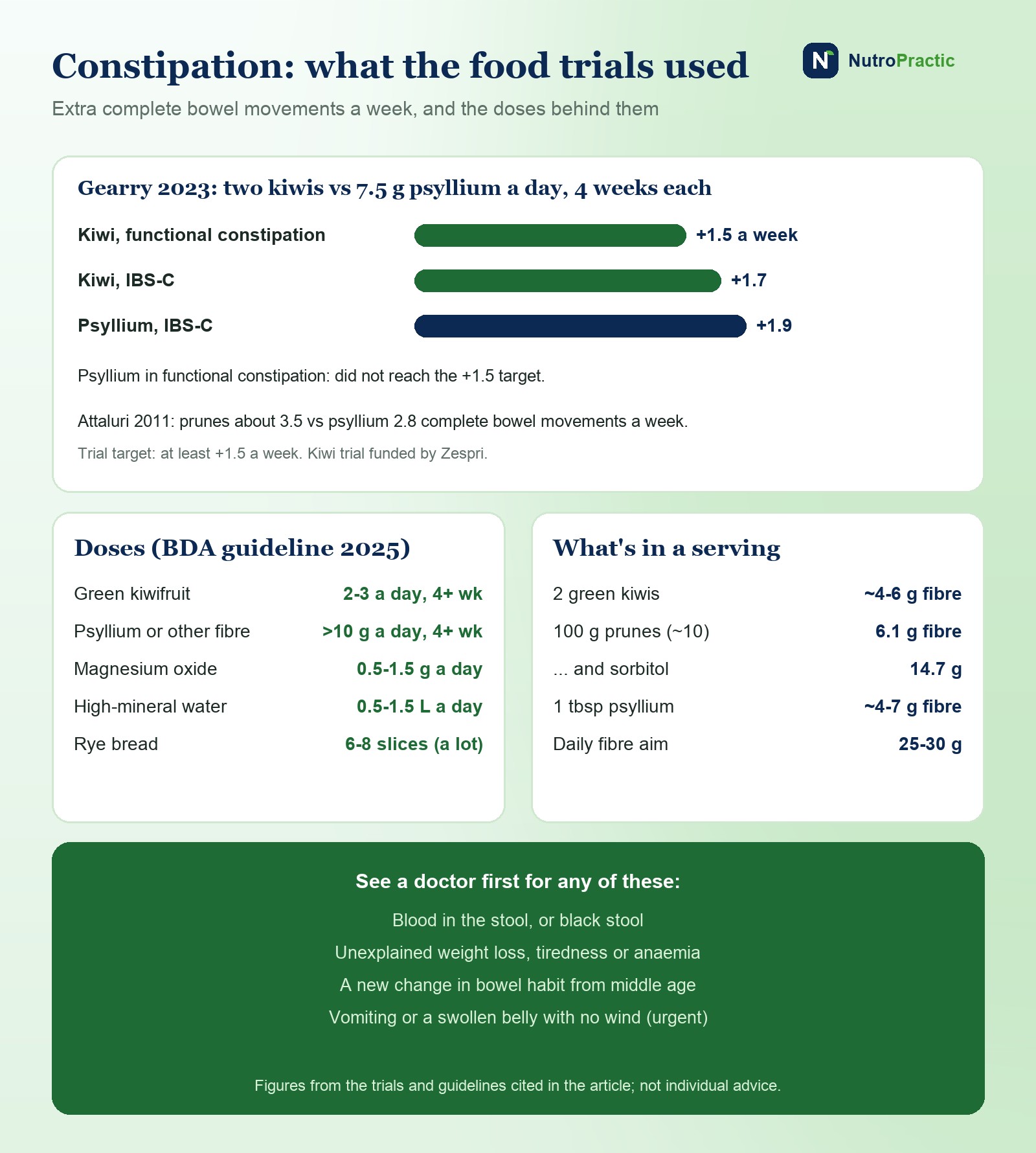
The largest food trial so far (Gearry and colleagues, American Journal of Gastroenterology 2023) ran in New Zealand, Italy and Japan. It took 184 adults, including 60 with functional constipation and 61 with IBS with constipation (IBS-C), and gave each person four weeks of two green kiwifruit a day and four weeks of 7.5 g of psyllium a day, with a washout in between. The two were matched for fibre, about 6 g a day each.
Two kiwis a day added about 1.5 complete bowel movements a week in functional constipation and 1.7 in IBS-C, both clearly past the trial's target. Psyllium reached the target only in IBS-C (+1.9). Across both groups together, kiwifruit beat psyllium on bowel movements, straining, stool consistency and the constipation part of a gut comfort score. Neither caused more than mild side effects.
Two cautions. The trial was funded by Zespri, the kiwifruit company, and two authors work for it. And the difference in abdominal pain between the two, though statistically significant, was smaller than what counts as clinically meaningful.
Kiwi vs prunes vs psyllium: the US trial
A smaller trial at the University of Michigan (Chey and colleagues, 2021) compared all three in 79 adults with three or fewer complete bowel movements a week, for four weeks: 2 green kiwifruit a day, 100 g of prunes a day (about 10 prunes), or 12 g of psyllium a day.
All three increased complete bowel movements by weeks three and four, and the share of people who responded was similar across the three. The differences were in how they felt: only kiwi significantly reduced bloating, side effects were most common with psyllium and least common with kiwi, and fewer people were dissatisfied with kiwi than with prunes or psyllium. One of the authors holds stock options in a kiwifruit company.
Prunes vs psyllium
An earlier US crossover trial (Attaluri and colleagues, 2011) gave 40 adults 50 g of prunes twice a day (100 g, about 6 g fibre) and 11 g of psyllium twice a day (also about 6 g fibre), three weeks each. Prunes did better on complete bowel movements, about 3.5 a week against 2.8 with psyllium, from a starting point near 1.7, and on stool consistency. Prunes work partly through sorbitol, a sugar alcohol that draws water into the bowel: 100 g of prunes has about 14.7 g of sorbitol and 6.1 g of fibre. Prune juice has almost no fibre but still about 6 g of sorbitol per 100 g.
The 2025 British guideline pooled these trials and was cautious: they were not designed to prove prunes equal or better, so it found prunes "not more effective than psyllium" on the evidence so far, and made no dose statement for prunes.
What the guidelines say
US: ACG and AGA, 2023
The joint guideline from the American Gastroenterological Association and the American College of Gastroenterology (Chang and colleagues, 2023) covers supplements and medicines, not foods. It gives a conditional recommendation for fibre supplements, and says that "among the evaluated fiber supplements, only psyllium appears to be effective": pooled across three trials, psyllium added about 2.3 bowel movements a week against placebo. It suggests 20 to 30 g of total fibre a day, from food and supplement together, with enough fluid.
It also conditionally recommends magnesium oxide (start at 400 to 500 mg a day; trials used 1,000 to 1,500 mg), and strongly recommends the over-the-counter laxative polyethylene glycol (PEG, 17 g a day) and stimulant laxatives such as bisacodyl for short-term or rescue use. So if food changes don't do enough, these are the evidence-based next steps, not a failure.
UK: British Dietetic Association, 2025
The BDA guideline (Dimidi and colleagues, 2025) reviewed 75 trials and is the most specific about food:
- Kiwifruit: 2 to 3 a day for at least 4 weeks. Peeled kiwi is what was tested. It "may be a preferred option over psyllium" for people who get bloating, pain or wind on psyllium. Kiwi extract capsules did nothing.
- Fibre supplements such as psyllium: more than 10 g a day for at least 4 weeks; 10 g or less did not raise the response. Build up gradually, and take it with extra fluid.
- Magnesium oxide: 0.5 to 1.5 g a day for at least 4 weeks, starting at 0.5 g and increasing weekly.
- High-mineral water: 0.5 to 1.5 litres a day for 2 to 6 weeks helped more people respond, but didn't change frequency or comfort much.
- Rye bread: 6 to 8 slices a day for at least 3 weeks increased frequency slightly, but the guideline itself says that may not be realistic, and it worsened overall symptoms in the pooled trials.
- A general "high-fibre diet": no recommendation either way, because only one trial has tested it.
A 2022 meta-analysis from the same group (van der Schoot and colleagues, AJCN) found 66% of people responded to a fibre supplement against 41% on control, with the benefit coming from psyllium and pectin, at doses over 10 g a day, used for at least 4 weeks. Wind was the main downside.
The other pieces: water, magnesium, coffee, rye
Water. Drinking more does little for constipation on its own if you are already well hydrated. But in an Italian trial (Anti and colleagues, 1998), 117 people on about 25 g of fibre a day were split: those told to drink 2 litres of water a day had more bowel movements and used fewer laxatives than those who drank as they liked (about 1.1 litres). Fibre needs water to work.
Magnesium-rich mineral water. In a French trial of 244 women (Dupont and colleagues, 2014), drinking 1 litre a day of a water high in magnesium sulphate led to 37.5% responding at two weeks, against 21% on low-mineral water; half a litre was not significantly better. Ordinary tap water has far less magnesium than the waters used in these studies (UK tap water 0.6 to 32 mg per litre, the trial waters 105 to 1,000), so check the label: the effect depends on the magnesium and sulphate content. The trial was run by the water's maker.
Magnesium oxide tablets. Two Japanese placebo-controlled trials used 1.5 g a day for four weeks. In one, overall improvement was 70.6% against 25% on placebo; in the other, 68% on magnesium oxide and 69% on senna against 12% on placebo. Avoid it if you have kidney disease, because magnesium can build up, and check with a pharmacist if you take other medicines, since magnesium can interfere with absorption of some antibiotics and thyroid tablets. Our magnesium article covers the forms and doses.
Coffee. In healthy volunteers, coffee made 29% of people want to go, and in lab tests caffeinated coffee stimulated the colon about as much as a 1,000 kcal meal, 60% more than water. Decaf worked too, a little less. No trial has tested coffee as a treatment, but if a morning coffee helps you, the physiology backs it.
Rye bread. In a Finnish trial (Holma and colleagues, 2010), whole-grain rye bread (at least 240 g a day) shortened gut transit time by 23% compared with white wheat bread and by 41% compared with laxatives. It is a lot of bread, though.
If you have IBS-C
Both kiwi (+1.7) and psyllium (+1.9) worked in the IBS-C group of the 2023 trial, and psyllium's comfort benefit showed up only in IBS-C. The American College of Gastroenterology suggests soluble fibre such as psyllium, not insoluble fibre such as wheat bran, for IBS, where bran did not help and often adds bloating. If constipation comes with pain and bloating that ease after a bowel movement, it may be IBS-C, which is worth a proper diagnosis; our article on IBS and the low-FODMAP diet explains the next steps. Note that prunes are high in sorbitol, a FODMAP, so they suit some people with IBS less well than kiwi.
In an Indian kitchen
Psyllium is isabgol, and India supplies most of the world's supply, grown mainly in Rajasthan and Gujarat and processed largely in Gujarat. A teaspoon stirred into water or curd at night is a traditional remedy that the trials support, as long as the dose reaches the amounts above and it is taken with enough fluid. Triphala is widely used too, but there is no good placebo-controlled trial of it for constipation, so it is hard to say what it adds. Kiwis have become easy to find in Indian cities; ripe papaya and guava are traditional choices but have not been tested head to head.
A four-week plan
1. Pick one food and give it four weeks. Two green kiwifruit a day (peeled, any time), or 100 g of prunes (about 10), or psyllium building up to more than 10 g a day.
2. If you choose psyllium, start low: about 1 teaspoon a day in a big glass of water, adding a little every few days. One tablespoon is roughly 4 to 7 g of fibre depending on the product, so read the label.
3. Drink enough: about 1.5 to 2 litres of fluid a day, more in heat. Fibre without water can make things worse.
4. Lift total fibre toward 25 to 30 g a day. More than 90% of US women and 97% of men fall short; our article on the fibre gap has an easy 30-gram day.
5. Use the urge: many people get a natural urge after breakfast or a morning coffee. Give it time, feet raised on a small stool.
6. Track it. Count complete bowel movements a week before and after. If four weeks bring no change, try a different food, or talk to a pharmacist about magnesium oxide or PEG.
When to see a doctor
Food is not the answer to every case. See a doctor promptly if you have:
- Blood in your stool, or black or very dark stool (urgent)
- Unexplained weight loss or unusual tiredness, or anaemia on a blood test
- A new change in bowel habit in middle age or later, especially from around 45 to 50 and over
- A family history of bowel cancer, inflammatory bowel disease or coeliac disease
- Severe pain, vomiting or a swollen belly with no wind passing (possible blockage: urgent)
- Constipation lasting more than a few weeks despite changes, or starting after a new medicine (opioid painkillers, iron tablets and some antidepressants are common culprits)
Two kiwis, a handful of prunes or a proper dose of psyllium, for four weeks, with enough water: that is what the trials tested, and it works for most people.
Constipated most weeks, or living with IBS-C and not sure which fibre suits you? Dr. Triveni's gut health plans build fibre, fluids and meals around your own symptoms, in a virtual consultation.
Book a consultationThis article is general information, not medical advice. If you have kidney disease, are pregnant, take regular medicines, or have any of the warning signs above, talk to your doctor before starting supplements such as magnesium or psyllium.
Sources
Gearry R. et al., Consumption of 2 green kiwifruits daily improves constipation and abdominal comfort: results of an international multicenter randomized controlled trial, Am J Gastroenterol 118(6):1058-1068 (2023). Chey S.W. et al., Exploratory comparative effectiveness trial of green kiwifruit, psyllium, or prunes in US patients with chronic constipation, Am J Gastroenterol 116(6):1304-1312 (2021). Attaluri A. et al., Randomised clinical trial: dried plums (prunes) vs. psyllium for constipation, Aliment Pharmacol Ther 33(7):822-828 (2011).
Chang L. et al., AGA-ACG clinical practice guideline: pharmacological management of chronic idiopathic constipation, Am J Gastroenterol 118(6):936-954 (2023). Dimidi E. et al., British Dietetic Association guidelines for the dietary management of chronic constipation in adults, J Hum Nutr Diet 38(5):e70133 (2025). van der Schoot A. et al., The effect of fiber supplementation on chronic constipation in adults, Am J Clin Nutr 116(4):953-969 (2022). Lacy B.E. et al., ACG clinical guideline: management of irritable bowel syndrome, Am J Gastroenterol 116(1):17-44 (2021).
Barberio B. et al., Global prevalence of functional constipation according to the Rome criteria00111-4), Lancet Gastroenterol Hepatol 6(8):638-648 (2021). Lacy B.E. et al., Bowel disorders (Rome IV), Gastroenterology 150:1393-1407 (2016). Stacewicz-Sapuntzakis M. et al., Chemical composition and potential health effects of prunes, Crit Rev Food Sci Nutr 41(4):251-286 (2001).
Mori S. et al., A randomized double-blind placebo-controlled trial on the effect of magnesium oxide in patients with chronic constipation, J Neurogastroenterol Motil 25(4):563-575 (2019). Morishita D. et al., Senna versus magnesium oxide for the treatment of chronic constipation, Am J Gastroenterol 116(1):152-161 (2021). Dupont C. et al., Efficacy and safety of a magnesium sulfate-rich natural mineral water for patients with functional constipation, Clin Gastroenterol Hepatol 12(8):1280-1287 (2014).
Anti M. et al., Water supplementation enhances the effect of high-fiber diet on stool frequency and laxative consumption in adult patients with functional constipation, Hepatogastroenterology 45(21):727-732 (1998). Brown S.R. et al., Effect of coffee on distal colon function, Gut 31(4):450-453 (1990). Rao S.S. et al., Is coffee a colonic stimulant?, Eur J Gastroenterol Hepatol 10(2):113-118 (1998). Holma R. et al., Constipation is relieved more by rye bread than wheat bread or laxatives, J Nutr 140(3):534-541 (2010). US Department of Agriculture and HHS, Dietary Guidelines for Americans 2020-2025.