Nuts have an odd reputation. They are on almost every list of foods that are good for the heart, and on almost every list of foods people on a diet are told to watch. A small bag of almonds carries about 160 calories, which sounds like a lot for a snack you can finish without noticing.
The research on nuts is unusually deep: two of the largest cohort studies ever run, dozens of feeding trials on cholesterol, one big randomised trial with a famous asterisk, and a set of careful studies from the US Department of Agriculture that measured how many of those calories the body actually keeps. Here is what they found, how much to eat, which kinds, and why the weight worry turns out to be mostly unfounded.
What the big studies found
The first hint came from Seventh-day Adventists in California. In 1992, a study of 31,208 Adventists found that people who ate nuts more than four times a week had about half the risk of a fatal heart attack (relative risk 0.52) compared with people who ate them less than once a week. Six years later the Nurses' Health Study followed 86,016 women for 14 years: those eating more than 5 oz (about 140 g) of nuts a week had 35% fewer heart disease events than those who almost never ate them.
The largest analysis so far pooled three Harvard cohorts, 210,836 men and women followed for up to 32 years (Guasch-Ferré and colleagues, JACC 2017). Eating a 28 g serving of nuts five or more times a week went with a 14% lower risk of cardiovascular disease and 20% lower risk of coronary heart disease than never eating them. Peanuts did about as well as tree nuts: two or more servings a week went with 13% lower cardiovascular risk for peanuts, 15% for tree nuts, and once a week or more with 19% for walnuts. Peanut butter showed no clear link, possibly because of what it is spread on.
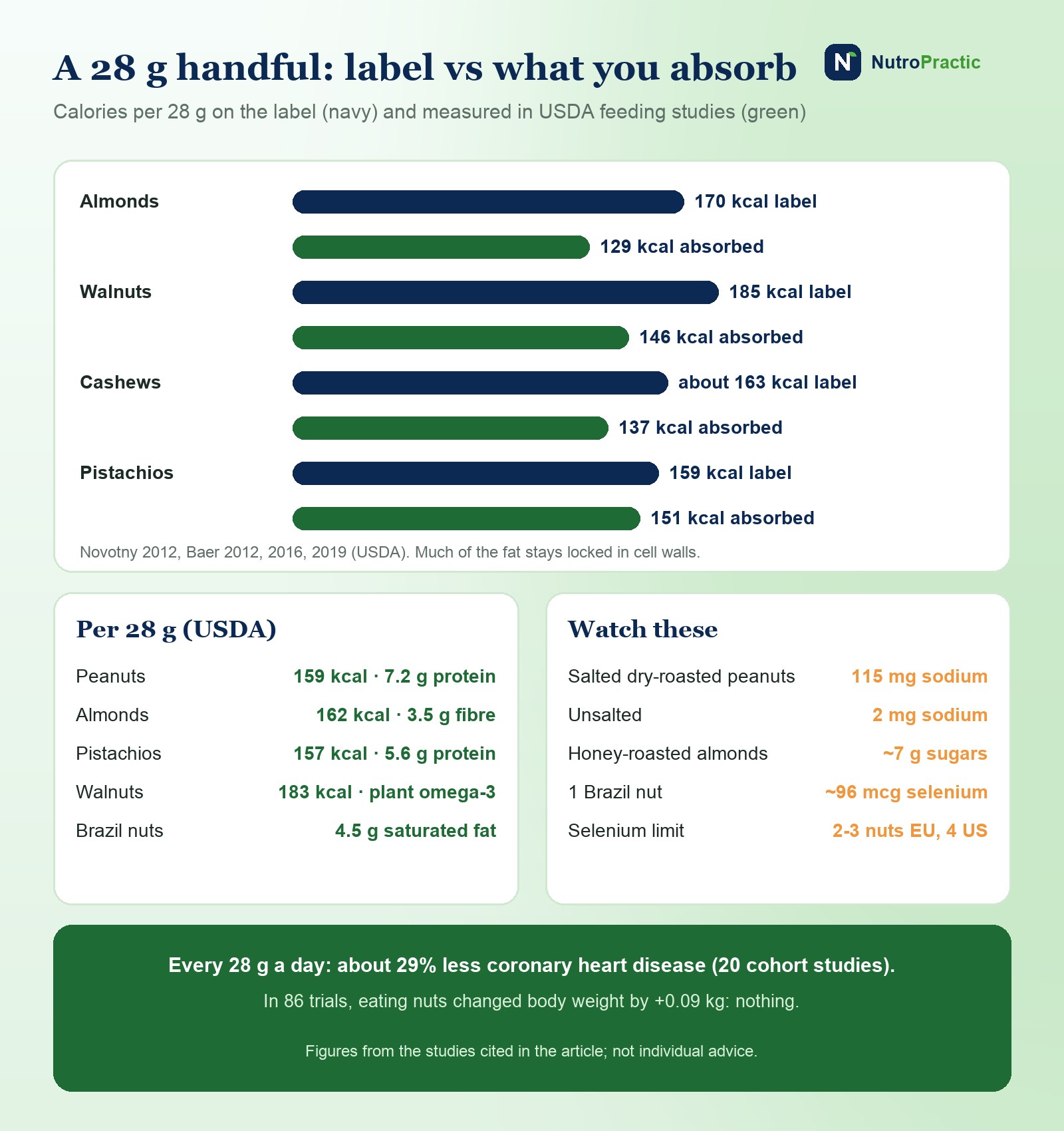
A 2016 meta-analysis of 20 cohort studies (Aune and colleagues, BMC Medicine) put it per handful: every 28 g a day went with about 29% lower coronary heart disease, 21% lower cardiovascular disease and 22% lower death from any cause.
These are observational studies. People who eat nuts tend to smoke less, exercise more and eat more vegetables, and the researchers adjust for that as well as they can, but they can't adjust for everything. That is why the trials matter.
The trial: PREDIMED, with its asterisk
PREDIMED randomised 7,447 Spanish adults aged 55 to 80 at high cardiovascular risk to one of three diets: a Mediterranean diet with extra olive oil, a Mediterranean diet with 30 g of mixed nuts a day (15 g walnuts, 7.5 g almonds, 7.5 g hazelnuts, handed out free), or advice to cut down on fat. After a median of 4.8 years there were 83 heart attacks, strokes or cardiovascular deaths in the nut group (3.4%) against 109 in the control group (4.4%), a hazard ratio of 0.72.
The asterisk: the original 2013 paper was retracted because some participants at a few sites had not been properly randomised, for example household members put into the same group. The authors re-analysed the data and republished in 2018 with almost the same result (0.72, 95% confidence interval 0.54 to 0.95), and the finding held when they left out the 1,588 people whose assignment had gone wrong. One more caution: the nut group ate a whole Mediterranean diet as well, and the comparison was low-fat advice, so PREDIMED shows that a Mediterranean diet with a daily handful of nuts protects the heart, not that nuts alone cut heart attacks by 28%.
Cholesterol: what nuts do to LDL
Here the evidence is from controlled feeding trials, and it is consistent. A pooled analysis of 25 trials in 583 people (Sabaté and colleagues, 2010) found that eating an average of 67 g of nuts a day lowered LDL cholesterol by 10.2 mg/dL (7.4%). The effect grew with the dose and was bigger in people who started with higher LDL.
A larger review of 61 trials (Del Gobbo and colleagues, AJCN 2015) scaled it to a single 1 oz serving a day: LDL fell by 4.8 mg/dL (about 0.12 mmol/L) and apolipoprotein B by 3.7 mg/dL. The authors' summary is worth keeping: dose mattered, not nut type. Almonds, walnuts, pistachios, hazelnuts and the rest all worked about the same per gram.
Two single trials give a feel for real life. In WAHA, 708 healthy adults aged 63 to 79 in Barcelona and California ate walnuts (30 to 60 g a day) or none for two years. LDL fell by 4.3 mg/dL (3.6%), small LDL particles by 6.1%, and the walnut eaters' weight barely moved (+0.06 kg). In a six-week US trial (Berryman 2015), 1.5 oz of almonds a day instead of a muffin with the same calories lowered LDL by 5.3 mg/dL and trimmed a little belly fat with no change in total weight.
On its own that is a modest effect, a few percent. It adds up when nuts are one of several changes, which is the idea behind the portfolio diet: our article on lowering LDL with food shows how nuts, plant sterols, sticky fibre and soy together lowered LDL by about 17% against a low-saturated-fat diet in a meta-analysis of seven trials.
How many: what the guidelines say
US (FDA): since 2003, nut packs may say "Scientific evidence suggests but does not prove that eating 1.5 ounces per day of most nuts as part of a diet low in saturated fat and cholesterol may reduce the risk of heart disease." 1.5 oz is about 43 g. Almonds, hazelnuts, pecans, pistachios, walnuts and some pine nuts qualify; cashews, Brazil nuts and macadamias did not, because of their saturated fat (macadamias got their own claim in 2017).
US (American Heart Association): about 5 oz a week of nuts, seeds, beans, peas and lentils combined on a 2,000 kcal diet, with protein mostly from plants.
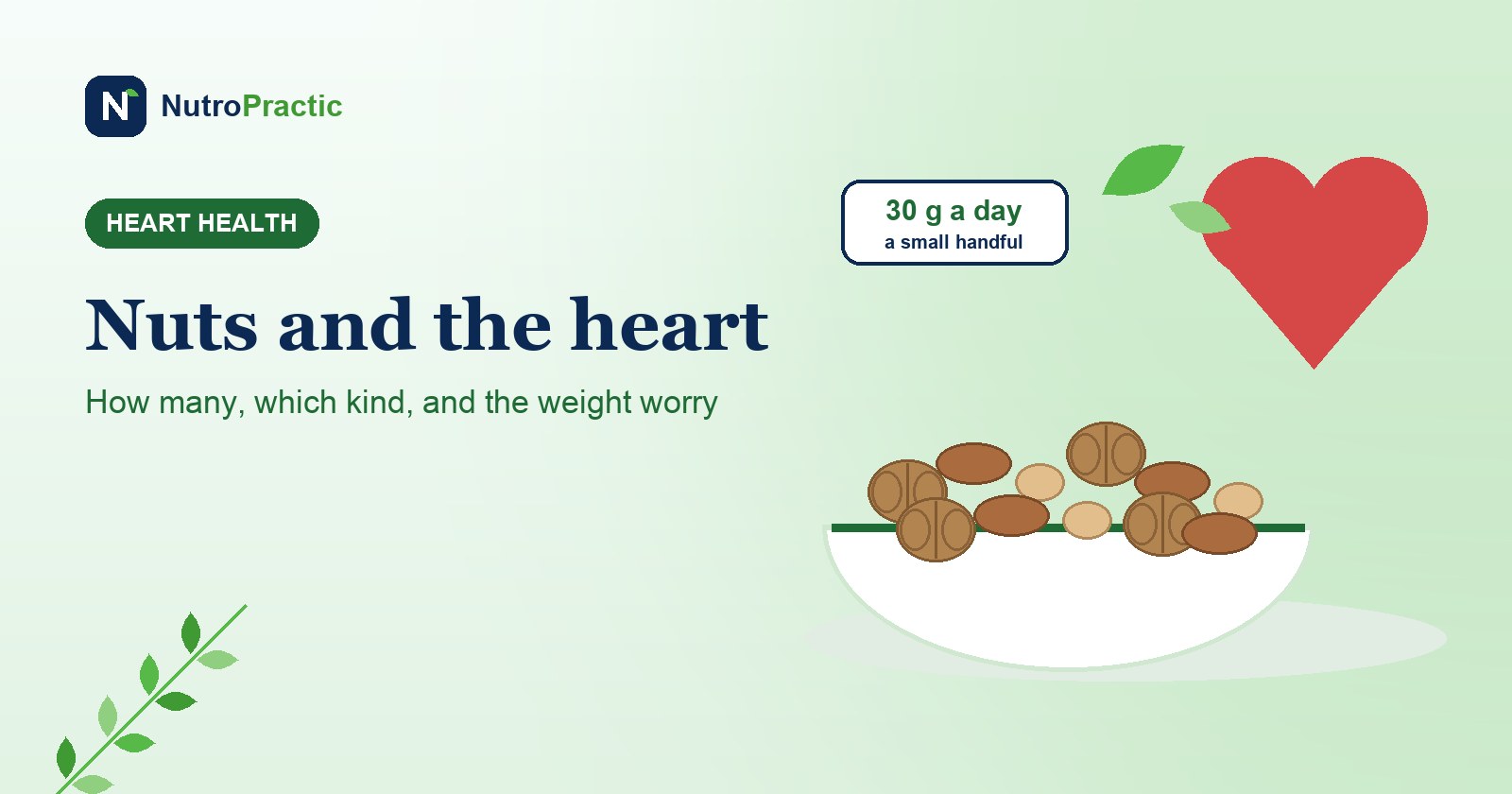
PREDIMED: 30 g a day.
India (ICMR-NIN): 35 g of nuts and seeds a day on a 2,000 kcal plate.
The cohorts: the benefit showed up from about two to five 28 g servings a week.
A practical answer: a small handful, 28 to 30 g, most days. That is about 23 almonds, 14 walnut halves, 49 pistachio kernels (the 1 oz counts the growers use). Weigh it once and you will know it by eye. If you eat that five days a week you are inside every guideline above.
Which kind?
Per 28 g, from the USDA's FoodData Central:
- Peanuts (technically a legume): 159 kcal, 7.2 g protein, the most of any common nut, and the cheapest
- Almonds: 162 kcal, 5.9 g protein, 3.5 g fibre, the most fibre
- Pistachios: 157 kcal, 5.6 g protein, 3.0 g fibre
- Walnuts: 183 kcal, 4.3 g protein, and the only common nut with a useful amount of plant omega-3 (ALA)
- Cashews: 155 kcal, 5.1 g protein, 2.2 g saturated fat
- Hazelnuts: 176 kcal, 4.2 g protein
- Brazil nuts: 185 kcal and 4.5 g saturated fat, the most of the group
Since the cholesterol trials found dose mattered more than type, the best nut is mostly the one you will eat regularly. Walnuts have the edge if you don't eat oily fish (see our article on omega-3 from fish, walnuts or capsules). Peanuts are the budget choice, and in the Harvard cohorts they did nearly as well as tree nuts.
Brazil nuts: one or two, not a handful
Brazil nuts are extraordinarily rich in selenium. USDA data give about 96 micrograms in a single nut, already 1.7 times the adult daily need of 55 mcg. The US upper limit is 400 mcg a day, reached at about 4 nuts; Europe's food safety authority set a lower limit in 2023, 255 mcg, reached at 2 to 3 nuts. Selenium content varies a lot from nut to nut and batch to batch, so treat Brazil nuts as one or two a day at most, not a snack to eat by the handful. Too much selenium over time causes hair and nail loss.
Salted, honey-roasted, or plain
Salt is where nuts can quietly undo some of their good. A 28 g serving of dry-roasted salted peanuts has about 115 mg sodium, against 2 mg unsalted; salted cashews about 179 mg against 4 mg; salted pistachios about 120 mg. That is not huge on its own, but salted nuts rarely stop at 28 g. Honey-roasted versions add sugar as well, about 4.5 g per 28 g for peanuts and 7 g for almonds in USDA's recipe estimates, plus salt. Plain, dry-roasted or raw are best; if you like them salted, mix half and half with unsalted.
The weight worry
This is the question people ask most, and the answer is reassuring for three reasons.
1. You don't absorb all the calories on the label. Label calories come from a century-old formula (the Atwater factors). When USDA researchers fed nuts to volunteers in controlled diets and measured what came out the other end, they found the body kept far less from nuts than the formula assumes, because much of the fat stays locked inside cell walls that chewing doesn't break:
- Almonds: 129 kcal per 28 g measured, against 168 to 170 on the label (32% less)
- Walnuts: 146 against 185 (21% less)
- Cashews: 137, 16% less than the label
- Pistachios: about 151 against 159 (5% less)
2. People eat less of other things. In a 19-week US study (Alper and Mattes, 2002), adults ate about 505 kcal of peanuts a day with no other instructions. On paper they should have gained 3.6 kg. They gained 1.0 kg, because they spontaneously ate less of other food, making up for about 66% of the peanut calories. In a 4-week trial of 43 g of almonds a day, people's other intake fell enough that their weight did not change, and almonds eaten as a snack reduced hunger.
3. The trials and cohorts show no gain. A 2021 review of 86 trials in 5,873 people (Nishi and colleagues, Obesity Reviews) found nut-eating changed body weight by +0.09 kg, statistically nothing, with high certainty. In six cohorts of nearly 570,000 people, nut eaters had a 7% lower risk of becoming overweight or obese. In the European EPIC study of 373,293 adults, the biggest nut eaters gained slightly less weight over five years than people who ate none.
The caveat is in how the trials were run: people added nuts to an ordinary diet, mostly in place of other snacks. A handful instead of crisps, biscuits or a pastry is the swap that works. A jar of honey-roasted cashews on the desk eaten on top of everything else is a different experiment.
Allergies and other reasons to skip them
In a survey of 40,443 US adults (Gupta and colleagues, 2019), 1.8% had a peanut allergy and 1.2% a tree nut allergy, and almost half of all adult food allergies had started in adulthood. If you are allergic, seeds such as pumpkin, sunflower, flax and chia give similar fats and fibre, but check with your allergist first, since some people react to seeds (sesame is now a labelled major allergen in the US). Whole nuts are a choking risk for children under five; for babies and peanut, see our article on peanuts, eggs and early introduction.
In an Indian kitchen
ICMR-NIN's 2024 guidance gives nuts and seeds 35 g a day, more generous than most Western advice. Peanuts (moongphali), the cheapest option, are backed by the same evidence as tree nuts. A few ways to use them: a small handful of roasted peanuts or almonds instead of namkeen at tea time, crushed peanuts in poha, upma or a kosambari salad, walnuts or almonds in place of some of the sugar-and-ghee sweets at festivals. Watch the salted, fried and masala-coated versions sold in packets: they are closer to namkeen than to plain nuts.
A simple way to do it
1. Portion once: weigh out 28 to 30 g one time to see what it looks like in your hand or a small bowl, then eye it.
2. Make it a swap: replace one snack a day, not add to it.
3. Mix kinds across the week, with walnuts on some days if you don't eat oily fish.
4. Choose plain raw or dry-roasted; keep salted and honey-roasted for occasions.
5. Brazil nuts: one or two at most.
6. Put them in meals: on porridge, in salads, in a stir-fry, ground into a sauce.
A small handful most days, in place of another snack: the trials say your heart gains and your waistline doesn't.
Working on your cholesterol or your weight and not sure how nuts, oils and the rest fit into your week? Dr. Triveni can build a heart-friendly plan around the food you actually eat in a virtual consultation.
Book a consultationThis article is general information, not medical advice. If you have a nut allergy, kidney disease, take medicines that affect your cholesterol or have been told to limit salt, talk to your doctor or dietitian before changing your diet.
Sources
Estruch R. et al., Primary prevention of cardiovascular disease with a Mediterranean diet supplemented with extra-virgin olive oil or nuts, NEJM 378(25):e34 (2018); original 2013 paper retracted (doi:10.1056/NEJMoa1200303). Fraser G.E. et al., A possible protective effect of nut consumption on risk of coronary heart disease: the Adventist Health Study, Arch Intern Med 152(7):1416-1424 (1992). Hu F.B. et al., Frequent nut consumption and risk of coronary heart disease in women, BMJ 317:1341-1345 (1998).
Guasch-Ferré M. et al., Nut consumption and risk of cardiovascular disease, J Am Coll Cardiol 70(20):2519-2532 (2017). Aune D. et al., Nut consumption and risk of cardiovascular disease, total cancer, all-cause and cause-specific mortality, BMC Medicine 14:207 (2016).
Sabaté J., Oda K., Ros E., Nut consumption and blood lipid levels: a pooled analysis of 25 intervention trials, Arch Intern Med 170(9):821-827 (2010). Del Gobbo L.C. et al., Effects of tree nuts on blood lipids, apolipoproteins, and blood pressure, Am J Clin Nutr 102(6):1347-1356 (2015). Rajaram S. et al., Effects of walnut consumption for 2 years on lipoprotein subclasses among healthy elders (WAHA), Circulation 144(13):1083-1085 (2021). Berryman C.E. et al., Effects of daily almond consumption on cardiometabolic risk and abdominal adiposity, J Am Heart Assoc 4(1):e000993 (2015).
Novotny J.A., Gebauer S.K., Baer D.J., Discrepancy between the Atwater factor predicted and empirically measured energy values of almonds, Am J Clin Nutr 96(2):296-301 (2012). Baer D.J. et al., Walnuts consumed by healthy adults provide less available energy than predicted, J Nutr 146(1):9-13 (2016). Baer D.J. et al., Measured energy value of pistachios in the human diet, Br J Nutr 107(1):120-125 (2012). Baer D.J., Novotny J.A., Metabolizable energy from cashew nuts is less than that predicted by Atwater factors, Nutrients 11(1):33 (2019).
Nishi S.K. et al., Are fatty nuts a weighty concern?, Obesity Reviews 22(11):e13330 (2021). Flores-Mateo G. et al., Nut intake and adiposity: meta-analysis of clinical trials, Am J Clin Nutr 97(6):1346-1355 (2013). Freisling H. et al., Nut intake and 5-year changes in body weight and obesity risk in adults (EPIC-PANACEA), Eur J Nutr 57(7):2399-2408 (2018). Alper C.M., Mattes R.D., Effects of chronic peanut consumption on energy balance and hedonics, Int J Obes 26(8):1129-1137 (2002). Tan S.Y., Mattes R.D., Appetitive, dietary and health effects of almonds consumed with meals or as snacks, Eur J Clin Nutr 67(11):1205-1214 (2013).
US FDA, Qualified health claims: letters of enforcement discretion for nuts and coronary heart disease (14 July 2003) and walnuts (9 March 2004). American Heart Association, Suggested servings from each food group (reviewed 2024). USDA FoodData Central, SR Legacy entries for almonds, walnuts, pistachios, cashews, peanuts, hazelnuts and Brazil nuts, and FNDDS honey-roasted nuts. Institute of Medicine, Dietary Reference Intakes for vitamin C, vitamin E, selenium and carotenoids (2000). EFSA NDA Panel, Tolerable upper intake level for selenium, EFSA Journal 21(1):e07704 (2023). Gupta R.S. et al., Prevalence and severity of food allergies among US adults, JAMA Netw Open 2(1):e185630 (2019). ICMR-NIN, My Plate for the Day and Dietary Guidelines for Indians (2024).