If your first child was born before 2015, you may well have been told to keep peanuts away until age three, and eggs until two. If your baby is being born now, the advice is close to the opposite: offer them early, around six months, and keep them coming. That is not a fashion swing. It is one of the clearest reversals in children's nutrition, and it came from a handful of large trials.
Here is what those trials found, what the guidelines say today in the US, UK, Canada, Europe and Australia, and how to actually do it at the kitchen table, including the amounts.
What the old advice was, and why it changed
In 2000 the American Academy of Pediatrics (AAP) suggested that babies at high risk of allergy wait for dairy until one, eggs until two and peanuts, tree nuts and fish until three. The idea made sense at the time: if a baby never meets the food, it can't react to it. By 2008 the AAP had looked at the evidence again and found little evidence that delaying foods beyond 4 to 6 months prevents allergy. Meanwhile peanut allergy kept climbing. In a 2015-16 survey of US families, about 2.2% of children had a peanut allergy, the most common food allergy in American children (Gupta and colleagues, Pediatrics 2018).
LEAP: peanut from infancy in babies at high risk
The LEAP trial (Du Toit and colleagues, NEJM 2015) took 640 babies aged 4 to 11 months who already had severe eczema, an egg allergy or both, the babies most likely to become allergic to peanut. Half were asked to avoid peanut completely until age five. The other half ate at least 6 g of peanut protein a week, spread over three or more meals, mostly as Bamba, a puffed peanut snack, or smooth peanut butter. More than nine in ten families stuck to their side of the plan.
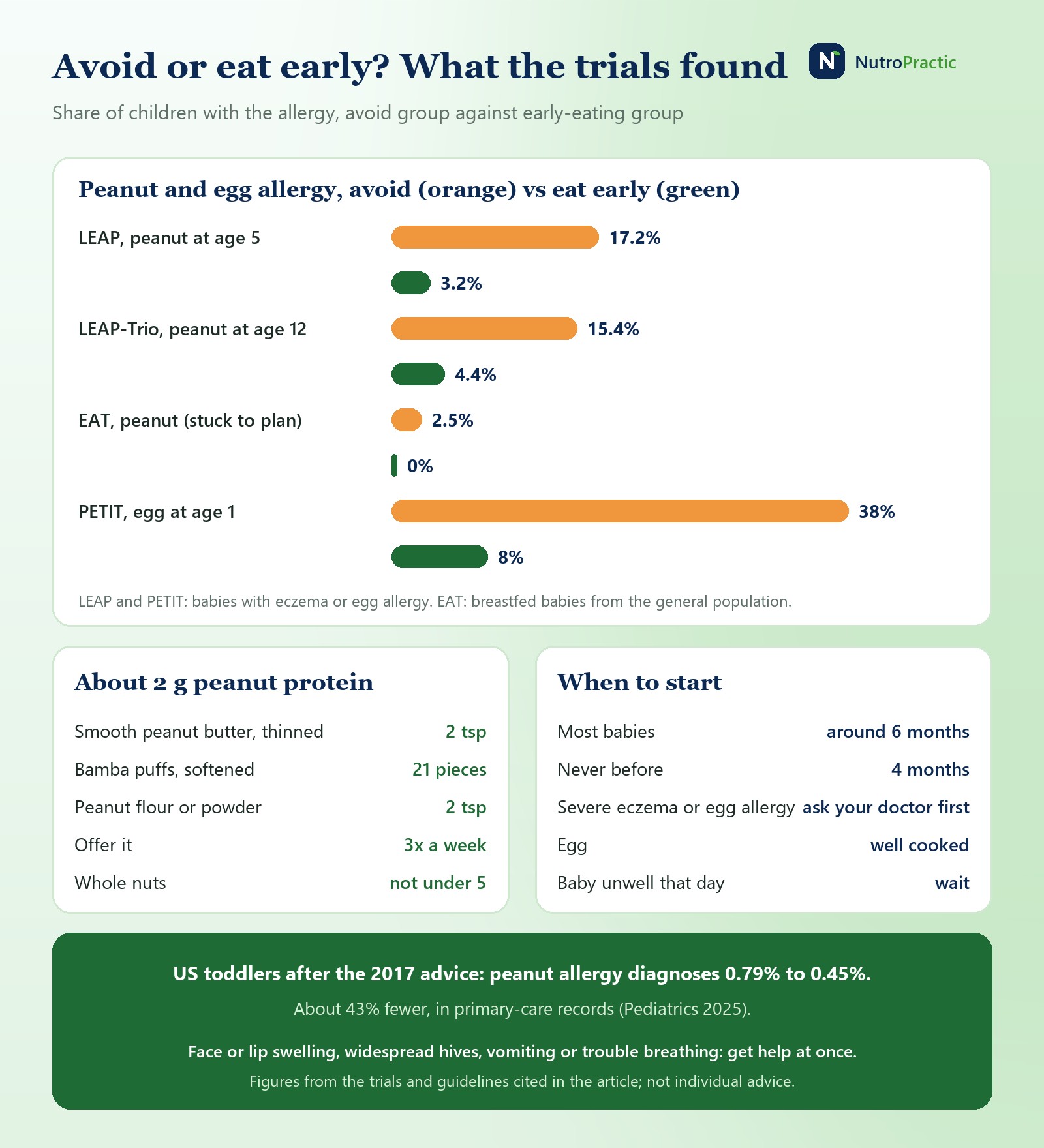
At age five, 17.2% of the avoiding children had a peanut allergy, against 3.2% of those who ate it. In babies whose skin-prick test showed no reaction at the start, the figures were 13.7% against 1.9%, an 86% reduction. Even babies who already showed some sensitivity on the skin test did better: 35.3% against 10.6%. Serious side effects were no more common in the peanut group.
Does it last?
Two follow-up studies asked the obvious question. In LEAP-On (NEJM 2016), all the children stopped peanut for a year, from age five to six. At six, 18.6% of the original avoiders were allergic against 4.8% of the early eaters, so the protection held through a year off. In LEAP-Trio (NEJM Evidence 2024), 497 of the children were checked again at age 12: 15.4% against 4.4%, about 71% fewer peanut allergies (our calculation from the paper's figures), even though many children in both groups had gone long stretches without peanut between six and twelve.
EAT and PETIT: other babies, other foods
LEAP was about high-risk babies. The EAT trial (Perkin and colleagues, NEJM 2016) tried six foods, peanut, cooked egg, cow's milk, sesame, white fish and wheat, from three months in 1,303 breastfed babies from the general population in England and Wales. Overall, the result was not significant: 5.6% against 7.1% had any of the six allergies. The catch was that six new foods every week is hard work at three months, and only 43% of the early group's families managed the plan as written.
Among the families who did, the difference was large: no peanut allergy at all against 2.5%, and 1.4% against 5.5% for egg. Babies who ate about 2 g of peanut or egg protein a week had clearly fewer of those allergies than babies who ate less. Milk, sesame, fish and wheat showed no clear effect.
In Japan, the PETIT trial (Natsume and colleagues, Lancet 2017) gave babies with eczema tiny daily amounts of heated egg powder from six months, 50 mg at first and 250 mg from nine months, while treating their eczema hard. At one year, 8% had an egg allergy against 38% on placebo, and the trial was stopped early because the difference was so clear. One caution: 10% of the egg group were admitted to hospital at some point, against none on placebo. This was a careful, stepwise, supervised dose, not a whole scrambled egg.
What the guidelines say now
In 2017 the US National Institute of Allergy and Infectious Diseases (NIAID) rewrote its advice around LEAP, with three groups of babies:
1. Severe eczema, egg allergy or both: peanut as early as 4 to 6 months, and the guideline suggests an allergy test first.
2. Mild to moderate eczema: peanut around 6 months, at home.
3. No eczema and no food allergy: introduce peanut freely with other solids, in whatever way fits the family's food.
For all three, the target is about 6 to 7 g of peanut protein a week over three or more feeds, which works out to about 2 g, three times a week. The AAP's 2019 report agreed, and added that mothers don't need to avoid peanut or egg in pregnancy or while breastfeeding.
In 2021, the American and Canadian allergy societies (AAAAI, ACAAI and CSACI) went a step further: introduce peanut and egg around six months, but not before four months, and screening before introduction is not required for most babies. Europe (EAACI) recommends well-cooked egg and age-appropriate peanut as part of normal first foods, and says the best window appears to be 4 to 6 months. In the UK, government advisers (SACN, 2018) said peanut and egg can go in from around six months like any other food, and that deliberately leaving them out past the first birthday may raise the risk of allergy. Australia (ASCIA) asks for both before 12 months, and once a food is in, to keep offering it at least once a week.
Is it working outside the trials?
The first real-world numbers are encouraging. A study of US primary-care records for children up to age three (Gabryszewski and colleagues, Pediatrics 2025) found peanut allergy diagnoses fell from 0.79% before the guidance to 0.45% after the 2017 addendum, about 43% fewer. Any food allergy fell from 1.46% to 0.93%. These are diagnoses in medical records rather than proven by food challenges, so the true figures may differ, but the direction is clear.
Australia, which changed its advice in 2016, saw a smaller shift. Peanut allergy in one-year-olds in Melbourne went from 3.1% (2007-11) to 2.6% (2018-19), a difference that could have been chance (Soriano and colleagues, JAMA 2022). But among babies of Australian background, those given peanut by six months had far lower odds of allergy than those who waited until twelve months. Early introduction helps most when it really is early, and regular.
In India, peanut allergy seems to be rare: in a school survey in Bengaluru and Mysore, only 0.14% of children aged 6 to 11 had a probable food allergy of any kind, even though 19% showed sensitivity on tests (Li and colleagues, 2020). The guidance above still applies, especially for babies with eczema.
How to do it at home
Each of these gives about 2 g of peanut protein, the NIAID's serving:
- 2 teaspoons of smooth peanut butter (9 to 10 g), thinned with 2 to 3 teaspoons of hot water and cooled, or stirred into a fruit or vegetable puree the baby already eats
- 21 Bamba puffs (about two-thirds of a 28 g bag), softened with 4 to 6 teaspoons of water for babies under seven months
- 2 teaspoons of peanut flour or powder mixed into puree or porridge
- About 10 whole peanuts, finely ground, mixed into food
Offer a serving like that about three times a week. For egg, give well-cooked egg: hard-boiled and mashed, or a fully cooked omelette cut into strips, not runny or raw egg. To keep track of peanut, egg and the other allergens week by week, our free baby allergen tracker flags anything not given in the last seven days and counts the peanut and egg protein, with a printout for your paediatrician.
The first time
Pick a day when the baby is well: no cold, fever, vomiting or diarrhoea. Do it at home, not at daycare or in a restaurant, and keep the next two hours free to watch. Offer a small taste first, wait about ten minutes, then give the rest at the baby's usual pace. Bring in one new allergen at a time, so you know what caused any reaction.
A new rash or a few hives around the mouth can happen; call your doctor about it before the next try. Swelling of the lips, face or tongue, widespread hives, vomiting, coughing, wheeze or any trouble breathing, pale or blue skin, or sudden floppiness need emergency help at once: call 911 in the US, 999 in the UK, 000 in Australia, 112 in Europe, or 112 in India.
Babies with severe eczema
If your baby has severe eczema (needing prescription creams often) or has already reacted to egg, speak to your doctor or an allergist before the first peanut. Under the US guideline, they may test first or give the first serving in clinic. Don't put the conversation off: for these babies the window between four and six months matters most.
Where parents go wrong
Waiting "to be safe". No guideline has found a benefit in waiting past six months, and in Australia the babies who waited until twelve months fared worse.
Giving it a few times and stopping. The trials fed peanut regularly for years, and in EAT what counted was about 2 g a week. ASCIA and NIAID both say to keep it in the diet once it's in.
Whole nuts or a spoon of peanut butter. Whole nuts are a choking risk until age five; thick peanut butter straight from a spoon is risky under four. Always thin it or mix it in.
Trying it on a sick day. A fever or a rash from a cold makes it hard to tell what happened.
Mothers cutting out peanut or egg. Avoiding allergens during pregnancy or breastfeeding is not recommended by the AAP, the American allergy societies or EAACI.
Once a baby is eating peanut and egg, the next challenge is often keeping a toddler eating them at all. Our article on picky eaters aged 2 to 8 covers what feeding studies show about repeated tastes, and if you are wondering about eggs for the rest of the family, see eggs and cholesterol.
Peanut and egg around six months, well prepared, and then regularly: the trials are clear that waiting does not protect a baby.
Starting solids and not sure how to fit peanut, egg and the other allergens into your baby's week, or planning meals for a family with an allergy? Dr. Triveni can help you build a simple plan in a virtual consultation.
Book a consultationThis article is general information, not medical advice. Every baby is different: talk to your paediatrician or an allergist before introducing allergens if your baby has severe eczema, a known food allergy, or has reacted to a food before. In an emergency, call your local emergency number.
Sources
Du Toit G. et al., Randomized trial of peanut consumption in infants at risk for peanut allergy, NEJM 372(9):803-813 (2015). Du Toit G. et al., Effect of avoidance on peanut allergy after early peanut consumption, NEJM 374(15):1435-1443 (2016). Du Toit G. et al., Follow-up to adolescence after early peanut introduction for allergy prevention, NEJM Evidence 3(6):EVIDoa2300311 (2024).
Perkin M.R. et al., Randomized trial of introduction of allergenic foods in breast-fed infants, NEJM 374(18):1733-1743 (2016). Natsume O. et al., Two-step egg introduction for prevention of egg allergy in high-risk infants with eczema (PETIT)31418-0), Lancet 389(10066):276-286 (2017).
American Academy of Pediatrics Committee on Nutrition, Hypoallergenic infant formulas, Pediatrics 106(2):346-349 (2000). Greer F.R., Sicherer S.H., Burks A.W., Effects of early nutritional interventions on the development of atopic disease in infants and children, Pediatrics 121(1):183-191 (2008). Greer F.R., Sicherer S.H., Burks A.W., The effects of early nutritional interventions on the development of atopic disease in infants and children, Pediatrics 143(4):e20190281 (2019).
Togias A. et al., Addendum guidelines for the prevention of peanut allergy in the United States, J Allergy Clin Immunol 139(1):29-44 (2017). Fleischer D.M. et al., A consensus approach to the primary prevention of food allergy through nutrition, J Allergy Clin Immunol Pract 9(1):22-43 (2021). Halken S. et al., EAACI guideline: preventing the development of food allergy in infants and young children (2020 update), Pediatr Allergy Immunol 32(5):843-858 (2021). ASCIA, Infant feeding for food allergy prevention. SACN, Feeding in the first year of life (2018).
Gupta R.S. et al., The prevalence, severity, and distribution of childhood food allergy in the United States, Pediatrics 128(1):e9-e17 (2011). Gupta R.S. et al., The public health impact of parent-reported childhood food allergies in the United States, Pediatrics 142(6):e20181235 (2018). Gabryszewski S.J. et al., Guidelines for early food introduction and patterns of food allergy, Pediatrics 156(5):e2024070516 (2025). Soriano V.X. et al., Association between earlier introduction of peanut and prevalence of peanut allergy in infants in Australia, JAMA 328(1):48-56 (2022). Li J. et al., Comparative study of food allergies in children from China, India, and Russia: the EuroPrevall-INCO surveys, J Allergy Clin Immunol Pract 8(4):1349-1358 (2020).