Few foods have been in and out of favour as often as the egg. In the 1980s it was the breakfast that clogged your arteries. By 2015 the US had dropped its daily cholesterol limit, and eggs were back. Then, in 2019, a large study in JAMA made headlines again: every extra half egg a day, higher risk of heart disease.
So which is it? The honest answer is that for most healthy people an egg a day is fine, for some people it's worth counting, and in nearly every case what you eat with the egg matters more than the egg. Here is how the advice changed, what the big studies found, and who should still keep an eye on the number.
Why eggs had a limit
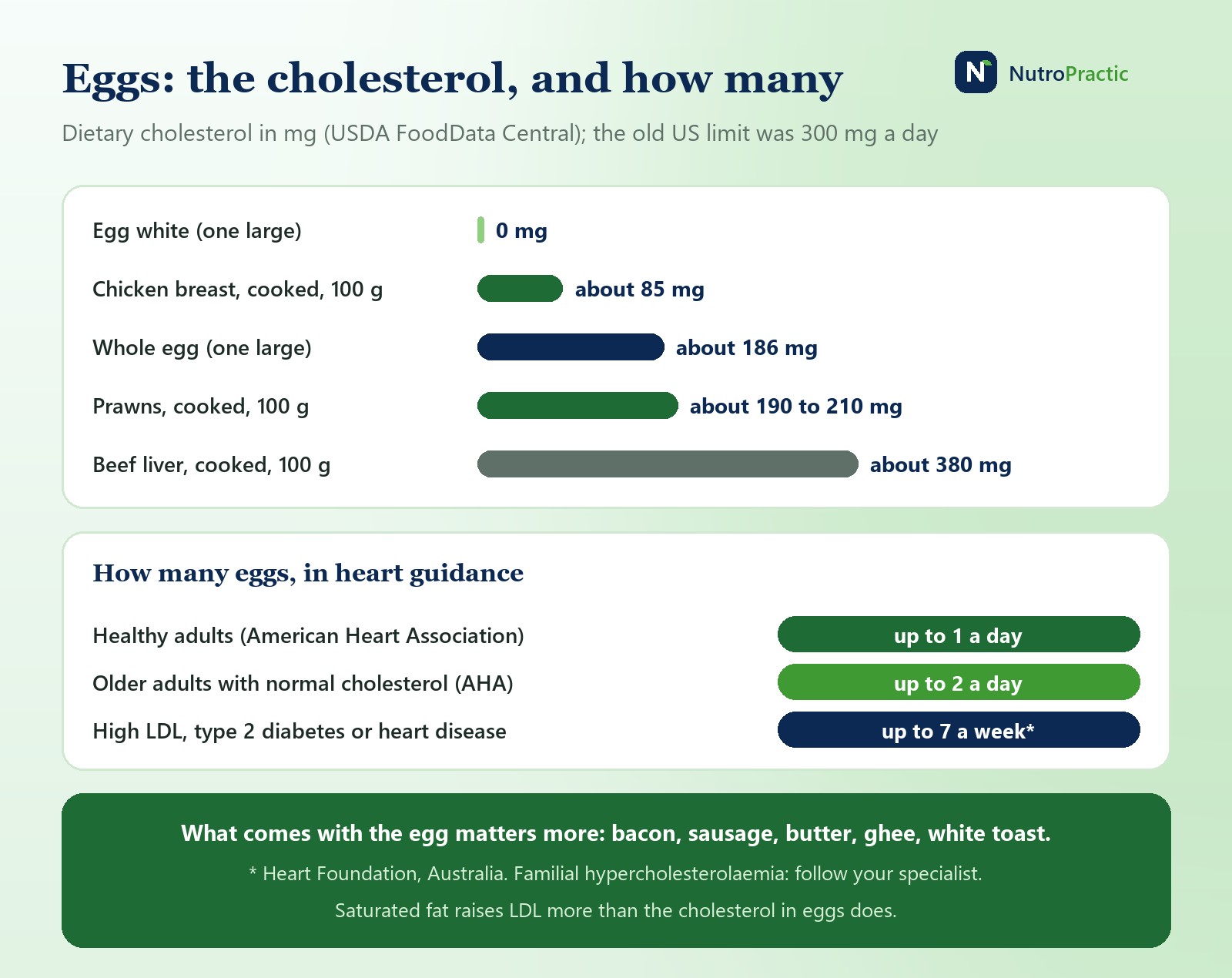
One large egg has about 186 mg of cholesterol, all of it in the yolk. For decades, US dietary guidelines set a ceiling of 300 mg of cholesterol a day, so a two-egg breakfast took you past it before lunch. The reasoning was simple: high blood cholesterol causes heart disease, so eating less cholesterol should help.
The trouble is that cholesterol in food has a much smaller effect on blood cholesterol than people assumed. Your liver makes most of the cholesterol in your blood, and when you eat more, it tends to make less, and your gut absorbs a smaller share. What pushes LDL ("bad") cholesterol up far more strongly is saturated fat, from fatty meat, butter, ghee, cheese, coconut oil and pastries, and trans fats.
What changed in 2015
The committee that wrote the 2015 to 2020 Dietary Guidelines for Americans concluded that "cholesterol is not a nutrient of concern for overconsumption", and the 300 mg limit was dropped. The UK had never set one, and the NHS says there is no recommended limit on how many eggs people eat.
The headlines that followed ("eggs are back!") skipped a line. The same guidelines still said to eat as little dietary cholesterol as possible within a healthy eating pattern. In practice, the healthy patterns they described (more vegetables, fruit, whole grains, beans, fish; less processed meat and sugar) are naturally lower in cholesterol, so the line was a nudge, not a number.
How much an egg moves your LDL
Feeding studies, where researchers control exactly what people eat, give the clearest picture. A 2001 pooled analysis of 17 such trials found that each extra 100 mg of dietary cholesterol raised total cholesterol by only about 2 mg/dL (0.06 mmol/L) on average, and HDL ("good") cholesterol a little too. An extra egg a day, on average, nudges LDL up by a few points.
Averages hide a spread. Roughly a quarter to a third of people are "hyper-responders": their LDL rises more than average when they eat more cholesterol. In most of them HDL rises too, so the ratio between the two changes less than LDL alone. But you can't tell which group you're in without testing, which is the practical case for checking your lipids if you're eating several eggs a day.
What the big studies found
The worrying one. In 2019, Zhong and colleagues pooled six US cohorts, almost 30,000 adults followed for a median of 17.5 years. Each extra 300 mg of dietary cholesterol a day was linked with a 17% higher risk of heart disease and stroke and an 18% higher risk of death. Each extra half egg a day was linked with 6% more heart disease and 8% more deaths. Most of the link with eggs came through their cholesterol.
The reassuring ones. A 2020 analysis in the BMJ followed more than 215,000 US nurses and health professionals for up to 32 years and found that eating an egg a day was not linked with more heart disease than eating less than one a month. Pooled with 28 other cohorts, covering 1.7 million people, the result held: no clear link overall, and a slightly lower risk in Asian cohorts. The PURE study, with about 177,000 people in 50 countries, also found no link between egg intake and blood lipids, heart disease or death.
Why do they differ? These are observational studies: they compare people who eat more eggs with people who eat fewer. In many Western cohorts, the heaviest egg eaters also ate more bacon, sausage, butter and white toast, smoked more and moved less. Researchers adjust for these things, but never perfectly. Where eggs are eaten with vegetables, rice or bread rather than fried meats, the link tends to disappear.
An egg with spinach on wholegrain toast and an egg with bacon, sausage and buttered white bread are not the same breakfast, even though they have the same egg.
The diabetes question
The one group where the signal keeps turning up is people with type 2 diabetes. In a 2013 meta-analysis, people with diabetes who ate the most eggs had about 70% more heart disease than those who ate the fewest, while no such link was seen in the general population. Diabetes already raises heart risk and may change how the body handles cholesterol.
Trials are more reassuring. In the Australian DIABEGG trial, 140 people with prediabetes or type 2 diabetes ate either 12 eggs a week or fewer than 2 for three months as part of a healthy diet: cholesterol and other heart markers were the same in both groups, and stayed that way over a year. The difference may again be what the eggs are eaten with.
Heart charities have settled on a middle path. The American Heart Association (2019 advisory) says healthy people can include up to one whole egg a day, older adults with normal cholesterol up to two, and vegetarians who don't eat meat can include more. Australia's Heart Foundation sets no limit for healthy people and suggests up to seven eggs a week for people with high LDL, type 2 diabetes or heart disease.
Who should still count them
People with familial hypercholesterolaemia, an inherited condition affecting about 1 in 250 people that causes very high LDL from birth. Here every source of LDL matters; follow your specialist's advice.
People with type 2 diabetes, high LDL or established heart disease. Up to about seven a week is a sensible ceiling unless your doctor or dietitian says otherwise, with saturated fat cut first.
Anyone whose LDL went up after a change in diet. If you've moved to a high-egg, low-carb or keto pattern and your LDL rose, eggs are one of the first things to look at, along with butter, cheese, coconut oil and fatty meat.
For everyone else, an egg a day sits comfortably in a healthy diet, and more on some days is fine.
What an egg brings
A large egg has about 72 kcal and 6 g of high-quality protein, plus choline, vitamin B12, vitamin D, selenium, and lutein and zeaxanthin for the eyes. It is cheap, quick and easy to chew, which makes it useful for older adults trying to eat more protein (our protein after 40 article has breakfast ideas), and for vegetarians who eat eggs, where it is one of the easiest sources of B12.
Egg whites have the protein with none of the cholesterol, so a one-egg-plus-two-whites omelette is a simple way to get a bigger breakfast while keeping cholesterol down if you're counting.
It's the company eggs keep
The research points at the plate more than at the egg:
A Western fry-up: eggs cooked in butter with bacon, sausage, hash browns and white toast. Most of the saturated fat and salt comes from everything but the egg.
An Indian breakfast: egg bhurji or an omelette made with a big spoon of ghee or butter, with white bread or parathas. Cook it in a little oil instead, add onions, tomatoes and greens, and eat it with wholegrain roti or toast.
Better versions: a vegetable omelette in olive or rapeseed oil; boiled eggs with salad and beans; shakshuka with plenty of tomato and peppers; egg curry with a tomato-onion base and more vegetables than gravy. Same eggs, very different plate.
If your LDL is high, the bigger levers are elsewhere: cutting saturated fat, and adding oats, beans, nuts, soy and plant sterols. Our portfolio diet article covers what lowered LDL in trials.
The short version
Healthy adults: up to an egg a day is fine; two on some days is fine too.
Older adults with normal cholesterol: up to two a day.
Type 2 diabetes, high LDL or heart disease: up to about seven a week, and cut saturated fat first.
Familial hypercholesterolaemia: follow your specialist.
Everyone: cook eggs in a little oil, not butter or ghee, and eat them with vegetables and whole grains rather than processed meat and white bread. Check your lipids if you eat a lot of eggs.
High LDL, diabetes, or just want to know whether your breakfast is helping? Dr. Triveni can look at your blood results and build a plan around the foods you like in a virtual consultation.
Book a consultationThis article is general information, not medical advice. If you have high cholesterol, diabetes, heart disease or an inherited lipid disorder, follow your doctor's advice on diet and medicines.
Sources
US Department of Health and Human Services and US Department of Agriculture, 2015-2020 Dietary Guidelines for Americans, 8th edition (2015), and the Scientific Report of the 2015 Dietary Guidelines Advisory Committee. Carson J.A.S. et al., Dietary cholesterol and cardiovascular risk: a science advisory from the American Heart Association, Circulation 141(3):e39-e53 (2020). Zhong V.W. et al., Associations of dietary cholesterol or egg consumption with incident cardiovascular disease and mortality, JAMA 321(11):1081-1095 (2019). Drouin-Chartier J.P. et al., Egg consumption and risk of cardiovascular disease: three large prospective US cohort studies, systematic review, and updated meta-analysis, BMJ 368:m513 (2020). Dehghan M. et al., Association of egg intake with blood lipids, cardiovascular disease, and mortality in 177,000 people in 50 countries, Am J Clin Nutr 111(4):795-803 (2020). Weggemans R.M., Zock P.L., Katan M.B., Dietary cholesterol from eggs increases the ratio of total cholesterol to high-density lipoprotein cholesterol in humans: a meta-analysis, Am J Clin Nutr 73(5):885-891 (2001). Fernandez M.L., Dietary cholesterol provided by eggs and plasma lipoproteins in healthy populations, Curr Opin Clin Nutr Metab Care 9(1):8-12 (2006). Shin J.Y. et al., Egg consumption in relation to risk of cardiovascular disease and diabetes: a systematic review and meta-analysis, Am J Clin Nutr 98(1):146-159 (2013). Fuller N.R. et al., The effect of a high-egg diet on cardiovascular risk factors in people with type 2 diabetes: the Diabetes and Egg (DIABEGG) study, Am J Clin Nutr 101(4):705-713 (2015). National Heart Foundation of Australia, Eggs and heart health position statement (2019). NHS, Eggs: nutrition. USDA, FoodData Central (cholesterol per serving).