Lutein and zeaxanthin are the yellow pigments that sit in the centre of your retina, the macula. Eye supplements sell them by the million. The big trial behind them, AREDS2, asked a narrower question than the ads suggest, and its answer was smaller than you might expect. Here's what it found, how much is in the food on your plate, and who might want a capsule.
What AREDS2 tested
- Who: 4,203 people aged 50 to 85 who were already at high risk of late age-related macular degeneration (AMD): intermediate AMD in both eyes, or late AMD in one eye. Run 2006 to 2012, median 5 years.
- What: everyone took the original AREDS vitamins and minerals (vitamins C and E, zinc and copper). On top, groups got 10 mg lutein plus 2 mg zeaxanthin, omega-3 fish oil, both, or placebo.
- Main result (JAMA, 2013): 31% of the placebo group had progressed to late AMD by 5 years against 29% on lutein plus zeaxanthin. The hazard ratio was 0.90 (98.7% CI 0.76 to 1.07, p = 0.12), so the main comparison was not statistically significant.
The results that came after
| Analysis | Outcome | Result |
|---|---|---|
| Lowest fifth of dietary lutein/zeaxanthin (2013 secondary analysis) | Late AMD, lutein/zeaxanthin vs none | HR 0.74 (0.59 to 0.94) |
| 10-year follow-up, 3,882 people (JAMA Ophthalmology 2022, Report 28) | Late AMD, lutein/zeaxanthin vs none | HR 0.91 (0.84 to 0.99) |
| Same, versus beta-carotene | Late AMD | HR 0.85 (0.73 to 0.98) |
| Omega-3 at 10 years | Late AMD | HR 1.01 (0.93 to 1.09), no effect |
- Reading it plainly: a modest benefit, about 9% fewer progressions over 10 years, with the clearest signal in people who ate the least lutein. The 10-year analysis was observational follow-up after the trial's randomised phase, which the authors note, so call it suggestive rather than proven.
- Lutein and zeaxanthin had no effect on cataract surgery overall (HR 0.96, not significant). In the lowest-intake fifth the hazard ratio was 0.68, which again points to people who start low.
Why smokers are told to watch the label
The original AREDS pill carried beta-carotene. In AREDS2, lung cancer was found in 23 people (2.0%) taking beta-carotene against 11 (0.9%) without it, mostly in former smokers. The 10-year analysis put the odds ratio for beta-carotene at 1.82 (1.06 to 3.12), against 1.15 (p = 0.46) for lutein and zeaxanthin. So the AREDS2 formula swapped it out. If you smoke or used to, check that an "eye vitamin" has no beta-carotene.
How much is in your food
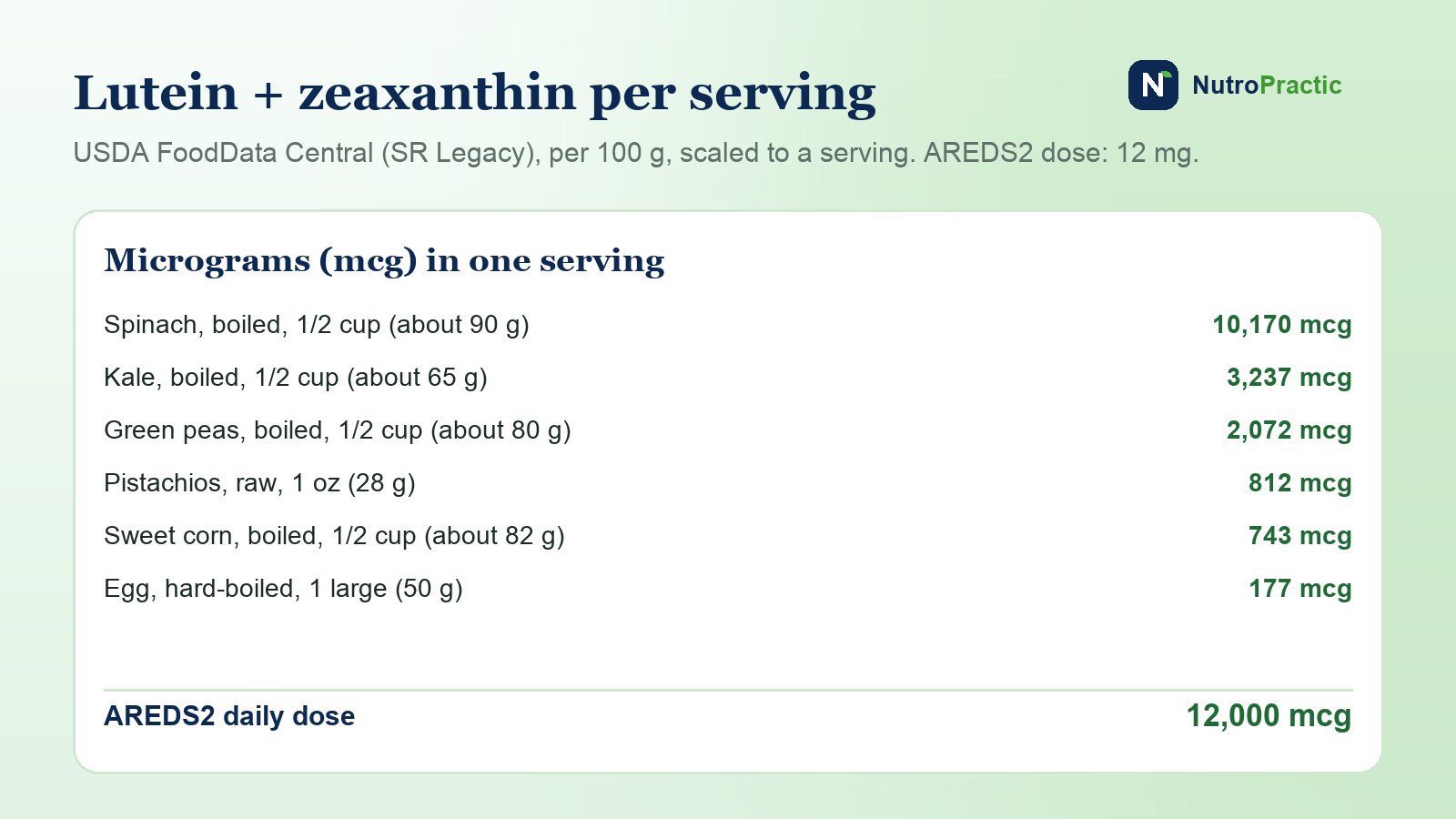
USDA FoodData Central values (SR Legacy data), per 100 g, then scaled to a typical serving. Serving weights are approximate.
| Food | mcg per 100 g | Serving | mcg per serving |
|---|---|---|---|
| Spinach, boiled | 11,300 | 1/2 cup (about 90 g) | 10,170 |
| Spinach, raw | 12,200 | 1 cup (about 30 g) | 3,660 |
| Kale, boiled | 4,980 | 1/2 cup (about 65 g) | 3,237 |
| Green peas, boiled | 2,590 | 1/2 cup (about 80 g) | 2,072 |
| Pistachios, raw | 2,900 | 1 oz (28 g) | 812 |
| Sweet yellow corn, boiled | 906 | 1/2 cup (about 82 g) | 743 |
| Egg, hard-boiled | 353 | 1 large (50 g) | 177 |
Values shift between database editions and varieties. An older USDA release listed boiled kale at about 23,700 mcg per cup, far above today's figure, so use these as ballpark numbers.
A worked day
- 1/2 cup boiled spinach at lunch: 10,170 mcg
- 1 hard-boiled egg at breakfast: 177 mcg
- 1/2 cup sweet corn with dinner: 743 mcg
Total about 11,100 mcg, roughly 11 mg, close to the 12 mg used in AREDS2. Mind the caveat: AREDS2 tested capsules in people with AMD risk, not a diet, so this is a comparison of amounts, not a proof that food does the same. Eggs are small in total but the fat in the yolk helps carotenoids absorb, and a little oil on greens does the same.
Who might want a supplement
- You have intermediate AMD, or late AMD in one eye and your eye doctor has said so: the AREDS2 formula is the one with evidence. Ask which version, and whether it fits with your other medicines.
- You eat few greens and have AMD in the family: food first. The signal was strongest in low-intake people, and greens bring other nutrients. Ask your eye doctor if you want more.
- You're healthy with no AMD: AREDS2 didn't test you, so it can't tell you a capsule helps. Screen-time and blue-light claims are not what that trial measured either. We didn't find evidence in this research that lutein capsules protect eyes from screens.
- Check the label: 10 mg lutein and 2 mg zeaxanthin, no beta-carotene if you smoke, and the minerals included in the AREDS2 pill.
Wondering how to fit more greens into your week, or whether an eye supplement fits with your other tablets? Dr. Triveni can plan it around the foods you already like, in a virtual consultation.
Book a consultationRelated: omega-3 from fish, walnuts or capsules (AREDS2 found no eye benefit from omega-3), and the fibre gap on getting more vegetables.
This article is general information, not medical advice. Talk to your doctor before taking supplements, especially if you take regular medicines, are pregnant or breastfeeding, or have a liver, gallbladder or eye condition.
Sources
AREDS2 Research Group (Chew E.Y. et al.), Lutein + zeaxanthin and omega-3 fatty acids for age-related macular degeneration, JAMA 2013;309:2005-15 (PubMed 23644932). Chew E.Y. et al., Long-term outcomes of adding lutein/zeaxanthin and omega-3 fatty acids to the AREDS supplements, AREDS2 Report 28, JAMA Ophthalmol 2022 (PMC9164119). AREDS2 secondary analysis by dietary lutein/zeaxanthin intake (lowest-quintile result), cataract report no. 4, PubMed 23645227. USDA FoodData Central, SR Legacy foods: spinach (FDC 168463, 168462), kale (169238). Other values from the same database search. Read 17 Nov 2026.