Plenty of people stop drinking milk after one bad afternoon: a latte, then bloating, cramps and a rush to the bathroom. Some cut out every kind of dairy for years, and with it a large share of their calcium. The trials suggest that for most people this goes further than it needs to. Not digesting lactose fully is very common; being made ill by a normal serving of it is much less so.
Here is what the research says about how much lactose people with lactose intolerance actually handle, how much lactose is in the dairy you eat, what lactase tablets and A2 milk do, and how to keep your calcium up if you do cut back.
Malabsorption and intolerance are not the same thing
Babies make plenty of lactase, the enzyme that splits lactose (milk sugar) in the small intestine. In most of the world's adults that enzyme falls after weaning. Lactose that isn't split moves on to the colon, where bacteria ferment it into gas and acids. That is lactose malabsorption, and it is what a breath test or a genetic test picks up.
Lactose intolerance is when that malabsorption causes symptoms: bloating, wind, cramps, rumbling, loose stools. Many people who malabsorb lactose feel little or nothing after an ordinary serving. And some people who are sure they are lactose intolerant turn out, in blinded tests, to digest lactose normally; their symptoms come from something else, often IBS.
How common is it?
You will often read that 68% of the world can't digest lactose. That number comes from a 2017 meta-analysis in The Lancet Gastroenterology & Hepatology (Storhaug and colleagues), and health agencies still quote it. The journal issued an expression of concern in September 2024 and has since retracted the paper, because many of its country estimates came from studies that didn't represent the general population. So treat the 68% as a rough idea at best. What is better supported:
- United States: about 36% of people have lactose malabsorption (NIDDK). It is more common in African American, American Indian, Asian American and Hispanic people.
- Northern Europe: the lowest rates in the world. Most lactase-persistent Europeans carry one variant (-13910*T), which keeps lactase working into adulthood.
- East Asia and much of Africa: malabsorption is the norm in adults.
- India: a north-south gradient. The same -13910*T variant is found in India, falling in frequency from the northwest to the southeast and close to zero in many southern and eastern groups (Gallego Romero and colleagues, 2,284 DNA samples, 2012).
The clearest Indian numbers come from a 2010 study of 153 healthy volunteers (Babu and colleagues, American Journal of Clinical Nutrition):
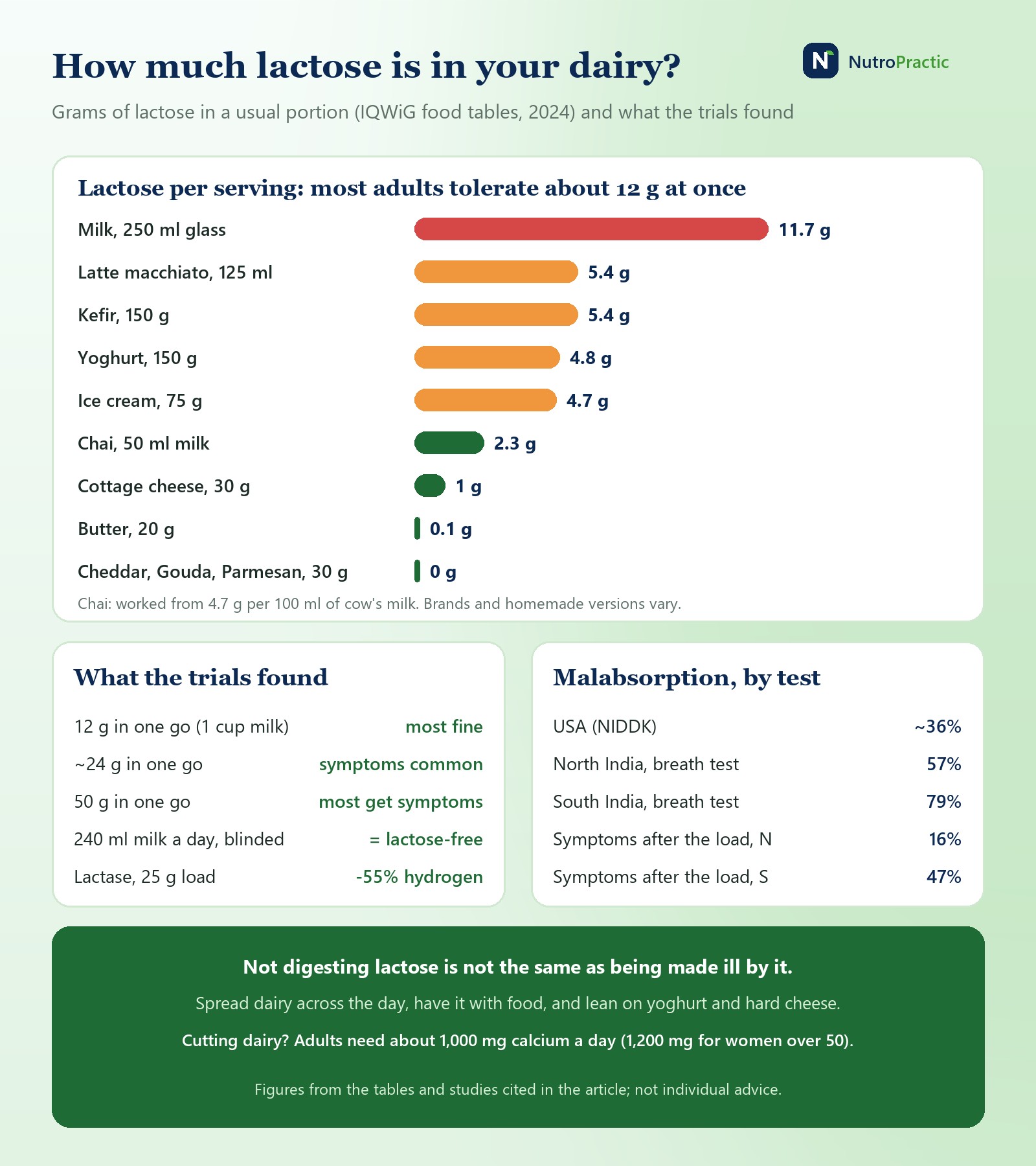
- Breath test abnormal: 78.9% of southern Indians, 57.1% of northern Indians
- Blood (lactose tolerance) test abnormal: 88.2% south, 66.2% north
- No copy of the persistence variant (CC genotype): 86.8% south, 67.5% north
- Actually had symptoms after the lactose drink: 47.4% south, 15.6% north
That last line is the useful one. Even in a group where most people malabsorbed lactose, fewer than half in the south and about one in six in the north felt unwell after a large test dose.
How much lactose can you tolerate? The 12 g trials
This has been tested many times, in blinded trials where people don't know whether they are drinking lactose or a look-alike.
- A 2010 systematic review for the US National Institutes of Health (Shaukat and colleagues, Annals of Internal Medicine) took in 36 randomised trials and found moderate-quality evidence that 12 to 15 g of lactose, about one cup of milk, is well tolerated by most adults with lactose malabsorption or intolerance. Symptoms rose with bigger doses, and in most studies that used 50 g, most people had symptoms.
- The European Food Safety Authority reached the same place the same year: the vast majority of people with lactose maldigestion tolerate up to 12 g in a single dose with no or minor symptoms, and more if it is spread through the day. But some people react to less than 6 g, so there is no single safe number for everyone.
- The classic test (Suarez, Savaiano and Levitt, New England Journal of Medicine, 1995) took 30 people who described themselves as severely lactose intolerant and gave them 240 ml of milk a day with breakfast for a week, either ordinary milk or lactose-hydrolysed milk, without telling them which. Their symptoms were minimal and much the same on both. The authors' conclusion: at 240 ml of milk a day or less, symptoms are likely to be negligible and lactase aids unnecessary.
Most adults who malabsorb lactose handle about 12 g at once, roughly a 250 ml glass of milk. Spread through the day and taken with food, many manage more.
How much lactose is in your dairy
Figures per usual serving from the food tables published by Germany's Institute for Quality and Efficiency in Health Care (IQWiG, updated November 2024). Cow's milk has about 4.7 g of lactose per 100 ml, so a 250 ml glass has about 11.7 g, right at the 12 g mark.
- Cow's milk, 150 ml: 7.0 g (a 250 ml glass: 11.7 g)
- Goat's milk, 150 ml: 6.3 g; sheep's milk: 6.6 g, so neither is a way out
- Whey, 150 ml: 7.1 g
- Buttermilk or soured milk, 150 ml: 6 g
- Latte macchiato, 125 ml: 5.4 g; cappuccino, 125 ml: 2.9 g
- Kefir, 150 g: 5.4 g
- Yoghurt, 150 g: 4.8 g
- Ice cream, 75 g: 4.7 g
- Mozzarella, 100 g: 3.3 g
- A dash of milk in tea or coffee, 30 ml: 1.4 g
- Milk chocolate, 20 g: 1.3 g
- Cottage cheese, cream cheese, mascarpone or quark, 30 g: about 1 g
- Cream, 15 g: 0.5 g; sour cream, 25 g: 0.9 g
- Butter, 20 g: 0.1 g
- Parmesan, Emmental, Gouda, Edam and most hard and sliced cheeses, 30 g: 0 g
Why hard cheese and yoghurt are easier
When cheese is made, most of the lactose drains away with the whey, and bacteria use up what stays in the curd as the cheese ages. That is why cheddar and Parmesan have practically none, while fresh, soft cheeses keep a little.
Yoghurt still contains lactose, but its live cultures (Lactobacillus bulgaricus and Streptococcus thermophilus) carry their own lactase, which keeps working in the gut. EFSA looked at 14 human studies, found that 13 showed better lactose digestion, and approved the claim that live yoghurt cultures improve the digestion of the lactose in yoghurt in people who malabsorb it, for yoghurt with at least 100 million live starter bacteria per serving. Yoghurt that is heat-treated after fermentation loses this; ordinary live yoghurt and homemade curd keep it. For which jars still have live microbes, see fermented foods and your gut.
Indian dairy
- Chai: a cup made with about 50 ml of milk carries roughly 2.3 g of lactose (from 4.7 g per 100 ml). Three cups a day is about 7 g, spread out, which most people manage.
- Dahi (curd): made like yoghurt with live cultures, so it behaves like yoghurt: about 4.8 g in a 150 g katori, digested better than the same lactose in milk.
- Chaas (thin buttermilk): usually dahi diluted with water, so it has less lactose per glass than the 6 g in 150 ml of the thicker buttermilk in the table.
- Ghee: butter with the milk solids removed. Butter has only 0.1 g in 20 g and ghee has even less, so it is not a lactose concern.
- Paneer: we could not find a reliable published lactose figure. Because the whey is drained off, it is likely to be in the range of other fresh cheeses (mozzarella has 3.3 g per 100 g), so a 50 g serving should be well under the 12 g line. Try a small serving and see.
- Kheer, payasam, rabri, kulfi and other milk sweets: made by boiling down milk, which concentrates the lactose. These are the Indian foods most likely to cause trouble in one sitting.
A day that stays under the line
Two worked examples using the table above. The point is not to count every gram for ever, but to see how much dairy fits without going over about 12 g at any one time.
A Western day: a cappuccino at breakfast (2.9 g), 150 g of yoghurt at lunch (4.8 g, and better digested), 30 g of cheddar in a sandwich (0 g), a dash of milk in an afternoon tea (1.4 g) and 75 g of ice cream after dinner (4.7 g). Total 13.8 g for the day, and the most at any one time is 4.8 g.
An Indian day: two cups of chai with 50 ml of milk each (4.7 g), a 150 g katori of dahi with lunch (4.8 g), ghee on the rotis (about 0 g) and 50 g of paneer at dinner (our estimate: under 2 g). Total about 11 g for the day, with no sitting above 5 g.
Compare that with a 350 ml glass of milk on an empty stomach: about 16 g in one go, which is where symptoms become likely.
Finding your own limit: a two-week check at home
Before cutting out dairy for good, or if you are not sure lactose is the problem at all, a two-week check is reasonable. See your doctor first if you have weight loss, blood in your stool, anaemia, diarrhoea that wakes you at night, or symptoms that began after age 50.
1. Week 1, baseline: keep the dairy you tolerate now and note your symptoms each day.
2. Days 8 to 10: add 125 ml of milk (about 6 g lactose) with a meal once a day.
3. Days 11 to 14: if that was fine, try 250 ml (about 12 g) with a meal.
4. Have it with food, not on an empty stomach, and spread larger amounts across the day.
5. If a level brings symptoms, go back to the last level that was fine. That is your working limit, and yoghurt and hard cheese can go on top of it.
Some people find their tolerance improves with regular small amounts, probably because gut bacteria adapt. The evidence is mixed: in one blinded trial, symptoms improved just as much on ordinary sugar as on lactose, which suggests part of the gain is simply expecting less trouble.
Lactase tablets: what they do
Lactase tablets supply the enzyme you are short of. They work only on the lactose eaten with them, so take them just before the dairy, and take another if the meal goes on for a long time.
A double-blind crossover trial in Delhi (Baijal and Tandon, JGH Open, 2021) gave 47 adults with proven lactose intolerance 25 g of lactose, with either three chewable tablets of 4,500 FCC units each (13,500 units) or a placebo five minutes before. With lactase, breath hydrogen over three hours was 55% lower; at two hours it was 52.9 ppm against 90.9 ppm on placebo. Symptom scores were lower too (0.14 against 1.21 at two hours), though the authors note symptoms did not follow hydrogen closely.
The NIH review found the evidence for lactase products weaker at the amounts most people actually eat than at big test doses. In practice they are most useful for the occasional large dairy meal: a pizza, a milkshake, a wedding feast with kheer.
Lactose-free milk and A2 milk
Lactose-free milk is ordinary milk with lactase added at the dairy, which splits the lactose into glucose and galactose. It has the same protein and calcium and tastes slightly sweeter. In many European countries "lactose-free" means under 0.1 g per 100 ml, effectively none.
A2 milk is a different thing. It comes from cows that make only the A2 type of beta-casein protein instead of the usual A1 and A2 mix. It contains the same lactose as regular milk. The main trial (He and colleagues, Nutrition Journal, 2017) gave 600 Chinese adults who described themselves as lactose intolerant 300 ml of ordinary or A2 milk in a blinded crossover, and all six digestive symptom scores at one and three hours were lower after A2 milk. The trial was funded by The a2 Milk Company, and it looked at self-reported intolerance rather than proven lactose malabsorption. It suggests some people who blame lactose may be reacting to something else in milk, but A2 milk is not a substitute for lactose-free milk if lactose is your problem.
If you cut back on dairy: keep your calcium up
Dairy is the biggest source of calcium in most Western and many Indian diets, so going dairy-free without a plan is how people drift low. Adults need about 1,000 mg a day (the US RDA for ages 19 to 50; 1,200 mg for women over 50 and men over 70). Approximate amounts in common foods, rounded from NIH and USDA data:
- Lactose-free milk or calcium-fortified soy milk, 250 ml: about 300 mg
- Plain yoghurt or dahi, 170 g: about 310 mg
- Hard cheese, 30 g: about 200 mg (and almost no lactose)
- Paneer, 50 g: about 240 mg
- Tofu set with calcium sulphate, 125 g: about 250 mg
- Canned sardines with bones, 85 g: about 325 mg
- Ragi flour, 30 g (about one roti): about 100 mg
- Cooked bok choy, 1 cup: about 160 mg
- Cooked spinach, ½ cup: about 120 mg, but only around 5% of it is absorbed
Two of the best sources, hard cheese and yoghurt, are also the easiest dairy on the gut. Most people with lactose intolerance don't have to choose between their stomach and their bones. Add up a typical day with our free calcium counter, which suggests foods to close any gap.
When it might not be lactose
If you still have symptoms after a careful low-lactose fortnight, lactose may not be the cause. Fructans in wheat and onion, other FODMAPs, IBS, coeliac disease and, less often, a milk protein allergy can all look similar. Our article on IBS and the low-FODMAP diet explains how to test foods one group at a time. A hydrogen breath test, arranged by your doctor, can confirm lactose malabsorption.
Cut out dairy and worried about calcium, or not sure whether it is lactose or something else upsetting your gut? Dr. Triveni can work out how much dairy suits you and plan meals around it in a virtual consultation.
Book a consultationThis article is general information, not medical advice. Lactose intolerance in babies and young children, and any gut symptoms with weight loss, bleeding or anaemia, need a doctor's assessment.
Sources
Shaukat A., Levitt M.D., Taylor B.C. et al., Systematic review: effective management strategies for lactose intolerance, Ann Intern Med 152(12):797-803 (2010). EFSA NDA Panel, Scientific Opinion on lactose thresholds in lactose intolerance and galactosaemia, EFSA Journal 8(9):1777 (2010). Suarez F.L., Savaiano D.A., Levitt M.D., A comparison of symptoms after the consumption of milk or lactose-hydrolyzed milk by people with self-reported severe lactose intolerance, NEJM 333(1):1-4 (1995). Savaiano D.A. et al., Lactose intolerance symptoms assessed by meta-analysis: a grain of truth that leads to exaggeration, J Nutr 136(4):1107-1113 (2006).
NIDDK, Definition and facts for lactose intolerance. Storhaug C.L., Fosse S.K., Fadnes L.T., Country, regional, and global estimates for lactose malabsorption in adults: a systematic review and meta-analysis, Lancet Gastroenterol Hepatol 2(10):738-746 (2017), retracted by the journal after an expression of concern (September 2024). Babu J. et al., Frequency of lactose malabsorption among healthy southern and northern Indian populations by genetic analysis and lactose hydrogen breath and tolerance tests, Am J Clin Nutr 91(1):140-146 (2010). Gallego Romero I. et al., Herders of Indian and European cattle share their predominant allele for lactase persistence, Mol Biol Evol 29(1):249-260 (2012).
IQWiG, Shopping tips for lactose-intolerant people, InformedHealth.org (updated 20 November 2024). EFSA NDA Panel, Scientific Opinion on live yoghurt cultures and improved lactose digestion, EFSA Journal 8(10):1763 (2010). Baijal R., Tandon R.K., Effect of lactase on symptoms and hydrogen breath levels in lactose intolerance: a crossover placebo-controlled study, JGH Open 5(1):143-148 (2021). He M. et al., Effects of cow's milk beta-casein variants on symptoms of milk intolerance in Chinese adults, Nutr J 16:72 (2017). NIH Office of Dietary Supplements, Calcium fact sheet for health professionals.