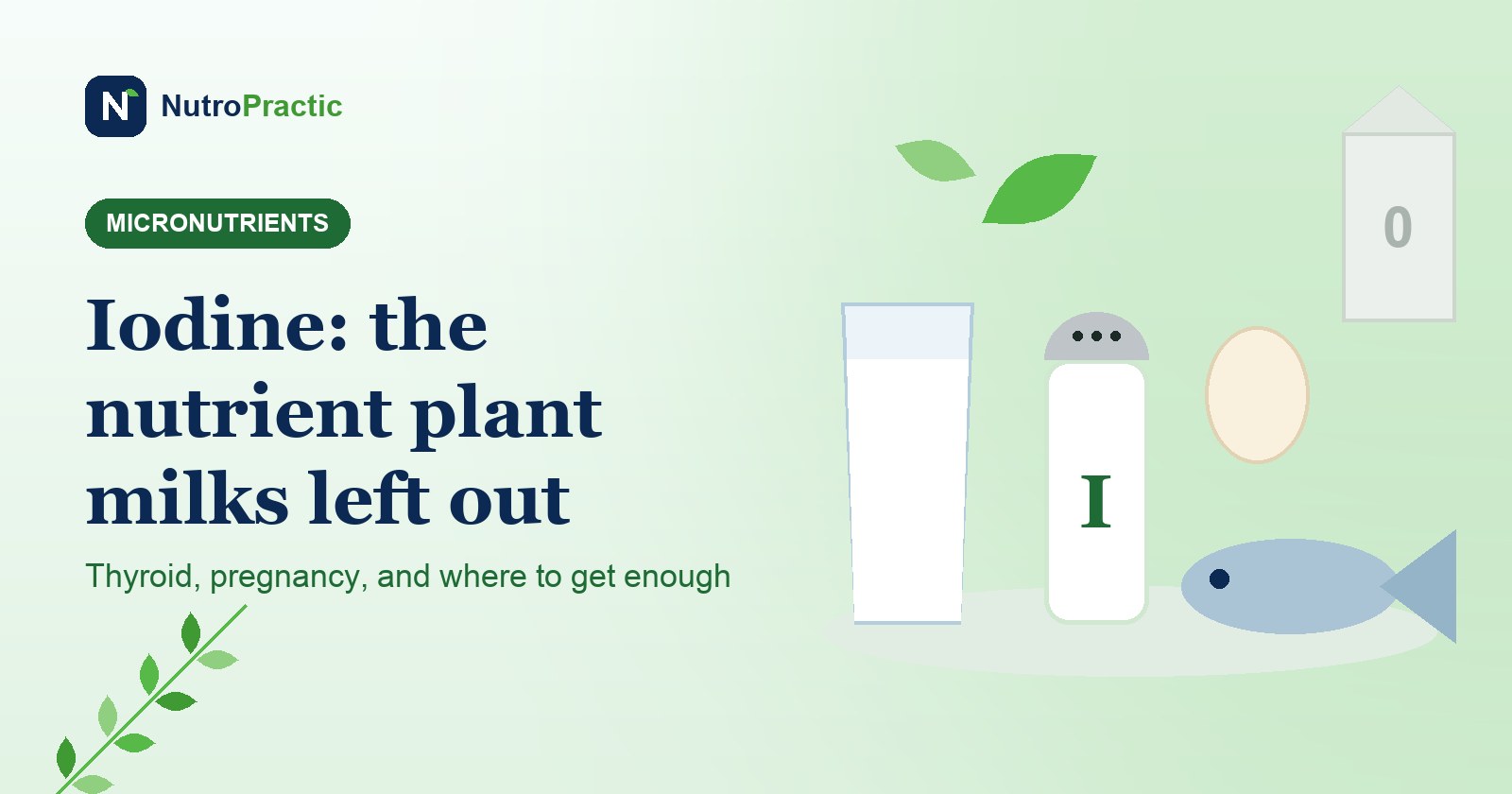
Iodine rarely comes up in conversations about healthy eating, and for decades it didn't need to. Most countries fixed iodine deficiency in the twentieth century by adding it to salt, or got it by accident from milk. Two modern habits are quietly undoing that: switching from dairy to plant-based drinks, and swapping iodised table salt for sea salt, pink salt or rock salt. Neither is unhealthy in itself. Both can leave a gap, and the people most likely to make the swaps, young women, are the people who most need the iodine.
What iodine does
Your thyroid gland uses iodine to make its two hormones, T4 and T3, which set the pace of almost every cell: heart rate, body temperature, energy use. Without enough, the thyroid enlarges (a goitre) and, in time, can't make enough hormone.
The bigger concern is pregnancy. A baby's brain depends on the mother's thyroid hormone in the first months, and the mother needs about 50% more iodine while pregnant and breastfeeding. Severe deficiency causes lasting intellectual disability, which is why the World Health Organization calls iodine deficiency the world's most common preventable cause of brain damage. Mild deficiency is subtler, and it's the kind now common in rich countries.
Mild deficiency, in places you wouldn't expect
In the UK, which has never iodised its salt, a Bristol study used urine samples stored from about 1,000 pregnant women in the 1990s and followed their children. About two thirds of the mothers were below the World Health Organization's cut-off in early pregnancy. Their children were more likely to score in the bottom quarter for verbal IQ at age 8 and reading at age 9, and the lower the mother's iodine, the bigger the gap. It is an observational study and can't prove cause, but similar findings came from Australia and Spain, and they changed advice across Europe.
National surveys put typical UK women of childbearing age in the mildly deficient range. Much of Europe is similar: salt iodisation is voluntary in many countries, and processed food, where most salt comes from, is usually made with plain salt. In Canada, a 2022 study found about 12% of adults with moderate to severe deficiency, and dairy intake was the strongest predictor of having enough. In the US, iodine in women of childbearing age has drifted down since the 1970s to the borderline range.
India took the opposite route: salt for eating must be iodised by law, and more than nine in ten households now use iodised salt. Deficiency there is now mostly in families who use loose crystal salt or rock salt.
Where iodine comes from
Iodine sits in seawater and in soils near the sea, so the amount in plants depends on where they were grown and is usually low. The reliable sources are:
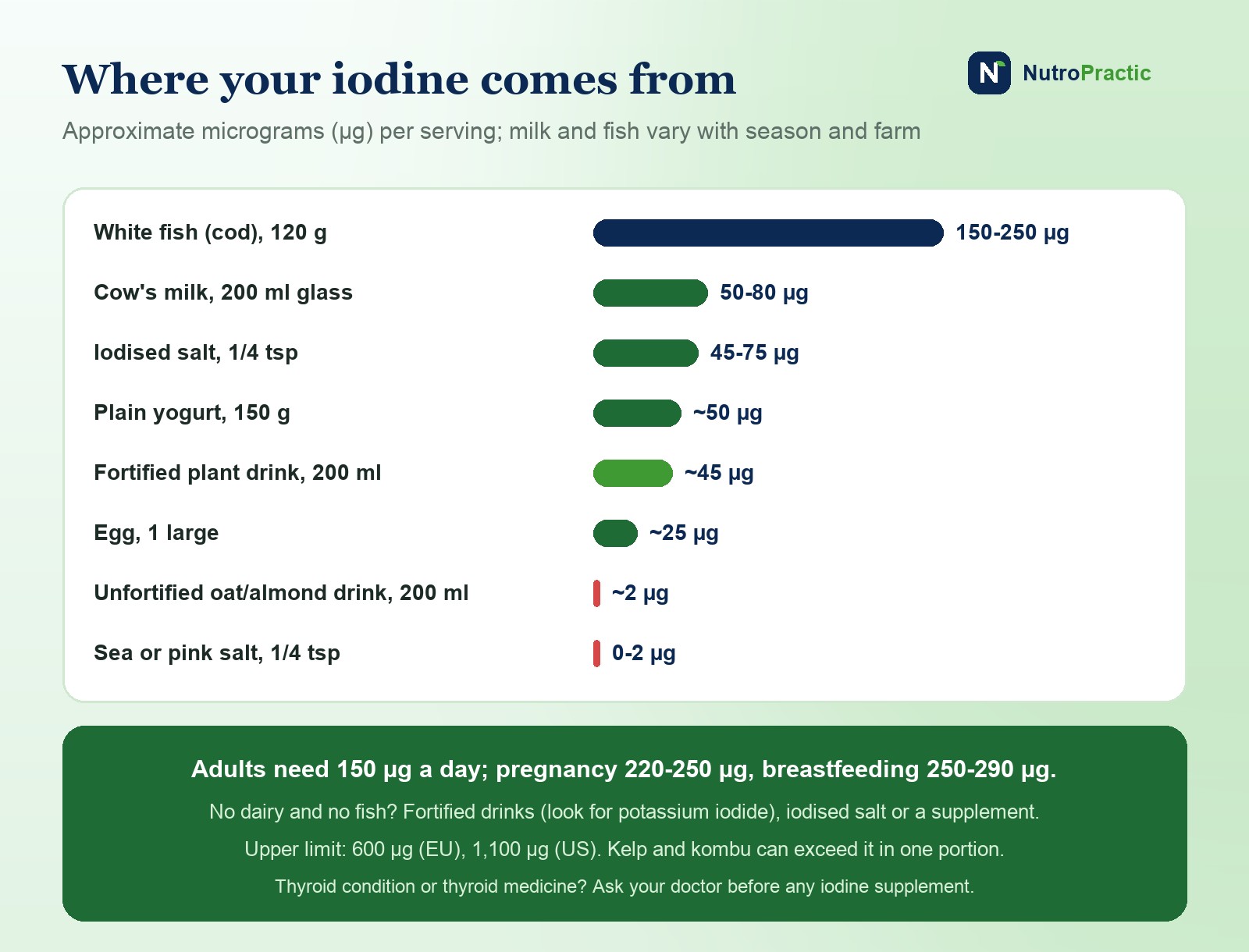
Cow's milk and dairy. In the UK and much of Europe and North America, dairy is the biggest single source, not because milk is naturally rich but because cattle feed is supplemented and iodine-based cleaners are used in milking. A 200 ml glass gives about a third of an adult's daily need. Organic milk tends to have less.
White fish and shellfish. Cod, haddock, pollock and prawns are the richest everyday foods: one portion of cod can cover a day or more. Oily fish such as salmon have less.
Eggs. About 25 µg in a large egg.
Iodised salt. In the US, Canada and India, the main source for anyone who cooks with it. A quarter teaspoon (about 1.5 g) gives around 45 to 75 µg depending on the country's standard. But processed and restaurant food rarely uses it, and most people are rightly trying to eat less salt, so salt is a backstop, not a plan.
The two swaps that leave a gap
Plant-based drinks. Oat, almond, soy, rice and coconut drinks contain almost no iodine unless it is added. In UK surveys, unfortified alternatives had about 7 µg per litre against roughly 440 µg in cow's milk, and women who drank only plant drinks had lower iodine levels. Several big brands now add iodine, typically about 22 µg per 100 ml, close to milk. Look for potassium iodide in the ingredients; "organic" versions usually can't be fortified.
Sea salt, pink Himalayan salt, rock salt and flaky salts. These are marketed as more natural, and they do contain trace minerals, but not iodine in any useful amount: tests of Himalayan salt found well under 1 µg per gram, compared with 15 to 45 µg per gram in iodised salt. If you cook at home and use salt at all, iodised salt is the better choice. In India, using sendha namak (rock salt) every day rather than only for fasting days removes the main source for many vegetarian families.
Who needs to think about it
Anyone fully plant-based, or dairy-free without eating fish. You won't get enough by accident.
Women who are planning a pregnancy, pregnant or breastfeeding. The body's iodine store sits in the thyroid, and filling it before conception matters, because the baby's brain is most sensitive in the first trimester.
People who avoid both dairy and fish for allergy, taste or weight-loss diets.
How much you need
Adults: 150 µg a day (US, UK and WHO).
Pregnancy: 220 µg (US), 250 µg (WHO). Breastfeeding: 290 µg (US), 250 µg (WHO). EFSA in Europe sets 200 µg for both.
A day with a glass of milk, a pot of yogurt and an egg comes to about 125 to 150 µg. Add a portion of white fish twice a week and you're covered on average. Without dairy or fish, you need fortified drinks plus iodised salt at home, or a supplement.
Supplements
The American Thyroid Association recommends that women in the US and Canada take 150 µg of iodine a day (as potassium iodide) while planning, pregnant and breastfeeding. Many prenatal vitamins contain it, but not all, so check the label. UK guidance doesn't recommend routine supplements but advises pregnancy multivitamins that contain iodine for women who don't eat dairy or fish. In India, iodised salt covers most needs and routine pills aren't advised.
For a plant-based adult who isn't pregnant, a supplement or multivitamin with 75 to 150 µg is the simplest way to be sure.
Avoid kelp tablets. Their iodine content varies enormously and is often far above the label.
The other end: too much iodine
The upper limit is 600 µg a day in Europe and 1,100 µg in the US. Excess can push the thyroid either way, under- or overactive, especially in people with existing thyroid disease.
The usual cause is seaweed. Brown seaweeds such as kelp, kombu and hijiki can contain thousands of micrograms per gram dried: a small portion of kombu broth or seaweed salad can carry more than a week's need. Nori (the sheets around sushi) is much lower and fine in normal amounts. Seaweed "superfood" powders and snacks are the ones to be wary of, and they're no replacement for steady sources. Hijiki also contains arsenic and is best avoided.
If you have a thyroid condition (Hashimoto's, Graves' disease, nodules) or take thyroid medicine, ask your doctor before taking any iodine supplement.
Quick checks for your kitchen
Plant drink in the fridge? Check for potassium iodide on the label.
Salt at home? Make it iodised; keep the pink salt for the table if you like it.
No dairy and no fish? Add a supplement or a multivitamin with iodine.
Pregnant or planning? Make sure your prenatal vitamin contains 150 µg iodine.
Seaweed every day? Cut back, especially kelp and kombu.
Iodine sits alongside vitamin B12 and vitamin D as one of the nutrients that need a plan on a plant-based diet; our guide to vitamin D and B12 covers the other two. For women, iron is the other one to check: see iron for women.
Planning a pregnancy, or moving to a plant-based diet and not sure what you're missing? Dr. Triveni can check your usual week for iodine, iron, B12 and the rest and build a plan you'll actually keep to.
Book a consultationThis article is general information, not medical advice. If you are pregnant, breastfeeding or have a thyroid condition, talk to your doctor or midwife before starting or changing an iodine supplement.
Sources
Bath S.C. et al., Effect of inadequate iodine status in UK pregnant women on cognitive outcomes in their children: results from the Avon Longitudinal Study of Parents and Children (ALSPAC), Lancet 382(9889):331-337 (2013). Bath S.C. et al., Iodine intake and status of UK women of childbearing age recruited at the University of Surrey in the winter, Br J Nutr 112:1715-1723 (2014). Dineva M., Rayman M.P., Bath S.C., Iodine status of consumers of milk-alternative drinks v. cows' milk: data from the UK National Diet and Nutrition Survey, Br J Nutr 126(1):28-36 (2021). University of Surrey market survey of iodine fortification in UK milk, yoghurt, cheese and fish alternatives, Br J Nutr (2023). McMaster University analysis of iodine status in Canadian adults (Canadian Health Measures Survey), 2022. National Institutes of Health Office of Dietary Supplements, Iodine fact sheet for health professionals. EFSA NDA Panel, Scientific opinion on dietary reference values for iodine, EFSA Journal 12(5):3660 (2014). WHO, UNICEF, ICCIDD, Assessment of iodine deficiency disorders and monitoring their elimination, 3rd ed. (2007). Alexander E.K. et al., 2017 Guidelines of the American Thyroid Association for the diagnosis and management of thyroid disease during pregnancy and the postpartum, Thyroid 27(3):315-389. British Dietetic Association, Iodine food fact sheet. Iodine Global Network, iodised salt or sea salt. India: Food Safety and Standards (Prohibition and Restrictions on Sales) Regulations 2011 on iodised salt, and NFHS-5 (2019-21) household iodised salt use.