Gestational diabetes is usually found between 24 and 28 weeks, after a glucose drink and a couple of blood tests, and the news tends to arrive with a long list of foods to avoid. Many women respond by cutting carbohydrates hard, and then feel shaky, hungry and anxious about every meal for the rest of the pregnancy.
It doesn't have to go that way. This is a guide to what the research actually supports: how much carbohydrate, which kinds, when to eat it, what a ten-minute walk does, when medicine is the right call, and why the weeks after the birth matter as much as the weeks before.
What it is, and why it happens
In the second half of pregnancy the placenta makes hormones that make the mother's body more resistant to insulin. That is normal: it keeps more glucose available for the baby. Most women make extra insulin to keep up. When the pancreas can't make enough, blood glucose rises, and that is gestational diabetes (GDM).
It is common. About 8% of US pregnancies are affected, around 4 to 5% in the UK, and more than one in ten in India, where women develop it at lower body weights. Risk is higher with a BMI over 30, a previous large baby or GDM, a parent or sibling with type 2 diabetes, polycystic ovary syndrome, and South Asian, Black, Hispanic or Middle Eastern family origin. Plenty of women with none of these get it, which is why many countries test everyone.
How it's diagnosed
In the US, most clinics use a two-step test: a 50 g glucose drink at any time of day, then a three-hour 100 g test if the first is high. Some use a single two-hour 75 g test.
In the UK, women with risk factors are offered a two-hour 75 g glucose tolerance test at 24 to 28 weeks (earlier if they had GDM before). GDM is diagnosed with a fasting glucose of 5.6 mmol/L or more, or 7.8 mmol/L or more at two hours.
In India, the national guideline uses the single-step DIPSI test: 75 g of glucose without needing to fast, with GDM diagnosed at 140 mg/dL (7.8 mmol/L) or more at two hours, ideally at the first antenatal visit and again at 24 to 28 weeks.
The thresholds differ, and the same woman could be diagnosed in one country and not another. What they share is the goal: catch raised glucose early enough to bring it down.
Why treating it matters
Two large trials settled whether treating even mild GDM is worth the effort. In Australia's ACHOIS trial, 1,000 women with mild GDM were randomised to treatment (diet advice, glucose monitoring and insulin if needed) or routine care. Serious complications for the baby fell from 4% to 1%. A US trial of 958 women found fewer very large babies, fewer shoulder-stuck births and less pre-eclampsia with treatment.
High glucose crosses the placenta, the baby makes extra insulin, and the extra insulin makes the baby grow larger and store more fat. Keeping the mother's glucose in range is how you prevent that.
The targets
Both NICE in the UK and the American Diabetes Association aim for:
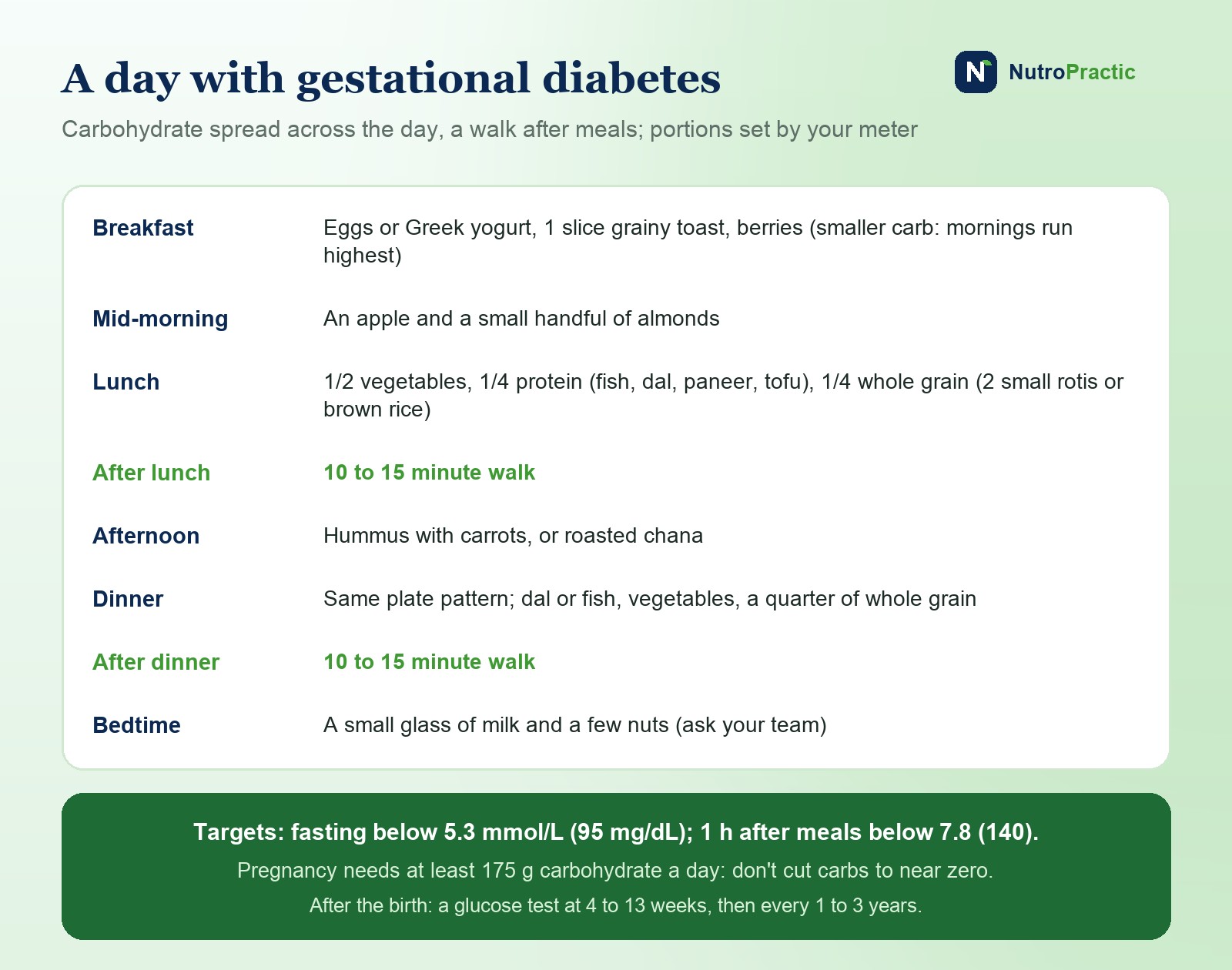
Fasting (on waking): below 5.3 mmol/L (95 mg/dL).
One hour after a meal: below 7.8 mmol/L (140 mg/dL), or two hours after: below 6.4 mmol/L (115 mg/dL) in the UK, 6.7 mmol/L (120 mg/dL) in the US.
Your team will tell you which timing to use. The meter readings are what decide everything else, including whether you need medicine. They are information, not a score.
Carbohydrates: enough, the right kind, spread out
The instinct is to cut carbs as low as possible. The trials don't support that, and there are reasons not to.
Don't go very low. Pregnancy needs at least 175 g of carbohydrate a day, mainly for the baby's brain, and very low-carbohydrate eating raises ketones and fat in the blood, which the baby is also exposed to. If you cut carbs hard, fasting glucose often gets worse rather than better.
More carbohydrate of a better kind can work as well. In the CHOICE trial at the University of Colorado, 59 women with diet-controlled GDM were given all their food: a conventional diet with 40% of calories from carbohydrate, or a diet with 60% from complex carbohydrate and less fat. Their glucose stayed in range on both, and their babies' body fat at birth was the same. The lesson isn't that carbs should be high, but that the quality and spread of carbohydrate matter more than squeezing the amount down.
Low glycaemic index helps. Reviews of the diet trials in GDM found that low-GI eating (whole grains, pulses, intact rather than puffed or finely milled grains) was linked with less need for insulin and fewer very large babies, without cutting calories.
Spread it out. Three moderate meals and two or three snacks keep the peaks lower than three big meals. Pair every carbohydrate with protein, fat or fibre.
Breakfast is the hardest meal. Morning hormones make insulin resistance worst early in the day, so many women find the same bowl of cereal that is fine at lunch spikes them at breakfast. A smaller-carbohydrate breakfast with more protein (eggs, Greek yogurt, paneer, tofu, nut butter on one slice of grainy toast) usually fixes it.
A bedtime snack with some protein and slow carbohydrate (a small glass of milk and a few nuts, or a slice of grainy toast with cheese) can help a high fasting reading for some women. Ask your team before you try it.
A plate that works
Half the plate: vegetables and salad.
A quarter: protein, such as fish, chicken, eggs, tofu, paneer, or a generous serving of dal or beans.
A quarter: whole-grain carbohydrate, such as brown or basmati rice, wholemeal pasta, new potatoes in their skins, two small rotis or a slice of grainy bread.
Drinks: water, milk, tea and coffee within the pregnancy caffeine limit. Juice and sweetened drinks raise glucose faster than almost anything else.
For an Indian kitchen, the pattern from our balanced Indian plate guide works well: rice or roti reduced to a quarter, with dal, a vegetable sabzi and curd taking more space. Rice is the usual culprit after lunch; switching some of it for a millet or adding a bowl of dal before the rice often brings the one-hour reading down.
Walk after meals
A short walk after eating uses glucose in the leg muscles while it's arriving in the blood. In small trials in pregnant women with GDM, a 10 to 15 minute walk after meals lowered the after-meal glucose more than the same walk at another time of day. It doesn't need to be brisk: a slow walk around the block or up and down a corridor counts. For most pregnancies, around 150 minutes of moderate activity a week is recommended, and the post-meal walk is an easy way to collect it. Ask your midwife or doctor first if you have bleeding, a low-lying placenta or any reason to rest.
Weight gain
GDM is not a reason to diet or lose weight in pregnancy. The US National Academy of Medicine ranges for total gain are:
Starting BMI under 18.5: 12.5 to 18 kg. 18.5 to 24.9: 11.5 to 16 kg. 25 to 29.9: 7 to 11.5 kg. 30 or more: 5 to 9 kg.
Gaining more than this makes glucose harder to control, but cutting calories hard risks the baby's growth. Your team will track it.
When diet isn't enough
Somewhere between one in five and one in three women with GDM end up needing medicine, and that is not a failure. It usually means the placenta's hormones are outpacing what the pancreas can do, which no diet fully changes.
Metformin is a tablet, often offered first in the UK if diet hasn't brought readings into range within one to two weeks. It crosses the placenta; children followed up so far look healthy, though some studies found slightly heavier children later on, so US guidance tends to prefer insulin.
Insulin doesn't cross the placenta and is the first choice in the US, and in the UK when fasting glucose is very high at diagnosis. Doses are adjusted every few days.
Either way, keep eating the same balanced pattern. Medicines work on top of the diet, not instead of it.
After the birth: the part people skip
Glucose usually returns to normal within days of delivery. But GDM is an early warning: women who have had it have about a ten times higher risk of type 2 diabetes later, with many cases in the first five to ten years.
Get the follow-up test. The UK offers a fasting glucose or HbA1c test around 13 weeks after the birth, then an HbA1c every year. US guidance is a 75 g glucose tolerance test at 4 to 12 weeks, then testing every one to three years. Many women miss it; book it before you leave the hospital.
Breastfeed if you can. In the US SWIFT study of more than 1,000 women with GDM, those who breastfed more intensively and for longer had roughly half the risk of developing type 2 diabetes within two years. It is observational, but the effect held after adjusting for weight and other factors.
Keep the habits. In the US Diabetes Prevention Program, women with a past GDM who took up a lifestyle programme or metformin cut their risk of type 2 diabetes by about half. A healthy weight before the next pregnancy also lowers the chance of GDM coming back, which happens in around a third to a half of women. Our article on type 2 diabetes remission covers what weight loss does for blood sugar outside pregnancy.
Just diagnosed and unsure what to eat, or worried about one stubborn reading? Dr. Triveni can build a meal pattern around your meter readings and the foods you already cook, in a virtual consultation that works alongside your pregnancy team.
Book a consultationThis article is general information, not medical advice. Gestational diabetes needs care from your midwife, obstetrician or diabetes team. Don't change your diet, activity or any medicine without talking to them.
Sources
Crowther C.A. et al., Effect of treatment of gestational diabetes mellitus on pregnancy outcomes (ACHOIS), N Engl J Med 352:2477-2486 (2005). Landon M.B. et al., A multicenter, randomized trial of treatment for mild gestational diabetes, N Engl J Med 361:1339-1348 (2009). Hernandez T.L. et al., Effect of a higher complex carbohydrate vs conventional diet in gestational diabetes on newborn adiposity (CHOICE), Diabetes Care (2023). Review of nutrition therapy trials in gestational diabetes, Current Diabetes Reports (2019). National Institute for Health and Care Excellence, NG3 Diabetes in pregnancy: management from preconception to the postnatal period (updated 2020). American Diabetes Association, Standards of Care in Diabetes, section 15: Management of diabetes in pregnancy (2025), and glucose monitoring in gestational diabetes. Ministry of Health and Family Welfare, India, National guidelines for diagnosis and management of gestational diabetes mellitus (DIPSI, 2018). Institute of Medicine, Weight gain during pregnancy: reexamining the guidelines (2009). Vounzoulaki E. et al., Progression to type 2 diabetes in women with a known history of gestational diabetes: systematic review and meta-analysis, BMJ 369:m1361 (2020). Gunderson E.P. et al., Lactation and progression to type 2 diabetes mellitus after gestational diabetes mellitus (SWIFT), Ann Intern Med 163(12):889-898 (2015). Ratner R.E. et al., Prevention of diabetes in women with a history of gestational diabetes (Diabetes Prevention Program), J Clin Endocrinol Metab 93(12):4774-4779 (2008). Rowan J.A. et al., Metformin versus insulin for the treatment of gestational diabetes (MiG), N Engl J Med 358:2003-2015 (2008). Centers for Disease Control and Prevention, gestational diabetes prevalence (National Vital Statistics, 2021).