For thirty years creatine lived on one shelf, next to the protein tubs with lightning bolts on them, and was bought almost entirely by young men who lift. Lately it has turned up somewhere else: in conversations about menopause, about staying strong at seventy, about memory. Women in their fifties are asking their doctors about it. So are their mothers.
Some of that interest is well founded and some has run ahead of the research. Creatine is one of the most studied supplements there is, which means we can be fairly exact about which is which.
What creatine is
It is not a steroid, a stimulant or a protein. It is a small compound the body makes for itself, about a gram a day, in the liver and kidneys. People who eat meat and fish take in roughly another gram from food. About 95% of it sits in muscle.
Its job is to recycle energy quickly. A muscle working hard burns through its immediate fuel within seconds, and stored creatine tops that fuel back up. More in the store means a little more work before the muscle tires: one more repetition, a slightly heavier weight, a faster climb up the stairs. The brain uses the same system, which is where the newer research comes in.
A supplement of 3 to 5 g a day fills the muscle store above what food manages. You could not do that from the plate: raw beef and salmon hold about 4 to 5 g of creatine per kilo. Vegetarians and vegans, who get almost none from food, start with lower stores and tend to respond more.
Muscle after 50: the part that's solid
From middle age we lose muscle slowly and strength rather faster. It decides how easily you get out of a chair at eighty and whether a stumble becomes a fall. Resistance training is the treatment that works. The question for creatine is whether it adds anything to the training.
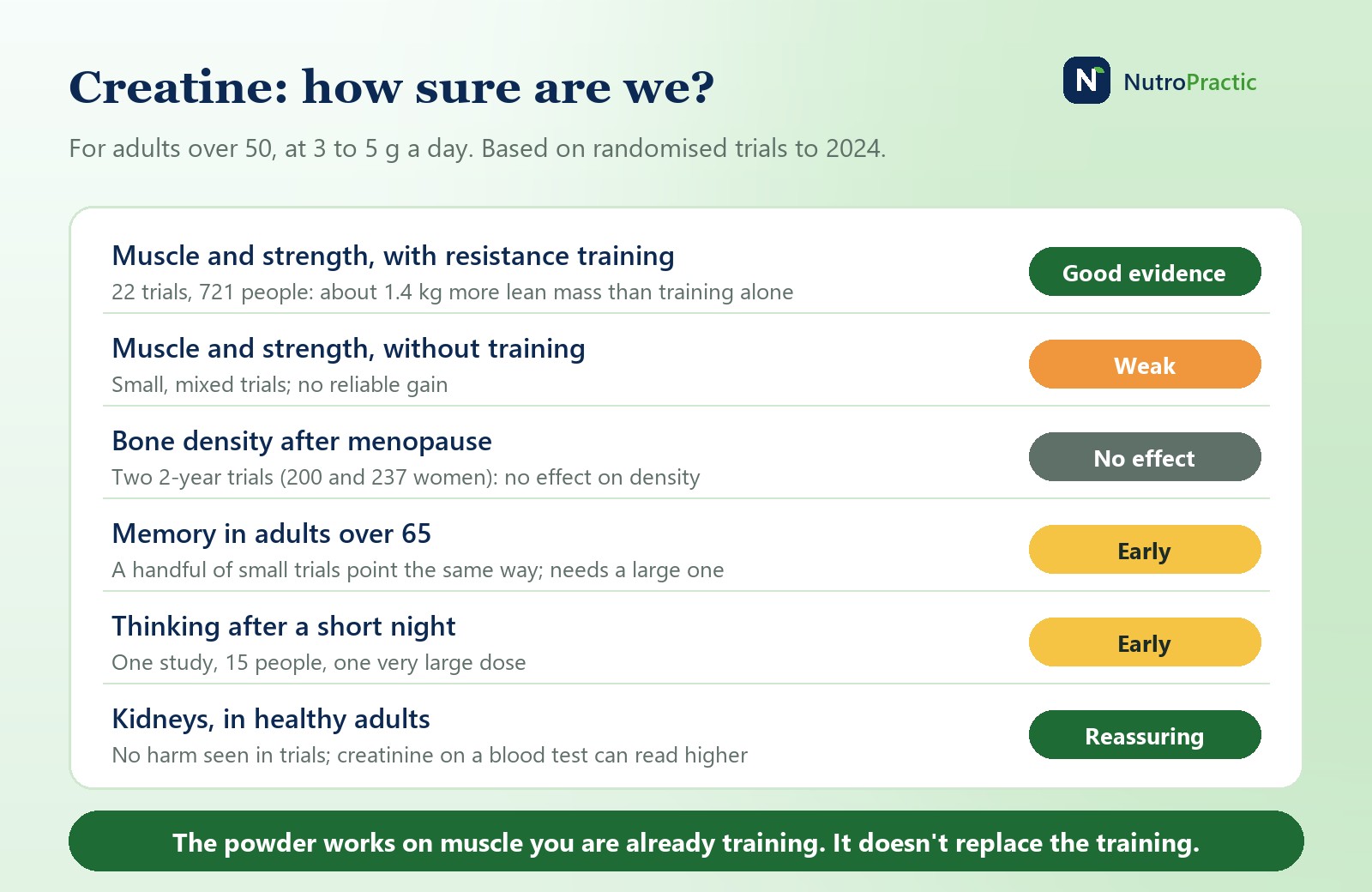
It does. A 2017 analysis pooled 22 randomised trials in 721 adults, with average ages between 57 and 70. Everyone did resistance training two or three days a week, for anything from seven weeks to a year. Half took creatine and half a placebo. The creatine groups gained about 1.4 kg more lean mass than the placebo groups, and improved more on chest press and leg press.
The European Food Safety Authority, not an easy body to impress, reviewed the evidence in 2016 and allowed one claim: that daily creatine can enhance the effect of resistance training on muscle strength in adults over 55. Its conditions were at least 3 g a day, with training of moderate intensity about three times a week.
Every part of that sentence matters, the training most of all. In trials where older adults took creatine and did no structured exercise, the results are small and inconsistent. One of the largest gave 3 g a day to 200 postmenopausal women for two years without an exercise programme, and found no change in muscle or in bone. Creatine lets you do a little more work in each session, and the work is what builds the muscle.
Women, and the years around menopause
Women were left out of most of the early creatine research, so the claims now made for them deserve a careful look. A few things are reasonably clear. Women carry less creatine in total than men, mainly because they carry less muscle, and on average eat less of it. Supplements raise their muscle stores as they do men's. And in the shorter training trials, women taking it gain strength and lean mass much as men do.
The best single study is Canadian. 237 postmenopausal women, average age 59, did resistance training three days a week and walked on six, for two years. Half took creatine at a fairly high dose (0.14 g per kg of body weight, about 10 g a day for a 70 kg woman) and half took a placebo.
The researchers were hoping for a bone result and didn't get one: bone mineral density fell at the same rate in both groups. There were smaller findings in creatine's favour. Some measures of the shape and strength of the hip bone held up better, the creatine group walked 80 metres a little faster, and among women who completed the programme, lean mass rose more. It made no difference to how much they could lift: both groups got a good deal stronger on bench press and squat, by the same amount. The training did that.
So the honest summary for women after menopause is this. Creatine is a modest addition to strength training for muscle, and the training does most of the work. It is not a bone treatment. Bones still depend on loading, calcium, vitamin D, protein and, where it's prescribed, medicine. You can check the calcium in an ordinary day with our calcium counter.
Brain, memory and sleep: early days
The idea is sound. The brain is a hungry organ, it uses creatine to buffer energy as muscle does, and supplements can raise brain creatine by a few percent. Whether that changes how well anyone thinks is a harder question.
Memory. A 2023 analysis of trials in healthy people reported better memory scores with creatine, mainly in adults aged 66 to 76. Other researchers pointed out that some participants had been counted twice. When the authors re-ran the numbers the overall effect faded, though the result in older adults remained. The trials behind it are few and small.
Short nights. A German study in 2024 kept 15 people awake for 21 hours and gave them a single very large dose, 0.35 g per kg, about 25 g for a 70 kg adult. Processing speed and scores on the thinking tests held up better than on placebo, and brain scans showed the energy chemistry shifting. It's an interesting experiment. It is also fifteen people and a dose five or more times what anyone takes daily, so it's no reason to stir creatine into your coffee after a bad night.
Mood. In one eight-week trial, 52 women with depression who took 5 g a day alongside their antidepressant improved faster than those on the antidepressant alone. That is a finding for psychiatrists to follow up, not a reason to self-treat.
In November 2024 the European Food Safety Authority looked at the whole body of evidence on creatine and thinking and concluded that a cause-and-effect link had not been shown. That's a fair reading. If you take creatine for your muscles and it turns out to help your memory too, good. Don't buy it for your memory yet.
How to take it
Which kind. Creatine monohydrate. It is the form used in nearly all the research and the cheapest. The fancier versions (hydrochloride, buffered, liquid) cost more and have not been shown to do more. Look for a third-party testing mark such as NSF Certified for Sport or Informed Sport.
How much. 3 to 5 g a day, every day, including days you don't train. The "loading" week of 20 g a day that gym lore recommends is not needed. A steady 3 g a day brings muscle to the same level in about four weeks, and with less chance of an upset stomach.
When. It doesn't much matter. Pick a time you'll remember. It dissolves in water, juice or a yogurt, and taking it with a meal is easier on the stomach.
What you'll notice. Possibly a kilo or so on the scale in the first weeks. That is water drawn into muscle, not fat, and it is less marked without a loading phase. Beyond that, nothing dramatic: a bit more left at the end of a set, after a month or so.
And the rest of the plan. Two or three sessions a week that work the legs, a push and a pull, with weights, bands or your own body weight, made gradually harder. Enough protein, spread through the day, which we set out in Protein after 40: how much you really need. Creatine is a small addition to those two. It doesn't stand in for either.
Safety, and who should skip it
In healthy adults, creatine at these doses has been studied for up to five years without evidence of harm to the kidneys or liver. The usual complaints are bloating or loose stools, mostly at high doses taken in one go.
One thing to know before your next blood test. Creatine breaks down into creatinine, the substance doctors measure to estimate kidney function. Taking the supplement can push that number up a little without anything being wrong with your kidneys. Tell your doctor you take it, so a slightly raised result isn't misread or, worse, a real problem explained away.
Leave it alone, or ask your doctor first, if you: have kidney disease or reduced kidney function, or a single kidney; are pregnant or breastfeeding, because it hasn't been tested in human pregnancy; take medicines that affect the kidneys, including regular anti-inflammatory painkillers or diuretics; have bipolar disorder, as there are a few case reports of mania; or are under 18.
On hair. The worry comes from one 2009 study in young rugby players that measured a hormone, not hair. Nobody has shown that creatine causes hair loss.
The short version
If you are over 50, healthy, and doing resistance training or about to start, 3 to 5 g of creatine monohydrate a day is a cheap, well-tested way to get a little more out of that training. If you aren't training, start there; the powder won't do it for you. For bone, the trials say no. For memory and sleep, wait for better ones.
Want to hold on to muscle through menopause or into your seventies, and not sure how protein, training and supplements fit together for you? Dr. Triveni can build a plan around your routine and your kitchen, in a virtual consultation.
Book a consultationThis article is general information, not medical advice. Talk to your doctor before starting creatine if you have kidney disease, diabetes or high blood pressure, take regular medicines, or are pregnant or breastfeeding. Supplements don't replace treatment prescribed for osteoporosis, depression or any other condition.
Sources
Chilibeck P.D. et al., Effect of creatine supplementation during resistance training on lean tissue mass and muscular strength in older adults: a meta-analysis, Open Access Journal of Sports Medicine 8:213-226 (2017). EFSA Panel on Dietetic Products, Nutrition and Allergies, Creatine in combination with resistance training and improvement in muscle strength, EFSA Journal 14(2):4400 (2016). Sales L.P. et al., Creatine supplementation (3 g/d) and bone health in older women: a 2-year, randomized, placebo-controlled trial, J Gerontol A 75(5):931-938 (2020). Chilibeck P.D. et al., A 2-yr randomized controlled trial on creatine supplementation during exercise for postmenopausal bone health, Med Sci Sports Exerc 55(10):1750-1760 (2023). Smith-Ryan A.E. et al., Creatine supplementation in women's health: a lifespan perspective, Nutrients 13(3):877 (2021). Prokopidis K. et al., Effects of creatine supplementation on memory in healthy individuals: a systematic review and meta-analysis of randomized controlled trials, Nutrition Reviews 81(4):416-427 (2023), with the later correspondence and authors' reply. Gordji-Nejad A. et al., Single dose creatine improves cognitive performance and induces changes in cerebral high energy phosphates during sleep deprivation, Scientific Reports 14:4937 (2024). Lyoo I.K. et al., A randomized, double-blind placebo-controlled trial of oral creatine monohydrate augmentation for enhanced response to a selective serotonin reuptake inhibitor in women with major depressive disorder, Am J Psychiatry 169(9):937-945 (2012). EFSA Panel on Nutrition, Novel Foods and Food Allergens, Creatine and improvement in cognitive function: evaluation of a health claim, EFSA Journal (November 2024). Kreider R.B. et al., International Society of Sports Nutrition position stand: safety and efficacy of creatine supplementation in exercise, sport, and medicine, J Int Soc Sports Nutr 14:18 (2017). Hultman E. et al., Muscle creatine loading in men, J Appl Physiol 81(1):232-237 (1996).