Somewhere around the first birthday, most families move a baby from breast milk or formula to ordinary milk. It feels like a small step, and mostly it is. But milk is also one of the few foods a toddler can easily have too much of, and when that happens the usual casualty is iron. Meanwhile the supermarket shelf next to the formula offers "growing-up milks" and "toddler milks" at several times the price of milk from the fridge.
Here is what the guidelines in the US, UK, Canada and India say about when to switch and how much, what the studies found on milk and iron, and whether toddler milks or plant milks earn a place.
When to switch
US (AAP): no cow's milk as a drink before 12 months; whole milk from 12 months.
UK (NHS): cow's milk can go into cooking and foods (porridge, sauces) from about 6 months, but not as the main drink until 12 months. Whole or semi-skimmed milk can be the main drink from age 1; skimmed and 1% are not suitable as a main drink under 5.
Canada (Health Canada, Canadian Paediatric Society): homogenised 3.25% whole milk can start between 9 and 12 months; no skim milk under 2.
WHO (2023 guideline): for babies of 6 to 11 months who are not breastfed, either formula or animal milk is acceptable; from 12 to 23 months, animal milk is the recommendation, and follow-up formulas are not.
India (IAP infant and young child feeding guidelines, 2016): breastfeeding continues into the second year; for children who are not breastfed, 1 to 2 cups of milk a day plus extra meals.
Why wait at all? Under a year, cow's milk is low in iron and its protein can irritate the gut lining. In a study of healthy babies switched to cow's milk at about 6 months (Ziegler and colleagues, 1990), the share with hidden blood in their stools rose from 3% to 30% within four weeks. The effect fades by about 12 months, which is part of why the first birthday is the line most guidelines draw.
How much is enough, and how much is too much
Here is where the advice varies more than you'd expect:
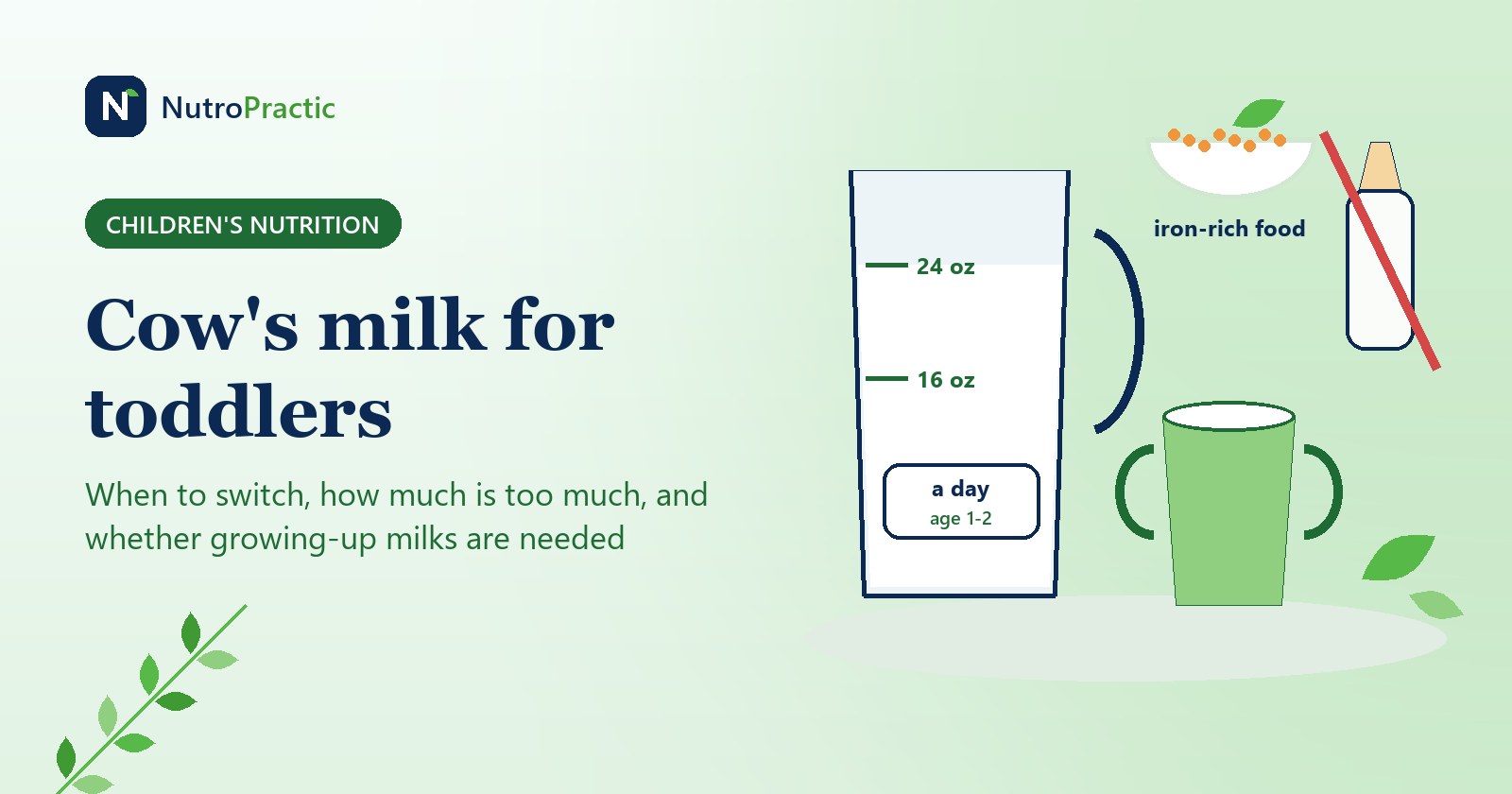
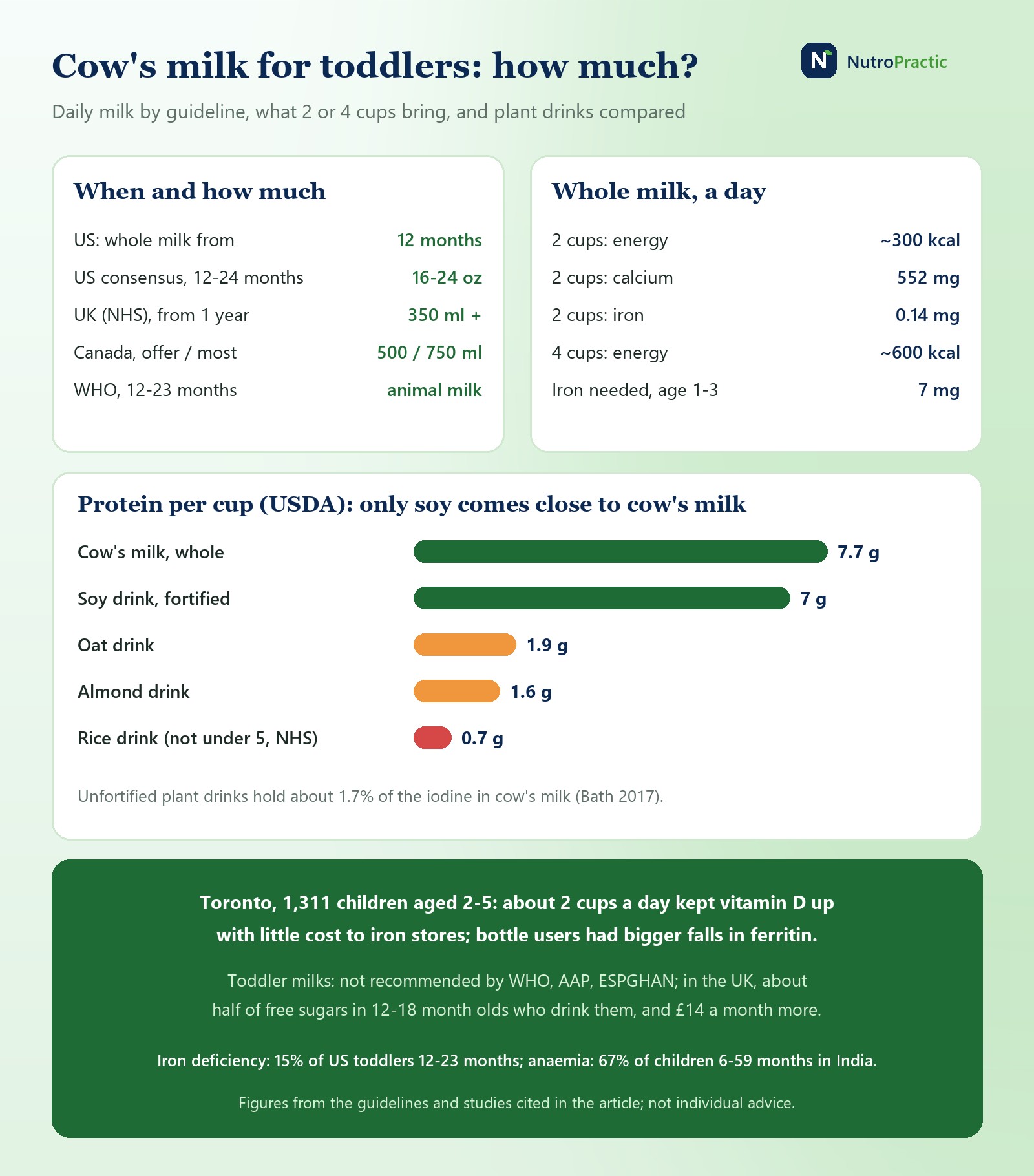
US, 2019 consensus (AAP, American Heart Association, Academy of Nutrition and Dietetics and dentists): 12 to 24 months, 2 to 3 cups (16 to 24 oz, 480 to 720 ml) of whole milk a day; 2 to 3 years, up to 2 cups of skim or 1%; 4 to 5 years, up to 2.5 cups.
AAP parent site (HealthyChildren): 12 to 24 months, 16 oz (2 cups); 2 to 5 years, 16 to 24 oz.
UK (NHS): at least 350 ml (12 oz) a day, or two servings of foods made from milk such as cheese or yoghurt.
Canada: offer about 500 ml (2 cups) a day and no more than 750 ml, because more can crowd out other foods and lead to iron-deficiency anaemia.
So the floor is roughly 350 to 500 ml and the ceiling roughly 700 to 750 ml (24 to 25 oz). Most toddlers do well with about 2 cups a day, served in an open cup with meals and snacks.
What 2 cups gives, and what 4 cups costs
Using USDA values for whole milk (per 244 g cup: about 149 kcal, 7.7 g protein, 276 mg calcium, 3.2 µg vitamin D in US-fortified milk, 82 µg iodine, 0.07 mg iron):
2 cups (about 490 ml): about 300 kcal, 15 g protein, 552 mg calcium (79% of the US 700 mg target for ages 1 to 3, and above the UK's 350 mg), 164 µg iodine (above the 90 µg target), but 0.14 mg iron, 2% of the 7 mg a 1 to 3 year old needs.
4 cups (about 980 ml), a common amount for a toddler who still drinks from a bottle: about 600 kcal. A 12 to 23 month old needs roughly 700 to 1,000 kcal a day in total (US Dietary Guidelines 2020-2025), so that is 60% or more of the day's energy from a drink with almost no iron. There isn't much room left for the meat, beans, eggs and fortified cereals that bring the iron in.
Milk and iron: what the studies found
The link is not a theory. In the TARGet Kids! study in Toronto (Maguire and colleagues, Pediatrics 2013), researchers measured vitamin D and iron stores (ferritin) in 1,311 children aged 2 to 5. More milk meant more vitamin D but lower iron stores, and about 2 cups (500 ml) a day kept vitamin D at a healthy level with very little cost to iron. Children who still drank milk from a bottle had steeper drops in ferritin. Children with darker skin who took no vitamin D supplement in winter needed 3 to 4 cups to reach the same vitamin D, which is a reason to talk to your doctor about vitamin D drops rather than pour more milk.
Three things work together. Cow's milk has almost no iron (0.03 mg per 100 g). It fills a small stomach, so less iron-rich food goes in. And its calcium and casein reduce how much non-haem iron the body absorbs from the rest of the meal (Ziegler, Nutrition Reviews 2011).
How common is the problem? In the US, 15% of toddlers aged 12 to 23 months were iron deficient in national survey data (Gupta and colleagues, 2017). In India, the National Family Health Survey 2019-21 found 67% of children aged 6 to 59 months anaemic, up from 59% five years earlier. Not all of that is iron or milk, but a toddler who fills up on milk or milky tea is starting from behind.
Signs worth mentioning to your doctor: a toddler who drinks a lot of milk but eats little, looks pale, tires easily or seems irritable. A simple blood test checks haemoglobin and ferritin.
Growing-up milks: what you get for the money
Toddler milks (also sold as growing-up milks, young child formulas or stage 3 or 4 milks) are powders or ready-to-drink milks for ages 1 to 3, usually cow's milk with added vegetable oils, vitamins, iron and often sugar. Every major body that has looked at them comes down the same way:
WHO (2023): from 12 months, animal milk; follow-up formulas are not recommended.
AAP (2023 clinical report): for most children these drinks have no advantage over cow's milk plus a normal diet, and they cost more.
ESPGHAN, Europe's paediatric nutrition society (2018): no need for routine use at 1 to 3 years; their makeup is "highly variable", sometimes with high amounts of added sugars.
2019 US consensus: not recommended, no unique nutritional value, and they may add sugar.
The UK charity First Steps Nutrition Trust looked at the products on sale in 2024: in 14 of 16, the 350 ml a day the NHS suggests would take a 1 to 2 year old over the free-sugars limit, these milks supplied about half of all free sugars in the 12 to 18 month olds who drank them, and they cost on average £14 a month more than cow's milk. In the US, toddler milk advertising quadrupled between 2006 and 2015 and sales rose 2.6 times (Choi and colleagues, 2020), and in a survey of 1,645 caregivers, 60% believed toddler milks give nutrition children can't get from other foods (Romo-Palafox and colleagues, 2020).
There are children who need a special formula: those with a diagnosed cow's milk protein allergy, faltering growth or certain medical conditions, on their doctor's or dietitian's advice. For everyone else, the iron and vitamins in a toddler milk are better got from food, and a vitamin D supplement where your country advises one.
Plant milks for under-5s
Many families use plant drinks for ethical, allergy or cultural reasons. They are not interchangeable with cow's milk for a small child, and they are not interchangeable with each other. Protein per cup (USDA, approximate):
Cow's milk, whole: 7.7 g
Soy drink, fortified, unsweetened: about 7 g
Oat drink: about 1.9 g
Almond drink: about 1.6 g
Rice drink: about 0.7 g
The 2019 US consensus and the AAP treat fortified unsweetened soy as the only plant drink close to cow's milk. The NHS allows unsweetened, calcium-fortified soy, oat or almond drinks from age 1 as part of a varied diet, but says children under 5 should not have rice drinks, because of their arsenic content. Health Canada says plant drinks are not suitable as the main milk under 2.
Iodine is the nutrient that gets forgotten. When UK researchers tested 47 milk-alternative drinks (Bath and colleagues, 2017), the unfortified ones held about 1.7% of the iodine in cow's milk, and only 3 of the 47 were fortified with iodine. In national survey data, people who drank only milk alternatives had lower iodine intake and a median urine iodine in the deficient range (Dineva and colleagues, 2021). Iodine matters for brain development, so if your toddler drinks a plant milk, choose one with added calcium, vitamin D, B12 and iodine, and check the label for each.
Practical notes
Whole, then lower fat. US advice is whole milk from 1 to 2, then skim or 1%. The UK says whole or semi-skimmed from 1, no skimmed before 5. A 2020 review of 28 observational studies (Vanderhout and colleagues) found children who drank whole milk were less likely to be overweight than those on reduced-fat milk (odds ratio 0.61); it can't prove cause and effect, but it is reassuring for parents worried about the fat.
Off the bottle by 12 to 18 months. The AAP suggests finishing bottle weaning by then. In a US cohort of 6,750 children, the 22% still using a bottle at age 2 were more likely to be obese at 5.5 years: 22.9% against 16.1% (Gooze and colleagues, 2011). Bedtime bottles of milk also feed tooth decay.
Milk with meals, water in between. Offer milk at meals and snacks in an open cup, and water when the child is thirsty.
Indian kitchens: toned milk (standardised to 3% fat) is close to US whole milk (3.25%); buffalo milk is richer, so a little goes further. Many toddlers in India get milk as milky tea: the 2019 consensus says caffeinated drinks are not recommended under 5, and tea's tannins also reduce iron absorption, so plain milk, curd or a milk-based porridge is the better habit.
Iron on the plate: meat, fish, eggs, dal, beans and chickpeas, tofu and iron-fortified cereals, with vitamin C (fruit, tomato, lemon) at the same meal to help absorption.
If your baby is just starting solids, our article on peanuts, eggs and early introduction covers the allergens to bring in before the first birthday. To check calcium from the whole day's food, not just milk, try our free calcium counter; and for older children and adults who think milk disagrees with them, see how much milk most people with lactose intolerance can actually take.
About two cups of plain milk a day, from an open cup, and the rest of the iron from food: that is what most toddlers need.
Worried your toddler drinks too much milk and eats too little, or planning meals for a plant-based or allergic child? Dr. Triveni can help you build a simple day of meals and drinks in a virtual consultation.
Book a consultationThis article is general information, not medical advice. If your child was born early, has a medical condition or a milk allergy, or you are worried about their growth or iron, talk to your paediatrician or health visitor.
Sources
American Academy of Pediatrics, HealthyChildren.org, Recommended drinks for young children ages 0-5 (2023) and Discontinuing the bottle (2023). Lott M. et al., Healthy beverage consumption in early childhood: recommendations from key national health and nutrition organizations, Healthy Eating Research (2019). NHS, Drinks and cups for babies and young children and What to feed young children.
Health Canada, Nutrition for healthy term infants: recommendations from six to 24 months. Canadian Paediatric Society, Feeding your baby in the first year (2020). World Health Organization, WHO guideline for complementary feeding of infants and young children 6-23 months of age (2023). Tiwari S. et al., Infant and young child feeding guidelines, 2016, Indian Pediatr 53:703-713 (2016).
Ziegler E.E. et al., Cow milk feeding in infancy: further observations on blood loss from the gastrointestinal tract90003-6), J Pediatr 116(1):11-18 (1990). Ziegler E.E., Consumption of cow's milk as a cause of iron deficiency in infants and toddlers, Nutr Rev 69(Suppl 1):S37-S42 (2011). Maguire J.L. et al., The relationship between cow's milk and stores of vitamin D and iron in early childhood, Pediatrics 131(1):e144-e151 (2013). Gupta P.M. et al., Iron status of toddlers, nonpregnant females, and pregnant females in the United States, Am J Clin Nutr 106(Suppl 6):1640S-1646S (2017). International Institute for Population Sciences, National Family Health Survey (NFHS-5), 2019-21.
USDA FoodData Central, whole milk 3.25% (SR Legacy 171265) and plant drinks. USDA, FDA and NIH ODS, Database for the iodine content of common foods, release 3. NIH Office of Dietary Supplements, Iron and Calcium fact sheets. US Dietary Guidelines for Americans 2020-2025.
Fuchs G.J. et al., Older infant-young child "formulas", Pediatrics 152(5):e2023064050 (2023). Hojsak I. et al., Young child formula: a position paper by the ESPGHAN Committee on Nutrition, J Pediatr Gastroenterol Nutr 66(1):177-185 (2018). First Steps Nutrition Trust findings on growing-up milks (2024), as reported by Sustain. Choi Y.Y., Ludwig A., Harris J.L., US toddler milk sales and associations with marketing practices, Public Health Nutr 23(6):1127-1135 (2020). Romo-Palafox M.J., Pomeranz J.L., Harris J.L., Infant formula and toddler milk marketing and caregivers' provision to young children, Matern Child Nutr 16(3):e12962 (2020).
Bath S.C. et al., Iodine concentration of milk-alternative drinks available in the UK in comparison with cows' milk, Br J Nutr 118(7):525-532 (2017). Dineva M., Rayman M.P., Bath S.C., Iodine status of consumers of milk-alternative drinks v. cows' milk, Br J Nutr 126(1):28-36 (2021). Vanderhout S.M. et al., Whole milk compared with reduced-fat milk and childhood overweight: a systematic review and meta-analysis, Am J Clin Nutr 111(2):266-279 (2020). Gooze R.A., Anderson S.E., Whitaker R.C., Prolonged bottle use and obesity at 5.5 years of age in US children, J Pediatr 159(3):431-436 (2011).