Every winter, pharmacy shelves overflow with cold remedies promising to halt upper respiratory infections in their tracks. Among the endless array of herbal extracts, high-dose vitamin C effervescents, and homeopathic syrups, zinc stands apart: it is one of the very few nutritional interventions backed by rigorous randomized controlled trials demonstrating a clinically meaningful reduction in the duration of the common cold.
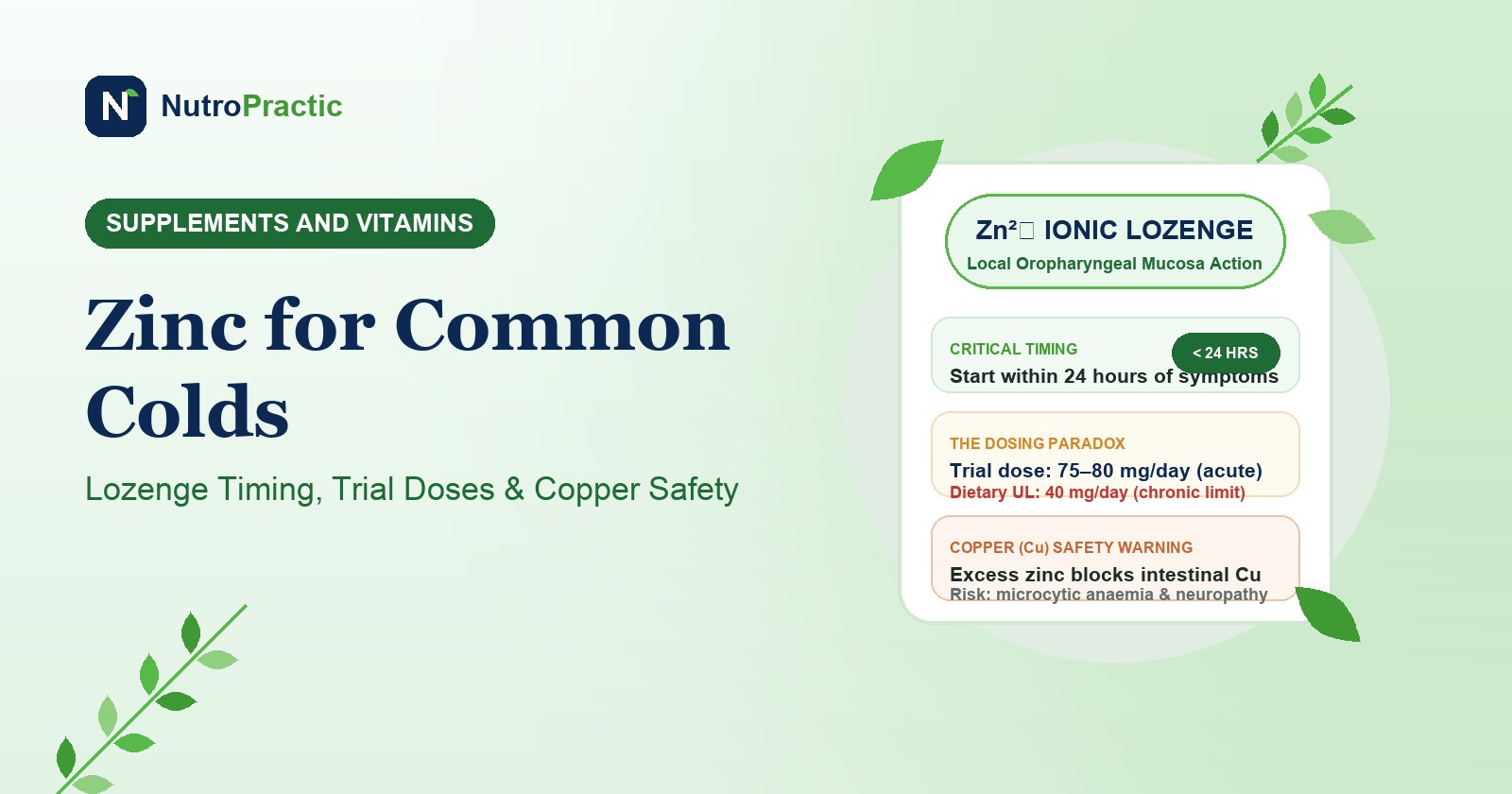
Yet behind that promising headline lies a profound disconnect between retail marketing and clinical pharmacology. Most people who pick up a bottle of zinc gummies or swallow a daily multivitamin experience zero shortening of their illness. To obtain genuine therapeutic efficacy against respiratory viruses, three exacting criteria must be satisfied simultaneously: the right delivery form (slow-dissolving oral lozenges), the right biological dose (75 to 80 mg or more of elemental zinc daily), and impeccable timing (within 24 hours of first symptom onset).
Furthermore, this clinical protocol presents a major pharmacological paradox. The elemental zinc dosage proven effective in clinical trials significantly exceeds the established dietary Tolerable Upper Intake Level (UL) of 40 mg per day. While a short 3-to-5-day burst during an acute infection is generally safe, chronic intake above 40 to 50 mg daily triggers severe copper deficiency, leading to microcytic anaemia, bone marrow suppression, and potentially irreversible neurological impairment.
The clinical trial evidence: Cochrane reviews and 33% shorter colds
The scientific rationale for zinc in viral rhinitis dates back to 1984, when Eby and colleagues published a landmark double-blind, placebo-controlled trial demonstrating that zinc gluconate lozenges dissolved every two hours dramatically accelerated recovery from common colds. Over the subsequent four decades, dozens of randomized trials evaluated various salt forms, doses, and schedules.
The gold-standard synthesis of this evidence comes from systematic reviews and meta-analyses led by Dr. Harri Hemilä (University of Helsinki) and the Cochrane Collaboration (Singh & Das, 2013):
• Duration reduction of ~33%: In a comprehensive 2017 individual-patient data meta-analysis published in JRSM Open, Hemilä analyzed seven double-blind trials and found that therapeutic zinc lozenges shortened the total duration of common colds by an average of 33% (95% CI: 21% to 45%). For an illness that typically runs for 7 to 10 days, this cuts nearly 2.5 to 3 full days of nasal discharge, sore throat, cough, and systemic malaise.
• Equal efficacy across symptom domains: Subgroup analyses revealed that zinc lozenges do not merely suppress nasal congestion; they shorten the duration of nasal discharge by 34%, nasal blockage by 37%, sneezing by 22%, scratchy throat by 33%, sore throat by 18%, hoarseness by 43%, and cough by 46%.
• No prophylactic advantage over healthy baseline diets: While therapeutic use during an active infection yields clear benefits, continuous daily zinc supplementation as a cold "preventative" shows inconsistent, marginal outcomes in well-nourished adults and carries significant risks of cumulative trace mineral imbalance.
The strict 24-hour symptom window: Timing dictates success
The single greatest determinant of whether zinc works is how quickly therapy begins. In virtually every trial reporting statistically significant cold duration reduction, participants commenced lozenge administration within 24 hours of the first prodromal symptom—the very first tickle in the nasopharynx, dry throat, or initial sneeze.
Why is the 24-hour mark an absolute dividing line? The answer lies in the cellular kinetics of viral replication:
1. Early attachment phase (0–24 hours): Human rhinoviruses (HRVs) and common cold enteroviruses land on the ciliated respiratory epithelial cells lining the posterior pharynx and adenoids. During these initial hours, viral docking and primary cellular entry are still localized, and viral titers in the pharyngeal mucosa are ascending rapidly.
2. Inflammatory cascade inflection (24–48+ hours): Beyond 24 to 48 hours, intracellular viral replication reaches peak density. Infected epithelial cells undergo cytolysis, releasing massive quantities of pro-inflammatory chemokines—chiefly Interleukin-8 (IL-8), IL-1β, and tumor necrosis factor-alpha (TNF-α). These cytokines recruit armies of neutrophils, driving mucosal edema, vascular permeability, profuse rhinorrhea, and systemic malaise.
Once this secondary host immune cascade is fully ignited, physical inhibition of viral docking by ionic zinc has negligible impact on your symptoms. Clinical trials that permitted participants to enroll 48 hours or longer after symptom onset showed no statistically significant difference between zinc and placebo. If you wait until you are deep into day three of a full-blown cold, zinc will not rescue you.
Delivery form matters: Local mucosal ionic zinc (Zn²⁺) vs swallowed pills
Many people attempt to treat colds by swallowing 50 mg zinc sulfate tablets, chewing multivitamin gummies, or drinking fizzy immune powders. Clinically, swallowed zinc does not treat an active common cold. Understanding why requires examining the exact biophysical mechanism through which zinc inactivates respiratory viruses.
Zinc does not shorten a cold through systemic immune stimulation. Rather, it exerts a direct, localized physical-chemical blockade in the oropharynx:
• ICAM-1 receptor competition: Human rhinoviruses utilize intercellular adhesion molecule-1 (ICAM-1) surface receptors on respiratory epithelial cells to bind and invade host tissue. Positively charged free zinc ions (Zn²⁺) competitively attach to specific clefts on the viral capsid proteins (VP1) and block the virus from docking onto human ICAM-1 receptors.
• Inhibition of viral capsid cleavage: Free ionic zinc directly inhibits viral 3C protease activity, arresting viral polyprotein cleavage and preventing newly assembled virions from replicating inside host mucosal cells.
For this antiviral mechanism to operate, free ionic zinc must physically bathe the posterior pharynx, palatine tonsils, and upper respiratory mucosa for minutes at a time. Swallowing a pill rushes the zinc directly down the esophagus into the stomach, completely bypassing the viral battleground in the throat.
Zinc acetate vs Zinc gluconate: The chemistry of ionic release
Even among lozenges, formulation chemistry dictates success. The key variable is how much free ionic zinc (Zn²⁺) dissociates into saliva at physiological mouth pH (~6.5 to 7.4):
• Zinc acetate: Universally regarded as the clinical gold standard. The acetate ligand binds zinc with very low chemical affinity, dissociating 100% of its zinc as free ionic Zn²⁺ immediately upon dissolution in saliva. Meta-analyses by Hemilä confirmed that zinc acetate lozenges produce the most uniform, consistent cold duration reductions.
• Zinc gluconate: Also clinically effective, releasing approximately 72% of its zinc as free ionic Zn²⁺ at salivary pH. However, zinc gluconate has an astringent, unpalatable metallic taste. To mask this, commercial manufacturers frequently add flavoring agents and binding excipients such as citric acid, tartaric acid, glycine, or sorbitol.
Beware of inactive lozenges: When commercial lozenges add citric acid or tartaric acid to improve taste, these organic acids strongly chelate zinc ions into tightly bound complexes. Salivary Zn2+ drops to near zero, rendering the lozenge biologically inert against rhinoviruses.
The dosing paradox: Trial doses (≥75 mg/day) vs the dietary upper limit (40 mg/day)
Herein lies the central challenge of zinc cold therapy: the dose required to beat a virus is substantially higher than standard nutritional recommendations.
In pooled meta-analyses, trials utilizing a total daily dose of ≥ 75 to 80 mg of elemental zinc demonstrated an average 33% reduction in cold duration. Conversely, trials that administered lower doses—such as 30 to 45 mg per day—demonstrated no statistically significant benefit over placebo. The mucosal concentration of ionic zinc achieved by lower doses is simply insufficient to saturate viral capsid binding sites.
To reach 75 to 80 mg of elemental zinc per day, clinical protocols require dissolving one 10 to 15 mg elemental zinc lozenge every 2 to 3 hours while awake, totaling 5 to 7 lozenges per day for the first 3 to 5 days of illness.
However, the official Tolerable Upper Intake Level (UL) established by the Institute of Medicine (National Academies of Sciences, Engineering, and Medicine) is 40 mg/day of elemental zinc for adults. This creates an apparent contradiction. How can medical literature recommend 80 mg/day when public health guidelines warn against exceeding 40 mg/day?
The resolution lies in the distinction between acute pharmacological pulse therapy and chronic daily intake:
• Acute pulse therapy (3 to 5 days): Administering 75 to 80 mg/day for 72 to 120 hours during the acute window of a cold carries transient risks of nausea and bad taste, but poses zero danger of systemic copper depletion or bone marrow suppression.
• Chronic intake (>40 mg/day for weeks/months): Continuing this elevated dose beyond 1 to 2 weeks triggers a profound biological trap inside the gastrointestinal tract.
Zinc formulations compared: Form, ionic yield, and clinical utility
Before choosing a supplement, compare how common delivery forms perform against clinical criteria:
| Delivery Form | Elemental Zn / Dose | Free Salivary Zn²⁺ | Cold Shortening Efficacy | Clinical Assessment |
|---|---|---|---|---|
| Zinc Acetate Lozenge | 10–15 mg | 100% | High (~33% shorter) | First-line choice. Complete ionic dissociation at salivary pH without chelation. |
| Zinc Gluconate Lozenge (unchelated) | 13.3–23 mg | ~72% | Moderate to High | Effective if free of citric/tartaric acid chelators; bitter or astringent aftertaste. |
| Flavored Retail Lozenges (with Citric Acid) | 5–10 mg | < 10% | None (Ineffective) | Citrate tightly binds Zn²⁺ ions into unabsorbable complexes; acts as candy. |
| Swallowed Tablets / Capsules (Picolinate/Sulfate) | 15–50 mg | 0% (mucosal) | None | Bypasses oropharynx directly to stomach; good for chronic deficiency, useless for acute cold. |
| Zinc Gummies / Chewables | 5–11 mg | Negligible | None | Chewed and swallowed in seconds; high sugar/gelatin matrix buffers active ions. |
| Intranasal Zinc Gel / Spray | Varies | Direct nasal | DANGEROUS | CONTRAINDICATED: Severe neurotoxic damage causing permanent anosmia. |
Copper deficiency risk: Why chronic doses >40 mg/day cause severe toxicity
While short-course high-dose zinc is benign, prolonged zinc intake exceeding 40 to 50 mg daily is one of the most reliable causes of acquired copper deficiency in clinical medicine. This interaction is not idiosyncratic; it is an unavoidable consequence of intestinal cell biochemistry.
The intestinal metallothionein trap
Inside the epithelial cells (enterocytes) lining the human duodenum and jejunum, metal absorption is regulated by a low-molecular-weight, cysteine-rich binding protein called metallothionein:
1. When intestinal enterocytes are exposed to high concentrations of luminal zinc (doses exceeding 40–50 mg/day), intracellular transcription factors activate the MT1 and MT2 genes, causing an exponential surge in enterocyte metallothionein production.
2. Metallothionein is not zinc-specific. In fact, metallothionein has an affinity for copper (Cu²⁺) that is roughly 1,000 times greater than its affinity for zinc. As a result, the abundant metallothionein molecules enthusiastically bind any dietary copper entering the cell, trapping it securely inside the enterocyte cytoplasm.
3. The enterocyte lifespan is brief—typically 3 to 5 days. At the end of their cycle, these cells slough off into the intestinal lumen and are excreted in the feces. The trapped copper is eliminated along with the shed enterocytes, completely blocked from crossing into systemic circulation.
The clinical sequelae of zinc-induced copper deficiency
As total-body copper reserves become depleted over several months of excessive zinc intake, multiple copper-dependent metalloenzymes fail, producing a classic triad of clinical pathology:
• Refractory microcytic or normocytic anaemia: Copper is an obligatory cofactor for ceruloplasmin (ferroxidase I) and hephaestin, enzymes responsible for converting ferrous iron (Fe²⁺) into ferric iron (Fe³⁺) so it can bind transferrin and travel to the bone marrow. Without copper, iron remains locked inside storage tissues and intestinal cells, paralyzing erythropoiesis. This anaemia is routinely misdiagnosed as iron deficiency, but iron supplements fail to correct it.
• Severe neutropenia: Copper deficiency impairs granulocyte maturation, causing absolute neutrophil counts to plummet. Patients often present with recurrent unexplained bacterial infections or fever of unknown origin.
• Sensory ataxia and myeloneuropathy: Perhaps the most devastating complication is subacute combined degeneration of the spinal cord, an axonal neuropathy that closely mimics vitamin B12 deficiency. Copper is required for cytochrome c oxidase and superoxide dismutase in neural myelin sheaths. Patients experience symmetric lower-extremity numbness, paresthesias, sensory ataxia, loss of vibration sense, and progressive difficulty walking. Tragically, while the hematological abnormalities reverse rapidly once zinc is stopped and copper is restored, neurological deficits are often permanent or only partially reversible.
Critical safety warning: Intranasal zinc sprays and permanent anosmia
No discussion of zinc and cold therapy is complete without addressing intranasal zinc products. In the early 2000s, over-the-counter nasal sprays, swabs, and gels containing zinc gluconate (most notably marketed under the brand name Zicam) became widely popular as rapid-acting cold preventatives.
In June 2009, the U.S. Food and Drug Administration (FDA) issued an urgent Public Health Advisory warning consumers to immediately stop using and discard intranasal zinc products after receiving over 130 reports of anosmia (permanent loss of smell), frequently accompanied by dysgeusia (loss of taste), occurring after as few as one or two doses.
The biological mechanism is straightforward and terrifying: the olfactory epithelium at the cribriform plate is directly connected to the olfactory bulb. Concentrated ionic zinc delivered directly onto this delicate neuroepithelium is violently cytotoxic, causing irreversible chemical necrosis of olfactory sensory neurons and sustentacular cells. Many victims lost their ability to smell and taste for life.
Crucial distinction: Oral lozenges dissolve in the mouth and throat, remaining entirely downstream in the alimentary canal and oropharynx where they pose zero risk of anosmia. Intranasal zinc sprays and swabs, however, must never be used under any circumstances.
Practical protocol: How to safely take zinc lozenges for an acute cold
If you wish to utilize zinc lozenges effectively and safely when a cold strikes, adhere strictly to this evidence-based clinical protocol:
1. Have them in your cabinet in advance: Because the 24-hour window is non-negotiable, buying lozenges after you feel sick often wastes precious hours. Keep a verified package of zinc acetate or unchelated zinc gluconate lozenges in your home.
2. Start at the very first sign: Begin lozenge therapy the moment you feel the first pharyngeal scratchiness, dry sneeze, or mild rhinorrhea.
3. Dissolve slowly over 15 to 20 minutes: Do not chew, crunch, or swallow the lozenge whole. Allow it to sit in your mouth, moving it gently across the tongue so that saliva carries ionic Zn²⁺ slowly over the posterior pharynx.
4. Target 75 to 80 mg total elemental zinc daily: Take one 10 to 15 mg elemental zinc lozenge every 2 to 3 hours while awake (approximately 5 to 6 lozenges per day).
5. Avoid food, coffee, and acidic drinks 15 minutes before and after: Citrus juices, coffee, tea, and meals containing phytates (whole grains, legumes) can bind ionic zinc and blunt mucosal absorption.
6. Cap duration at 3 to 5 days maximum: As soon as cold symptoms resolve—or on day 5, whichever comes first—discontinue the lozenges immediately. Never transition acute cold lozenges into a daily wellness habit.
7. Mitigate nausea: High salivary zinc commonly causes mild nausea, gastric discomfort, or temporary taste distortion. Never take lozenges on a completely empty, acidic stomach; taking them shortly after a light snack significantly improves gastrointestinal tolerance.
Navigating supplement dosages, trace mineral balances, and immune nutrition requires personalized clinical care. Dr. Triveni provides evidence-based virtual medical consultations to evaluate your supplement routine, lab markers, and overall health.
Book a clinical consultationDisclaimer: This article is for informational and educational purposes only and does not constitute personalized medical advice, diagnosis, or treatment. Always consult a qualified physician or healthcare provider before initiating high-dose nutritional supplements, especially if you take prescription medications, have kidney disease, or have underlying medical conditions.
Scientific references
Hemilä H., Zinc lozenges and the common cold: a meta-analysis comparing zinc acetate and zinc gluconate, JRSM Open 8(5):2054270417694291 (2017).
Singh M., Das R.R., Zinc for the common cold, Cochrane Database of Systematic Reviews 2013(6):CD001364 (2013).
Hemilä H., Zinc lozenges may shorten the duration of colds: a systematic review, Open Respir Med J 5:51-58 (2011).
Eby G.A., Davis D.R., Halcomb W.W., Reduction in duration of common colds by zinc gluconate lozenges in a double-blind study, Antimicrob Agents Chemother 25(1):20-24 (1984).
Willis M.S., Monaghan S.A., Rosenthal M.L., et al., Zinc-induced copper deficiency: a report of three cases initially recognized by bone marrow examination and review of the literature, Clin Chim Acta 361(1-2):52-62 (2005).
Duncan A., Yacoubian C., Watson N., Morrison I., The risk of copper deficiency in patients prescribed zinc supplements, J Clin Pathol 68(11):923-925 (2015).
U.S. Food and Drug Administration (FDA), Public Health Advisory: Loss of sense of smell with intranasal zinc products, FDA Drug Safety Communication (June 2009).