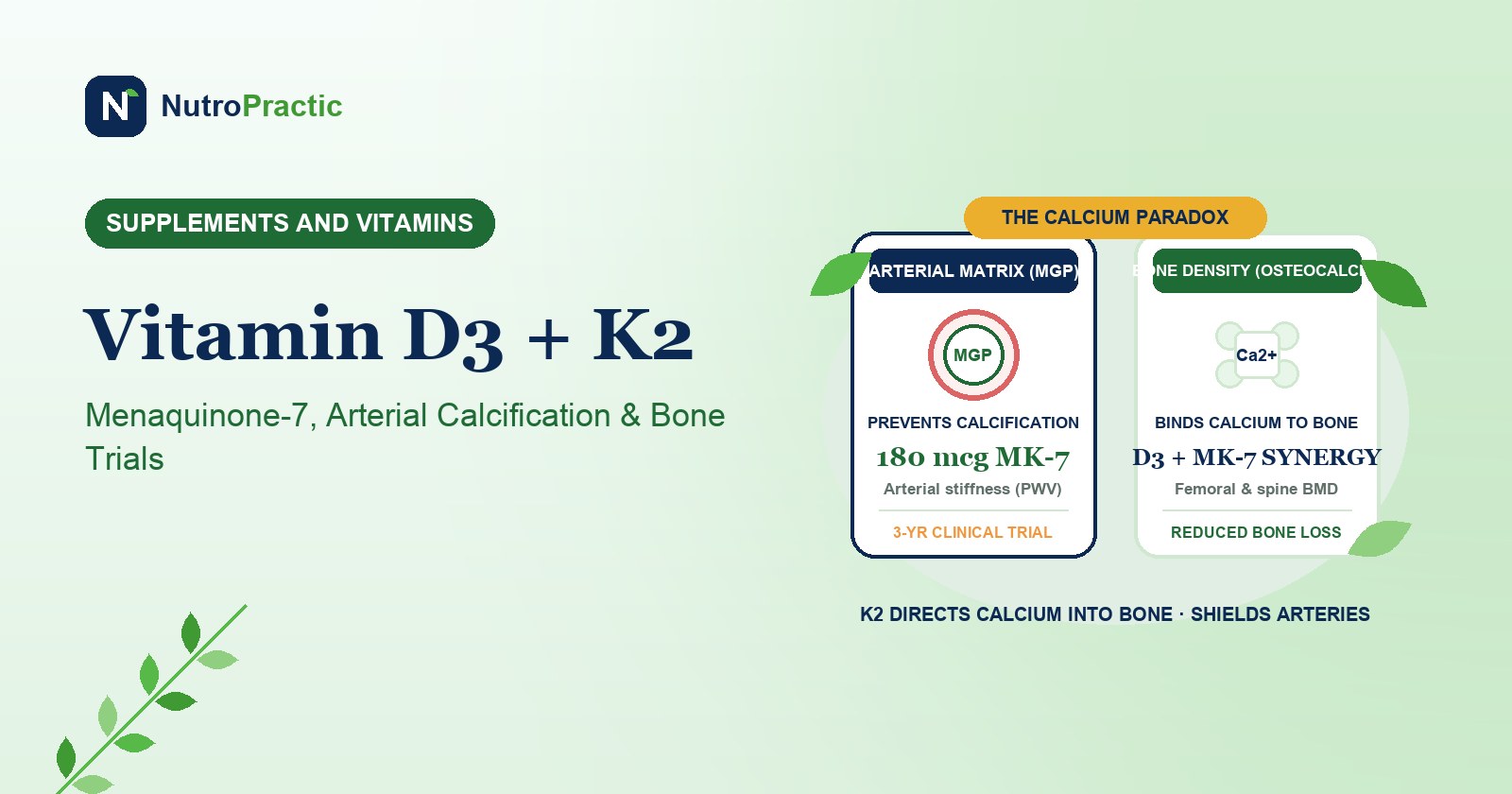
For decades, medical guidance on bone health focused almost exclusively on a simple two-part prescription: consume adequate calcium and supplement with vitamin D3 to enhance its absorption. In recent years, however, cardiovascular and bone researchers have identified a biological complication known as the "Calcium Paradox." While high calcium intake and elevated circulating vitamin D ensure robust intestinal calcium uptake, they do not dictate where that absorbed mineral ultimately settles.
Without active biochemical guidance, calcium does not migrate solely into skeletal bone; it readily precipitates into soft tissues, including coronary arteries, the aortic valve, and peripheral vessel walls. This vascular calcification drives arterial stiffening, elevates systolic blood pressure, and significantly compounds cardiovascular event risks. To understand how systemic nutrients influence arterial wall mechanics, see our analysis of anti-inflammatory dietary patterns.
This is where vitamin K2 (specifically menaquinone-7 or MK-7) enters the spotlight. By serving as an obligatory cofactor for the post-translational carboxylation of specific protective proteins, vitamin K2 acts as an enzymatic traffic controller—directing calcium into hydroxyapatite bone crystal while actively inhibiting its crystallization inside vascular walls. But does this theoretical synergy translate into hard clinical outcomes in human trials? Let us examine the clinical trial evidence, biochemical mechanisms, dosing realities, and essential safety warnings.
The Calcium Paradox: How vitamin D3 and K2 collaborate
To appreciate why vitamin D3 and vitamin K2 form an indispensable biological duo, one must examine the division of labor between intestinal absorption and tissue distribution:
1. Vitamin D3 drives calcium absorption: In the duodenum and jejunum, 1,25-dihydroxyvitamin D (the active hormonal form of vitamin D3) binds to nuclear vitamin D receptors (VDR). This upregulates the transcription of epithelial calcium channels (TRPV6) and calcium-binding proteins (calbindin-D9k), driving calcium across the intestinal brush border into systemic circulation. Simultaneously, vitamin D signals osteoblasts and vascular cells to manufacture two crucial vitamin K-dependent proteins: Osteocalcin and Matrix Gla Protein (MGP).
2. Vitamin K2 activates calcium transport proteins: Although vitamin D3 stimulates the synthesis of Osteocalcin and MGP, these proteins are produced in an inactive, uncarboxylated state. They cannot bind calcium until they undergo post-translational gamma-carboxylation by the enzyme gamma-glutamyl carboxylase (GGCX). This enzyme requires the reduced hydroquinone form of vitamin K as an essential cofactor:
• Matrix Gla Protein (MGP): Synthesized primarily by vascular smooth muscle cells (VSMCs) and chondrocytes in arterial media. When fully carboxylated by vitamin K2, MGP contains five gamma-carboxyglutamic acid (Gla) residues that bind free calcium ions and microcrystalline hydroxyapatite nuclei with high affinity. Fully carboxylated MGP is the body's primary endogenous inhibitor of vascular and valvular calcification. When vitamin K is deficient, inactive dephosphorylated-uncarboxylated MGP (dp-ucMGP) accumulates, leaving vascular walls unprotected against ectopic mineralization.
• Osteocalcin (Bone Gla Protein): Synthesized by osteoblasts in skeletal tissue. When carboxylated by vitamin K2, its three Gla residues undergo a conformational change that permits tight binding to calcium ions within the hydroxyapatite matrix of bone, anchoring mineral density and structural tensile strength. Without adequate K2, circulating uncarboxylated osteocalcin (ucOC) remains high, reflecting incomplete bone mineralization.
Vitamin D3 provides the materials by absorbing calcium and creating Gla proteins, but vitamin K2 provides the enzymatic keys to activate them. Supplying vitamin D without vitamin K2 is like assembling a construction crew without assigning them a foreman.
Arterial calcification: What clinical trials demonstrate
Vascular calcification is not simply passive calcium encrustation; it is an active cell-mediated process where vascular smooth muscle cells undergo transdifferentiation into osteoblast-like cells, producing bone-like crystalline matrix inside arterial walls. Clinical research evaluating menaquinone-7 has addressed whether supplemental K2 can counteract this process in living humans.
The landmark 3-year Knapen trial (Thrombosis and Haemostasis, 2015):
In one of the most rigorously conducted long-term trials on vascular health, Dr. Marjo Knapen and colleagues at Maastricht University randomized 244 healthy postmenopausal women (aged 55 to 65) to receive either 180 mcg/day of nutritional menaquinone-7 (MK-7) or an identical placebo for three full years. Key findings included:
• Reduction in inactive MGP: Circulating levels of inactive dp-ucMGP dropped by approximately 50% in the MK-7 group compared to baseline, confirming potent systemic enzymatic activation of vascular Matrix Gla Protein.
• Preserved arterial elasticity: In the placebo group, carotid-femoral pulse wave velocity (cfPWV)—the gold standard non-invasive measurement of aortic stiffness—progressively worsened over the 36-month period, reflecting typical age-related vascular stiffening. In the MK-7 group, arterial elasticity was preserved, and cfPWV significantly improved.
• Pronounced response in stiff arteries: Women who entered the study with higher baseline arterial stiffness experienced the greatest functional recovery: the stiffness index (beta) and carotid compliance improved significantly, demonstrating that MK-7 can halt and partially reverse pathological vascular stiffening over a multi-year horizon.
Coronary artery calcification (CAC) score trials: Nuance and realistic expectations:
The public often asks whether taking high-dose vitamin K2 can "erase" established calcified plaques detected on a Coronary Artery Calcium (CAC) CT scan. Recent trials—including the AVADEC (Aortic Valve and Coronary Artery Calcification) trial and DanK2 trials—provide critical clinical clarity:
1. Existing dense calcium does not vanish: In patients with advanced, long-standing calcified plaques, a 12-to-24-month course of MK-7 does not dramatically reduce the total Agatston score. Dense macrocalcifications are structurally stable scar lesions that the body does not readily resorb without aggressive multi-pathway intervention.
2. Inhibition of active microcalcification: What MK-7 accomplishes is the inhibition of active, progressive microcalcification and media wall elastocalcinosis. Fluoride PET/CT imaging confirms that vitamin K2 dampens active mineral deposition in non-calcified or developing plaques, stabilizing vascular architecture and preserving compliant vessel dynamics.
3. Functional compliance matters most: Vascular mortality is closely correlated with pulse wave velocity and arterial stiffness. Even when structural Agatston scores change slowly, the functional preservation of arterial distensibility demonstrated in the Knapen trial delivers meaningful cardiovascular protection.
MK-4 vs MK-7: Half-life, origins, and clinical trial dosing
Vitamin K2 is not a single chemical entity. It comprises a family of isoprenoid compounds designated menaquinones (MK-n), where 'n' denotes the number of 5-carbon isoprenyl units in the aliphatic side chain. The two predominant commercial and clinical forms are Menaquinone-4 (MK-4) and Menaquinone-7 (MK-7):
| Characteristic | Menaquinone-4 (MK-4) | Menaquinone-7 (MK-7) |
|---|---|---|
| Molecular structure | Short isoprenoid side chain (4 units; menatetrenone) | Long, lipophilic isoprenoid side chain (7 units) |
| Primary natural source | Animal tissues (liver, egg yolks, grass-fed butter) or chemical synthesis | Bacterial fermentation (Japanese natto via Bacillus subtilis var. natto, aged Gouda/Brie) |
| Elimination half-life | ~1.5 to 3 hours (rapid hepatic clearance) | ~72 hours (3 full days) (sustained systemic circulation) |
| Pharmacokinetics & distribution | Captured rapidly by the liver; negligible extrahepatic tissue distribution at microgram doses | Incorporated into VLDL and LDL particles; continuously redistributed to arterial wall VSMCs and bone osteoblasts |
| Standard clinical trial dose | 45 mg/day (45,000 mcg/day), divided into 15 mg three times daily with meals | 90 to 180 mcg/day, taken as a single daily dose |
| Pill burden & compliance | High pill burden (three pharmaceutical doses daily; approved prescription drug Glakay in Japan) | Low pill burden (single microgram-level daily softgel or capsule with high long-term adherence) |
| Circulating dp-ucMGP suppression | Requires pharmacological milligram doses to sustain peripheral carboxylation | Consistently suppresses inactive dp-ucMGP by ~50% at standard 180 mcg daily doses |
In a pivotal pharmacokinetic investigation published in Blood (2007), Dr. Leon Schurgers and colleagues compared equal molar doses of vitamin K1, MK-4, and MK-7 in healthy volunteers. While MK-4 was rapidly cleared by the liver within hours, MK-7 remained elevated in circulating serum for more than 72 hours. Because of this extended biological half-life, MK-7 accumulates to stable steady-state concentrations within several weeks, providing continuous 24-hour enzymatic coverage for arterial and bone Gla proteins.
Bone mineral density and fracture prevention trials
While the cardiovascular data centers on vascular elasticity and MGP carboxylation, the earliest clinical trials on vitamin K2 focused on postmenopausal osteoporosis and fracture reduction. Bone strength is governed by two distinct qualities: bone mineral density (BMD) (how much mineral is packed into bone matrix) and bone quality / microarchitecture (the organic collagen cross-linking framework that provides tensile flexibility).
The Japanese high-dose MK-4 fracture trials:
In Japan, high-dose MK-4 (45 mg/day menatetrenone) has been an approved prescription therapy for postmenopausal osteoporosis since 1995. Landmark trials by Orimo, Shiraki, and colleagues demonstrated that while MK-4 produced only modest increases in lumbar spine BMD (typically 1% to 2%), it yielded dramatic reductions in clinical fracture incidence:
• In a systematic review and meta-analysis published in the Archives of Internal Medicine (Cockayne et al., 2006), pooling 13 randomized controlled trials of vitamin K supplementation, high-dose MK-4 reduced vertebral fractures by 60% (odds ratio 0.40), hip fractures by 77% (odds ratio 0.23), and all non-vertebral fractures by 81% (odds ratio 0.19).
• Researchers discovered that K2 enhances bone strength not solely by increasing mineral density, but by optimizing collagen cross-linking via osteoblast activation and suppressing osteoclast-mediated bone resorption.
The 3-year MK-7 low-dose bone trial (Osteoporosis International, 2013):
Can microgram doses of nutritional MK-7 achieve similar skeletal preservation? In a companion 3-year trial of the Maastricht cohort, Knapen et al. evaluated 244 healthy postmenopausal women taking 180 mcg/day of MK-7:
• Significantly reduced bone loss: In the placebo cohort, bone mineral content (BMC) and BMD at the lumbar spine and femoral neck declined progressively over 3 years. In the MK-7 group, bone loss was significantly attenuated at both critical skeletal sites.
• Preserved bone strength indices: Compression strength index (CSI) and impact strength index of the femoral neck were significantly maintained in the MK-7 arm, indicating superior structural resistance to compressive loads and fall impacts.
• D3 + K2 synergy in combined trials: Multi-center randomized trials combining vitamin D3 (800–2,000 IU) with vitamin K2 demonstrate consistently greater improvements in bone mineral density and reductions in uncarboxylated osteocalcin than regimens supplying vitamin D3 or calcium alone. Vitamin D upregulates osteocalcin production, while K2 ensures it binds calcium efficiently to the skeleton.
Safety, drug interactions, and clinical cautions
Despite its impressive clinical profile, vitamin K2 is a pharmacologically active substance with significant contraindications and safety considerations that must never be overlooked:
1. CRITICAL CONTRAINDICATION: Vitamin K Antagonist (VKA) blood thinners:
If you take warfarin (Coumadin, Jantoven), acenocoumarol, or phenprocoumon, you must NOT take supplemental vitamin K2 without direct medical coordination. Warfarin achieves its therapeutic anticoagulation by competitively inhibiting the enzyme VKORC1 (vitamin K epoxide reductase), deliberately restricting active vitamin K to slow the production of clotting factors II, VII, IX, and X.
Because menaquinone-7 has a 72-hour half-life and potent biological activity, even modest supplemental doses (as low as 10 to 45 mcg/day) can bypass the VKORC1 blockade, flood hepatic enzymes, dramatically plunge your International Normalized Ratio (INR), and trigger catastrophic blood clots or ischemic strokes. For a detailed guide on managing prescription anticoagulation safely, read our protocol on warfarin and dietary vitamin K consistency.
2. Direct Oral Anticoagulants (DOACs):
Direct Oral Anticoagulants—such as apixaban (Eliquis), rivaroxaban (Xarelto), and dabigatran (Pradaxa)—operate via direct enzymatic inhibition of Factor Xa or thrombin, completely independent of the vitamin K epoxide reductase cycle. Consequently, vitamin K2 does not biochemically counteract DOAC efficacy. Nevertheless, patients on DOACs should always disclose all dietary supplements to their managing physician or cardiologist prior to initiation.
3. High-dose vitamin D3 and hypercalcemia risk:
Many supplement protocols aggressively promote mega-doses of vitamin D3 (10,000 to 50,000 IU daily) combined with K2, claiming K2 confers complete immunity against vitamin D toxicity. While K2 activates protective MGP, it does not prevent hypercalcemia if vitamin D intake drives serum 25(OH)D levels above 100–150 ng/mL. Hypercalcemia can precipitate nephrocalcinosis, kidney stones, cardiac arrhythmias, and renal dysfunction. High-dose D3 therapy requires periodic lab testing of serum calcium, 25-hydroxyvitamin D, albumin, and parathyroid hormone (PTH).
4. Fat-soluble absorption requirements:
Both vitamin D3 and menaquinone-7 are lipophilic fat-soluble vitamins. Taking them on an empty stomach with a glass of water results in poor micellar incorporation and low bioavailability. They should always be ingested with a meal containing dietary lipids (such as avocado, extra virgin olive oil, nuts, or whole-milk yogurt) to trigger biliary secretion and optimize intestinal absorption.
What to ask your doctor before starting D3 and K2
Before starting a combined vitamin D3 and K2 regimen, have a structured conversation with your healthcare provider. Here are the five key questions to discuss:
• "What is my baseline 25(OH)D blood level?" Establish your baseline before guessing a daily D3 dose. Most clinical societies recommend targeting a serum 25(OH)D concentration between 30 and 50 ng/mL (75 to 125 nmol/L) for optimal musculoskeletal health.
• "Am I taking any medications that interact with vitamin K?" Confirm whether any anticoagulant, antiplatelet, or bile-acid sequestrant regimen interacts with menaquinones.
• "Would a baseline coronary artery calcium (CAC) scan or DEXA scan be clinically appropriate for my risk profile?" If you are considering D3 and K2 for cardiovascular prevention or bone preservation, objective baseline imaging helps assess your personal risk trajectory.
• "Do I have a history of calcium oxalate kidney stones or hypercalciuria?" Individuals with nephrolithiasis require tailored urinary calcium excretion assessments before supplementing with calcium or high-dose vitamin D.
• "Which specific form and dose of vitamin K2 fits my medical goals?" In clinical trials, 180 mcg/day of menaquinone-7 (MK-7) demonstrated proven efficacy for arterial elasticity and bone mineral preservation in adults without anticoagulation conflicts.
Navigating fat-soluble vitamin synergy, cardiovascular imaging, and bone density markers requires a personalized clinical strategy. Dr. Triveni evaluates your laboratory results, dietary habits, and medication profile in a comprehensive virtual consultation.
Book a consultationThis article is for informational and educational purposes only and does not constitute individual medical advice, diagnosis, or treatment. Never alter your prescription medications, anticoagulant therapy, or start high-dose dietary supplements without consulting your personal physician. If you experience chest pain, sudden shortness of breath, or unexplained bruising, seek immediate medical care.
Scientific references
Knapen M.H.J. et al., Menaquinone-7 supplementation improves arterial stiffness in healthy postmenopausal women: a double-blind randomised clinical trial, Thromb Haemost 113(5):1135-1144 (2015).
Knapen M.H.J. et al., Three-year low-dose menaquinone-7 supplementation helps decrease bone loss in healthy postmenopausal women, Osteoporos Int 24(9):2499-2507 (2013).
Schurgers L.J. et al., Vitamin K-containing dietary supplements: comparison of synthetic vitamin K1 and natto-derived menaquinone-7, Blood 109(8):3279-3283 (2007).
Theuwissen E. et al., Low-dose menaquinone-7 supplementation improved extra-hepatic vitamin K status, but had no effect on thrombin generation in healthy subjects, Br J Nutr 108(9):1652-1657 (2012).
Cockayne S. et al., Vitamin K and the prevention of fractures: systematic review and meta-analysis of randomized controlled trials, Arch Intern Med 166(12):1256-1261 (2006).
Zwakenberg S.R. et al., The effect of menaquinone-7 supplementation on vascular calcification in patients with diabetes: a randomized, double-blind, placebo-controlled trial, Atherosclerosis 286:135-141 (2019).
Shea M.K. et al., Vitamin K supplementation and progression of coronary artery calcium in older men and women, Am J Clin Nutr 89(6):1799-1807 (2009).
D'Amelio P. et al., Vitamin D and vitamin K: team players in bone health, Calcif Tissue Int 106(6):593-605 (2020).