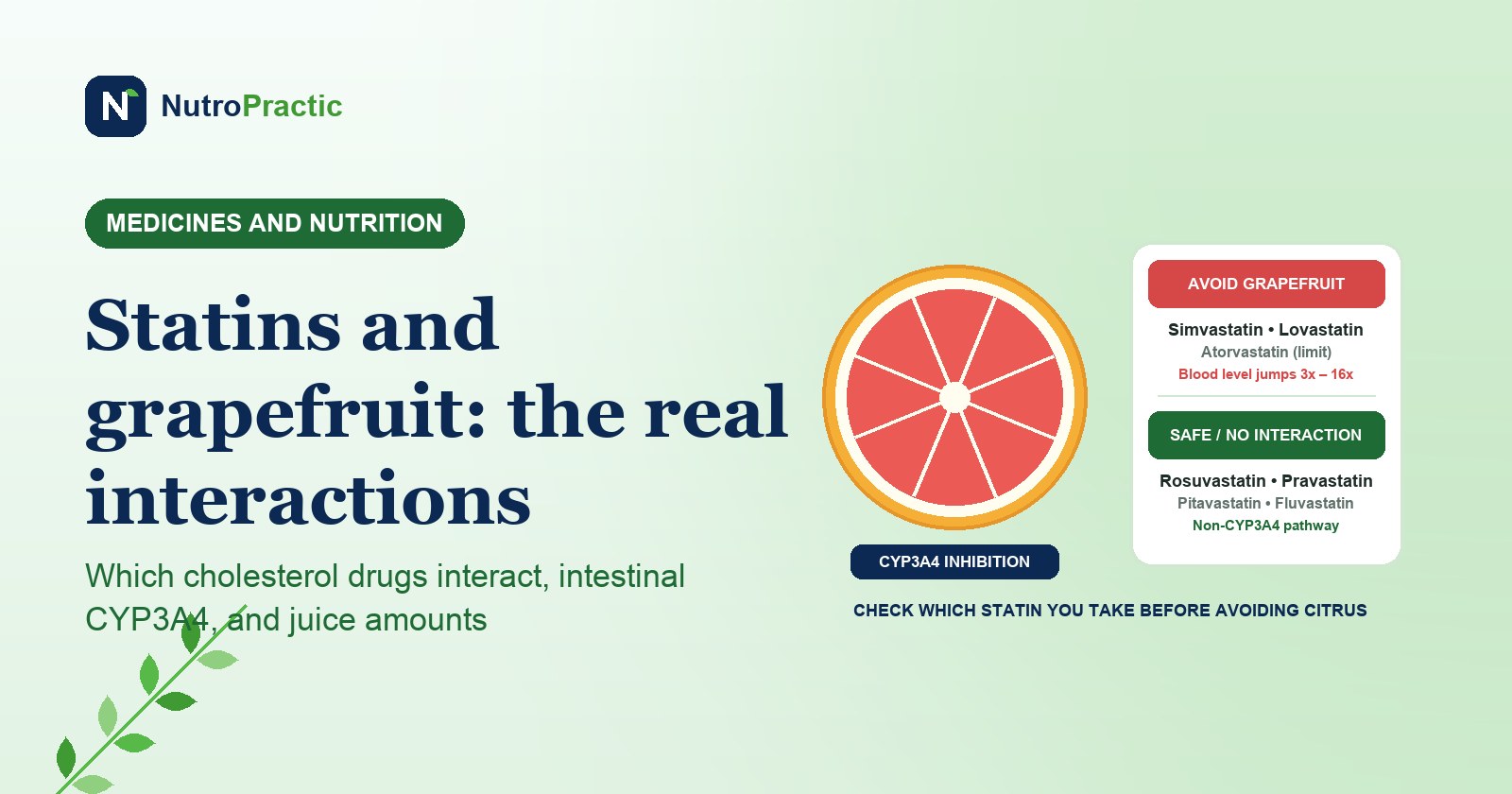
For decades, patients starting a cholesterol-lowering statin have received a stark warning at the pharmacy counter: "Never eat grapefruit or drink grapefruit juice while on this medication." Breakfast menus are reorganized, fresh fruit bowls are purged, and citrus lovers resign themselves to complete abstinence.
Yet clinical pharmacology reveals a far more nuanced reality. While the interaction between grapefruit and certain statins is potent and clinically dangerous, several of the most commonly prescribed statins have zero or negligible interaction with grapefruit. Furthermore, for statins with moderate interactions, the risk depends heavily on the volume of fruit consumed. If you are also managing other cardiovascular medications alongside your lipid therapy, see our guide on warfarin and vitamin K consistency and what food can do for LDL cholesterol.
Understanding how grapefruit affects your body requires looking at a specific enzyme system in your gut wall, the precise statin molecule you take, and why separating your morning juice from your evening pill does not protect you.
The mechanism: Intestinal CYP3A4 and furanocoumarins
When you swallow a statin tablet, it travels to your small intestine before entering the bloodstream and reaching the liver, where cholesterol synthesis occurs. Lining the mucosal wall of the small intestine are specialized epithelial cells called enterocytes, densely packed with a metabolic enzyme known as cytochrome P450 3A4 (CYP3A4).
Under standard conditions, intestinal CYP3A4 performs extensive first-pass metabolism: it breaks down a substantial fraction of the statin before it can enter portal circulation. For example, in the case of simvastatin, intestinal CYP3A4 and liver metabolism normally eliminate roughly 95% of the swallowed dose, leaving an oral bioavailability of only about 5%.
Grapefruit alters this physiology through naturally occurring chemical compounds called furanocoumarins, most notably bergamottin and 6',7'-dihydroxybergamottin (DHB). These molecules act as mechanism-based "suicide inhibitors" of CYP3A4:
1. Furanocoumarins bind to the catalytic site of CYP3A4 enzymes in the intestinal lining.
2. During the metabolic reaction, the furanocoumarin molecule forms a covalent bond that irreversibly destroys the enzyme protein.
3. With the intestinal CYP3A4 gatekeeper knocked out, oral statin molecules pass unhindered across the intestinal wall into the bloodstream.
4. Blood plasma concentrations of the active statin surge dramatically, mimicking the effect of a massive pharmaceutical overdose and escalating the risk of toxic adverse effects.
Crucially, regular consumption of grapefruit juice primarily inhibits intestinal CYP3A4, leaving liver (hepatic) CYP3A4 largely intact unless consumed in extreme, continuous quantities. Because the drug-metabolizing machinery in your gut is structurally incapacitated, your body cannot safely process CYP3A4-dependent statins.
Statin comparison: High risk, moderate risk, and completely safe
Not all statins utilize the CYP3A4 metabolic pathway. Statins are distinct chemical entities divided into three clinical risk tiers regarding grapefruit interaction:
| Statin medication | Metabolic pathway | Plasma exposure (AUC) spike with grapefruit | Clinical advice |
|---|---|---|---|
| Simvastatin (Zocor) | Major CYP3A4 substrate (~5% baseline bioavailability) | 3.6x to 16x increase | STRICTLY AVOID grapefruit and Seville oranges |
| Lovastatin (Mevacor, Altoprev) | Major CYP3A4 substrate (~5% baseline bioavailability) | 5x to 15x increase | STRICTLY AVOID grapefruit and Seville oranges |
| Atorvastatin (Lipitor) | Moderate CYP3A4 substrate (~14% baseline bioavailability) | 1.25x to 2.5x increase (80%–150% rise) | Limit portions: avoid daily juice or >1 fruit/day |
| Rosuvastatin (Crestor) | Minimal CYP2C9 (10%); 90% eliminated unchanged | Zero / No change | SAFE: Grapefruit freely permitted |
| Pravastatin (Pravachol) | Hydrophilic; non-CYP sulfation and renal clearance | Zero / No change | SAFE: Grapefruit freely permitted |
| Pitavastatin (Livalo) | Glucuronidation (UGT1A3/2B7), minor CYP2C9 | Zero / No change | SAFE: Grapefruit freely permitted |
| Fluvastatin (Lescol) | Metabolized primarily by CYP2C9 (~75%) and CYP2C8 | Zero / No change | SAFE: Grapefruit freely permitted |
As demonstrated in clinical pharmacokinetic studies, taking simvastatin with a single normal glass of grapefruit juice (200 mL) increases drug plasma exposure (Area Under the Curve, or AUC) by approximately 3.6-fold, with peak blood levels (Cmax) spiking up to 9-fold. If a patient drinks double-strength juice or multiple glasses daily, simvastatin concentrations can soar by 16-fold—effectively transforming a standard 20 mg tablet into the pharmacological equivalent of over 300 mg.
In stark contrast, patients taking rosuvastatin or pravastatin can enjoy fresh grapefruit, pomelo, or grapefruit juice without any alteration in drug levels.
The clinical risks: Muscle damage and rhabdomyolysis
Why is an accidental spike in statin blood levels so dangerous? Statins inhibit HMG-CoA reductase to block cholesterol production in the liver. However, excessive circulating concentrations in peripheral tissues trigger dose-dependent toxicities:
• Statin-Associated Muscle Symptoms (SAMS): Manifests as bilateral aching, stiffness, tenderness, or cramping in large proximal muscle groups (thighs, buttocks, calves, upper arms). Mild myalgia occurs in 5% to 10% of users, but excessive plasma levels escalate symptom severity.
• Myositis and marked Creatine Kinase (CK) elevation: High intracellular statin concentrations impair mitochondrial respiration and disrupt coenzyme Q10 synthesis in myocytes, causing muscle inflammation and membrane leakage. Blood tests show serum creatine kinase rising greater than 10 times the upper limit of normal.
• Rhabdomyolysis: The most severe, life-threatening complication. Skeletal muscle fibers disintegrate rapidly, releasing massive quantities of myoglobin, potassium, and intracellular enzymes into systemic circulation. Myoglobin precipitates in renal tubules, leading to acute kidney failure, severe electrolyte derangements, cardiac arrhythmias, and potential fatality.
• Hepatotoxicity: Significant, sustained statin overdoses can trigger elevated hepatic transaminases (ALT and AST), leading to liver enzyme inflammation.
How much fruit matters: Juice vs whole fruit, and other citrus
Not all citrus fruits contain furanocoumarins. Furthermore, the physical form of the fruit influences interaction potency:
| Citrus fruit / product | Furanocoumarin status | Safety with Simvastatin / Lovastatin |
|---|---|---|
| Grapefruit juice (commercial/fresh) | High concentration (extracted from whole pressed fruit) | Dangerous: Avoid completely |
| Whole fresh grapefruit | High in segment pulp and inner rind membranes | Dangerous: Avoid completely |
| Seville oranges (sour / bitter oranges) | High in bergamottin; common in traditional bitter marmalade | Dangerous: Avoid Seville orange marmalade |
| Pomelo | High furanocoumarin content (ancestor species of grapefruit) | Dangerous: Avoid completely |
| Tangelos (Minneola) | Moderate (hybrid of tangerine and grapefruit) | Caution: Avoid or limit strictly |
| Sweet oranges (Navel, Valencia) | Zero furanocoumarins | Completely safe |
| Mandarins, Clementines, Tangerines | Zero furanocoumarins | Completely safe |
| Lemons and Limes | Trace / negligible furanocoumarins in culinary amounts | Completely safe |
A standard 200 mL glass of commercial grapefruit juice delivers a higher dose of furanocoumarins than eating half a fresh grapefruit, because industrial juicing presses the rind and peel tissues where bergamottin is concentrated. However, eating even half a whole fruit contains more than enough furanocoumarin to trigger near-total intestinal CYP3A4 inactivation.
The timing myth: Why separating by 12 hours does not work
One of the most dangerous misconceptions shared among patients is: "I take my statin at bedtime, so drinking grapefruit juice at 8:00 AM is completely fine."
This reasoning applies to physical binding interactions (such as antacids binding iron or thyroid hormone), but it fails completely with grapefruit. Because furanocoumarins are mechanism-based suicide inhibitors, they do not merely sit on the enzyme while passing through. They destroy the existing CYP3A4 molecules.
Once intestinal CYP3A4 enzymes are destroyed, your body cannot simply reactivate them. Recovery requires the enterocytes to synthesize brand-new enzyme proteins from scratch:
• 24 hours after a single glass of juice: Approximately 50% of intestinal CYP3A4 activity remains suppressed.
• 48 to 72 hours after consumption: CYP3A4 enzyme concentrations only gradually normalize back to baseline as enterocytes turn over.
Taking your simvastatin or lovastatin 12 or 14 hours after your morning grapefruit still exposes the drug to a gutted intestinal enzyme barrier. Separating drug and fruit timing provides zero protection.
Furanocoumarins destroy intestinal CYP3A4 enzymes irreversibly. Because enzyme regeneration takes up to 72 hours, spacing your morning grapefruit juice apart from your evening statin pill offers no protection against toxic drug spikes.
What to ask your doctor or pharmacist
If you love grapefruit, pomelos, or bitter orange marmalade and currently take a cholesterol medication, you do not necessarily have to abandon your favorite fruit for life. Take proactive steps with your medical team:
1. Identify your exact statin: Look at your prescription bottle. If you are taking rosuvastatin, pravastatin, or pitavastatin, confirm with your pharmacist that you have no dietary citrus restrictions.
2. Request a switch if taking simvastatin or lovastatin: If you are prescribed simvastatin or lovastatin and miss eating grapefruit, ask your physician: "Could we switch my prescription to rosuvastatin or pravastatin? These do not interact with intestinal CYP3A4 and would allow me to safely consume grapefruit." In the majority of clinical cases, switching to an equipotent dose of rosuvastatin or pravastatin is straightforward and clinically advantageous.
3. Discuss atorvastatin moderation: If you take atorvastatin (Lipitor) at low-to-moderate doses (10 mg or 20 mg), discuss whether an occasional single serving of grapefruit (once or twice weekly) is acceptable, or whether a switch to rosuvastatin is preferable to eliminate all guesswork.
4. Know the danger signs: If you take simvastatin, lovastatin, or atorvastatin and accidentally consume grapefruit products, watch for unexplained muscle soreness, profound fatigue, dark tea-colored urine, or weakness. Contact your prescribing clinic immediately.
Navigating lipid panels, cardiovascular risk factors, and medication-nutrition interactions requires personalized clinical expertise. Dr. Triveni evaluates your full nutritional pattern and therapeutic goals in a 1-on-1 virtual consultation.
Book a clinical consultationThis article is for educational purposes only and does not constitute individual medical advice. Never discontinue, adjust, or switch your prescribed statin dosage or medications without consulting your prescribing physician or clinical team.
Scientific references
Bailey D.G. et al., Grapefruit-medication interactions: Forbidden fruit or avoidable consequences?, CMAJ 185(4):309-316 (2013).
Neuvonen P.J. et al., Simvastatin but not pravastatin is very susceptible to interaction with the CYP3A4 inhibitor itraconazole, Clin Pharmacol Ther 63(3):332-341 (1998).
Lilja J.J. et al., Grapefruit juice-simvastatin interaction: effect on serum concentrations of simvastatin, simvastatin acid, and HMG-CoA reductase inhibitors, Clin Pharmacol Ther 64(5):477-483 (1998).
Kantola T. et al., Grapefruit juice greatly increases serum concentrations of lovastatin and lovastatin acid, Clin Pharmacol Ther 63(4):397-402 (1998).
Lilja J.J. et al., Grapefruit juice increases serum concentrations of atorvastatin and has no effect on pravastatin, Clin Pharmacol Ther 66(2):118-127 (1999).
U.S. Food and Drug Administration (FDA), Grapefruit Juice and Some Drugs Don't Mix, Consumer Updates (revised 2021).
Paine M.F. et al., Identification of furanocoumarins as the principal mediators of the grapefruit-drug interaction, Am J Clin Nutr 83(5):1097-1105 (2006).