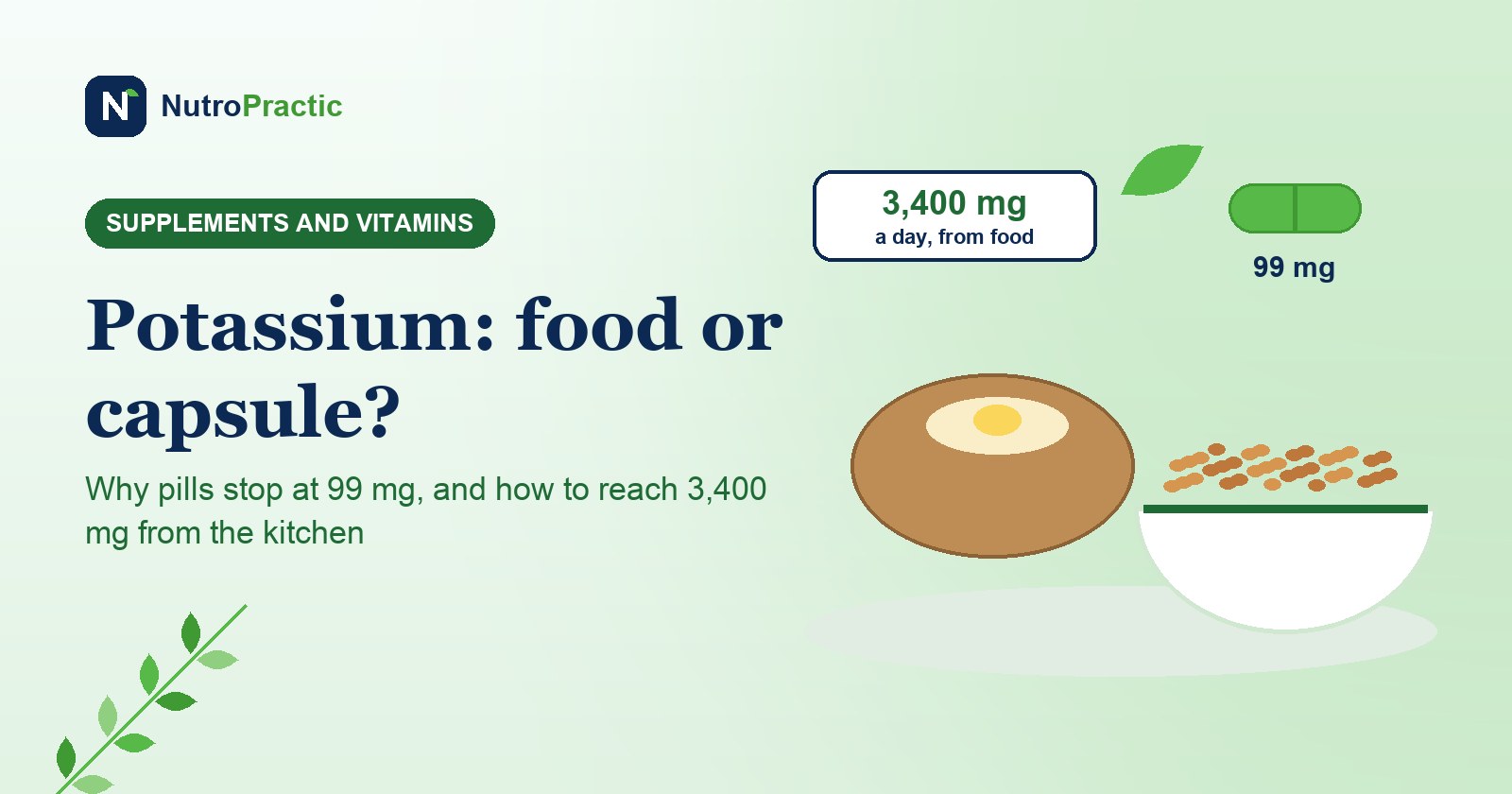
Walk down the supplement aisle and look for potassium. You'll find tiny capsules that say 99 mg. Now compare that with what the US National Academies set as the daily target in 2019: 3,400 mg for men and 2,600 mg for women (adults, 19 and over). One capsule is about 3% of a man's day. So why is the pill so small, and what are you meant to do about the other 97%?
Short answer: eat it. Here's the long answer, with numbers.
Where the 99 mg line comes from
Most people assume there's a legal cap. There isn't one for supplements. The NIH Office of Dietary Supplements explains it like this:
- It started with drugs, not vitamins. The FDA ruled that some oral drug products with potassium chloride above 99 mg were not safe, because they were linked to small-bowel lesions (ulcers) in people taking them.
- Some potassium salt tablets above 99 mg need a warning label about those lesions.
- The FDA hasn't ruled on whether supplements above 99 mg need the warning, and by law it can't limit a nutrient in a supplement except for safety reasons.
- So most makers just stay at 99 mg per serving (about 2% of the Daily Value) and avoid the whole question. A multivitamin that has any potassium usually gives about 80 mg.
The upshot: the small pill is a company habit that grew out of a drug-safety ruling. It isn't a statement that 99 mg is the most you can safely get, and it doesn't mean food potassium is dangerous. It does mean no supplement on the shelf is going to close your gap.
How big is the gap?
In NHANES 2013-2014 the average American adult got 3,016 mg a day (men) and 2,320 mg (women) from food. Against the targets, that's about 400 mg short for men and 280 mg short for women, on average, and plenty of people are further below. The US Dietary Guidelines list potassium as a nutrient of public health concern for exactly this reason.
Why bother? A 2016 analysis of 16 cohort studies (639,440 people) found a 15% lower stroke risk in people with the highest intakes (median about 4,027 mg) than the lowest (about 2,053 mg), with the lowest risk around 3,500 mg. A cohort of 45,619 men found 51% fewer kidney stones at 4,042 mg or more versus 2,895 mg or less. These are observational, so they show a link, not proof. For the blood-pressure trials, see our article on salt, potassium and blood pressure.
What foods actually hold
Figures are from the NIH fact sheet (USDA data), per the serving shown. The body absorbs roughly 85-90% of food potassium, and a 2016 trial found potassium gluconate from supplements is absorbed at about 94%, similar to a potato. So the form isn't the problem; the dose is.
| Food (serving) | Potassium | Capsules of 99 mg it equals |
|---|---|---|
| Dried apricots, 1/2 cup | 755 mg | 7.6 |
| Lentils, cooked, 1 cup | 731 mg | 7.4 |
| Prunes, dried, 1/2 cup | 635 mg | 6.4 |
| Potato, baked, flesh only, 1 medium | 610 mg | 6.2 |
| Kidney beans, canned, 1 cup | 607 mg | 6.1 |
| Orange juice, 1 cup | 496 mg | 5.0 |
| Banana, 1 medium | 422 mg | 4.3 |
| Milk, 1%, 1 cup | 366 mg | 3.7 |
| Spinach, raw, 2 cups | 334 mg | 3.4 |
| Salmon, farmed, cooked, 3 oz | 326 mg | 3.3 |
| Tomato, raw, 1 medium | 292 mg | 2.9 |
| Greek yogurt, plain nonfat, 6 oz | 240 mg | 2.4 |
| Broccoli, cooked, 1/2 cup | 229 mg | 2.3 |
| Brown rice, cooked, 1 cup | 154 mg | 1.6 |
| Egg, 1 large | 69 mg | 0.7 |
| White bread, 1 slice | 37 mg | 0.4 |
The banana, the one everyone names, is just average. A baked potato or a cup of lentils has about 45-75% more. Dried fruit and beans are the quiet winners. At the bottom: refined grains, eggs and oils (0 mg) barely register, which is part of why a diet heavy on white bread and takeaway falls short.
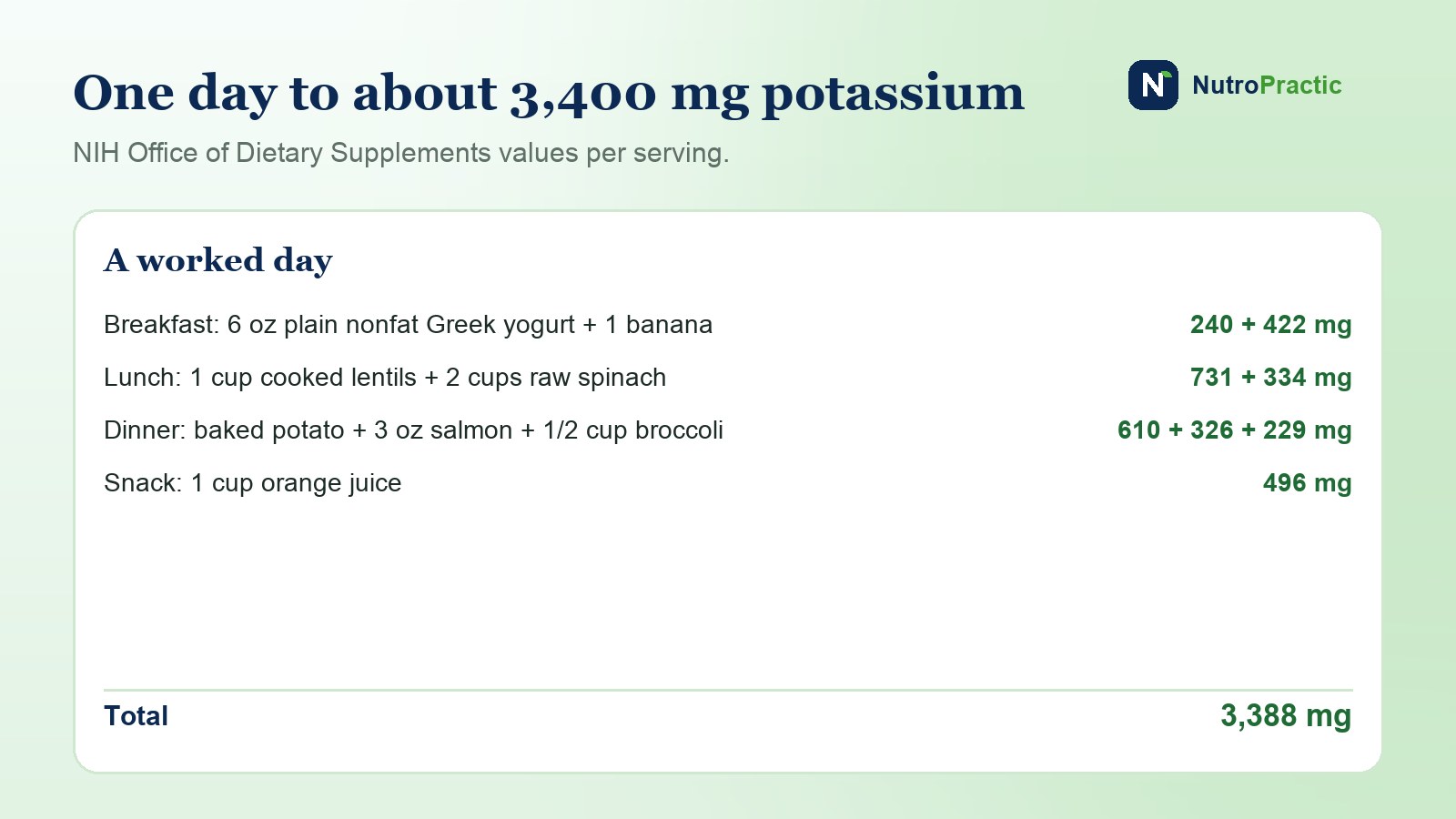
One worked day to 3,400 mg
- Breakfast: 6 oz plain nonfat Greek yogurt (240) + a banana (422) = 662 mg
- Lunch: 1 cup cooked lentils (731) + 2 cups raw spinach (334) = 1,065 mg
- Dinner: a baked potato (610) + 3 oz salmon (326) + 1/2 cup broccoli (229) = 1,165 mg
- Snack: 1 cup orange juice = 496 mg
Total: 3,388 mg. No supplement, nothing exotic. For a woman the 2,600 mg target is reached by about the lunch-plus-dinner part of this list plus a yogurt. If you want a lighter version, swap the juice for a handful of raisins (1/2 cup is 618 mg) or a glass of milk (366 mg).
Easy upgrades: beans or lentils in a soup (a cup of either is the best single move), a potato eaten with its skin, a handful of dried apricots instead of a biscuit, plain yogurt instead of a sweet drink.
Who should not push potassium up
This is the part that matters more than the numbers. In people with healthy kidneys, extra dietary potassium is simply passed in the urine. But the target of 3,400 / 2,600 mg does not apply to anyone whose body can't clear potassium well. Normal blood potassium is 3.6-5.0 mmol/L; above that is hyperkalaemia, which can cause muscle weakness, palpitations and dangerous heart rhythms, and can be silent until it isn't.
| Situation | Why it matters |
|---|---|
| Chronic kidney disease | Kidneys remove most potassium; levels can climb even on ordinary diets |
| ACE inhibitors (e.g. benazepril) and ARBs (e.g. losartan) | Reduce potassium loss in urine; the NIH notes hyperkalaemia can occur even below the usual target |
| Potassium-sparing diuretics (amiloride, spironolactone) | Keep potassium in the body by design |
| Type 1 diabetes, heart failure, adrenal insufficiency, liver disease | Linked to higher hyperkalaemia risk |
| Potassium-based salt substitutes and 'lite' salts | Potassium chloride, about 440 to 2,800 mg per teaspoon depending on brand |
The pattern to avoid is the quiet stack: someone on an ACE inhibitor starts a salt substitute because they've been told to cut salt, adds a potassium capsule, and nobody checks a blood test. Not that any one of these is wrong; the combination needs a number from a lab. If you take any medicine in the second or third row, ask your doctor what potassium level they want to see and whether to go easy on high-potassium foods before you change your diet.
The flip side: low potassium (below 3.6 mmol/L) happens with thiazide-type water tablets, vomiting, diarrhoea, heavy laxative use and inflammatory bowel disease. Then a doctor may prescribe potassium on purpose, at doses far above 99 mg, and monitor it. That's treatment, not a supplement.
The short version
- A 99 mg capsule is a habit left over from a drug-safety ruling, not a dose that does anything. Skip it as a gap-filler.
- Aim for 3,400 mg (men) or 2,600 mg (women) from food. Beans, lentils, potatoes, dried fruit, yogurt, fish and greens do the heavy lifting.
- Kidney disease or one of the medicines above? Get your own target from your doctor first.
Not sure whether your medicines and your plate go together? Dr. Triveni can go through what you eat in a normal week and where your potassium, sodium and fibre sit, and work with your doctor's advice, in a virtual consultation.
Book a consultationThis article is general information, not medical advice. Don't start potassium supplements or potassium salt substitutes, or stop or change a medicine, without talking to your doctor.
Sources
NIH Office of Dietary Supplements, Potassium: Health Professional Fact Sheet (adequate intakes, food table, the 99 mg limit, NHANES 2013-2014 intakes, hyperkalaemia and drug interactions): https://ods.od.nih.gov/factsheets/Potassium-HealthProfessional/. National Academies of Sciences, Engineering, and Medicine, Dietary Reference Intakes for Sodium and Potassium (2019). Vinceti M. et al., Meta-analysis of potassium intake and the risk of stroke, J Am Heart Assoc (2016). Curhan G.C. et al., Comparison of dietary calcium with supplemental calcium and other nutrients as factors affecting the risk for kidney stones in women, Ann Intern Med 126:497-504 (1997). Viera A.J., Wouk N., Potassium disorders: hypokalemia and hyperkalemia, Am Fam Physician 92:487-495 (2015).