Anyone who has passed a kidney stone remembers it. The pain is often compared to childbirth, it tends to arrive at three in the morning, and the first question afterwards is nearly always the same: what do I stop eating so this never happens again?
The answers people get are often wrong. For decades, people with calcium stones were told to cut out milk and cheese, and many still are. A trial in Italy showed that this makes stones more likely to come back. Here is what the research supports, what it doesn't, and why the most useful thing you can do after a stone may be a 24-hour urine test rather than a list of banned foods.
How common stones are, and why they come back
About one in eleven people in the US has had a kidney stone (NHANES, 2007 to 2010), men more often than women, and the share has been rising alongside obesity and diabetes. Stones are more common in hot places, where people sweat more and pass less urine: the south-eastern US, the Gulf, north and west India in summer.
They also come back. In older studies, roughly half of people who had one stone had another within about ten years. That is why urologists talk about prevention: the first stone is treated, and the job afterwards is to make the urine a place where crystals don't form.
Know your stone
Stones are not all the same, and the advice depends on the type. If a stone is caught (your doctor may give you a strainer), ask for it to be analysed.
Calcium oxalate stones are by far the most common, about 70 to 80% of all stones. Calcium phosphate stones make up most of the rest of the calcium stones. Uric acid stones, around 5 to 10%, form when urine is too acidic; they are more common with gout, type 2 diabetes and excess weight. Struvite stones grow around certain urine infections, and cystine stones come from a rare inherited condition. Most of this article is about calcium stones, with a short section on uric acid stones.
Water comes first
Stones form when urine is concentrated enough for crystals to settle out. Dilute urine is the single change with the strongest evidence.
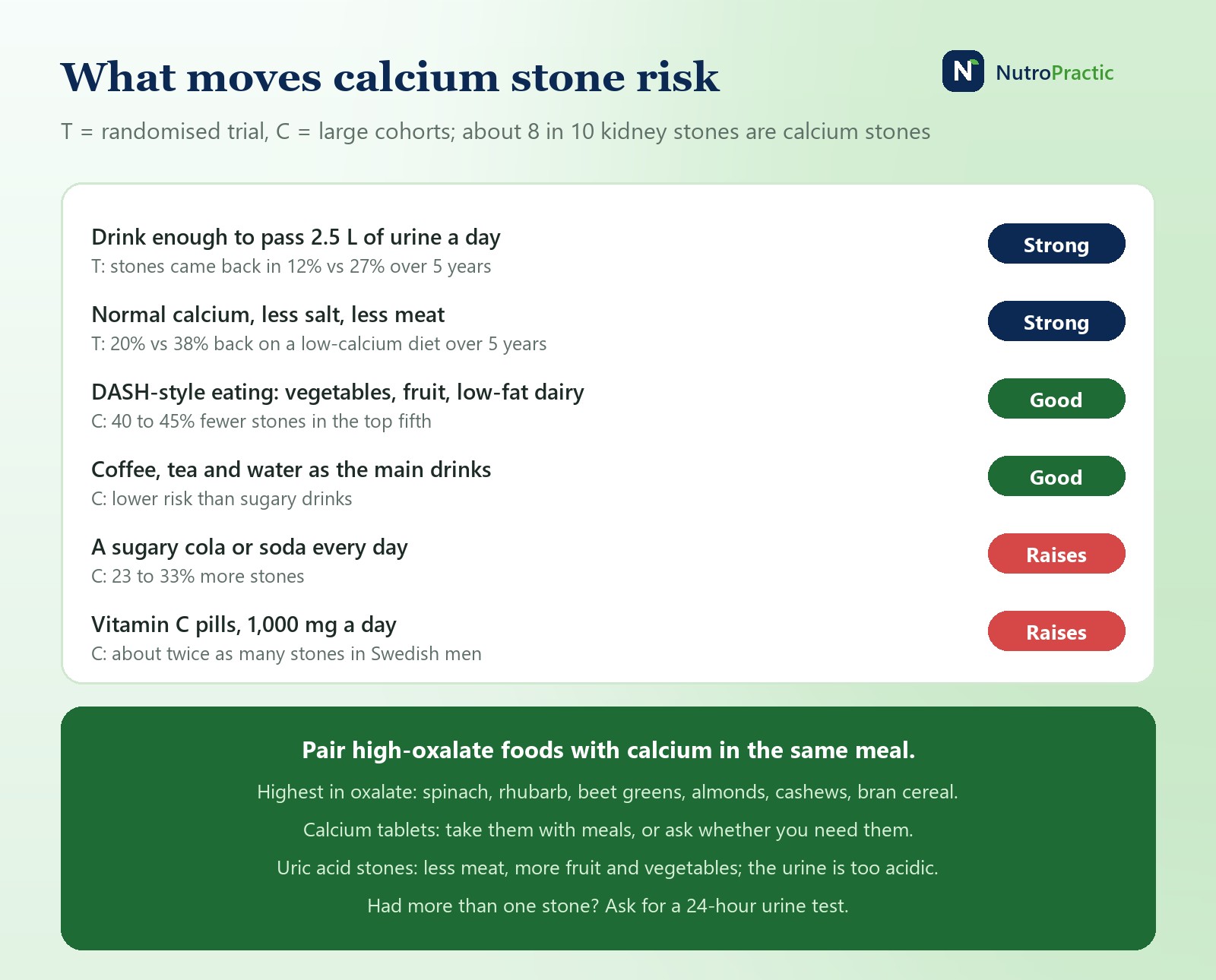
In a five-year Italian trial (Borghi and colleagues, 1996), 199 people after their first calcium stone were split into two groups: one was told to drink enough to pass at least 2 litres of urine a day, the other got no advice on fluids. Stones came back in 12% of the high-water group and 27% of the others, and when they did come back, it took longer.
Guidelines in the US and Europe now aim for 2.5 litres of urine a day. For most people that means about 2.5 to 3 litres of fluid, more in hot weather or with a sweaty job, and spread through the day rather than in one go. Pale urine most of the day is the practical sign you're there. Our water article explains how much people need in general; with a history of stones, aim higher than that.
What you drink matters a little too. In three large US cohorts followed for decades (Ferraro and colleagues, 2013), people who drank a sugar-sweetened cola or soda every day had 23 to 33% more stones than those who drank them rarely. Coffee, tea, and orange juice were each linked with fewer stones. Water, tea and coffee are good choices, and tea and coffee count toward the total.
Don't cut calcium
This is the part most people get backwards. Calcium stones are made of calcium, so cutting calcium seems obvious. It doesn't work, because of how oxalate is absorbed.
In the gut, calcium from food binds oxalate from food, and the pair leaves in the stool. When there is little calcium in the meal, more oxalate is free to be absorbed and ends up in the urine, where it does far more to drive crystals than calcium does.
The proof came in 2002 in the New England Journal of Medicine. Borghi's team followed 120 men with repeated calcium oxalate stones for five years. Half ate a low-calcium diet (400 mg a day). The other half ate normal calcium (about 1,200 mg a day, mostly from dairy) with less salt and less meat. Stones came back in 38% of the low-calcium group and 20% of the normal-calcium group, roughly half the risk. Urine oxalate went up on the low-calcium diet and down on the other.
Large cohorts point the same way: in US men and women, those who ate the most calcium from food had the fewest stones. Calcium supplements are different. In a big US trial of calcium and vitamin D tablets in older women, stones were about 17% more common in the supplement group, probably because tablets are often taken between meals, when there is no oxalate to bind. If you need a calcium supplement for your bones, take it with a meal, and check with your doctor whether you need it at all. Our calcium counter adds up what you already get from food.
The target for most people with calcium stones is the normal amount of calcium for their age, about 1,000 to 1,200 mg a day, from food, spread across meals. That is milk or yogurt with breakfast, cheese or paneer at lunch, and so on, not a calcium-free diet.
Oxalate: a few foods, not a long list
Oxalate is found in many plant foods, and online lists can make it look as though vegetables, nuts and tea are all off limits. They aren't. Most foods carry small amounts. A handful carry a lot:
Spinach (by far the most: a portion of cooked spinach can hold more oxalate than everything else in a typical day), rhubarb, beet greens and Swiss chard, almonds and cashews, bran cereals, and to a lesser extent beetroot, potatoes with skin, cocoa and dark chocolate, and strong black tea.
Two practical rules cover most of it. First, if your urine test shows high oxalate, go easy on the top few, especially big daily spinach smoothies and handfuls of almonds as a snack. Second, eat oxalate-rich foods with calcium in the same meal, so the two bind in the gut. Spinach with paneer or yogurt, almonds with milk, a little milk in strong tea: the idea behind palak paneer is sound chemistry. Cutting out fruit and vegetables generally is a mistake, because they help in other ways (see citrate, below).
One supplement is worth a warning: vitamin C is turned partly into oxalate in the body. In a cohort of more than 23,000 Swedish men, those taking 1,000 mg vitamin C tablets had about twice as many stones. Vitamin C from fruit and vegetables is fine; high-dose tablets are not a good idea after a calcium oxalate stone.
Salt and meat
Salt makes the kidneys let more calcium into the urine. In Borghi's trial, lower salt was part of the diet that halved recurrences, and guidelines advise keeping sodium to about 2,300 mg a day (roughly a level teaspoon of salt in total) or less. Most of it comes from bread, cheese, processed meat, ready meals, pickles and restaurant food, not the salt shaker; our sodium counter shows where yours comes from.
Meat, fish and poultry make urine more acidic, raise uric acid and lower citrate, all of which favour stones. Nobody needs to give them up, but large portions twice a day are a stone risk. Guidelines suggest keeping non-dairy animal protein moderate; a palm-sized portion once a day, with beans, lentils, dairy and eggs filling the rest of your protein, is a reasonable shape.
Citrate: why lemons come up
Citrate in urine binds calcium and stops crystals from growing. Many people with stones have low urine citrate. Fruit and vegetables raise it, because their potassium and organic acids leave the body as alkali. That is one reason the DASH diet (lots of vegetables, fruit, nuts, beans and low-fat dairy, less red meat and sugar) was linked with 40 to 45% fewer stones in three large US cohorts, despite containing plenty of oxalate.
Lemon and lime juice are the richest food sources of citrate. In a small US study, about half a cup (120 ml) of lemon juice a day, diluted into water as unsweetened or lightly sweetened lemonade, raised urine citrate in people whose levels were low. Other studies have been less consistent, and the effect is smaller than the medicine: potassium citrate tablets, prescribed when urine citrate is low, cut recurrences in randomised trials. Lemon water is a cheap, pleasant way to add both fluid and some citrate; it doesn't replace a prescription if you need one.
Plenty of fluid, normal calcium with meals, less salt, and a plate that looks more like DASH than like a steakhouse: that covers most calcium stones.
Uric acid stones are different
Uric acid stones form when urine stays too acidic, below a pH of about 5.5, which is common with type 2 diabetes and excess weight. Here oxalate and calcium matter little. What helps is more fluid, less meat and seafood, more fruit and vegetables, weight loss if needed, and often potassium citrate to make the urine less acidic. Unlike calcium stones, uric acid stones can sometimes dissolve with that treatment. Our gout article covers the foods that raise uric acid.
The 24-hour urine test
General advice gets most people most of the way. After a second stone, or a first stone in someone young or with a strong family history, US and European urology guidelines recommend a 24-hour urine collection: you collect everything you pass for a day, and the lab measures volume, calcium, oxalate, citrate, uric acid, sodium and pH. It shows your reason for making stones, so the diet can target that instead of everything at once.
Someone whose test shows low volume and high sodium needs a very different plan from someone with high oxalate and low citrate. Repeating the test after a few months of changes shows whether they worked.
A simple plan after a calcium stone
Drink through the day until your urine is pale most of the time: about 2.5 to 3 litres of fluid, more in heat. Water, tea and coffee all count; skip daily sugary sodas.
Keep calcium normal and with meals: two or three servings of milk, yogurt, cheese or paneer, or calcium-set tofu, spread across the day.
Pair oxalate with calcium, and keep the very high foods (spinach, rhubarb, almonds) occasional if your oxalate is high.
Cut back on salt, mostly by cooking more and buying fewer packaged and restaurant foods.
Moderate meat, and fill the plate with vegetables, fruit, beans and whole grains.
Skip high-dose vitamin C tablets, and take any calcium supplement with food.
Ask for the stone to be analysed and for a 24-hour urine test if stones keep coming back.
Had a stone, or have a 24-hour urine report you don't know what to do with? Dr. Triveni can turn it into meals you will actually eat in a virtual consultation.
Book a consultationThis article is general information, not medical advice. Severe pain with fever, vomiting you can't stop, or very little urine needs urgent medical care. If you have kidney disease, take medicines for stones, or have been told to limit fluids, follow your doctor's advice.
Sources
Borghi L. et al., Urinary volume, water and recurrences in idiopathic calcium nephrolithiasis: a 5-year randomized prospective study, J Urol 155(3):839-843 (1996). Borghi L. et al., Comparison of two diets for the prevention of recurrent stones in idiopathic hypercalciuria, N Engl J Med 346(2):77-84 (2002). Curhan G.C. et al., A prospective study of dietary calcium and other nutrients and the risk of symptomatic kidney stones, N Engl J Med 328(12):833-838 (1993). Curhan G.C. et al., Comparison of dietary calcium with supplemental calcium and other nutrients as factors affecting the risk for kidney stone formation in women, Ann Intern Med 126(7):497-504 (1997). Jackson R.D. et al., Calcium plus vitamin D supplementation and the risk of fractures, N Engl J Med 354(7):669-683 (2006). Taylor E.N., Fung T.T., Curhan G.C., DASH-style diet associates with reduced risk for kidney stones, J Am Soc Nephrol 20(10):2253-2259 (2009). Ferraro P.M. et al., Soda and other beverages and the risk of kidney stones, Clin J Am Soc Nephrol 8(8):1389-1395 (2013). Thomas L.D.K. et al., Ascorbic acid supplements and kidney stone incidence among men: a prospective study, JAMA Intern Med 173(5):386-388 (2013). Seltzer M.A. et al., Dietary manipulation with lemonade to treat hypocitraturia in calcium nephrolithiasis, J Urol 156(3):907-909 (1996). Barcelo P. et al., Randomized double-blind study of potassium citrate in idiopathic hypocitraturic calcium nephrolithiasis, J Urol 150(6):1761-1764 (1993). Scales C.D. et al., Prevalence of kidney stones in the United States, Eur Urol 62(1):160-165 (2012). Pearle M.S. et al., Medical management of kidney stones: AUA guideline, J Urol 192(2):316-324 (2014). European Association of Urology, Guidelines on Urolithiasis (2024).