Somewhere along the way, eight glasses of water a day became a rule. Water bottles are marked with hourly targets, apps buzz at you to drink, and plenty of people feel faintly guilty for falling short of a number nobody can quite trace.
The number was never based on a study. When researchers finally measured how much water thousands of people actually turn over in a day, the answer turned out to depend on age, size, activity and climate far more than any single rule allows. For most healthy adults in a temperate place, it is less than eight glasses from drinks. For some people, on some days, it is a lot more. Here is what the evidence says, what counts, and when the amount really matters.
Where eight glasses came from
The usual trail leads back to 1945, when the US Food and Nutrition Board suggested that adults take in about 2.5 litres of water a day. The very next sentence said that most of this quantity is contained in prepared foods. That sentence got lost, and 2.5 litres of food and drink turned into eight glasses to drink on top of everything else.
In 2002 the kidney physiologist Heinz Valtin went looking for the scientific basis of "at least eight glasses a day" and found none: no study showing that healthy adults living in a temperate climate need that much from drinks.
What the official numbers say
Health authorities set adequate intakes for total water, from drinks and food together. They are based on what healthy people actually consume, not on a proven minimum.
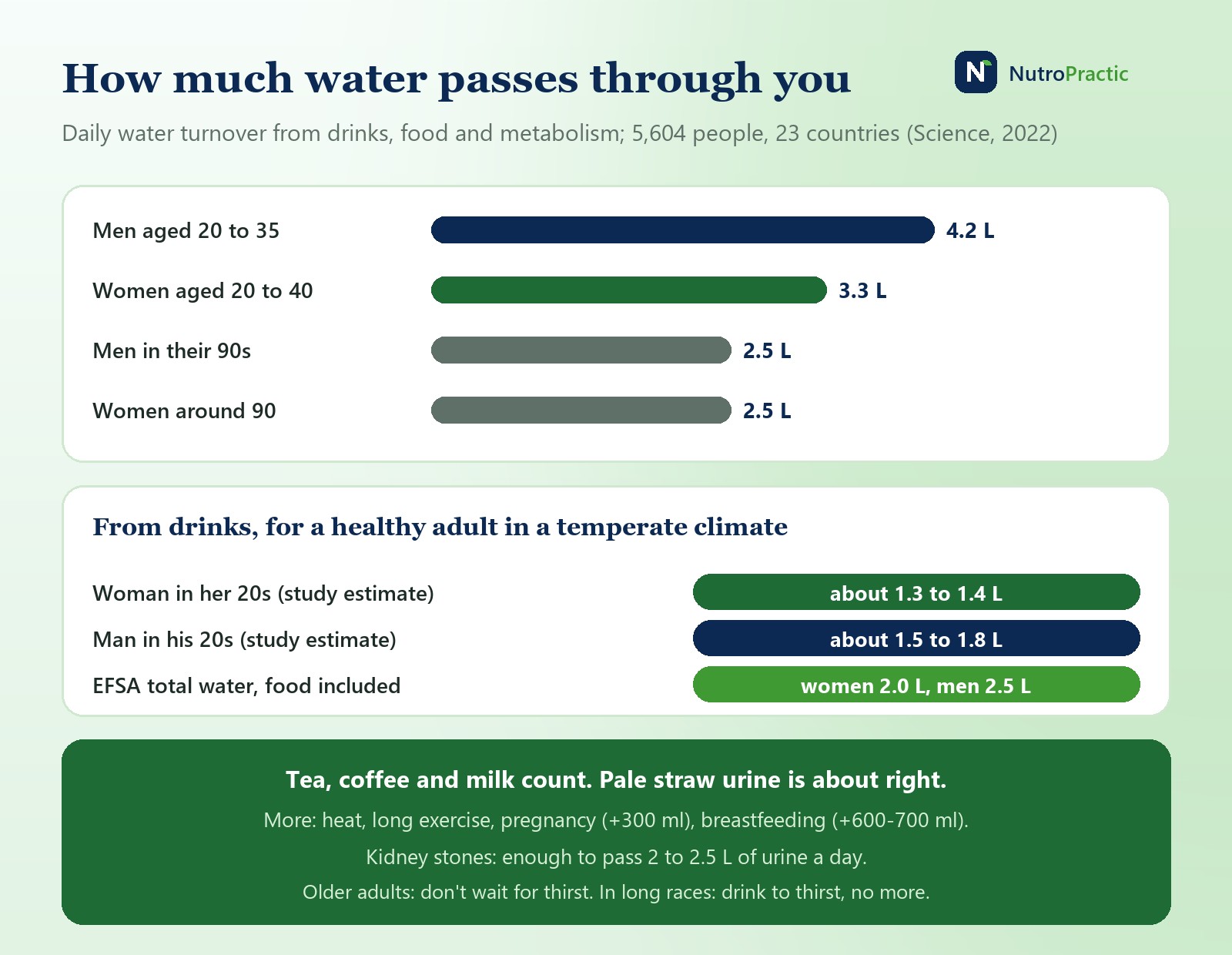
Europe (EFSA, 2010): about 2.0 litres a day for women and 2.5 litres for men, of which roughly 70 to 80% usually comes from drinks and 20 to 30% from food. That works out to about 1.4 to 1.6 litres of drinks for women and 1.75 to 2 litres for men.
US and Canada (National Academies, 2004): 2.7 litres for women and 3.7 litres for men, again total water, with about 80% from drinks in American diets. These figures are higher because they reflect what Americans drink, not because Americans need more.
Both reports say plainly that healthy people meet their needs by drinking when thirsty and with meals. Neither is a target to force down.
The study that measured it
In 2022 an international team published the largest study of water needs so far, in Science (Yamada and colleagues). They gave 5,604 people aged 8 days to 96 years, in 23 countries, a drink of water labelled with a harmless heavy form of hydrogen, then measured how quickly it washed out of their bodies. That gives water turnover: how much water passes through you each day, whether it comes from drinks, food or your own metabolism.
Men aged 20 to 35 turned over the most, about 4.2 litres a day, and women aged 20 to 40 about 3.3 litres. Turnover fell with age, to about 2.5 litres for men and women in their nineties.
It was higher in people who were more active, in athletes, in pregnant and breastfeeding women, in hot and humid places, at altitude, and in poorer countries, where more people do manual work and fewer have air conditioning.
Turnover is not the same as what you need to drink. About 15% of it is water exchanged through the skin and lungs or made by the body as it burns food, and a large share comes from food. The researchers worked out that a man in his twenties in the US or Europe needs to drink roughly 1.5 to 1.8 litres a day, and a woman of the same age about 1.3 to 1.4 litres. That is six or seven glasses, and less with age. A "one size fits all" policy for water intake, they concluded, is not supported by the data.
Eight glasses of drinks a day is more than most healthy adults need in a temperate climate, and far less than a roofer needs in a heatwave.
Food is water too
Fruit and vegetables are 80 to 95% water: cucumber, lettuce, watermelon, oranges, tomatoes. Soups, stews, dal, yogurt, porridge, cooked rice and pasta add more. A day built on vegetables, fruit and home-cooked food brings a litre or more of water with it; a day of crackers, toast, crisps and biscuits brings very little.
If you are raising your fibre, as our fibre gap article suggests, drink a little more alongside it: fibre holds water in the gut, which is part of how it works.
Tea and coffee count
The old warning that coffee "dehydrates you" doesn't hold up for normal drinking. In a 2016 Scottish trial, 72 men drank a litre of one of 13 different drinks, and the researchers measured how much urine they passed over the next four hours. Coffee, tea, cola, diet cola, orange juice, sparkling water, a sports drink and even lager were no different from still water. Milk and an oral rehydration solution were held on to a little better, because their protein, fat and salts slow the stomach and the kidneys keep more.
So the tea, coffee and milk you drink through the day all count toward your fluids. What sets the limit on coffee is caffeine, not water: up to about 400 mg a day for healthy adults and 200 mg in pregnancy (our caffeine counter adds it up). Sugary drinks and juice count as water too, but they bring sugar you don't need; water, tea, coffee and milk are the better everyday choices.
Thirst and urine colour
For a healthy adult, thirst is a good guide. It switches on when the blood becomes only slightly more concentrated, well before any harm. Drinking with meals and when you feel thirsty is enough for most people on most days.
A simple check is the colour of your urine: pale straw is about right; dark yellow or amber, especially in small amounts, means drink more. First-morning urine is normally darker, and supplements with riboflavin (vitamin B2) turn it bright yellow whatever you drink. Completely clear urine all day usually means you are drinking more than you need, which is harmless for most people but no healthier.
Older adults: thirst fades
This is where it really matters. With age, the thirst signal weakens and the kidneys get worse at concentrating urine, so older people can run short of water without feeling thirsty. Add memory problems, trouble getting to the kitchen or toilet, worry about incontinence, and medicines such as diuretics, and dehydration becomes common.
In the UK DRIE study of 188 people living in care homes, one in five was dehydrated on a blood test, and thirst had no link with who was dehydrated. For older parents, waiting until they feel thirsty doesn't work. What helps: a drink with every meal and every dose of medicine, a jug or bottle within reach, tea or milky drinks they enjoy at set times, and water-rich foods such as soups, yogurt and fruit. If someone cuts back on drinks to avoid night-time trips to the toilet, move the drinks earlier in the day rather than dropping them.
When to drink more
Heat and exercise. Sweat losses range from about half a litre to more than two litres an hour in hard exercise or hot work. A practical check is to weigh yourself before and after a long session: each kilogram lost is roughly a litre to replace, with some salt (from food or a sports drink) after long, sweaty sessions. In a summer in Chennai, Delhi, Phoenix or southern Spain, needs go up for everyone, not just athletes.
Pregnancy and breastfeeding. EFSA adds about 300 ml a day in pregnancy and 600 to 700 ml a day while breastfeeding. A glass of water at each feed is often the easiest way to get there.
Kidney stones. This is the clearest case where more water is treatment. Urology guidelines advise drinking enough to pass at least 2 to 2.5 litres of urine a day, which for most people means 2.5 to 3 litres of fluid. In an Italian trial of people after their first stone, those who drank more had about half as many stones come back over five years.
Repeat bladder infections. In a 2018 trial of 140 premenopausal women who drank little (under 1.5 litres a day) and had frequent cystitis, adding 1.5 litres of water a day cut infections over a year from about 3.2 to 1.7.
Fever, vomiting and diarrhoea. Losses go up fast; small, frequent sips and an oral rehydration solution work better than large amounts of plain water.
When to drink less: people with heart failure, advanced kidney disease or some liver conditions may be told to limit fluids. If your doctor has given you a fluid limit, it overrides everything here.
Too much water is possible
Drinking far beyond thirst can dilute the sodium in your blood, a condition called hyponatraemia. Mild cases cause nausea and headache; severe ones cause confusion, seizures and, rarely, death. It shows up most in endurance events, where people are told to "stay ahead" of thirst.
At the 2002 Boston Marathon, researchers tested 488 runners at the finish: 13% had low blood sodium and 0.6% had dangerously low levels. The strongest warning sign was gaining weight during the race, which means drinking more than you sweat. Slower runners, out for more than four hours with time to drink at every station, were at higher risk. The type of drink didn't matter: sports drinks didn't protect them.
The advice for long events now is to drink to thirst, not on a schedule. Healthy kidneys can clear only about 0.8 to 1 litre an hour; drinking much faster than that for hours, in a race or a water-drinking challenge, is where the danger lies.
Will more water help with weight or skin?
Water instead of sugary drinks clearly helps with weight, because it removes calories. Drinking water before meals may help a little more: in a 12-week trial in middle-aged and older adults on a diet, drinking 500 ml before each main meal led to about 2 kg more weight loss than the diet alone. In younger adults the results are mixed. The evidence that extra water improves healthy skin or "flushes out toxins" is weak; your kidneys and liver do the clearing whether you drink six glasses or ten.
A simple way to get it right
Drink with every meal and when you're thirsty: water, tea, coffee and milk all count.
Glance at your urine: pale straw is the target; dark yellow means drink more.
Eat your water: vegetables, fruit, soups and home-cooked food at most meals.
Plan for heat, long exercise, pregnancy and breastfeeding: a bottle with you, and fluid plus some salt after heavy sweating.
For older parents: drinks at set times, a full glass with medicines, a jug within reach. Don't rely on their thirst.
In a race or long event: drink to thirst, and ease off if you are gaining weight.
Kidney stones, an older parent who barely drinks, or training through a hot summer? Dr. Triveni can work out what you need from drinks and food in a virtual consultation.
Book a consultationThis article is general information, not medical advice. If you have heart, kidney or liver disease, or have been given a fluid limit, follow your doctor's advice on how much to drink.
Sources
Yamada Y. et al., Variation in human water turnover associated with environmental and lifestyle factors, Science 378(6622):909-915 (2022), and the University of Aberdeen summary. EFSA Panel on Dietetic Products, Nutrition and Allergies, Scientific opinion on dietary reference values for water, EFSA Journal 8(3):1459 (2010). Institute of Medicine, Dietary Reference Intakes for Water, Potassium, Sodium, Chloride, and Sulfate, National Academies Press (2004). Valtin H., "Drink at least eight glasses of water a day." Really? Is there scientific evidence for "8 x 8"?, Am J Physiol Regul Integr Comp Physiol 283(5):R993-R1004 (2002). Maughan R.J. et al., A randomized trial to assess the potential of different beverages to affect hydration status: development of a beverage hydration index, Am J Clin Nutr 103(3):717-723 (2016). Hooper L. et al., Which frail older people are dehydrated? The UK DRIE study, J Gerontol A Biol Sci Med Sci 71(10):1341-1347 (2016). Almond C.S.D. et al., Hyponatremia among runners in the Boston Marathon, N Engl J Med 352:1550-1556 (2005). Hew-Butler T. et al., Statement of the 3rd International Exercise-Associated Hyponatremia Consensus Development Conference, Clin J Sport Med 25(4):303-320 (2015). Borghi L. et al., Urinary volume, water and recurrences in idiopathic calcium nephrolithiasis: a 5-year randomized prospective study, J Urol 155(3):839-843 (1996). Pearle M.S. et al., Medical management of kidney stones: AUA guideline, J Urol 192(2):316-324 (2014). Hooton T.M. et al., Effect of increased daily water intake in premenopausal women with recurrent urinary tract infections: a randomized clinical trial, JAMA Intern Med 178(11):1509-1515 (2018). Dennis E.A. et al., Water consumption increases weight loss during a hypocaloric diet intervention in middle-aged and older adults, Obesity 18(2):300-307 (2010).