Turmeric capsules usually say "with BioPerine" or "with black pepper", and the pitch is the same: pepper makes curcumin absorb 2,000% better. That number is real, but it comes from one small study from 1998 in a handful of volunteers. Here's what that study did, what later work found, what the trials in ulcerative colitis and knee osteoarthritis measured, and who should stay away.
How much curcumin is in the spice, and how much do trials use?
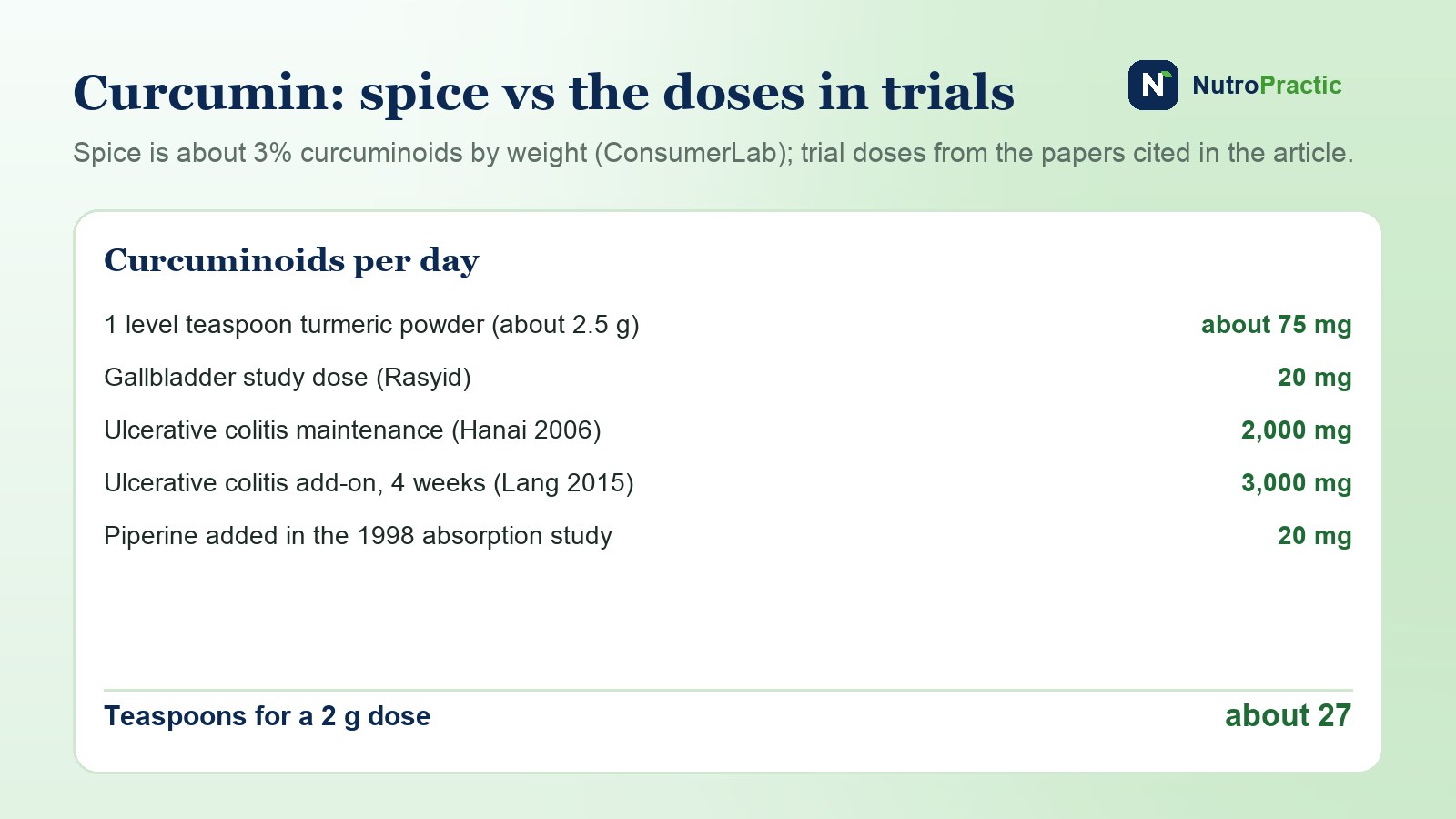
- Turmeric powder is only about 3% curcuminoids by weight (ConsumerLab's figure; batches range from roughly 2% to 9%). A level teaspoon weighs about 2.5 g, so it holds roughly 75 mg of curcuminoids. That's our own arithmetic from those two numbers, so treat it as a ballpark.
- The trials below used 2,000 to 3,000 mg a day. That would take about 27 teaspoons of spice a day. Cooking with turmeric is a different thing from taking a supplement, and the trial results don't carry over to the spice.
Why curcumin is hard to absorb, and what pepper does
Curcumin is poorly absorbed and the liver and gut wall quickly attach a sugar acid to it (glucuronidation), which makes it easy to excrete. Piperine, the pungent compound in black pepper, slows that step, at least in lab and animal work. In the 1998 human test it seemed to help.
| Shoba et al., Planta Medica, 1998 | Result |
|---|---|
| Rats, curcumin with piperine | Bioavailability up 154% |
| Healthy volunteers (reported as 8 to 10 men), curcumin 2 g alone | Blood levels undetectable or very low |
| Same volunteers, curcumin 2 g plus piperine 20 mg | Much higher levels from 15 minutes to 1 hour; reported rise of 2,000% |
Two things to know about that 2,000%. First, the curcumin-only arm was near the limit of detection, so any measurable level after adding pepper looks like a huge percentage jump. The UK Committee on Toxicity pointed this out. Second, a randomised crossover trial in 30 healthy adults (Fança-Berthon et al., Journal of Nutrition, 2021) gave a piperine-curcuminoid product (1,515 mg) and a standard turmeric extract (1,500 mg), among other formulas, and found no significant difference between those two. That trial was funded by a maker of a competing turmeric formula, so read its other claims with care too. Our reading: pepper may help, but "20 times more" isn't settled.
Ulcerative colitis: two small trials, one big caveat
| Trial | Dose | Result |
|---|---|---|
| Hanai 2006, Japan, 89 people in remission, 6 months | 2 g/day curcumin, on top of sulfasalazine or mesalamine | Relapse 4.65% (2 of 43) vs 20.51% (8 of 39) on placebo, per protocol, p = 0.04 |
| Lang 2015, Israel, 50 people with mild to moderate flares not settling on mesalamine, 4 weeks | 3 g/day curcumin plus mesalamine | Clinical remission 53.8% vs 0%; response 65.3% vs 12.5%; endoscopic remission 8 of 22 checked (38%) vs 0 of 16 |
- In both trials curcumin was added to standard UC medicine, never used instead of it.
- Both are small. The Cochrane review of the Hanai trial gave the relapse ratio as 0.24, but the range (0.05 to 1.09) crossed 1, so it called the evidence not strong enough. The Lang trial had no power calculation, and a 0% remission rate on placebo is unusually low.
- Who does it fit? Someone with UC, with a gastroenterologist who knows they're trying it. Stopping your UC medicine for turmeric risks a flare.
Joint pain and CRP: modest, and mostly pain
- A 2022 review of 15 trials (1,670 people with knee osteoarthritis) found curcuminoids beat placebo for pain and were not worse than NSAIDs. The pooled gap in WOMAC pain score was about 1.4 points (range 0.4 to 2.4).
- A 2021 review that split trials at 1,000 mg a day found no clear difference in pain relief between higher and lower doses.
- A 2024 network analysis of 23 trials (80 to 2,000 mg a day) found less pain but no change in WOMAC function or stiffness, and flagged possible publication bias.
- On inflammation, a recent review found blood CRP lower on curcumin than placebo (standardised difference −0.9). That's a lab number, and it doesn't tell you your knees will feel different. For food that moves CRP, see anti-inflammatory eating.
Who should be careful
- Liver. In 10 turmeric cases collected by the US Drug-Induced Liver Injury Network, 5 people were hospitalised and 1 died. Injury showed up 1 to 4 months after starting. 7 of the 10 carried the gene variant HLA-B*35:01: it turned up at a frequency of 0.45 in the cases against about 0.06 in population controls. Three of the products tested also contained piperine. Ten cases can't give a rate, and most people take turmeric without trouble, but if you get dark urine, yellow eyes or itching, stop and call your doctor.
- Gallbladder and bile ducts. Curcumin makes the gallbladder contract. In a crossover study of 12 healthy volunteers, 20 mg cut gallbladder volume by 29% two hours later. People with gallstones or a blocked bile duct are routinely told to avoid curcumin supplements for this reason.
- Dose against the safe daily intake. EFSA's acceptable daily intake for curcumin as an additive is 3 mg per kg of body weight. For a 70 kg adult that's 210 mg. A 2,000 mg trial dose is about 9.5 times that (2,000 ÷ 210). Germany's BfR has warned that supplements can exceed it. The ADI was set for additives, not as a ceiling on supplements, but the gap shows these are drug-sized doses.
- Medicines. Piperine can change how fast the body clears some medicines, and there are reports of a raised INR on warfarin. Check with your pharmacist before combining it with blood thinners, diabetes medicines or anything with a narrow safe range. Stop it before surgery as your surgeon advises.
What we'd do with this
- For flavour and food: cook with turmeric, add pepper and some fat. It's tasty, and the doses are far below the cautions above.
- For UC: only as an add-on your gastroenterologist agrees to. Keep your usual medicine.
- For knee pain: a trial of 8 to 12 weeks is reasonable if you have no liver, gallbladder or medicine issues. Judge it on your own pain score, not on CRP. Eating patterns for inflammation and weight loss help joints too.
- Skip the maths on "2,000%". If you buy one, check the label for the milligrams of curcuminoids, not the pepper claim.
Thinking about turmeric for gut or joint symptoms alongside other medicines? Dr. Triveni can go through what you take and eat in a virtual consultation and set out food-first steps.
Book a consultationRelated: the older turmeric, fenugreek and cinnamon article looks at blood sugar only.
This article is general information, not medical advice. Talk to your doctor before taking supplements, especially if you take regular medicines, are pregnant or breastfeeding, or have a liver, gallbladder or eye condition.
Sources
Shoba G. et al., Influence of piperine on the pharmacokinetics of curcumin in animals and human volunteers, Planta Medica 1998;64:353-6 (PubMed 9619120). Hanai H. et al., Curcumin maintenance therapy for ulcerative colitis, Clin Gastroenterol Hepatol 2006 (PubMed 17101300) and Cochrane review CD008424. Lang A. et al., Curcumin in combination with mesalamine induces remission in patients with mild-to-moderate ulcerative colitis, Clin Gastroenterol Hepatol 2015 (PubMed 25724700). Fança-Berthon P. et al., Pharmacokinetics of a single dose of turmeric curcuminoids depends on formulation, J Nutr 2021;151:1802-16. UK Committee on Toxicity discussion paper on turmeric and curcumin supplements. Knee osteoarthritis meta-analysis, BMC Complement Med Ther 2022 (doi 10.1186/s12906-022-03740-9); CRP review PMC12231615; dose review, Complement Ther Med 2021. DILIN turmeric case series, Am J Med 2023 (PubMed 36252717). Rasyid A. et al., gallbladder contraction by curcumin in healthy volunteers (PubMed 10102956; Asia Pac J Clin Nutr 2002). EFSA Journal 2010;8(9):1679 (curcumin ADI 3 mg/kg bw/day); BfR opinion 040/2021. ConsumerLab, turmeric spice vs supplements. Read 17 Nov 2026.