Choline is an essential nutrient: your body makes some, but not enough, so it has to come from food. Hardly anyone talks about it, and most of us fall short. US government survey data show the average adult eats 402 mg a day (men) and 278 mg (women). The official targets, called Adequate Intakes, are 550 mg for men and 425 mg for women, 450 mg in pregnancy and 550 mg while breastfeeding.
That gap matters most for your liver. Here's what the research says, with the numbers, and what you can do with a fork.
What choline does in the liver
- Packages fat for export. The liver builds phosphatidylcholine from choline, and it needs that to wrap fat into particles (VLDL) it sends into the blood. Without enough choline, fat stays stuck in liver cells.
- Feeds the methyl pathway. Choline turns into betaine, which helps recycle homocysteine into methionine. If your folate is low, your body leans harder on choline, so the need goes up.
- Makes acetylcholine, the messenger nerves use for memory and muscle control, and builds cell membranes.
The body can make choline itself, mostly through an enzyme called PEMT, but "mostly" isn't "enough".
Who needs more: estrogen and the PEMT variant
PEMT is switched on by estrogen. That's why premenopausal women can supply more of their own choline, and why the picture changes after menopause. In a feeding study at the University of North Carolina (Fischer et al., 2010), volunteers ate a very-low-choline diet for up to 42 days, until they developed liver or muscle damage, then a high-choline diet to reverse it.
| Group (trial) | Developed liver/muscle damage on low choline |
|---|---|
| Premenopausal women with 0 copies of the PEMT variant rs12325817 (n=27 total) | 13% |
| Premenopausal women with 1 copy | 43% |
| Premenopausal women with 2 copies | 80% |
| Postmenopausal women on placebo (n=22 total) | 73% |
| Postmenopausal women on estrogen | 18% |
Two things to take from that. First, a common gene change (about 75% of people in the North Carolina population had at least one copy of the variant) can raise the choline you need, in a stepwise way. Second, after menopause the requirement goes up. An earlier analysis of 64 women found that having one or two copies raised the odds of damage about 21-fold. These were small, tightly controlled studies, with the diet cut to a tiny fraction of normal. They show a mechanism and who may be more exposed. They don't tell you that you have a problem at a normal diet, and you can't read your genotype from how you feel.
The NIH adds that a separate depletion study (57 adults on under 50 mg of choline per 70 kg of body weight a day for up to 42 days) saw 37 develop liver dysfunction, which cleared in everyone once choline went back to 25-75% of the target or they ate freely.
Fatty liver: what the data support
Fatty liver disease linked to weight and blood sugar (now called MASLD, formerly NAFLD) has far bigger levers than choline, and we cover those in the fatty liver article. Choline's role is narrower but real:
- Deficiency causes fatty liver. It's reliably shown in the depletion studies above, and in people on long-term intravenous feeding without choline, whose livers develop fat until choline is added.
- Intake and risk, in a big survey. Among 56,195 Chinese adults aged 40-75, women in the top fifth of choline intake (about 412 mg a day) had 32% lower odds of fatty liver than the bottom fifth (179 mg); men (452 vs 199 mg) had 25% lower. In women the link held only in those of normal weight, not overweight or obesity. It's one cross-sectional study using a one-day food recall.
- Scarring. In 664 people from a US liver research network, postmenopausal women with the severe form (NASH) who ate under half the target had more fibrosis (scarring). Choline intake wasn't tied to how much fat was in the liver.
- Treatment? The NIH's view is that data on using choline to treat fatty liver are limited and more research is needed. So: enough choline is protective of the plumbing; there's no trial showing a choline supplement reverses fatty liver in someone already eating enough. Weight loss, food quality and less alcohol are what move liver fat.
Foods, in milligrams
From the NIH fact sheet (USDA data). Targets: 425 mg (women), 550 mg (men).
| Food (serving) | Choline | Share of 425 mg |
|---|---|---|
| Beef liver, pan fried, 3 oz | 356 mg | 84% |
| Egg, hard boiled, 1 large | 147 mg | 35% |
| Beef top round, braised, 3 oz | 117 mg | 28% |
| Soybeans, roasted, 1/2 cup | 107 mg | 25% |
| Chicken breast, roasted, 3 oz | 72 mg | 17% |
| Cod, cooked, 3 oz | 71 mg | 17% |
| Potato, red, baked, 1 large | 57 mg | 13% |
| Kidney beans, canned, 1/2 cup | 45 mg | 11% |
| Quinoa, cooked, 1 cup | 43 mg | 10% |
| Milk, 1%, 1 cup | 43 mg | 10% |
| Brussels sprouts, boiled, 1/2 cup | 32 mg | 8% |
| Broccoli, boiled, 1/2 cup | 31 mg | 7% |
| Brown rice, cooked, 1 cup | 19 mg | 4% |
| Apple, 1/2 cup | 2 mg | 0% |
Eggs are the easy win: the yolk is where the choline is, and two eggs give 294 mg. If you skip eggs, the work gets harder, and the plant picture is thin. Soybeans, quinoa, beans, broccoli, Brussels sprouts and potatoes help, but they add up in tens of milligrams, not hundreds. For the cholesterol side of eggs, see our article on eggs and dietary cholesterol.
Betaine comes mostly from wheat products, spinach, beets and shellfish. Published betaine values for some of these foods were later revised downward, so we haven't put numbers on it here; the practical point is that a diet with whole grains and greens contributes some, and the AI is set for choline itself.
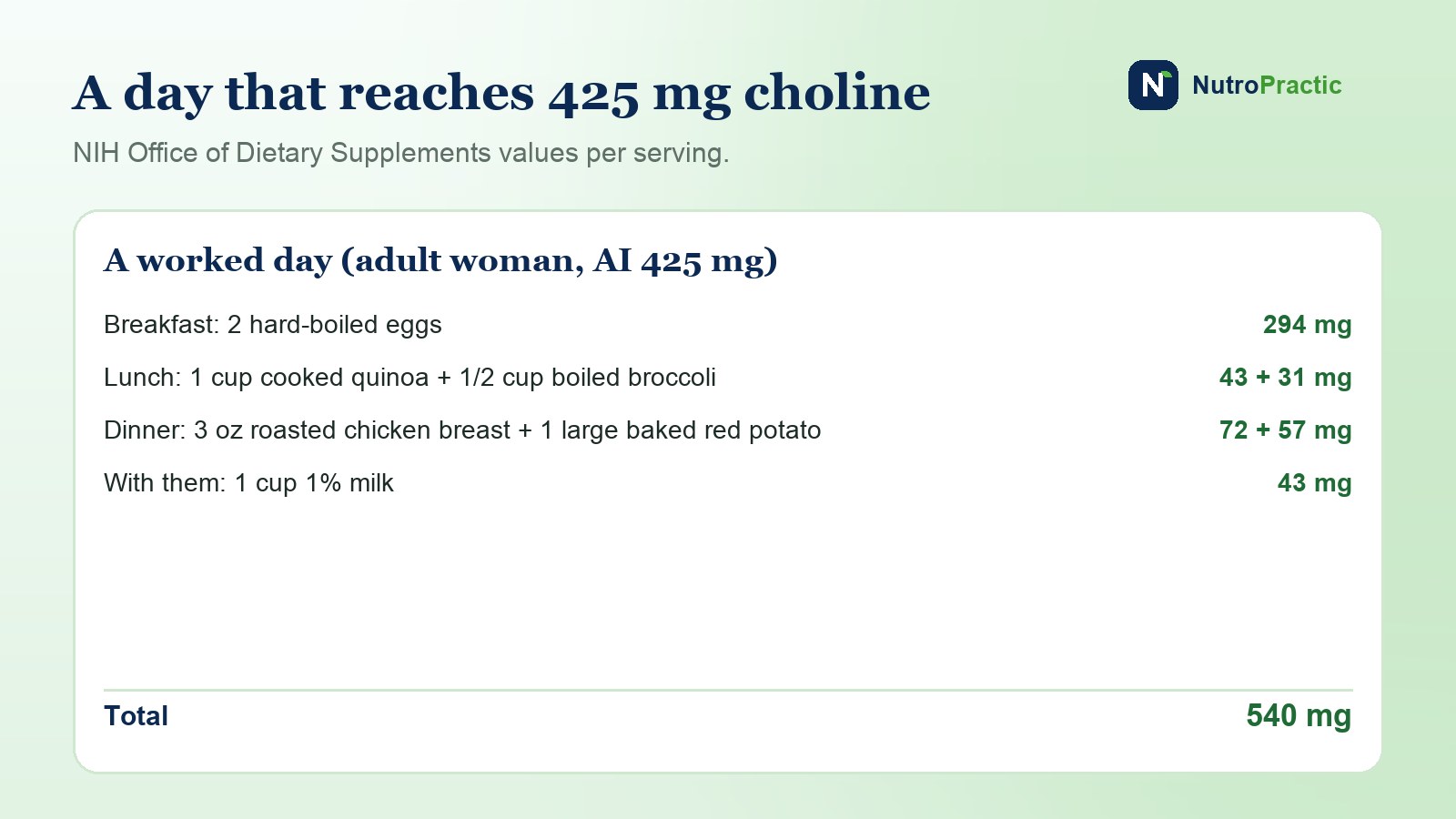
One worked day to 425 mg and beyond
- Breakfast: 2 hard-boiled eggs = 294 mg
- Lunch: 1 cup cooked quinoa (43) + 1/2 cup broccoli (31) = 74 mg
- Dinner: 3 oz roasted chicken (72) + 1 large baked red potato (57) = 129 mg
- With a meal: 1 cup 1% milk = 43 mg
Total: 540 mg. Now take the eggs out and the same day gives 246 mg, about 58% of a woman's target and 45% of a man's. That's how a normal vegan or egg-free day ends up where the survey averages sit. Swap eggs for roasted soybeans (107 mg), a bean or tofu dish and a larger serving of fish or lean meat, and you can get close; if you eat no animal foods at all, mention it to your doctor or dietitian, because a lab-checked plan is better than guessing.
Supplements: not a free pass
- The upper limit is 3,500 mg a day for adults from food and supplements together. Too much causes a fishy body odour, vomiting, heavy sweating and salivation, low blood pressure and liver toxicity.
- Gut bacteria turn some choline into TMA, which the liver converts to TMAO, a compound linked to heart disease risk. Large cohorts haven't found consistent links between choline intake and heart disease or peripheral artery disease, but a Nurses' Health Study / Health Professionals analysis (80,978 women, 39,434 men) found higher death risk at higher intakes, which the authors thought might be TMAO. It's unsettled, which is another reason to get choline from food first.
- Supplements add very little to the typical diet anyway. If you're pregnant or breastfeeding, you need more (450 / 550 mg) and prenatal vitamins often carry little choline, so food, and a conversation with your doctor, matter.
The short version
- Aim for 425 mg (women) or 550 mg (men). Most adults don't get there.
- The easy way is eggs, with fish, poultry, lean meat, soy, beans, quinoa, potatoes and cruciferous vegetables as backup.
- Post-menopause and people with the PEMT variant (you can't tell by looking) have the least slack.
- Choline protects the liver against fat build-up, but it isn't a cure for fatty liver. Weight, food quality and alcohol come first.
Told you have a fatty liver, or eat no eggs and no meat and wonder where your choline will come from? Dr. Triveni can check what you eat in a normal week and build a plan around the foods you like, in a virtual consultation.
Book a consultationThis article is general information, not medical advice. Talk to your doctor before taking choline supplements, especially if you are pregnant, breastfeeding or have liver disease.
Sources
NIH Office of Dietary Supplements, Choline: Health Professional Fact Sheet (Adequate Intakes, UL, food table, NHANES intakes, fatty liver studies, TMAO): https://ods.od.nih.gov/factsheets/Choline-HealthProfessional/. Fischer L.M. et al., Dietary choline requirements of women: effects of estrogen and genetic variation, Am J Clin Nutr 92(5):1113-1119 (2010), https://pmc.ncbi.nlm.nih.gov/articles/PMC2954445. Institute of Medicine, Dietary Reference Intakes for Thiamin, Riboflavin, Niacin, Vitamin B6, Folate, Vitamin B12, Pantothenic Acid, Biotin, and Choline (1998). Corbin K.D., Zeisel S.H., Choline metabolism provides novel insights into nonalcoholic fatty liver disease and its progression, Curr Opin Gastroenterol 28:159-165 (2012).