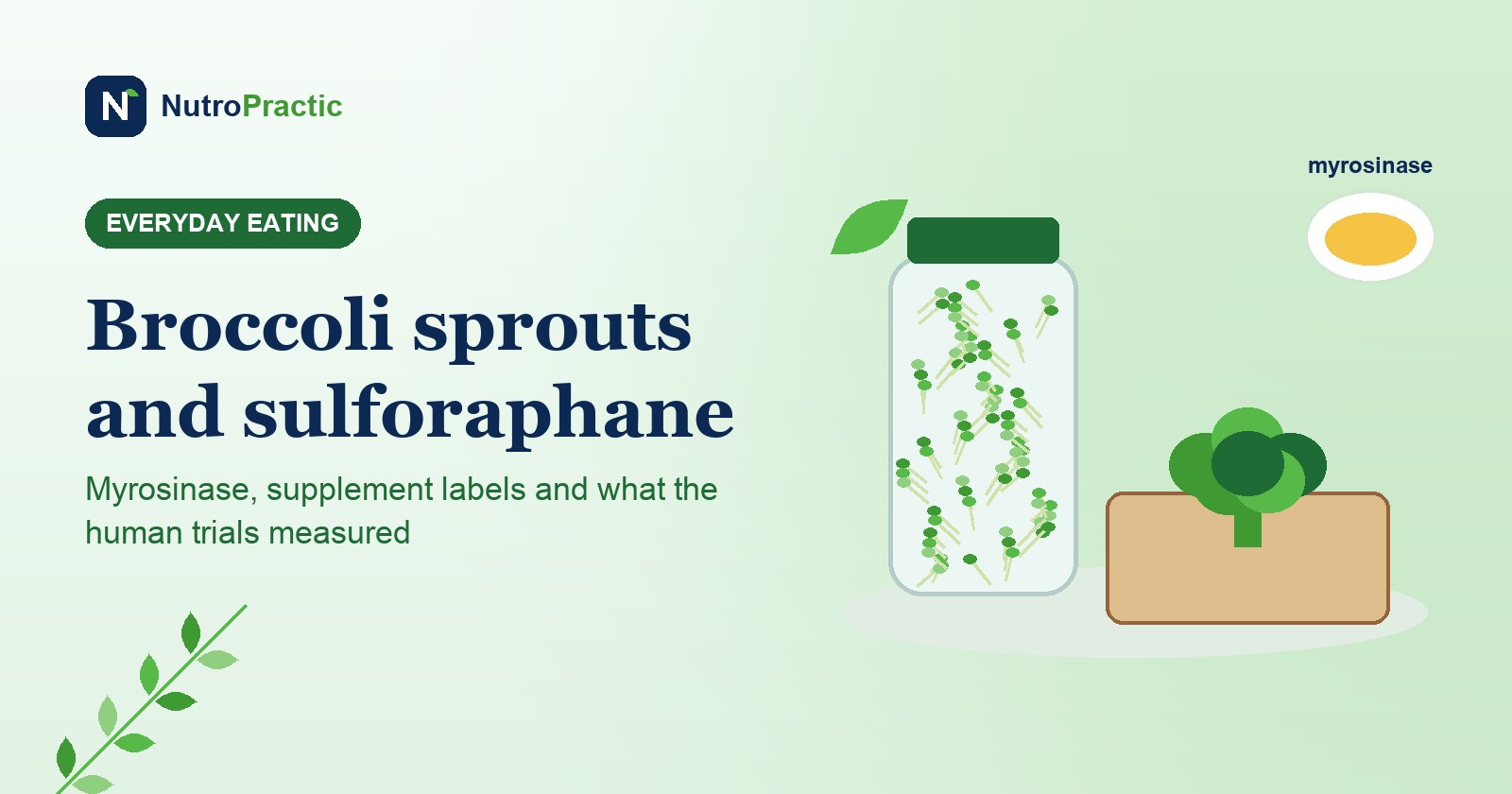
Broccoli sprouts get sold as a superfood, and the bottles of "sulforaphane" next to them promise even more. Here is what is actually in them, why a kitchen habit matters more than the label, and what the human trials did and did not find.
Short version: sulforaphane is not in the broccoli. It is made when the plant is chopped or chewed, and only if a particular enzyme is still alive.
How sulforaphane gets made
• An intact broccoli plant holds glucoraphanin, a stable sulphur compound.
• It also holds an enzyme, myrosinase, kept in separate compartments of the cell.
• Chop, chew or blend, and the two meet. Myrosinase turns glucoraphanin into sulforaphane, the compound the trials study.
• Heat destroys myrosinase. If it is gone, some of the conversion still happens later in your gut, done by bacteria, and that part varies a lot from person to person.
Why sprouts, and how much more they hold
Three-day-old broccoli sprouts hold roughly 10 to 100 times more glucoraphanin by weight than mature broccoli. The range is wide because it depends on the seed lot and how the sprouts were grown, so no pack can promise one number. Source: Linus Pauling Institute, Isothiocyanates.
Does cooking ruin it? A table of what was measured
| What you do | What the measurements showed |
|---|---|
| Eat raw sprouts or chopped raw broccoli, chewed well | Myrosinase is active. Best exposure of the options below. |
| Steam lightly, under about 5 minutes | Some myrosinase survives (LPI). |
| Boil or cook until soft | Plant myrosinase is gone. Exposure depends on your gut bacteria. |
| Cook the broccoli, then add 1 g of powdered brown mustard | Urinary sulforaphane metabolites rose from 9.8 to 44.7 umol per g creatinine, more than four times, in a 12-person crossover (Mol Nutr Food Res 2018). Mustard seed carries its own myrosinase. |
| Take a supplement with no active myrosinase | In one feeding study fresh broccoli gave about 8 times the plasma and 5 times the urinary metabolites of a myrosinase-free supplement (LPI). |
Practical read: chop it, let it sit a few minutes, and eat it raw or lightly steamed. If you cook it longer, a pinch of mustard powder puts the enzyme back (raw sprouts on top do too, but see the sprout warning below).
Reading a supplement label
• "Glucoraphanin" on the label is the starting material, not sulforaphane.
• Look for active myrosinase (sometimes "myrosinase-activated" or a mustard seed extract). Without it, you are depending on your gut bacteria.
• In one 45-person feeding study the average conversion of glucosinolates into usable products was about 12%, but individuals ranged from 1.1% to 40.7%. So the same pill can mean very different doses for two people.
• There is no agreed dose and no standard test of what a capsule delivers. Be wary of any label that claims one.
What the human trials measured
Almost all trials are small, short, and use different products, so they are hard to compare. Nulls are part of the picture:
| Trial | What was given | What happened |
|---|---|---|
| Axelsson 2017, type 2 diabetes (12 weeks, double-blind) | Broccoli sprout extract, 150 umol sulforaphane a day | Fasting glucose fell in the subgroup who were obese with poorly controlled diabetes. A subgroup effect in an early trial, not a treatment. |
| Singh 2014, autism (18 weeks) | Sulforaphane-rich extract, men aged 13 to 27, 29 vs 15 | Behaviour scores improved, then drifted back after stopping. Small. |
| Zimmerman, children with autism (3 to 12 years) | Sulforaphane vs placebo, 22 vs 23 analysed | No better than placebo on the main measure at 7 and 15 weeks. A promising signal that did not hold. |
| Yanaka 2009 | 70 g of sprouts a day for 2 months | Inflammation markers lower against alfalfa sprouts (LPI summary). |
| Cipolla 2015, after prostate surgery | 4.4 or 26.6 mg sulforaphane a day, 6 months | PSA rose less than on placebo (LPI summary). A marker, not survival. |
| Atwell 2015, before breast surgery | About 220 mg glucoraphanin a day from seed extract | No change in the markers measured (LPI summary). |
So: some surrogate markers moved in some trials, one replication in children failed, and none of this shows that sprouts prevent or treat any disease.
Safety, and who should skip raw sprouts
• Sulforaphane itself: no serious side effects have been reported in people. There is little safety data for purified or high-dose products in pregnancy and breastfeeding, so leave those out unless your doctor says otherwise.
• Raw sprouts are a food-poisoning risk. Sprouts are grown warm and wet, which suits bacteria such as Salmonella and E. coli. The FDA advises children, older adults, pregnant women and people with weakened immune systems to avoid raw or lightly cooked sprouts. Cooking them thoroughly kills the bacteria but also the enzyme, so these groups can use well-cooked broccoli with a little mustard powder instead.
• No drug interactions are known, but tell your doctor about any new supplement.
What to do with this
1. Eat crucifers regularly: broccoli, cabbage, cauliflower, kale. That habit has far more behind it than any capsule.
2. Chop it and let it sit a few minutes before it meets heat, and keep the cooking short.
3. Cooked it all the way? Add a little mustard powder.
4. Skip supplements unless your doctor has a reason. If you buy one, pick active myrosinase and do not expect a disease effect.
Related: if you have a thyroid condition and wonder where broccoli fits, see Hypothyroidism and food: soy, goitrogens, gluten and when to take levothyroxine.
Not sure how to fit more vegetables, or a supplement, into your plan? Dr. Triveni can look at your meals, labs and medicines together in a virtual consultation.
Book a consultationDisclaimer: This article is for general information and does not replace personal medical advice, diagnosis or treatment. Talk to your doctor or dietitian before you start a supplement, especially if you are pregnant, take medicines or have a health condition.
Scientific references
Linus Pauling Institute, Isothiocyanates, Oregon State University (reviewed summary of the trials and conversion figures above).
Effect of brown mustard powder on sulforaphane metabolite excretion from cooked broccoli, Mol Nutr Food Res 2018.
Axelsson A.S. et al., Sulforaphane reduces hepatic glucose production and improves glucose control in patients with type 2 diabetes, Sci Transl Med 9(394) (2017).
Singh K. et al., Sulforaphane treatment of autism spectrum disorder, PNAS (2014).
Zimmerman A.W. et al., placebo-controlled pilot study of sulforaphane in children with autism (trial NCT02561481).
U.S. Food and Drug Administration, Selecting and serving produce safely (sprouts advice).