Every winter, millions of people reach for fizzy 1,000 mg vitamin C tablets or mega-dose effervescent packets at the first sign of a scratchy throat. In popular culture, vitamin C is treated as a harmless, unlimited antioxidant where more is always better. The underlying human physiology tells a very different story.
Your gut does not absorb vitamin C passively. It relies on a saturable, rate-limited sodium-dependent active transporter (SVCT1). Once you exceed 200 to 400 mg in a single dose, intestinal absorption efficiency plunges, and your kidneys excrete the excess into your bladder within hours. Worse, a portion of mega-dosed ascorbic acid degrades into oxalate, doubling the risk of painful calcium oxalate kidney stones in men.
The pharmacokinetics: what happens at 200 mg vs 1,000 mg
In the late 1990s and early 2000s, Dr. Mark Levine and his colleagues at the National Institutes of Health (NIH) conducted rigorous depletion-repletion trials in healthy men and women confined to a metabolic hospital ward (Levine et al. 1996 PNAS, 2001 Ann Intern Med). They measured exact plasma, neutrophil, and urinary excretion curves across daily doses ranging from 30 mg to 2,500 mg:
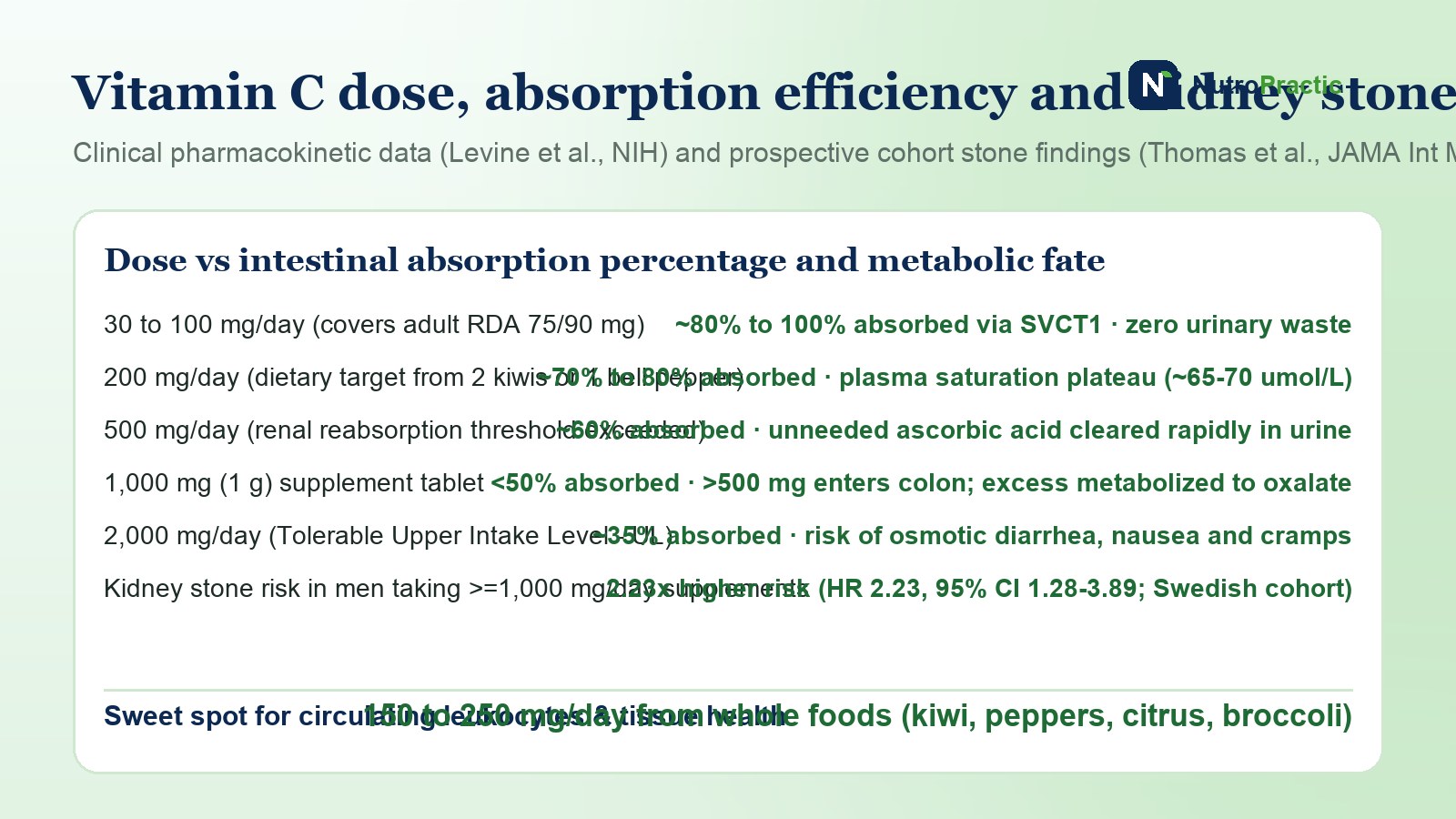
- At 30 to 100 mg/day (covers RDA): Intestinal absorption is near 100% efficient. Circulating white blood cells (neutrophils and lymphocytes) take up the vitamin avidly, and virtually zero ascorbic acid spills into the urine because renal tubules reabsorb all of it.
- At 200 mg/day (the physiological sweet spot): Absorption efficiency remains high at 75% to 80%. At this daily intake, steady-state plasma concentrations plateau at approximately 65 to 70 micromol/L, completely saturating circulating leukocytes and intracellular enzyme cofactors. Circulating tissues reach 100% of their biological storage capacity.
- At 500 mg/day: Absorption falls to around 60%. The renal reabsorption threshold (~60 micromol/L) is completely overwhelmed. Circulating plasma levels barely rise, while urinary excretion of unchanged ascorbic acid surges dramatically.
- At 1,000 mg/day (the standard retail tablet): Fractional absorption drops below 50%. More than 500 mg of unabsorbed ascorbic acid continues down into the large intestine, while the majority of what was absorbed is dumped by the kidneys into the bladder within 2 to 4 hours.
- At 2,000 mg/day and above: Fractional absorption collapses to under 35%. The heavy unabsorbed solute load in the bowel draws water via osmosis, causing gas, abdominal cramping, and osmotic diarrhea.
| Daily dose | Intestinal absorption | Steady-state plasma level | Urinary excretion | Primary biological fate |
|---|---|---|---|---|
| 75 to 90 mg (RDA) | ~90% to 100% | ~40 to 50 umol/L | Negligible | Complete cellular uptake, prevents scurvy |
| 200 mg | ~75% to 80% | ~65 to 70 umol/L | Trace to low | Full saturation of leukocytes & tissues |
| 500 mg | ~60% | ~70 to 75 umol/L | Substantial | Renal threshold saturated; excreted rapidly |
| 1,000 mg (1 g tablet) | <50% | ~75 to 80 umol/L | Heavy | >500 mg passes unabsorbed; kidneys excrete excess |
| 2,000 mg (Upper Limit) | ~30% to 35% | ~80 to 85 umol/L | Massive | Osmotic GI distress; heightened oxalate conversion |
What the common cold clinical trials actually found
The belief that vitamin C prevents common colds dates back to Linus Pauling's 1970 book Vitamin C and the Common Cold. But what do modern double-blind randomised controlled trials show?
In the definitive Cochrane Systematic Review (Hemilä & Chalker 2013), researchers analyzed 29 randomised trial comparisons involving 11,306 participants taking between 200 mg and 2,000 mg daily:
- Zero prevention in the general community: In regular community trials, regular daily vitamin C supplementation did not prevent colds. The Relative Risk (RR) was 0.97 (95% CI: 0.94 to 1.00), which is a statistically non-significant difference from a blank sugar pill. Taking 1,000 mg every morning does not stop viruses from infecting respiratory mucosa.
- A modest shortening of duration: In people who took vitamin C continuously before getting infected, cold duration was reduced by a modest 8% in adults (roughly equivalent to 10 to 12 hours shaved off a 6-day illness) and 14% in children.
- Therapeutic dosing after symptoms start fails: In 7 trials where participants waited until their first sneeze or sore throat to start taking 1 to 4 grams of vitamin C, there was no consistent or significant benefit on cold duration or symptom severity.
- The extreme stress exception: In 5 randomised trials involving 598 participants undergoing extreme physical exertion in freezing environments (marathon runners, subarctic military recruits, and competitive skiers), prophylactic vitamin C cut cold incidence in half (RR 0.48; 95% CI: 0.35 to 0.64). For an elite marathoner in cold weather, acute supplementation has evidence; for an office worker, it does not.
If you are looking for evidence-based cold remedies that actually shorten duration once sick, zinc lozenges show much stronger clinical data. Check our detailed guide on zinc lozenge trial doses and timing.
The dark side of 1,000 mg tablets: kidney stones
Vitamin C is water-soluble, but that does not mean it is metabolically inert. When excessive ascorbic acid enters the bloodstream, hepatic and renal enzymes metabolize a significant fraction into dehydroascorbic acid, 2,3-diketogulonic acid, and ultimately oxalate.
In the urinary collecting ducts, oxalate binds tightly with free calcium to form sharp, insoluble calcium oxalate stones, which account for over 80% of all nephrolithiasis cases:
- Thomas et al. 2013 (JAMA Internal Medicine): In a prospective cohort of 23,355 Swedish men followed for 11 years, men who reported taking supplemental vitamin C (typically 1,000 mg effervescent tablets) experienced double the risk of developing kidney stones compared to non-users (Hazard Ratio 2.23; 95% CI: 1.28 to 3.89).
- Harvard Health Professionals Follow-Up Study (Ferraro et al. 2016): In a 20-year analysis of over 150,000 men and women, men consuming 1,000 mg/day or more of supplemental vitamin C had a 19% to 43% higher risk of incident kidney stones. Crucially, high dietary intake of vitamin C from fresh fruits and vegetables showed no increased stone risk.
- Why food is safe: Fruits and vegetables provide ascorbic acid in moderate, steady doses (50 to 100 mg per serving) accompanied by potassium citrate and water. Dietary citrate alkalizes urine and acts as a powerful natural inhibitor of calcium oxalate crystallization, neutralizing stone risk.
For anyone with a personal or family history of nephrolithiasis, daily 1,000 mg tablets are a clear hazard. Read our comprehensive review on kidney stones, dietary calcium, oxalate, and citrate for deeper guidance on urinary crystal prevention.
Getting your 200 mg from the kitchen in real milligrams
The physiological saturation target identified by the NIH (~200 mg daily) is effortlessly achieved through everyday food without pills:
| Food item | Typical kitchen portion | Vitamin C (mg) | % of daily saturation target (200 mg) |
|---|---|---|---|
| Guava (fresh, pink/white) | 1 medium fruit (100 g) | 228 mg | 114% (exceeds total target in one fruit!) |
| Yellow bell pepper | 1/2 cup raw chopped (75 g) | 137 mg | 68% |
| Red bell pepper | 1/2 cup raw chopped (75 g) | 95 mg | 48% |
| Kiwi fruit | 2 medium peeled (140 g) | 128 mg | 64% |
| Fresh strawberries | 1 cup sliced (150 g) | 89 mg | 45% |
| Papaya | 1 cup diced (145 g) | 88 mg | 44% |
| Orange (fresh whole) | 1 medium fruit (130 g) | 70 mg | 35% |
| Broccoli (lightly steamed) | 1/2 cup cooked (80 g) | 51 mg | 26% |
| Brussels sprouts (cooked) | 1/2 cup cooked (80 g) | 48 mg | 24% |
| Lemon juice | Fresh juice of 1 lemon (45 ml) | 18 mg | 9% |
A single kiwi fruit with breakfast and half a sliced red bell pepper with dinner provides 160 mg of natural vitamin C. That completely saturates your circulating neutrophils and monocytes, supplies co-occurring flavonoids like quercetin and hesperidin, and generates zero excess oxalate in your kidneys.
Other supplement cautions: iron overload and rebound scurvy
Two additional clinical cautions are worth knowing before mega-dosing:
- Non-heme iron hyperabsorption: Vitamin C reduces ferric iron (Fe3+) to ferrous iron (Fe2+), dramatically increasing iron uptake in the duodenum. While this is helpful for people with iron-deficiency anemia, it is dangerous for individuals with hereditary hemochromatosis or iron overload mutations. Check our guide on oral iron, hepcidin, and absorption kinetics.
- Hepatic enzyme upregulation (rebound phenomenon): Chronic mega-dosing (>2,000 mg/day for months) induces hepatic clearance enzymes. If you abruptly discontinue mega-dosing, your upregulated enzymes can temporarily clear normal dietary vitamin C too fast, triggering transient gum tenderness and fatigue until metabolic homeostasis resets.
What we'd do
- Ditch the 1,000 mg fizzy tablets: Unless medically prescribed for severe malabsorption or IV critical care, stop taking 1,000 mg pills. You are paying for expensive, stone-promoting urine.
- Aim for 150 to 250 mg daily from food: Two kiwis, a cup of strawberries, or half a bell pepper each day provides 100% of the active transport capacity your leukocytes can physically use.
- If you must supplement, take 100 to 250 mg: If travel or illness makes fresh fruit difficult, choose a low-dose 100 mg or 250 mg tablet rather than a 1,000 mg horse pill. Your gut will absorb 80% instead of 45%.
- Protect your kidneys with hydration: If you take any supplements, drink plenty of water throughout the day to keep urine dilute, particularly in hot climates or during intense training.
Want evidence-based dietary guidance tailored to your health goals, micronutrient blood work, and kidney health? Dr. Triveni provides customized virtual nutrition and wellness consultations.
Book a consultationThis article is general nutritional information, not medical advice. Consult your doctor or nephrologist before taking high-dose supplements, particularly if you have kidney disease, a history of kidney stones, or hemochromatosis.
Sources
Levine M. et al., Vitamin C pharmacokinetics in healthy volunteers: evidence for a recommended dietary allowance, Proc Natl Acad Sci U S A 1996;93(8):3704-3709 (PubMed 8623000); Levine M. et al., A new recommended dietary allowance of vitamin C for healthy young women, Proc Natl Acad Sci U S A 2001;98(17):9842-9846; Hemila H., Chalker E., Vitamin C for preventing and treating the common cold, Cochrane Database Syst Rev 2013;(1):CD000980 (PubMed 23440782); Thomas L.D.K. et al., Ascorbic acid supplements and kidney stone incidence among men: a prospective study, JAMA Intern Med 2013;173(5):386-388 (PubMed 23381623); Ferraro P.M. et al., Total, dietary, and supplemental vitamin C intake and risk of incident kidney stones, Am J Kidney Dis 2016;67(3):400-407 (PubMed 26463139); Institute of Medicine, Dietary Reference Intakes for Vitamin C, Vitamin E, Selenium, and Carotenoids, National Academies Press 2000; USDA FoodData Central (Guavas, FDC ID 173044; Peppers, sweet, yellow, raw, FDC ID 170104; Kiwifruit, green, raw, FDC ID 168153; Oranges, raw, FDC ID 169097). Read 20 Nov 2026.