Brightly coloured electrolyte packets have turned plain drinking water into a massive wellness trend. Advertisements suggest that unless your morning water is spiked with sodium and magnesium, you are chronically dehydrated and operating at a deficit.
Before dropping a $2 packet into every water bottle, look at the numbers on the back. Some mixes deliver over 1,000 mg of sodium in a single glass—nearly half your total daily limit. Others pack 11 grams of added cane sugar. Here is how the labels compare, what your body actually loses in sweat, and when plain tap water is all you need.
Four labels, one fair comparison
We examined four widely available electrolyte products alongside the World Health Organization's clinical oral rehydration formula. Here is what one packet or standard serving delivers:
| Product / Formula | Sodium (mg) | Potassium (mg) | Sugar (g) | Calories & Sweeteners |
|---|---|---|---|---|
| Liquid I.V. Hydration Multiplier | 500 mg (22% DV) | 370 mg | 11 g added sugar | 45 kcal; cane sugar + stevia |
| LMNT Recharge | 1,000 mg (43% DV) | 200 mg | 0 g | 5–10 kcal; stevia (has 60 mg Mg) |
| Nuun Sport (1 tablet) | 300 mg (13% DV) | 150 mg | 1 g | 15 kcal; stevia (has 25 mg Mg) |
| Gatorade Thirst Quencher (20 oz / 591 ml) | 270 mg (12% DV) | 75 mg | 34 g added sugar | 140 kcal; sucrose + dextrose |
| WHO Low-Osmolarity ORS (per 1 litre) | 1,725 mg (75 mmol/L) | 780 mg (20 mmol/L) | 13.5 g glucose | Clinical rehydration formulation |
Notice the massive variation in sodium: Nuun delivers 300 mg, Liquid I.V. delivers 500 mg, and LMNT delivers 1,000 mg of sodium—the equivalent of 2.5 grams of table salt in a single 16-ounce mug.
The physiology of sweat: what do you actually lose?
To know whether you need an electrolyte powder, you have to compare its label against human sweat physiology. In sports medicine trials (such as Baker et al. in Sports Medicine), sweat composition was analysed across thousands of athletes:
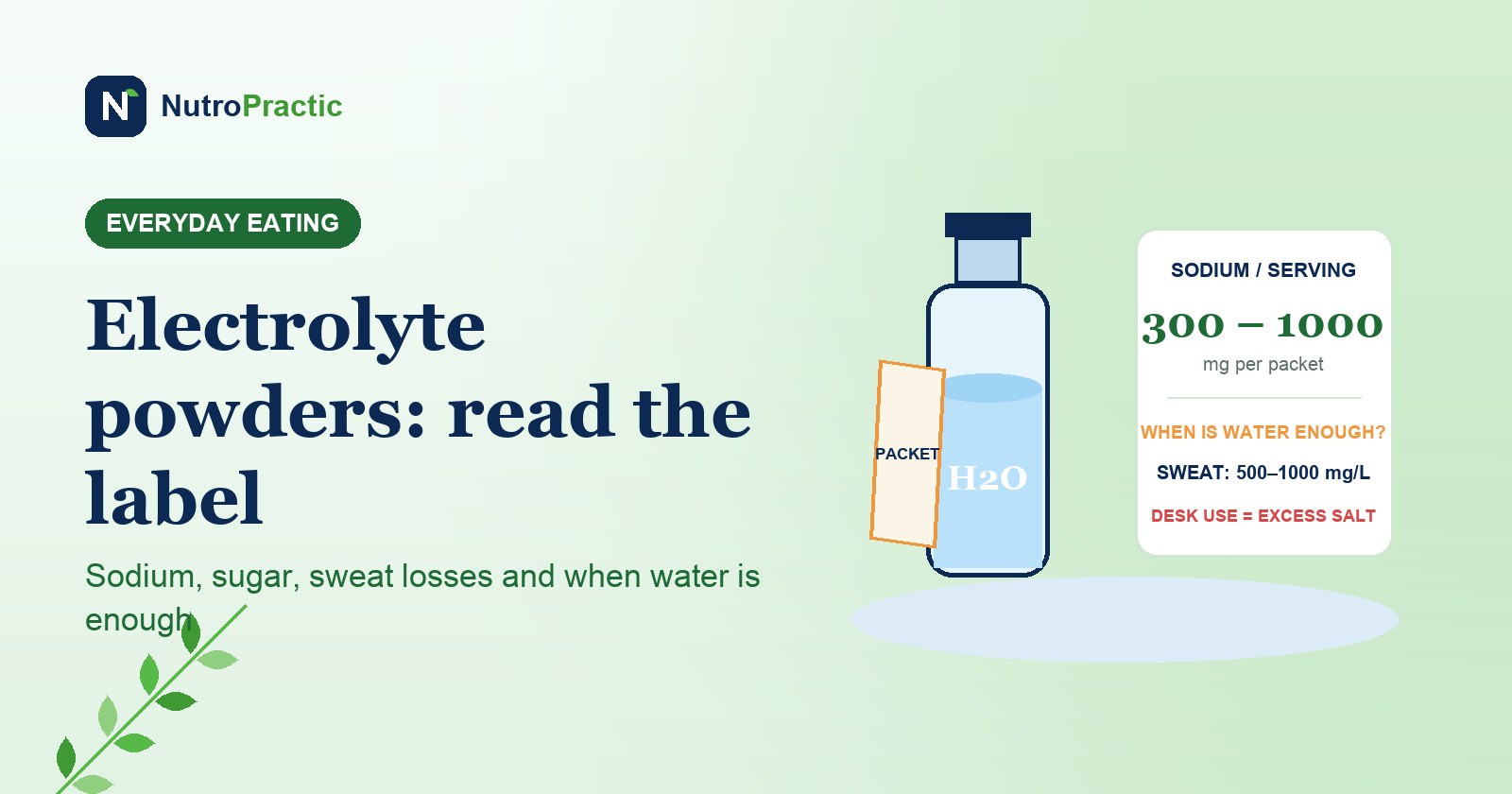
• Sweat is hypotonic: Normal human blood has a sodium concentration of 135 to 145 mmol/L. Human sweat has an average sodium concentration of only 20 to 60 mmol/L (about 460 mg to 1,380 mg of sodium per litre of sweat, with a population average around 800–900 mg/L).
• Sweat is mostly water: Because sweat contains significantly less sodium than blood, sweating actually causes your blood sodium concentration to rise slightly during normal exercise, not drop. Your brain detects this concentration and triggers thirst to make you drink water.
• Potassium and magnesium losses in sweat are tiny: Sweat contains only about 4 to 8 mmol/L of potassium (150 to 300 mg/L) and negligible magnesium (less than 5 mg/L). Heavy muscle cramps are almost never caused by whole-body magnesium depletion from sweat.
Now look at a typical day. A person doing a brisk 40-minute walk or lifting weights in an air-conditioned gym typically loses between 0.3 and 0.6 litres of sweat—roughly 250 to 500 mg of sodium total. You do not need a 1,000 mg sodium supplement to replace that.
The diet math: you already eat plenty of salt
The most overlooked variable in electrolyte marketing is everyday food. The World Health Organization recommends consuming less than 2,000 mg of sodium per day (about 5 grams of salt), and the American Heart Association sets an ideal limit of 1,500 mg/day for adults with elevated blood pressure.
In reality, dietary surveys show:
• In the US, Canada, the UK, and Europe, average adult sodium intake is 3,400 to 3,600 mg per day, coming primarily from bread, cheese, soups, restaurant meals, and processed foods.
• In India, comprehensive dietary studies (such as ICMR-NIN assessments) show average daily salt consumption is 8 to 10 grams (roughly 3,200 to 4,000 mg of sodium), driven by pickles, curries, snacks, and salted dough.
If you already consume 3,500 mg of sodium from your regular meals, adding two LMNT packets (2,000 mg) or three Liquid I.V. packets (1,500 mg) pushes your daily sodium to 5,000–5,500 mg. For salt-sensitive individuals, that surplus increases extracellular fluid volume and raises systolic blood pressure. Our salt, potassium and blood pressure analysis details how excess sodium affects vascular resistance.
Why do some powders have 11 grams of sugar?
Brands like Liquid I.V. market 'Cellular Transport Technology' and contain 11 grams of cane sugar per stick. That is not an accident or cheap filler; it relies on a genuine biological mechanism discovered in the 1960s.
The small intestine contains the sodium-glucose cotransporter 1 (SGLT-1). SGLT-1 actively transports two sodium ions and one glucose molecule across the intestinal lining together. This creates an osmotic pressure gradient that pulls water molecules rapidly into the bloodstream.
This glucose-sodium pairing is what makes the WHO Oral Rehydration Solution one of the greatest medical breakthroughs in history, saving tens of millions of lives from acute dehydrating diarrhoeal diseases like cholera. When the gut is inflamed, passive water absorption fails, but the SGLT-1 cotransporter still works.
However, if you are sitting at an office desk or doing an easy 30-minute jog, your intestinal tract absorbs plain water easily through passive osmosis. You do not need 11 grams of added sugar to absorb water when you are healthy and eating regular meals. See our guide on how much water you actually need for daily fluid balance.
Who actually needs an electrolyte powder?
Electrolyte supplements have legitimate, evidence-based applications, but they belong in specific circumstances:
1. Endurance training over 60 to 90 minutes: If you are running, cycling, or playing competitive sport for longer than an hour, continuous sweat loss accumulates. Replacing water alone over several hours can dilute blood sodium, creating risk for exercise-associated hyponatremia. An electrolyte drink with 300 to 500 mg sodium per 500 ml is warranted.
2. Heavy, salty sweaters in high heat: Some individuals lose 1.5 to 2.5 litres of sweat per hour with high sodium concentrations (evident from white salt rings on workout shirts and stinging eyes). In hot or humid climates, targeted sodium replacement prevents dizziness and heat cramps.
3. Acute illness with fluid loss: Bouts of gastroenteritis, food poisoning, vomiting, or diarrhoea deplete water and electrolytes rapidly. A standardised low-osmolarity oral rehydration packet (like WHO ORS, Hydralyte, or Pedialyte) is clinical therapy.
4. Strict ketogenic or carnivore diets (first 2–3 weeks): When carbohydrate intake drops below 30 g/day, circulating insulin falls. Lower insulin prompts the kidneys to excrete more sodium (natriuresis of fasting), leading to the 'keto flu' (headaches, lethargy). A temporary sodium supplement or drinking salted broth can ease transition symptoms.
5. Clinical conditions like POTS: Patients diagnosed with Postural Orthostatic Tachycardia Syndrome or orthostatic hypotension are frequently prescribed high sodium (3,000 to 5,000 mg/day) and high fluid volume by their cardiologists to expand intravascular blood volume.
Who should be cautious or skip them?
• People with high blood pressure: If you have stage 1 or 2 hypertension, adding 1,000 mg of sodium to your daily intake directly opposes your dietary management and antihypertensive medications.
• Chronic kidney disease (CKD) or heart failure: Impaired kidneys struggle to clear sodium and potassium loads. Consuming commercial electrolyte powders can lead to fluid retention, peripheral oedema, or dangerous hyperkalemia (high blood potassium).
• Desk workers and light exercisers: If your main exercise is a 30-minute walk or a low-intensity gym session, your ordinary meals will restore any lost minerals. Plain water, tea, or water with a squeeze of lemon is completely adequate.
A simple 15-second decision rule
• Sweating for less than an hour? Drink plain water. Your next meal will provide all the sodium, potassium, and chloride you need.
• Training hard in the heat for over 90 minutes? Use an electrolyte mix with 300 to 500 mg of sodium per 500 ml.
• Looking for a budget option? 1 litre of water + 1/4 teaspoon table salt (about 575 mg sodium) + a squeeze of fresh lemon and a teaspoon of honey gives you an effective, clean hydration drink for pennies.
Electrolyte powders are sports medicine tools, not daily desk accessories. Match sodium and glucose to your actual sweat losses, not to social media hydration hype.
Curious about your hydration, blood pressure, sodium balance, and everyday nutrition? Dr. Triveni provides individualized dietary consultations to keep your markers on track.
Book a consultationThis article is for general informational purposes only and does not replace professional medical advice. Individuals with high blood pressure, kidney disease, heart failure, or those taking ACE inhibitors, ARBs, or diuretics should consult their physician before using high-sodium or high-potassium supplements.
Sources
Official nutrition labels, accessed November 2026: Liquid I.V. Hydration Multiplier (Lemon Lime), LMNT Recharge Electrolyte Drink Mix, Nuun Sport Effervescent Tablets, and Gatorade Thirst Quencher. Clinical standards: World Health Organization, Oral Rehydration Salts (ORS): A new reduced osmolarity formulation (WHO/FCH/CAH/06.1).
Baker L.B. et al., Sweat electrolyte analysis: methods, challenges and best practices, Sports Medicine 47(Suppl 1):111–128 (2017). Barnes K.A. et al., Normative data for sweat rate, sweat sodium concentration, and sweat sodium loss in athletes: An update, Journal of Sports Sciences 37(20):2356–2366 (2019).
American Heart Association, Sodium and Salt Guidelines (2024 update). Hew-Butler T. et al., Statement of the 3rd International Exercise-Associated Hyponatremia Consensus Development Conference, British Journal of Sports Medicine 49:1432–1446 (2015).