For decades, the standard household and clinical advice given to women with recurrent urinary tract infections (rUTIs) has been almost reflexive: "Drink cranberry juice." Millions of women have dutifully purchased jugs of supermarket cranberry cocktail, drank glass after glass through uncomfortable episodes, and still found themselves sitting in urgent care 72 hours later clutching a prescription for another round of broad-spectrum antibiotics.
This disconnect between common folklore and clinical reality has led many patients—and even physicians—to dismiss cranberry products altogether as an outdated myth. However, contemporary molecular biology and rigorous clinical trials tell a vastly different, more nuanced story. The problem is not that cranberry compounds lack efficacy; the problem is that standard grocery-store cranberry cocktails are biologically useless for preventing bacterial colonization, while also delivering massive quantities of refined sugar that can actively aggravate urinary and metabolic health.
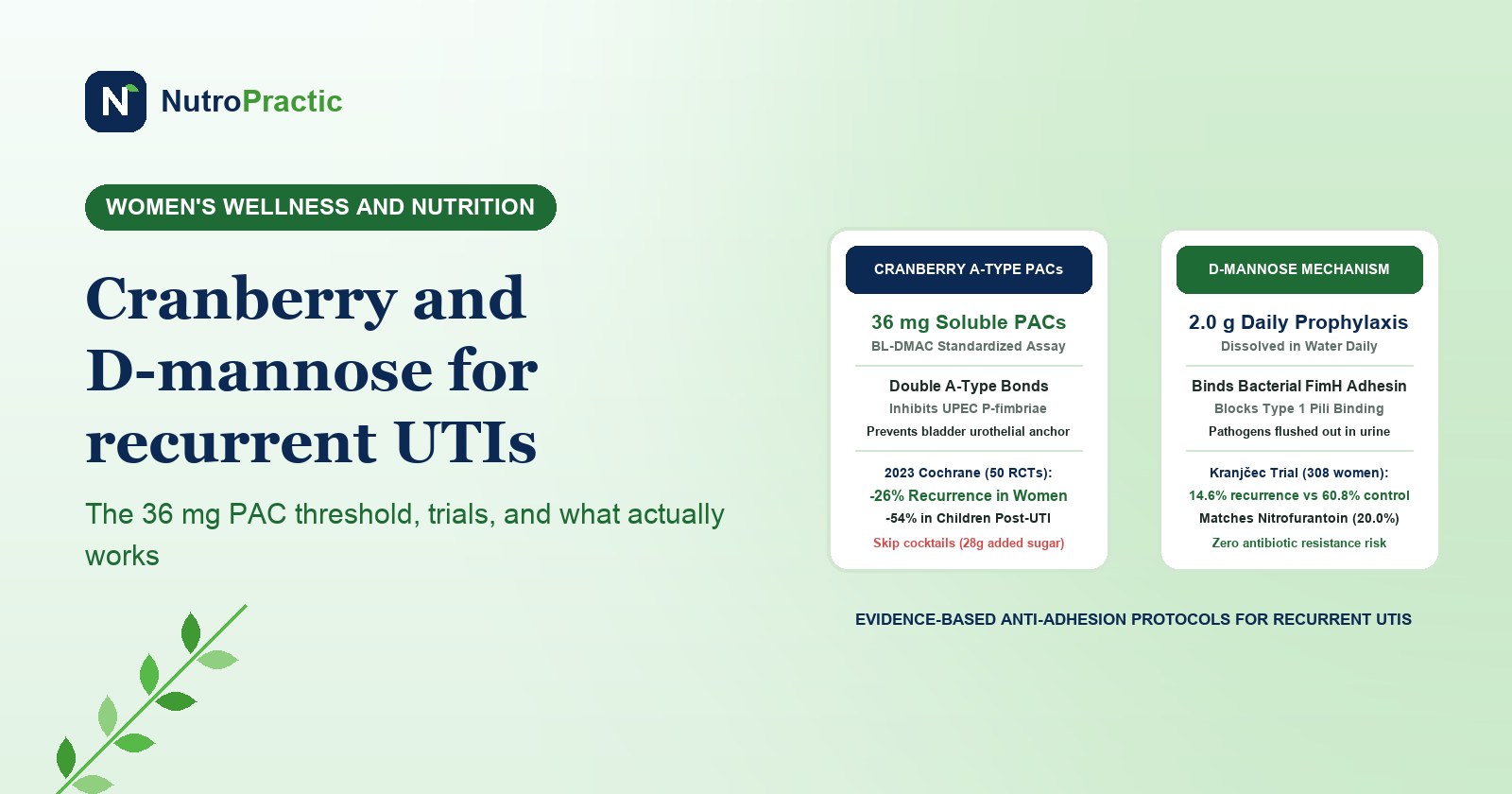
To achieve genuine, measurable clinical prevention against recurrent UTIs, two precise criteria must be met: reaching a verified 36 mg threshold of soluble A-type proanthocyanidins (PACs) quantified by standardized BL-DMAC assay, or deploying 2 grams of daily D-mannose to competitively disable bacterial docking pili. To understand how systemic nutritional inputs and mucosal barriers interact to protect tissues against chronic inflammation, see our review on anti-inflammatory dietary patterns.
Let us examine the molecular mechanisms of uropathogenic bacterial adhesion, the updated 2023 Cochrane systematic review, landmark randomized controlled trials comparing D-mannose to daily prophylactic antibiotics, and how Dr. Triveni structures an evidence-based clinical prevention protocol.
How uropathogenic E. coli (UPEC) colonizes the bladder
To understand why anti-adhesion therapy works, one must first understand how an uncomplicated urinary tract infection begins. Upwards of 80% to 85% of community-acquired UTIs are caused by a specialized subset of bacteria known as Uropathogenic Escherichia coli (UPEC). These strains originate in the rectal microbiome, migrate across the perineum to colonize the periurethral space, ascend the urethra, and enter the bladder.
Under normal physiological conditions, the urinary bladder is an inhospitable, self-cleaning environment. Every time a person urinates, the mechanical shear force of hydrodynamic urine flow flushes out unattached micro-organisms. To survive this flushing force and establish infection, UPEC strains deploy specialized filamentous protein tentacles called fimbriae (or pili) that anchor directly into the bladder wall:
• Type 1 Pili (tipped with FimH adhesin): These hair-like projections cover the bacterial surface. At the very tip of each pilus sits a specialized lectin called FimH. FimH binds with nanomolar affinity to terminal D-mannose residues on uroplakin 1a (UP1a) glycoproteins that coat the apical surface of umbrella cells lining the bladder epithelium (urothelium). This initial lock-and-key docking triggers host cell signaling, allowing bacteria to be engulfed into the intracellular space.
• P-Fimbriae (tipped with PapG adhesin): Pyelonephritis-associated pili (P-fimbriae) are specialized structures that recognize and bind alpha-D-galactopyranosyl-(1→4)-beta-D-galactopyranoside carbohydrate epitopes present on urothelial cells and renal tubular epithelium. P-fimbriae are especially critical for ascending infection into the ureters and renal parenchyma.
• Intracellular Bacterial Communities (IBCs): Once anchored and internalized within umbrella cells, UPEC can replicate rapidly into biofilm-like pods known as intracellular bacterial communities. Shielded inside the host urothelium, these bacteria escape neutrophils and broad-spectrum antibiotics. When umbrella cells naturally exfoliate, IBCs burst, spilling thousands of bacteria back into the bladder lumen to seed a new recurrent infection. Preventing the initial attachment is therefore the single most critical intervention in halting the chronic recurrence cycle.
Bacterial adhesion is the indispensable prerequisite for urothelial invasion. If UPEC cannot anchor its pili to mucosal receptors, hydrodynamic urine flow washes the pathogen out before an inflammatory cascade can take hold.
Cranberry A-type vs B-type PACs: The molecular difference
For decades, it was mistakenly believed that cranberry prevented UTIs simply by "acidifying the urine" via benzoic and hippuric acid excretion. Modern biochemistry has thoroughly disproved this hypothesis: normal dietary amounts of cranberry do not lower urinary pH sufficiently to inhibit bacterial replication. Instead, the true active constituents are proanthocyanidins (PACs), which are complex polyphenol polymers composed of flavan-3-ol subunits.
However, not all PACs are created equal. In botanical nutrition, PACs are categorized based on their interflavanoid linkages:
1. B-Type Proanthocyanidins: Found abundantly in common foods such as apples, grapes, red wine, dark chocolate, and blueberries. In B-type PACs, the flavan-3-ol units are connected by a single interflavanoid carbon-carbon bond (typically C4→C8 or C4→C6). Extensive research demonstrates that B-type PACs exhibit zero bacterial anti-adhesion activity against UPEC in human urine. Consuming foods rich in B-type PACs does not protect the urinary tract.
2. A-Type Proanthocyanidins: Found in high concentrations almost exclusively in the North American cranberry (Vaccinium macrocarpon) and lingonberry. A-type PACs feature an additional ether cross-linkage between C2 and O-C7 (creating a dual C4→C8, C2→O→C7 interflavanoid bond). This rigid double-bond geometry creates a specific steric conformation that allows the molecule to bind to bacterial surface appendages, altering surface hydrophobicity, changing bacterial morphology from rod to spherical, and functionally disabling P-fimbriae from latching onto urothelial receptors.
The 36 mg PAC threshold and the BL-DMAC assay
Knowing that cranberry contains A-type PACs is not enough; one must know the exact dose required to achieve clinical anti-adhesion in living human urine. In groundbreaking clinical pharmacokinetic studies led by Dr. Amy Howell at Rutgers University, researchers administered graded doses of standardized cranberry powder to healthy volunteers and collected urine over 24 hours to measure ex vivo anti-adhesion activity against uropathogenic E. coli.
The Howell trials established three pivotal pharmacokinetic facts:
• A dose-dependent response: Doses containing 18 mg of PACs yielded only weak, transient anti-adhesion activity that waned within 6 to 8 hours. However, a single dose containing 36 mg of soluble PACs induced potent, highly significant bacterial anti-adhesion activity that peaked between 6 and 12 hours and remained clinically active for up to 24 full hours.
• The BL-DMAC assay standard: The supplement marketplace is flooded with products claiming "500 mg cranberry extract" or "concentrated 50:1 ratio," yet when tested in independent analytical laboratories, the vast majority contain less than 2 to 5 mg of active PACs. Many manufacturers use non-specific European Pharmacopoeia (Ph. Eur.) spectrophotometric methods or UV-Vis assays that measure total polyphenols, anthocyanins, and sugars, falsely reporting enormous PAC numbers. Clinical efficacy requires verification by the BL-DMAC (Brunswick Laboratories 4-dimethylaminocinnamaldehyde) assay, the validated international standard specifically calibrated to soluble A-type PAC dimers and trimers.
• Daily continuous dosing: Because cranberry metabolites are cleared renally within 24 hours, anti-adhesion protection is non-cumulative. A patient who takes a 36 mg PAC capsule on Monday is unprotected by Wednesday unless the supplement is taken consistently on a daily schedule.
Clinical trial evidence: The 2023 Cochrane Systematic Review
For years, medical meta-analyses on cranberry yielded conflicting conclusions. In April 2023, the Cochrane Collaboration published an exhaustive updated systematic review (Williams et al., Cochrane Database of Systematic Reviews), evaluating 50 randomized controlled trials (RCTs) encompassing 8,862 participants. This update fundamentally settled the debate regarding cranberry's preventive efficacy:
• 26% reduction in recurrent UTIs in women: Across randomized clinical trials comparing cranberry products against placebo or no treatment in women with a history of recurrent UTIs, cranberry reduced the risk of repeat symptomatic, culture-confirmed UTIs by 26% (Risk Ratio [RR] 0.74, 95% Confidence Interval [CI] 0.55 to 0.99; moderate-certainty evidence).
• 54% risk reduction in pediatric populations: In children with recurrent UTIs or neurogenic bladder, cranberry products demonstrated an even more dramatic 54% reduction in UTI recurrence (RR 0.46, 95% CI 0.32 to 0.68).
• 53% reduction in post-intervention patients: In individuals susceptible to UTIs following medical interventions (such as bladder catheterization or gynecological surgery), cranberry interventions cut symptomatic infection rates by 53% (RR 0.47, 95% CI 0.37 to 0.59).
Crucially, the Cochrane investigators highlighted that trial results varied dramatically based on the delivery vehicle. Trials that utilized juice formulations suffered from high participant dropout rates (up to 30–40%) due to unpalatability, acid reflux, and GI upset. Conversely, trials utilizing standardized oral capsules demonstrated superior compliance, consistent pharmacokinetic exposure, and significantly stronger clinical risk reduction.
D-Mannose: The molecular decoy that traps FimH
While cranberry PACs target P-fimbriae, an equally potent non-antibiotic agent targets Type 1 pili: D-mannose. D-mannose is a naturally occurring simple aldohexose carbohydrate (a C-2 epimer of glucose) that plays a critical role in human glycosylation.
When ingested orally, D-mannose exhibits a unique pharmacokinetic profile. Unlike glucose, D-mannose is absorbed rapidly in the upper gastrointestinal tract via sodium-dependent glucose cotransporters (SGLT4) but is largely ignored by hepatic hexokinase. Over 90% of absorbed D-mannose remains unmetabolized, passes through the systemic circulation without causing blood glucose spikes, and is rapidly filtered by the renal glomeruli directly into the bladder within 30 to 60 minutes.
Once inside the urinary bladder, D-mannose functions as an elegant competitive molecular decoy:
1. UPEC Type 1 pili rely on the adhesin protein FimH to dock onto mannose-rich uroplakin 1a receptors on the bladder wall.
2. When a woman ingests therapeutic D-mannose, the bladder lumen fills with trillions of free D-mannose molecules.
3. The bacterial FimH adhesin binds to these free floating D-mannose molecules with high affinity, effectively "capping" the bacterial pili.
4. Blinded and fully saturated, the bacteria cannot anchor to the urothelium. When the patient voids, the bacteria are harmlessly flushed out with the urine.
The landmark Kranjčec Trial: D-mannose vs Nitrofurantoin
Does this elegant molecular decoy actually prevent real-world clinical infections in women suffering from chronic recurrences? The definitive answer came from a landmark prospective randomized trial published in the World Journal of Urology by Dr. Bojana Kranjčec and colleagues.
The study followed 308 women with an acute uncomplicated UTI and a documented medical history of recurrent UTIs. After initial acute antibiotic treatment with ciprofloxacin, all 308 women were confirmed culture-negative and symptom-free. They were then randomized into three distinct groups for 6 months of continuous prophylaxis:
• Group 1 (D-Mannose): 103 women received 2 grams of D-mannose powder dissolved in 200 mL of water once daily in the evening.
• Group 2 (Antibiotic Prophylaxis): 103 women received 50 mg of Nitrofurantoin (a standard daily prophylactic antibiotic) once daily at bedtime.
• Group 3 (Control / No Prophylaxis): 102 women received no preventive therapy.
The 6-month clinical outcomes were striking:
• In the control group, 60.8% of women (62 of 102) suffered a recurrent symptomatic UTI.
• In the Nitrofurantoin group, recurrence dropped sharply to 20.0% (21 of 103).
• In the D-mannose group, recurrence dropped even further to 14.6% (15 of 103), demonstrating statistically significant superiority over control and therapeutic non-inferiority to daily antibiotic prophylaxis.
The most profound clinical difference lay in safety and tolerability. While the prophylactic antibiotic group suffered a 17.9% adverse event rate (predominantly nausea, gastric burning, diarrhea, and secondary vaginal candidiasis), the D-mannose group experienced only a 4.2% adverse event rate, limited exclusively to mild, transient loose stools that did not require discontinuing therapy.
The supermarket cocktail trap: 28 grams of added sugar
When patients ask Dr. Triveni whether they can simply drink commercial cranberry juice cocktail from the grocery aisle, the answer is an emphatic clinical no. An examination of retail nutrition facts panels explains why standard juice drinks are actively counterproductive:
• Heavy sugar load: A standard 8 fl oz (240 mL) glass of commercial cranberry cocktail contains 28 to 32 grams of total sugar—almost all of it high-fructose corn syrup or added sucrose, included to mask cranberry's natural bitterness. A patient drinking two glasses a day ingests 56 to 64 grams of refined sugar, exceeding the American Heart Association's entire daily recommended sugar limit.
• Aggravation of bladder and vaginal dysbiosis: Excess dietary sugar intake promotes postprandial hyperglycemia, alters urinary osmolarity, and fuels the overgrowth of Candida albicans in the vaginal vault. Disruption of protective vaginal lactobacilli creates an ideal ecological niche for colonic UPEC to colonize the introitus.
• Negligible active PACs: Commercial cocktail juice is diluted to roughly 25% cranberry juice reconstituted from concentrates that undergo pasteurization and extended shelf storage, degrading fragile A-type PAC oligomers. A patient would need to consume 1 to 2 liters of cocktail juice daily to reach 36 mg of intact PACs—delivering over 120 grams of sugar in the process.
Side-by-side comparison of UTI prevention strategies
The following table compares the biochemical properties, clinical trial efficacy, metabolic load, and practical clinical considerations across all primary UTI prevention modalities:
| Delivery Form / Strategy | Active Dose Tested | PAC / Active Marker | Mechanism of Action | Clinical Trial Recurrence Reduction | Sugar & Caloric Load | Clinical Verdict & Tolerability |
|---|---|---|---|---|---|---|
| Retail Cranberry Cocktail Juice | 8–16 fl oz (240–480 mL) daily | Unstandardized; typically < 15–20 mg degraded PACs | Weak/transient urinary anti-adhesion; rapid dilution | Poor to Inconsistent High dropout in Cochrane trials | Very High: 28–32g added sugars per 8 oz glass (HFCS) | Not recommended. Exacerbates insulin resistance and candida; poor patient compliance due to GI acid reflux. |
| 100% Pure Unsweetened Cranberry Juice | 4–8 fl oz (120–240 mL) diluted in water | Variable: ~30–45 mg PACs per cup (contains A-type PACs) | P-fimbriae anti-adhesion plus urinary acidification (hippuric acid) | Moderate (~20–26% lower recurrence) | Low sugar: 7–9g naturally occurring fruit sugars; 0g added sugar | Effective but highly astringent and sour; frequent gastrointestinal irritation, reflux, and tooth enamel erosion if undiluted. |
| Standardized PAC Extract Capsules | 1 capsule daily (evening meal or bedtime) | Strictly standardized to ≥ 36 mg soluble A-type PACs (BL-DMAC) | Targeted anti-adhesion against UPEC P-fimbriae (PapG) lasting 24 hours | Robust (~26–39% reduction) Highest adherence | Zero sugar (0 calories) | First-line botanical choice. Consistent bioactivity, optimal tolerability, no caloric or dental consequences. |
| Pure D-Mannose Powder | 2.0 g powder dissolved in 200 mL water once daily | 2,000 mg pure unadulterated aldohexose isomer | High-affinity competitive decoy binding to UPEC Type 1 fimbriae (FimH adhesin) | High: 14.6% recurrence vs 60.8% no-prophylaxis Non-inferior to Nitrofurantoin | Minimal: 8 kcal; ~90% excreted unchanged in urine; negligible glycemic impact | First-line targeted non-antibiotic. Proven in 308-patient RCT; avoids antimicrobial resistance and vaginal dysbiosis. Rare transient loose stools (4%). |
| Low-Dose Daily Antibiotics (Nitrofurantoin / TMP-SMX) | Nitrofurantoin 50–100 mg or TMP-SMX 40/200 mg nightly | Synthetic pharmaceutical antimicrobial | Bacterial cell wall inhibition / folate synthesis block; direct bactericidal action | High: 20.0% recurrence in RCT Matches D-mannose efficacy | Zero sugar | Significant long-term risks: 17.9% adverse effects (GI distress, Candida vaginitis), multidrug resistance development, rare pulmonary/hepatic toxicity. |
Dual anti-adhesion synergy: Combining PACs and D-mannose
One of the most promising frontiers in preventive urology is the combined administration of standardized cranberry A-type PACs and D-mannose. Because UPEC strains express multiple adhesive organelles simultaneously, dual therapy provides complementary, non-overlapping mechanistic coverage:
• D-Mannose disarms the Type 1 fimbriae (FimH), neutralizing the primary mechanism by which UPEC binds to the superficial umbrella cells of the lower bladder.
• A-Type PACs disarm P-fimbriae (PapG), neutralizing the secondary adhesion pathway that allows bacteria to climb into the upper urinary tract and renal tubules.
By saturating both docking systems at once, the bacteria have no anchor points remaining. Clinical trials evaluating combined formulations (e.g., 36 mg PACs plus 1.5 to 2 grams D-mannose taken daily) report enhanced clearance rates, prolonged infection-free intervals, and a substantial reduction in the need for rescue antibiotics.
When supplements are NOT enough: Red flags for pyelonephritis
Anti-adhesion compounds are preventive prophylactic agents, not treatments for active, invasive systemic bacterial infections. If uropathogenic bacteria have already breached the mucosal barrier, invaded deep tissue, or ascended to the kidneys, neither cranberry nor D-mannose can eradicate the infection. Attempting to manage an invasive upper urinary tract infection with dietary supplements carries severe medical risks, including bacteremia, urosepsis, and permanent renal scarring.
Seek immediate emergency medical evaluation and prescription antibiotic therapy if you experience any of the following "Red Flag" pyelonephritis symptoms:
• Systemic Fever & Chills: Oral temperature exceeding 100.4°F (38°C) or rigors (shaking chills).
• Flank or Back Pain: Dull, throbbing, or sharp unilateral/bilateral pain located in the mid-to-upper back beneath the lower ribs (Costovertebral Angle Tenderness, CVA).
• Gross Hematuria: Visible pink, red, or cola-colored blood, or visible blood clots in the urine.
• Systemic Toxicity: Severe nausea, intractable vomiting, lightheadedness, confusion, or marked fatigue.
• Immunocompromised Status or Pregnancy: Any UTI symptoms in pregnant women, diabetic patients, or immunosuppressed individuals require immediate clinical intervention.
Dr. Triveni's clinical protocol for recurrent UTIs
In clinical practice, preventing recurrent UTIs requires a multifaceted protocol combining targeted anti-adhesion biochemistry, hydrodynamic bladder flushing, and microbiome restoration. Here is how Dr. Triveni approaches recurrent UTI prevention:
1. Clear active infection first: Never initiate prophylactic supplements during an active acute infection. Confirm clearance with a clean-catch midstream urine culture showing < 10³ CFU/mL after an appropriate course of targeted antibiotics.
2. Daily maintenance anti-adhesion regimen:
• D-Mannose: 2.0 grams of pure unflavored powder dissolved in 200–250 mL of water once daily before bedtime. (Voiding right before bed allows D-mannose to pool in concentrated nocturnal urine inside the bladder for 6 to 8 hours).
• Cranberry PACs: 1 capsule containing at least 36 mg of soluble A-type PACs (BL-DMAC certified) taken with the evening meal.
3. Targeted post-coital prophylaxis: For women whose recurrences correlate with sexual activity (honeymoon cystitis), take 2.0 grams of D-mannose dissolved in water plus 1 standardized PAC capsule within 2 hours post-intercourse, accompanied by prompt post-coital voiding.
4. Optimize hydrodynamic kinetics: Consume 2.0 to 2.5 liters of total fluid daily (primarily filtered water). Practice scheduled voiding every 3 to 4 hours while awake. Never hold urine for prolonged periods, as urinary stasis allows bacteria to multiply logarithmically.
5. Vaginal microbiome and hormonal support:
• In peri- and post-menopausal women, estrogen deficiency leads to thinning of the vaginal epithelium and loss of glycogen, causing protective hydrogen peroxide-producing lactobacilli to collapse. Low-dose topical vaginal estradiol cream restores mucosal thickness, lowers vaginal pH back to 3.8–4.5, and cuts UTI recurrences by over 50% in clinical trials.
• Targeted oral probiotics featuring Lactobacillus crispatus and Lactobacillus rhamnosus GR-1 help maintain healthy urogenital colonization.
What to ask your doctor at your next visit
Before starting a new preventive supplement regimen, have an open, structured discussion with your gynecologist, urologist, or primary care physician. Here are five essential questions to ask:
• "Are all of my episodes confirmed by clean-catch urine culture and antimicrobial sensitivity?" Overprescribing empiric antibiotics without culture verification leads to misdiagnosis. Conditions like interstitial cystitis (painful bladder syndrome), pelvic floor hypertonicity, and vaginal atrophy can mimic UTI symptoms without bacterial presence.
• "Could estrogen depletion be contributing to my recurrent infections?" If you are over 45 or experiencing perimenopausal symptoms, ask whether local topical vaginal estrogen therapy is clinically appropriate for you.
• "Do my current medications or renal function conflict with D-mannose or high-PAC cranberry extract?" Cranberry extracts contain moderate levels of oxalates and may weakly interact with warfarin (INR monitoring recommended); confirm compatibility with your medical history.
• "Would a 6-month trial of daily D-mannose (2g) and standardized PACs (36 mg) be a suitable alternative to daily low-dose prophylactic antibiotics?" Point to the 2014 Kranjčec trial and 2023 Cochrane systematic review when exploring non-antibiotic alternatives.
• "Do I need urological anatomical evaluation?" If UTIs persist despite strict adherence to prevention protocols, ask whether a renal/bladder ultrasound, post-void residual urine measurement, or cystoscopy is indicated to rule out anatomical anomalies, kidney stones, or incomplete emptying.
Struggling with painful recurrent UTIs and tired of endless rounds of antibiotics? Dr. Triveni develops personalized, root-cause nutrition and anti-adhesion protocols tailored to your microbiome, hormonal profile, and laboratory results.
Book a clinical consultationThis clinical guide is for educational and informational purposes only and does not substitute for individualized medical evaluation, diagnosis, or treatment. Never discontinue or alter prescribed antibiotics without consulting your physician. If you experience fever, flank pain, visible blood in your urine, or vomiting, seek immediate emergency medical care.
Scientific references
Williams G. et al., Cranberries for preventing urinary tract infections, Cochrane Database Syst Rev 4(4):CD001321 (2023).
Howell A.B. et al., Dosage effect on uropathogenic Escherichia coli anti-adhesion activity in urine following consumption of cranberry powder standardized for proanthocyanidin content: a multicentric randomized double blind study, BMC Infect Dis 10:94 (2010).
Kranjčec B. et al., D-mannose powder for prophylaxis of recurrent urinary tract infections in women: a randomized clinical trial, World J Urol 32(1):79-84 (2014).
Altarac S. & Papeš D., Use of D-mannose in prophylaxis of recurrent urinary tract infections (UTIs) in women, BJU Int 113(1):9-10 (2014).
Fu Z. et al., Cranberry reduces the risk of urinary tract infection recurrence in otherwise healthy women: a systematic review and meta-analysis, J Nutr 147(12):2282-2288 (2017).
Howell A.B., A-type cranberry proanthocyanidins and uropathogenic bacterial anti-adhesion molecular mechanisms, Mol Nutr Food Res 51(6):732-737 (2007).
Lenger S.M. et al., D-mannose for recurrent urinary tract infection prevention in humans: a systematic review and meta-analysis, Am J Obstet Gynecol 223(2):265.e1-265.e13 (2020).
Anger J. et al., Recurrent uncomplicated urinary tract infections in women: AUA/CUA/SUFU guideline, J Urol 202(2):282-289 (2019).