Dark chocolate is frequently marketed as a heart-healthy superfood packed with antioxidant polyphenols. That reputation got a major boost when the landmark COSMOS clinical trial reported a significant 27% reduction in cardiovascular death among older adults taking cocoa flavanols daily. However, there is a massive difference between the purified cocoa extract capsules used in medical trials and the dark chocolate bars sold in supermarkets.
Commercial chocolate processing destroys up to 90% of native flavanols, commercial bars carry hundreds of calories of sugar and saturated fat, and independent testing has repeatedly found concerning levels of heavy metals like cadmium and lead. Here is what the trials found, the flavanols you actually get per gram, and how to enjoy chocolate safely.
What the COSMOS trial actually measured
The Cocoa Supplement and Multivitamin Outcomes Study (COSMOS), led by Dr. Howard Sesso and published in The American Journal of Clinical Nutrition in 2022, is the largest clinical trial on cocoa flavanols ever conducted. It evaluated 21,442 older US adults (women aged 65+ and men aged 60+) over a median follow-up of 3.6 years.
- The intervention: Participants took 500 mg daily of cocoa flavanols (standardized to contain 80 mg of (–)-epicatechin) in capsule form, compared against a matching placebo.
- Total cardiovascular events (primary endpoint): There were 410 events in the cocoa extract group versus 456 in the placebo group—a 10% reduction that fell just short of statistical significance (HR: 0.90; 95% CI: 0.78 to 1.02; p = 0.11).
- Cardiovascular death (secondary endpoint): Cocoa flavanols produced a statistically significant 27% reduction in death from cardiovascular causes (76 deaths in the cocoa group versus 104 in the placebo group; HR: 0.73; 95% CI: 0.54 to 0.98).
- Composite major CVD events: A combination of heart attack, stroke, and cardiovascular death was significantly reduced by 16% (HR: 0.84; 95% CI: 0.71 to 0.99).
- Per-protocol analysis (compliant participants): When researchers evaluated participants who faithfully took their pills every day, total cardiovascular events dropped by 15% (HR: 0.85; p < 0.05) and cardiovascular mortality dropped by a dramatic 39% (HR: 0.61; 95% CI: 0.42 to 0.88).
- Blood pressure in trials: A 2017 Cochrane systematic review of 35 clinical trials (Ried et al.) found that flavanol-rich cocoa produced a modest but statistically significant blood pressure drop of -1.8 mmHg systolic and -1.2 mmHg diastolic, primarily mediated through endothelial nitric oxide synthase activation.
The flavanol trap: pills vs candy bars
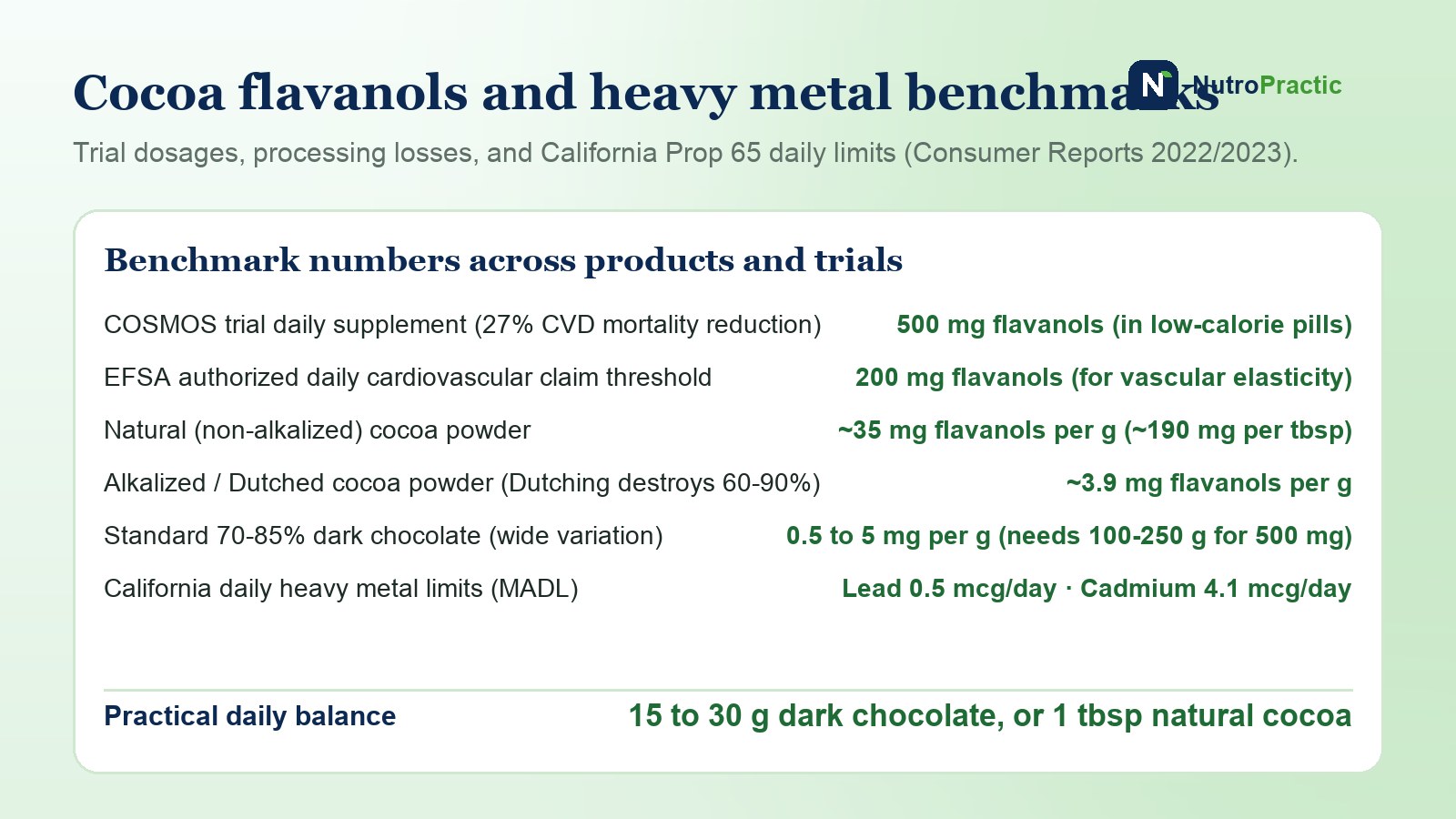
Crucially, the COSMOS trial did not feed participants dark chocolate. They were given concentrated, unroasted cocoa extract capsules supplying 500 mg of flavanols at negligible calorie cost (~10 kcal) with zero sugar.
In commercial chocolate manufacturing, native flavanols are aggressively destroyed during processing:
- Alkalization ("Dutching"): To darken cocoa and remove bitter astringency, manufacturers treat cocoa with alkaline potassium carbonate solutions. Research in the Journal of Agricultural and Food Chemistry showed that alkalization destroys 60% to over 90% of natural flavanols. Natural cocoa powder contains ~34.6 mg flavanols per gram, lightly alkalized powder contains ~13.8 mg/g, and heavily alkalized Dutched powder drops to just ~3.9 mg/g or less.
- Standard dark chocolate bars: High-temperature roasting and hours of conching further degrade epicatechins. Typical commercial 70% to 85% dark chocolate bars yield only 0.5 mg to 5 mg of flavanols per gram.
- The conversion reality: To obtain the 500 mg flavanol dose used in the COSMOS trial from ordinary retail dark chocolate, you would have to consume between 100 and 250 grams of chocolate every single day.
The calorie and sugar penalty of eating that much chocolate
Attempting to match clinical trial flavanol doses with commercial confectionery introduces an insurmountable calorie penalty:
- A standard 100 g bar of 70% dark chocolate contains 580 to 600 calories, 40 to 45 g of fat (including 25 g of saturated fat from cocoa butter), and 25 to 35 g of added sugar (6 to 8 teaspoons).
- Even a small 30 g daily portion (about 2 large squares) contributes ~175 calories, 12 g of fat, and 9 to 11 g of sugar. Eating 100 to 200 grams daily to chase flavanols would trigger rapid weight gain and insulin resistance, completely negating any subtle cardiovascular protection.
Heavy metals: cadmium and lead in dark chocolate
Beyond sugar and calories, heavy metal contamination is an unavoidable reality of cocoa agriculture:
- Cadmium is absorbed through tree roots: Cocoa trees (Theobroma cacao) naturally bioaccumulate cadmium from volcanic or acidic soils, particularly across Latin America. The cadmium is transported into the cocoa bean itself, meaning processing cannot wash it away.
- Lead contaminates bean shells outdoors: Unlike cadmium, lead does not enter through the roots. After harvest, cocoa beans are spread out on mats or asphalt along roadways to dry in the tropical sun. Airborne lead from industrial dust, vehicular exhaust, and soil particles adheres to the sticky cocoa bean shells. When beans are processed, traces of shell enter the chocolate liquor.
- The Consumer Reports findings (2022 & 2023): Consumer Reports tested dozens of popular dark chocolate bars against California's Proposition 65 Maximum Allowable Dose Levels (MADL), which set strict safety benchmarks: 0.5 micrograms (mcg) per day for lead and 4.1 mcg per day for cadmium. In their 2022 investigation of 28 dark chocolate bars, 23 bars (82%) exceeded the daily limit for lead, cadmium, or both in a single 1-ounce (28 g) serving.
- The higher the percentage, the higher the metals: Because heavy metals reside in the cocoa solids, bars with 85% to 90% cacao tested with significantly higher heavy metal concentrations than 50% or 70% bars.
| Product Form | Flavanols per Serving | Heavy Metal Risk | Calories & Sugar |
|---|---|---|---|
| COSMOS Trial Capsule | 500 mg (including 80 mg epicatechin) | Negligible (purified extract) | ~10 kcal, 0 g sugar |
| Natural Cocoa Powder (1 tbsp / 5.4 g) | 180 to 190 mg (~35 mg/g) | Low to moderate | ~12 kcal, 0 g sugar |
| Alkalized / Dutched Cocoa (1 tbsp) | 20 to 40 mg (~3.9 mg/g) | Low to moderate | ~12 kcal, 0 g sugar |
| Dark Chocolate (30 g / ~1 oz portion) | 15 to 150 mg (highly variable) | Frequently exceeds Prop 65 daily limits | ~175 kcal, 9 to 11 g sugar |
| Dark Chocolate (100 g full bar) | 50 to 500 mg | High cumulative lead and cadmium | ~590 kcal, 30 to 35 g sugar |
The pragmatic sweet spot
- Natural cocoa powder in food: If your goal is daily cardiovascular flavanol support without excess calories or heavy metals, use 1 tablespoon of non-alkalized, natural cocoa powder stirred into morning oatmeal, plain yogurt, or a smoothie. It provides ~180 to 190 mg of flavanols—very close to the 200 mg daily dose approved by the European Food Safety Authority (EFSA) for vascular elasticity—with just 12 calories and zero sugar.
- Read labels for alkalization: Check the ingredient list. If it says "cocoa processed with alkali" or "Dutched cocoa", it has lost 60% to 90% of its flavanols. Look for pure "natural unsweetened cocoa powder".
- Enjoy dark chocolate as a sensory treat: Treat dark chocolate (70% to 85% cacao) as a culinary pleasure rather than an unlimited health prescription. A modest portion of 15 to 20 grams (1 to 2 small squares) a few times a week provides rich flavour, small amounts of magnesium and polyphenols, while keeping your cumulative cadmium, lead, and sugar exposure comfortably low.
- Look at broader dietary patterns: Heart protection does not come from a single confectionery item. Our portfolio diet article breaks down foods that clinically lower LDL cholesterol, and our anti-inflammatory eating review details what actually moves vascular inflammation markers.
Looking for personalized cardiovascular nutrition guidance tailored to your blood pressure, lipid panels, and lifestyle? Dr. Triveni offers structured virtual dietary consultations.
Book a consultationThis article is general information, not medical advice. Consult your healthcare provider before taking concentrated supplements or making significant dietary changes, especially if you have existing cardiovascular disease or kidney impairment.
Sources
Sesso H.D. et al., Effect of cocoa flavanol supplementation for the prevention of cardiovascular events: the COSMOS randomized clinical trial, Am J Clin Nutr 2022;115(6):1490-1500 (PubMed 35293963); Ried K. et al., Effect of cocoa on blood pressure, Cochrane Database Syst Rev 2017;4(4):CD008893 (PubMed 28439881); European Food Safety Authority (EFSA), Scientific Opinion on the substantiation of a health claim related to cocoa flavanols and maintenance of normal endothelium-dependent vasodilation, EFSA J 2012;10(7):2809; Miller K.B. et al., Impact of alkalization on the antioxidant and flavanol content of commercial cocoa powders, J Agric Food Chem 2008;56(18):8527-8533 (PubMed 18710243); Consumer Reports, Lead and Cadmium Could Be in Your Dark Chocolate, Dec 2022 & Oct 2023 testing reports; California Office of Environmental Health Hazard Assessment (OEHHA), Proposition 65 Maximum Allowable Dose Levels (MADL) for Lead (0.5 mcg/day) and Cadmium (4.1 mcg/day); Grassi D. et al., Cocoa reduces blood pressure and insulin resistance and improves endothelium-dependent vasodilation in hypertensives, Hypertension 2005;46(2):398-405. Read 19 Nov 2026.