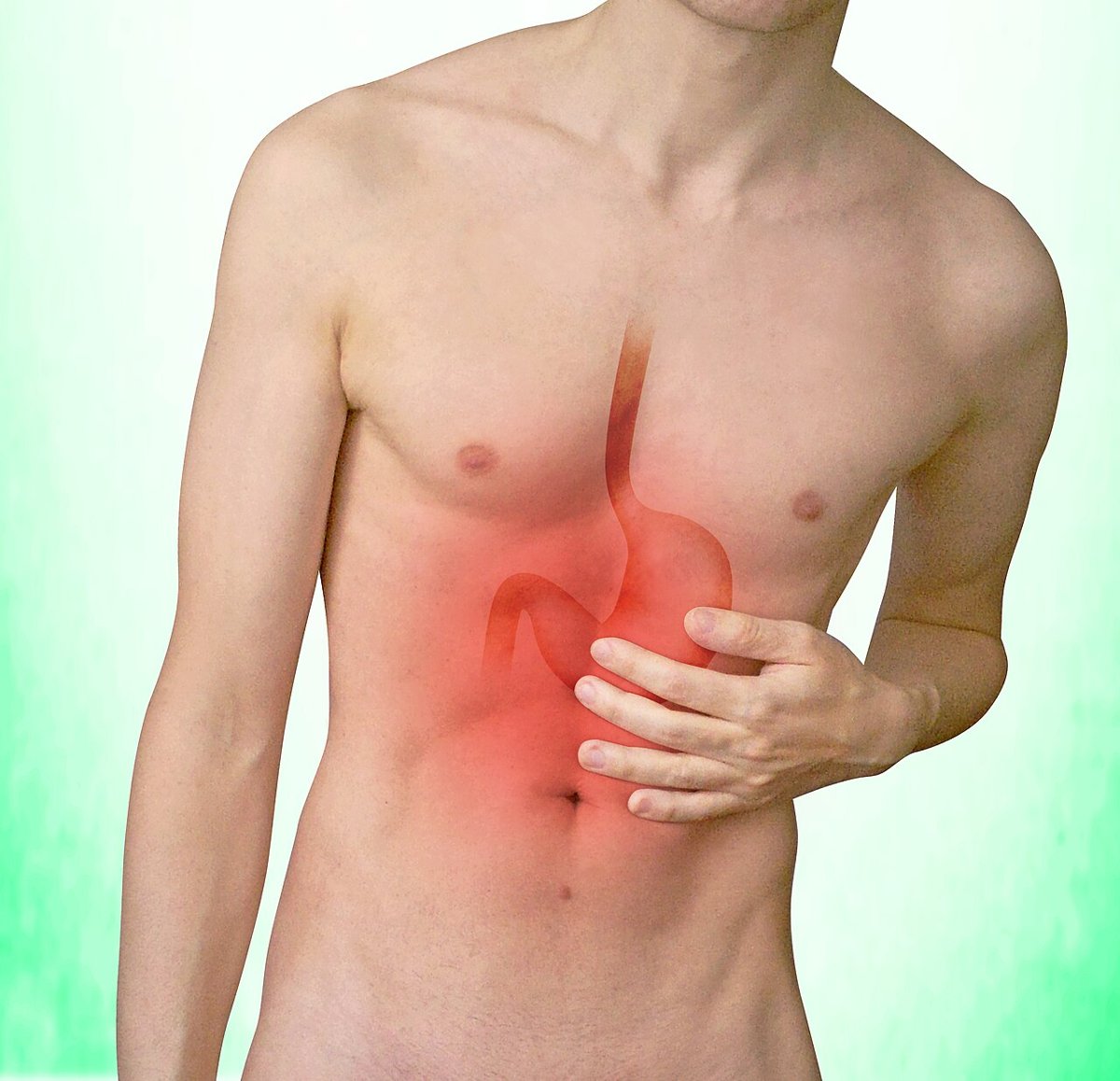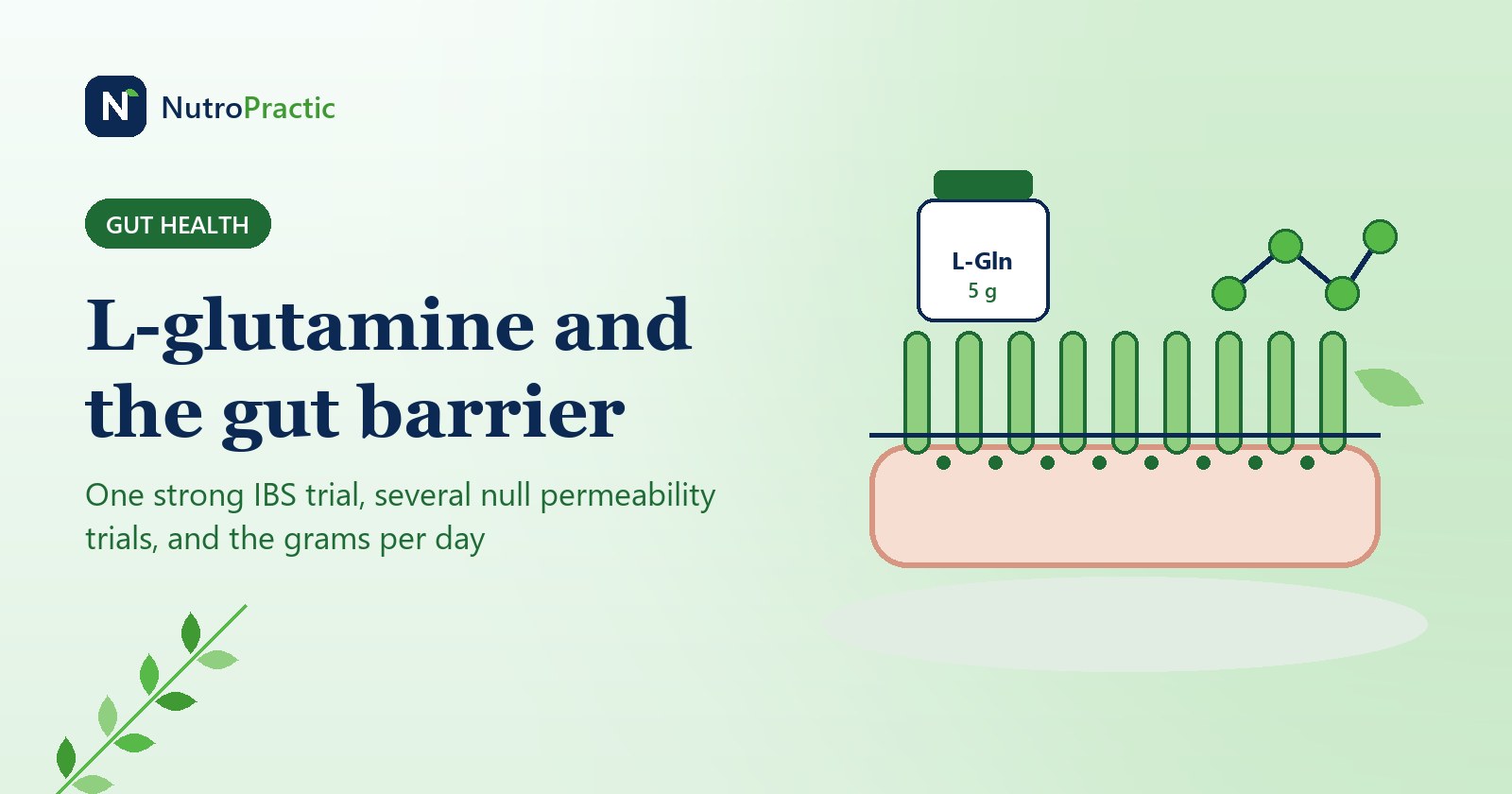
L-glutamine is the amino acid gut cells burn for fuel, and it has become the default "leaky gut" supplement. The trial record is more uneven than the marketing. One 2019 trial in post-infection IBS with diarrhoea gave striking results at 15 g a day. Several trials that measured gut permeability directly found no benefit. Here are the figures from each, the grams per day, and the safety limits.
The post-infectious IBS trial: the strongest result
Zhou and colleagues (Gut, 2019) randomised adults who developed IBS with diarrhoea (IBS-D) and raised intestinal permeability after a gut infection. Participants took <strong>5 g of glutamine three times a day (15 g/day)</strong> or placebo for 8 weeks. 54 glutamine and 52 placebo participants completed it.
| Outcome at 8 weeks | Glutamine (15 g/day) | Placebo |
|---|---|---|
| Responders (fall of 50 or more points on the IBS Severity Scoring System) | 43 of 54 (79.6%) | 3 of 52 (5.8%) |
| Average IBS-SS score (lower is better) | 181 | 301 |
| Bowel movements per day | 2.9 | 5.4 |
| Bristol stool scale (6 to 7 is loose or watery) | 3.9 | 6.5 |
| Intestinal permeability (urinary lactulose/mannitol ratio) | 0.05, normalised | 0.11 |
Adverse events and dropouts were low and similar in both groups, and no serious events occurred. Two cautions apply. It was a single trial of 106 completers, and the authors themselves asked for larger confirmation; effects this large in small trials often shrink on replication. And it tested a specific group: IBS-D that began after an infection, with measured hyperpermeability. It says little about other IBS types or about healthy people with vague "leaky gut" symptoms.
What the permeability trials in other conditions found
Gut permeability is usually measured with a sugar test: you drink lactulose (which barely crosses a healthy gut wall) and mannitol (which crosses easily), and the urine ratio rises when the barrier is leakier. These are the randomised trials that used it with oral glutamine:
| Trial | Dose and length | People | Result |
|---|---|---|---|
| Benjamin et al., 2012, Crohn's disease in remission with abnormal permeability | 0.5 g/kg ideal body weight/day for 2 months (35 g/day at a 70 kg ideal weight) vs whey protein at the same dose | 30 (15 per group, 14 finished each) | Lactulose/mannitol fell 0.071 to 0.029 on glutamine but also 0.067 to 0.033 on whey; permeability normalised in 8 of 14 in both groups |
| Severe acute pancreatitis, 2014 | Oral glutamine for 7 days | 80 (41 glutamine, 39 placebo) | No change in permeability; CRP fell in the glutamine group; the authors called the study underpowered |
| Alanyl-glutamine in HIV, 2013 | 24 g/day for 10 days vs glycine | 46 (22 and 24) | Urinary mannitol rose from 14.4 to 21.2 in 14 treated patients, read as better absorptive surface |
| Exertional heat stress, 2022 | One dose of 0.3 g/kg lean mass (18 g at 60 kg lean mass) before an 80 minute test | 10 men, crossover | No protection of permeability (p = 0.06, medium effect size favouring placebo); gut injury marker I-FABP unchanged |
| Chemotherapy for breast cancer, 2006 | Oral glutamine for at least 12 days | 60 | Eased the chemotherapy-related rise in permeability; no interference with the antitumour effect; no clear effect on diarrhoea or mouth sores |
| Very low birth weight infants, 2006 | Glutamine-enriched feeds | About 90 with at least two sugar tests | No effect on the fall in permeability (p = 0.78) |
The Crohn's trial teaches the most: both arms improved by the same amount, so glutamine did no better than plain whey protein there. The improvement may have come from protein, time in remission or test variation.
What the meta-analysis says, and the grams per day
A 2024 meta-analysis of 10 randomised trials from 1998 to 2014 (352 people, 216 glutamine and 212 control) found <strong>no overall effect on intestinal permeability</strong> (mean difference -0.00, 95% CI -0.04 to 0.03). Its subgroup analysis reported a reduction in trials giving more than 30 g/day for under two weeks. The abstract's printed interval and units for that subgroup are internally inconsistent, so treat it as a hypothesis, not a result. Putting it together:
- Effect on permeability: none overall; a possible benefit at high short-term doses in sick populations.
- Where the best evidence sits: 15 g/day for 8 weeks in post-infectious IBS-D.
- Doses used across trials: 15 g/day (IBS), about 35 g/day (Crohn's, weight-based), 24 g/day (HIV, as the alanyl-glutamine dipeptide) and a single 18 g bolus (heat stress).
Safety: how much is too much?
A 2008 risk assessment of amino acid supplements (Shao and Hathcock) could not set a conventional upper limit because trials showed no consistent pattern of harm. It identified an observed safe level instead: <strong>glutamine up to 14 g/day</strong>. The IBS trial's 15 g/day sits just above that line and the Crohn's trial dose can be well above it. A 2022 review of amino acid supplement side effects looks at ammonia production, kidney and gut function, and names the elderly, pregnancy, breastfeeding, diabetes and liver disease as situations that need care. Practical limits:
- Avoid glutamine with liver or kidney disease unless your specialist approves it.
- Use it for a defined trial period (for example 4 to 8 weeks) and stop if symptoms do not change.
- Mix the powder into cool or room-temperature water, split into 2 to 3 servings, and start at 5 g a day to check tolerance.
- Get a diagnosis first: persistent diarrhoea, blood in the stool or weight loss needs a doctor, not a supplement.
What we recommend
- If IBS-D symptoms began after a gut infection: discuss a time-limited glutamine trial (15 g/day in three doses) with your doctor, since that is the group with the best evidence.
- For general bloating or "leaky gut": the trials do not support glutamine. Better-backed steps are in our articles on the low-FODMAP diet, probiotic capsules and zinc carnosine for the gut lining.
- For Crohn's or ulcerative colitis: do not substitute glutamine for treatment; the one Crohn's trial showed no edge over whey protein.
Gut symptoms that will not settle and a cupboard full of supplements? Dr. Triveni offers virtual nutrition consultations to work out which foods, tests and (if any) supplements fit your situation.
Book a consultationThis article provides educational nutrition information and does not constitute medical advice. If you take diabetes medicines or anticoagulants, or have liver or kidney disease, speak to your doctor before starting any supplement.
Sources
1. Zhou Q, et al. (2019). Randomised placebo-controlled trial of dietary glutamine supplements for postinfectious irritable bowel syndrome. Gut 68(6):996-1002. PMID: 30108163
2. A systematic review and meta-analysis of clinical trials on the effects of glutamine supplementation on gut permeability in adults (2024). PMID: 39397201
3. Benjamin J, et al. (2012). Glutamine and whey protein improve intestinal permeability and morphology in patients with Crohn's disease: a randomized controlled trial. PMID: 22038507
4. Effect of oral glutamine supplementation on gut permeability and endotoxemia in patients with severe acute pancreatitis: a randomized controlled trial (2014). PMID: 24809408
5. Improvement of intestinal permeability with alanyl-glutamine in HIV patients (2013). PMID: 23657308
6. No protective benefits of low dose acute L-glutamine supplementation on small intestinal permeability in response to subclinical exertional-heat stress (2022). PMID: 36106146
7. Oral glutamine ameliorates chemotherapy-induced changes of intestinal permeability in patients with breast cancer (2006). PMID: 17168431
8. The effect of glutamine-enriched enteral nutrition on intestinal permeability in very-low-birth-weight infants (2006). PMID: 16931609
9. Shao A, Hathcock JN (2008). Risk assessment for the amino acids taurine, L-glutamine and L-arginine. PMID: 18325648
10. Holecek M (2022). Side effects of amino acid supplements. PMID: 35043647