Beetroot juice is often promoted as a natural blood-pressure remedy, and unlike many supplement trends, this one is supported by rigorous randomised human trials. A single 250 ml glass of nitrate-rich beetroot juice produces measurable reductions in systolic blood pressure within hours. However, the mechanism relies on oral bacteria rather than the stomach alone, and the high oxalate load means it is not suitable for everyone.
Here is what clinical trials actually measured in people with elevated blood pressure, how your tongue converts plant nitrate into nitric oxide, why standard antibacterial mouthwash completely cancels the benefit, and how much nitrate you can get from everyday vegetables without juicing.
What the clinical trials measured
- Kapil et al. 2015 (Hypertension, Queen Mary University of London): In a double-blind, placebo-controlled trial of 68 patients with high blood pressure (both untreated and treated with background medications), participants drank 250 ml daily of either inorganic nitrate-rich beetroot juice (~6.4 mmol or ~400 mg nitrate) or nitrate-depleted placebo beetroot juice for 4 weeks. Clinic systolic blood pressure fell by 7.7 mmHg (diastolic dropped by 2.4 mmHg) compared to placebo. 24-hour ambulatory monitoring confirmed an 8.1 mmHg systolic drop, alongside improved endothelial function and a 0.59 m/s reduction in pulse wave velocity (less arterial stiffness).
- Siervo et al. 2013 (Journal of Nutrition meta-analysis): A systematic review of 16 randomised clinical trials found that inorganic nitrate and beetroot juice significantly lowered systolic blood pressure overall. In the beetroot juice subgroup, the mean reduction was -5.3 mmHg systolic (95% CI: -8.8 to -1.7 mmHg) and -2.6 mmHg diastolic.
- Webb et al. 2008 (Hypertension): In healthy volunteers given 500 ml of beetroot juice, systolic blood pressure dropped within 1 hour, peaked at 2.5 to 3 hours after drinking (a drop of ~10 mmHg systolic), and remained significantly lower for up to 24 hours. The peak drop closely mirrored peak concentrations of circulating plasma nitrite.
To put these numbers into context: a persistent 5 to 8 mmHg drop in systolic blood pressure is comparable to what doctors expect from a first-line antihypertensive medication at standard starting doses, and corresponds epidemiologically to a 10% to 15% reduction in cardiovascular event risk.
The mouth-to-blood pathway: how vegetables become nitric oxide
Humans cannot directly convert inorganic nitrate into nitric oxide on their own because our cells lack functional nitrate reductase enzymes. Instead, the body uses an elegant enterosalivary circuit that depends entirely on oral microbes:
- 1. Absorption and salivary recycling: You drink beetroot juice or eat leafy greens containing inorganic nitrate ($NO_3^-$). The nitrate is rapidly absorbed in the upper small intestine into the bloodstream. Around 25% of all circulating nitrate is extracted by the salivary glands and concentrated into your saliva at levels up to 10 times higher than in blood plasma.
- 2. Tongue bacteria do the work: Specialized facultative anaerobic bacteria living in the deep crypts at the back of your tongue (such as Veillonella, Actinomyces, and Rothia) use their nitrate reductase enzymes to reduce salivary nitrate into nitrite ($NO_2^-$).
- 3. Acid conversion and systemic nitric oxide: When you swallow your saliva, the nitrite reaches the acidic environment of the stomach, where some converts to nitric oxide gas ($NO$). The rest passes into circulation, where deoxygenated hemoglobin, myoglobin, and tissue enzymes reduce it into active nitric oxide ($NO$). Nitric oxide signals vascular smooth muscle to relax, dilating resistance arteries and lowering systemic pressure.
Why antibacterial mouthwash wipes out the effect
Because the entire first step relies on oral bacteria, anything that sterilizes your mouth breaks the chain. Multiple trials have verified this directly:
- Govoni et al. 2008 & Kapil et al. 2013: Volunteers were given dietary nitrate with or without an antibacterial mouthwash containing chlorhexidine. The antiseptic wash killed the tongue's nitrate-reducing flora. As a result, salivary nitrite formation dropped to near zero, circulating plasma nitrite failed to rise, and the blood-pressure-lowering effect was completely abolished.
- Spitting vs swallowing: Spitting out your saliva after drinking beetroot juice or eating salads similarly dumps the concentrated nitrite before it can enter circulation. If you use strong alcohol-based or chlorhexidine mouthwashes daily, you lose virtually all the vascular benefits of dietary nitrate.
Nitrate in food: beyond beetroot
You do not have to drink bottled beetroot juice to obtain effective amounts of dietary nitrate. Dark leafy salad greens actually contain comparable or even higher concentrations per 100 grams. Below are the figures from published food composition analyses, with the amounts needed to reach the 300 to 400 mg trial target.
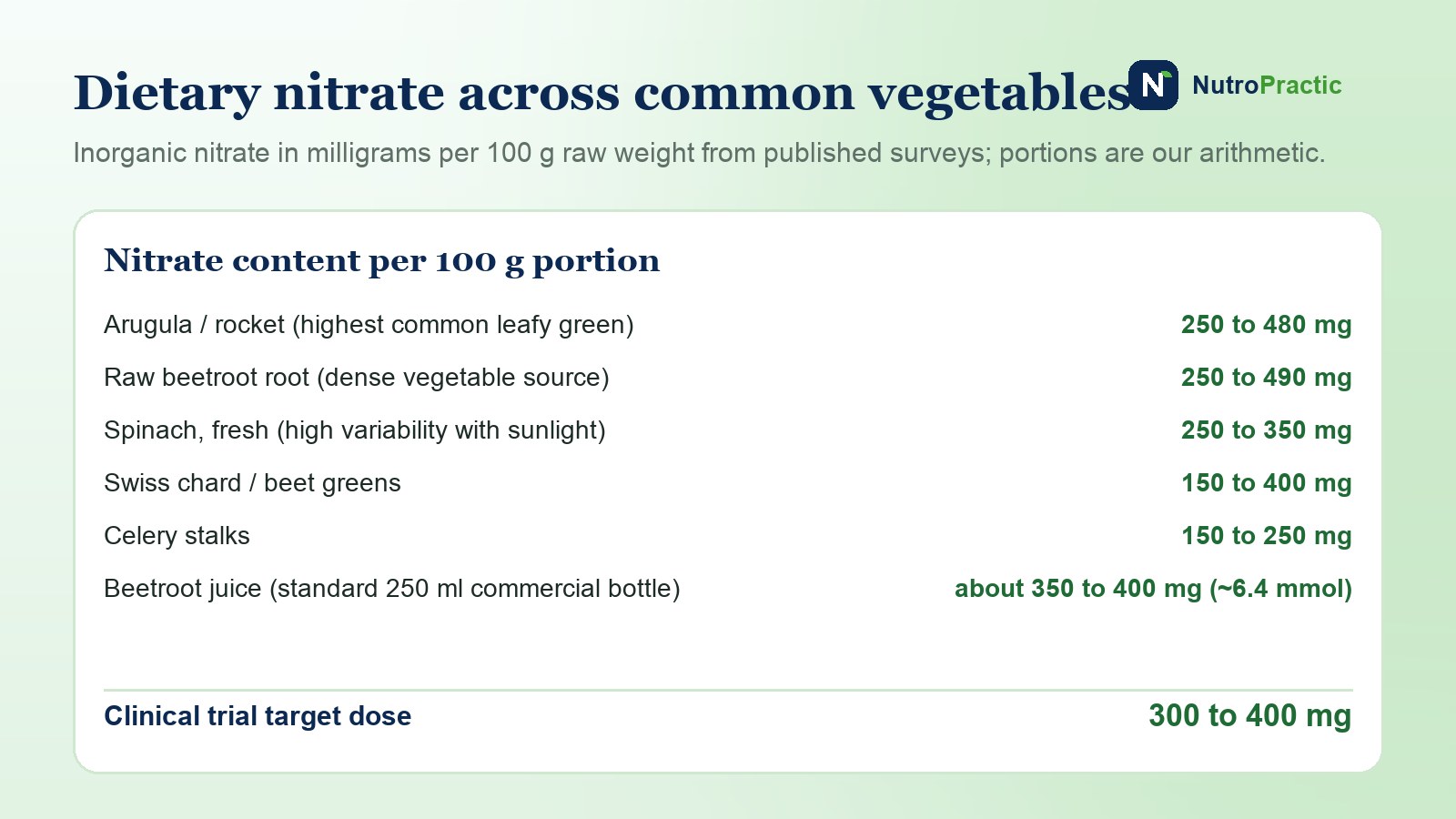
| Vegetable / Source | Nitrate per 100 g (raw) | Amount to reach ~350 mg nitrate |
|---|---|---|
| Arugula / Rocket | 250 to 480 mg | about 75 to 100 g (2 generous handfuls) |
| Raw beetroot root | 250 to 490 mg | about 100 to 120 g (1 medium beet) |
| Fresh spinach | 250 to 350 mg | about 100 to 140 g (a large salad bowl) |
| Swiss chard / beet greens | 150 to 400 mg | about 100 to 150 g |
| Celery stalks | 150 to 250 mg | about 150 to 200 g (3 to 4 long stalks) |
| Standard commercial beetroot juice | ~140 to 160 mg per 100 ml | 250 ml bottle (contains ~350 to 400 mg) |
- Arugula (rocket) is often the single densest everyday source: two handfuls in a salad can match or exceed a small bottle of beet juice without the concentrated sugar or earthy taste.
- Variation by season and soil: Nitrate in crops depends heavily on sunlight, soil nitrogen, and fertilizer. Winter greenhouse crops often hold higher nitrate than summer open-field crops because lower sunlight slows the plant's internal nitrogen metabolism.
Who should be careful: oxalates, hypotension and red urine
- Kidney stones (calcium oxalate): Beetroots are notoriously high in oxalates. The root contains 60 to 150 mg of oxalate per 100 g, and much of it is in the water-soluble form that is rapidly absorbed through the gut. Juicing strips away the insoluble matrix and concentrates soluble oxalate. If you juice beet tops (beet greens), the danger is even higher: beet greens carry 500 to 900+ mg of oxalate per 100 g. Anyone with a personal or family history of calcium oxalate kidney stones should avoid daily beet juicing. If you consume beets, pairing them with dietary calcium (such as yogurt or cheese) helps bind oxalate in the intestine.
- Dangerous medication interactions: Nitric oxide dilates blood vessels via the cGMP pathway. Taking high doses of dietary nitrate alongside PDE5 inhibitors (sildenafil, tadalafil) or prescription organic nitrates (nitroglycerin, isosorbide mononitrate) can cause a severe, life-threatening drop in blood pressure. Never combine nitrate shots or concentrated beet extracts with these medications.
- Orthostatic hypotension: If your baseline systolic pressure is already low (e.g. 100 to 105 mmHg), drinking 250 ml of beet juice can drop you into lightheadedness, dizziness, or fainting upon standing.
- Beeturia (red urine and red stools): Between 10% and 14% of healthy people cannot fully metabolize betalain pigments in the gut and kidney, leading to striking red or pink urine (beeturia) and reddish stools 12 to 24 hours later. While completely harmless, it is frequently mistaken for blood in the urine or gastrointestinal bleeding.
What we'd do
- Food-first over bottles: Eating 80 to 100 g of fresh arugula or baby spinach with lunch provides the same 300 to 400 mg nitrate dose as a bottle of juice, alongside dietary fibre, potassium, and magnesium, with far fewer calories and lower oxalate concentration.
- Timing around exercise or readings: If you use beetroot juice for endurance or blood pressure, drink it 2 to 3 hours beforehand, which corresponds to the physiological peak in plasma nitrite.
- Ditch the antiseptic rinse: Avoid chlorhexidine and harsh antibacterial mouthwashes, especially around mealtimes, so your tongue's microbiome can do its job.
- Look at your overall sodium and potassium balance: Nitrate is powerful, but dietary mineral balance is foundational. Our salt, potassium and blood pressure article details how potassium lowers vascular tone, and our kidney stones and food article breaks down dietary oxalate management.
Working on lowering your blood pressure naturally and want personalized guidance on food choices, mineral targets, and safe supplement use? Dr. Triveni provides comprehensive virtual nutrition consultations.
Book a consultationThis article is general information, not medical advice. Talk to your doctor before using concentrated nitrate supplements or changing your diet, especially if you take blood pressure medications, nitrates, or PDE5 inhibitors, or have a history of kidney stones.
Sources
Kapil V. et al., Dietary nitrate provides sustained blood pressure lowering in hypertensive patients: a randomized, phase 2, double-blind, placebo-controlled study, Hypertension 2015;65(2):320-327 (PubMed 25421976); Siervo M. et al., Inorganic nitrate and beetroot juice supplementation reduces blood pressure in adults: a systematic review and meta-analysis, J Nutr 2013;143(6):818-826 (PubMed 23596162); Webb A.J. et al., Acute blood pressure lowering, vasoprotective, and antiplatelet properties of dietary nitrate via bioconversion to nitrite, Hypertension 2008;51(3):784-790 (PubMed 18250365); Govoni M. et al., The increase in plasma nitrite after a dietary nitrate load is markedly attenuated by an antibacterial mouthwash, Nitric Oxide 2008;19(4):333-337 (PubMed 18708157); Kapil V. et al., Physiological role for nitrate-reducing oral circulation in blood pressure control, Free Radic Biol Med 2013;55:93-100 (PubMed 23142475); Hord N.G. et al., Food sources of nitrates and nitrites: the physiologic context for potential health benefits, Am J Clin Nutr 2009;90(1):1-10; Massey L.K., Food oxalate: factors affecting measurement, biological variation, and dietary intake, J Am Diet Assoc 2007; Chai W. and Liebman M., Assessment of oxalate content in foods and effectiveness of cooking on oxalate leaching, J Agric Food Chem 2005. Read 19 Nov 2026.