Athlete recovery · November 3, 2026
Whey protein and the liver numbers of 59 young track athletes: they dipped a little on whey, but the biggest move came from nine runners on placebo
Thirty grams of whey a day for eight weeks, and the paper talks of attenuated stress on liver and muscle. Look at the four small groups one by one, though, and the story gets a lot less tidy.
Hard training leaves marks in the blood. Enzymes usually read as signs of liver strain and muscle damage drift up, and sports nutrition has spent years asking whether protein can pull them back down. A trial published in the European Journal of Sport Science on 26 October adds an unusual angle: it put endurance and power athletes side by side.
The 59 volunteers were male track and field athletes with an average age of about 18, living and eating at a national training centre and training five times a week for two hours a session. The authors work in Tunisia and Switzerland, and the blood tests were run at the Pasteur Institute of Tunis. Twenty-nine did middle and long distance. Thirty were sprinters, jumpers and throwers. Within each camp, about two in three took 30 g of whey after training for eight weeks, and the rest took a carbohydrate powder matched for look and taste. So the groups were 20 and 20 on whey, but only 10 and 9 on placebo.
On whey, ALT, the enzyme most closely tied to the liver, fell from 17.5 to 15.2 units per litre in the power athletes and from 17.6 to 15.4 in the endurance athletes. AST fell from 27.1 to 22.9 and from 21.7 to 18.3. And these results did pass the test that counts in a trial, whey against placebo, with p below 0.001 for both enzymes.
Now look at what drove that gap. The nine endurance athletes on placebo went from 18.1 to 22.2 on ALT and from 23.0 to 29.6 on AST. Those are the largest shifts in either enzyme, in the smallest group in the trial. By our arithmetic, about two-thirds of the whey-placebo gap among endurance athletes comes from that rise, not from a fall on whey. The paper suggests oxidative and metabolic stress without nutritional support. That's possible, but it's an explanation offered after the fact, for nine people.
The muscle story is weaker than the summary makes it sound. Creatine kinase, or CK, dropped significantly on whey in both groups, from 409 to 362 and from 390 to 335, while it barely moved on placebo. But a fall inside one group isn't the same as beating placebo. The whey-against-placebo test for CK came in at p = 0.082, and for the inflammation marker CRP at p = 0.090, so neither cleared the bar. The authors say as much in the discussion, calling the CK effect confined to the whey subgroups rather than an overall effect of supplementation. Their abstract still leads with those falls.
There's also a question of what these enzymes are measuring here. AST is plentiful in muscle as well as liver, and the authors themselves say that part of the fall in both enzymes may simply follow from less muscle breakdown, rather than any protective effect on the liver. They didn't measure the markers that could separate the two. Nor were these worrying numbers to begin with. Even the highest group average for ALT, 22.2, sits below the 29 to 33 that US gastroenterology guidance gives as healthy for men, though that cut-off is debated. So this is no evidence that whey treats a liver problem, and it wasn't tested in anyone who had one.
Other gaps matter too. Nobody recorded what the athletes ate, so the authors can't rule out that whey was just topping up diets short on protein. They also note that the carbohydrate placebo may have had an effect of its own. Among the power athletes, the whey group started higher than the placebo group on ALT (17.5 against 13.5), AST and CK, which leaves room for high readings to drift back on their own, by our reading. Only men took part, there were only two blood draws, and performance wasn't measured.
What can you take from this? A modest one: in young men training hard, 30 g of whey a day came with no rise in these enzymes over eight weeks, and liver enzymes moved in a better direction than on a carbohydrate powder. That may be mildly reassuring for anyone who has heard that protein shakes strain the liver, within the narrow limits of this group. It isn't proof that whey protects the liver or speeds recovery, and the paper's call for individual protocols goes further than four small groups can carry. A larger trial, with diet recorded and liver-specific and muscle-specific markers measured, could settle what this one only hints at.
Effects of whey protein supplementation on muscle damage, hepatic stress and inflammatory markers in power- and endurance-trained athletes (European Journal of Sport Science, 2026)
59 men
Trained track and field athletes: 20 power and 20 endurance on whey, 10 power and 9 endurance on placebo
30 g a day
Whey after training for 8 weeks, against a carbohydrate powder matched for look and taste
17.5 to 15.2
ALT in units per litre, power athletes on whey. Their placebo group went from 13.5 to 14.2
17.6 to 15.4
ALT in units per litre, endurance athletes on whey. Their placebo group went from 18.1 to 22.2
23.0 to 29.6
AST in units per litre in the 9 endurance athletes on placebo, the largest shift in either liver enzyme
p < 0.001
Whey against placebo over time for both ALT and AST
p = 0.082
Whey against placebo over time for CK, the muscle damage marker. Not significant, despite the falls within the whey groups
p = 0.090
Whey against placebo over time for CRP, the inflammation marker. Also not significant
Figures come from the paper's Tables 1, 3 and 4. Group values are means. Our arithmetic: among endurance athletes, the ALT gap is 2.25 down on whey plus 4.11 up on placebo, so about 65% comes from the placebo rise, and the AST gap is 3.40 plus 6.56, about 66%. Two details in the paper don't quite add up, and we've reported them as printed. It gives an age range of 18 to 26, but Table 1 lists group averages of 17.6 and 18.2. It also calls the placebo isocaloric at about 30 g of carbohydrate and about 197 kcal, while 30 g of carbohydrate would normally give about 120 kcal at 4 kcal per gram. The healthy ALT range is from a US guideline and isn't a cut-off set by this trial.
- The power group mixed very different athletes: shot putters, javelin throwers, jumpers, pole vaulters and sprinters from 100 to 400 m. The authors say this may have added statistical noise, because these enzymes track active muscle mass and mechanical load.
- The second blood draw came at least 72 hours after each athlete's last training session and final supplement, to let the short-term spike in these enzymes settle, so the trial was looking at a longer-term effect.
- ALT was the only marker where the response to whey differed significantly by type of athlete, at p = 0.003. For AST, CK and CRP, that three-way test wasn't significant.
- The whey kits were provided by an athletics federation, according to the acknowledgements. The funding credited is from the biochemistry laboratory at the Pasteur Institute of Tunis, and the authors declare no conflicts of interest.
- To qualify, athletes needed at least six months of regular training. The authors note this makes them trained or developmental rather than elite, even though they competed at national or international level.
- The International Society of Sports Nutrition suggests 0.25 g of high-quality protein per kg of body weight per dose, or 20 to 40 g, so the 30 g in this trial sits in the usual range. It also says 1.4 to 2.0 g per kg a day is enough for most people who exercise.
- Effects of Whey Protein Supplementation on Muscle Damage, Hepatic Stress, and Inflammatory Markers in Power- and Endurance-Trained AthletesEuropean Journal of Sport Science, published 26 October 2026 · The paper's DOI. Open access. Design, group results, interaction tests, limitations, funding.
- ACG Clinical Guideline: Evaluation of Abnormal Liver ChemistriesAmerican Journal of Gastroenterology, 2017 · The healthy ALT range of about 29 to 33 IU/L for men.
- International Society of Sports Nutrition Position Stand: protein and exerciseJournal of the International Society of Sports Nutrition, 2017 · Protein per dose and per day for people who exercise.
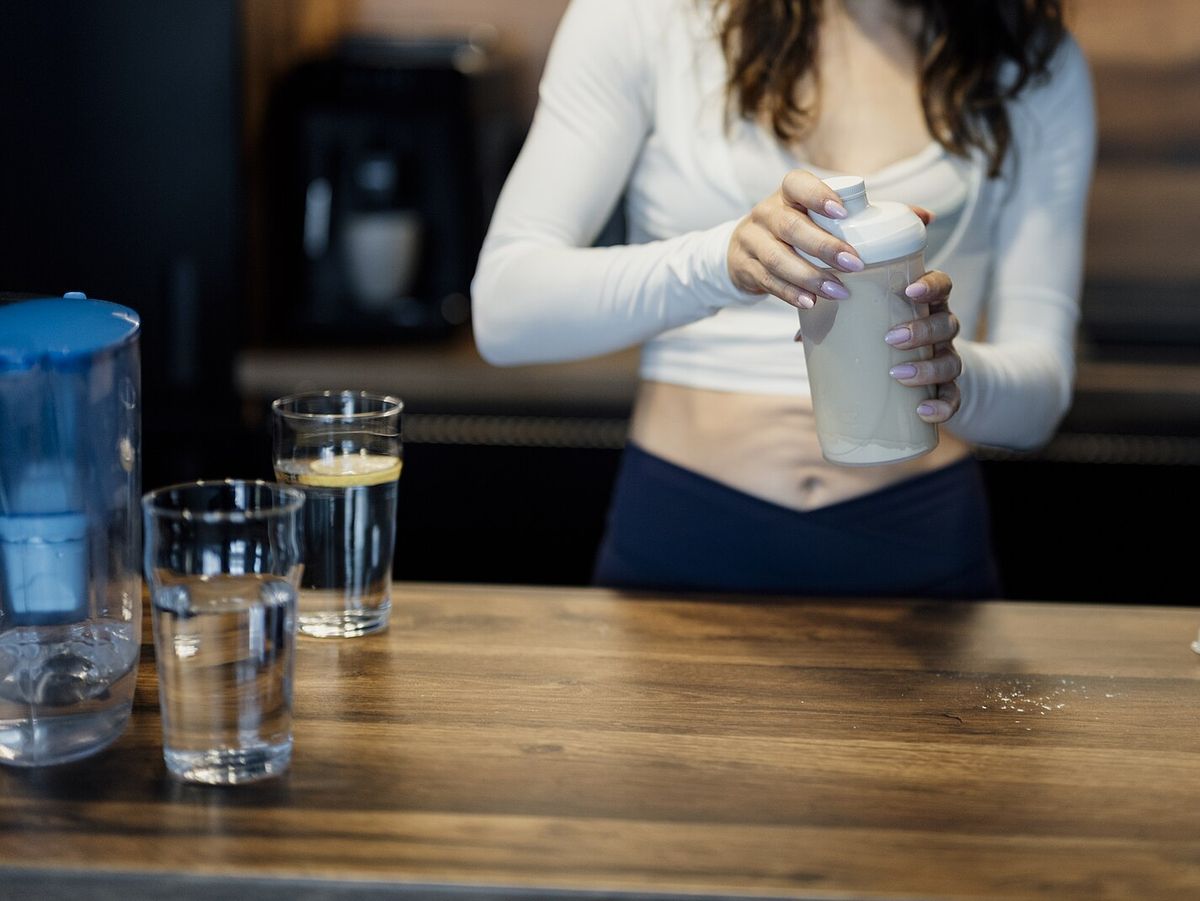
- Person prepares a protein shake in a modern kitchen with water and containers nearbyWikimedia Commons · CC BY 2.0 photo by Shixart1985.
General information, not medical advice. This small trial in young male athletes doesn't show that whey protein protects the liver, treats liver disease or speeds recovery. If you have raised liver enzymes or a liver or kidney condition, talk to your doctor before using protein supplements.
Analysis by NutroPractic from the sources listed. Written for general readers; it does not replace advice from your own doctor.
From our articles
Our guides on this subject
Plain-language guides on nutrition and wellness, backed by research.
Weight-loss medicines
Eating on Ozempic, Wegovy or Mounjaro: protein first, so the weight you lose isn't your muscle
GLP-1 medicines shrink your appetite, and with it often your protein. In the big trials a quarter to more than a third of the weight lost was lean mass. What the 2025 joint nutrition advisory recommends, the arithmetic for your own target, and four small plates that get there.
8 Oct 2026
Healthy ageing
Protein after 40: how much you really need, and why timing matters
The standard protein target was set to prevent deficiency, not to protect muscle as you age. What the research and expert groups suggest for adults over 40, how to spread protein across the day, and easy ways to hit 25 to 30 grams at breakfast.
3 Oct 2026
Women's health
Eating through menopause: what changes for your bones, muscle and heart, and what to put on the plate
Around the final period, bone density at the spine drops by about 2% a year and LDL cholesterol jumps within a year or two. Hot flushes get the attention, but these quieter changes are where food and strength training do the most. Targets for protein, calcium and vitamin D, an honest look at soy, and a week you can start on Monday.
8 Oct 2026
Newsfeed for your website
Want this feed on your website?
Add it to any site with one copy-and-paste snippet. No sign-up, and it updates itself every hour.
Start with a virtual consultation
Tell Dr. Triveni what you want to change. You will leave with a clear next step, whether you are in Toronto, London, New York or Chennai.