Surgery and recovery · October 24, 2026
Two weeks of 'training' for a new hip: 71 patients in Turkey took a daily whey shake and did home exercises before surgery, and went home almost two days sooner
A team in Kütahya gave half their hip replacement patients 25 g of whey protein a day plus a simple home exercise plan for the 14 days before the operation. Those patients were more independent after surgery and left hospital after about 5 days instead of 7. It is a small, open-label trial with some loose ends, but the idea behind it is gaining ground: get ready for surgery the way you'd get ready for a race.
A hip replacement is one of the most reliable operations in medicine, but the first days after it are hard work. Patients have to get out of bed, walk with a frame, wash and dress again, and the slower that goes, the longer they stay in hospital. Most of the effort goes into rehabilitation afterwards. A growing idea, often called prehabilitation, turns that around: use the weeks before surgery to build up the body that will have to recover. A trial from Turkey, published on 18 October in the Journal of Orthopaedic Surgery and Research, tested a short and cheap version of it.
Three researchers at Kütahya University of Health Sciences, two in orthopaedics and one in physical medicine and rehabilitation, randomly assigned 71 patients waiting for a total hip replacement to one of two groups. 36 began a 14-day programme before their operation: 25 g of whey protein a day, the protein from milk that is sold as shakes and powders, plus a structured exercise routine done at home. They were shown the exercises face to face once and then followed up by telephone. The other 35 had the hospital's standard care before surgery, with no extra protein and no exercise plan. Before the operation, and again three and five days after it, the team measured how independent each patient was with the Barthel Index, a 0 to 100 score of everyday tasks such as getting out of bed, walking, washing and using the toilet, and took blood for C-reactive protein (CRP, a marker of inflammation) and albumin (a protein made by the liver, often read as a rough sign of nutrition).
The prepared group did better on the measures that matter most to patients. After allowing for age and chronic illness, their Barthel scores after surgery were clearly higher, and the gap was large by the usual statistical yardsticks (a standardised effect, Cohen's d, of 1.59). They also went home sooner: after 5.1 days on average against 6.9, a difference of almost two days, or about a quarter of the stay, by our arithmetic. CRP and albumin followed different paths over the five days in the two groups, but the published summary doesn't say how, so we won't guess.
There are good reasons for caution, and the authors name the first one themselves: the two groups were not evenly matched at the start, so the size of the benefit may be overstated. Nobody was blinded, and the comparison group got no shake, no exercise sheet and no phone calls, so extra attention alone may have helped. Because protein and exercise were given together, the trial can't say which of the two did the work. Our check of the public trial registry (NCT07329010) turned up more loose ends: it lists Erciyes University in Kayseri as the sponsor, 62 patients rather than 71, and only CRP and albumin as main outcomes, with hospital stay and function as secondary ones; it was first submitted in December 2025, after the study had started in September. The full paper is an early version, and so far only its summary is public.
Still, the result fits a wider body of evidence that people go into surgery in better shape when they eat enough protein and stay active in the weeks before, and that recovery tends to go more smoothly when they do. European clinical nutrition guidelines already recommend nutrition support before major surgery for patients at nutritional risk. What this trial adds is a hint that a short, home-based package, cheap enough for almost any hospital, might pay off even for people who are not obviously undernourished. It needs a larger, blinded trial, ideally one that separates the shake from the exercise, before it becomes routine advice.
Whey protein plus home exercise for 14 days before total hip replacement: randomised trial in 71 patients, Kütahya, Turkey
71
Patients waiting for a total hip replacement, randomised: 36 to the programme, 35 to standard care
25 g a day
Whey protein taken for 14 days before surgery, with a home exercise routine shown once in person and followed up by phone
5.1 vs 6.9 days
Average hospital stay, programme group against standard care (5.11 ± 1.38 vs 6.94 ± 1.72 days)
1.8 days
Shorter stay, about a quarter of the control group's (our arithmetic from the paper's figures)
d = 1.59
Size of the advantage in the Barthel Index of daily independence after surgery, adjusted for age and chronic illness (a large effect)
62
Patients listed as enrolled in the trial's public registry entry, against 71 in the paper
Source: Yüksel H, Demirkıran ND, Yaman F, 'Preoperative whey protein and exercise improve early recovery after total hip arthroplasty: a randomized controlled trial', Journal of Orthopaedic Surgery and Research (2026), published 18 October 2026 as an early version, doi:10.1186/s13018-026-07317-x, open access (CC BY 4.0). Figures come from the published abstract; the full text was not yet available. Outcomes were measured before surgery and on days 3 and 5 after it. Analysis: ANCOVA adjusted for age and chronic disease, and repeated-measures ANOVA for CRP and albumin (group × time interaction p < 0.001 for CRP and p = 0.008 for albumin; direction not given in the abstract). Barthel Index p < 0.001, partial eta squared 0.31; hospital stay p = 0.004 after adjustment. The authors report baseline imbalances between groups. Registry entry NCT07329010 (ClinicalTrials.gov): open-label, ages 50 to 70, start 25 September 2025, first submitted 2 December 2025, sponsor Erciyes University. No funding reported; no conflicts declared.
- The Barthel Index was published in 1965 by a physician, Florence Mahoney, and a physiotherapist, Dorothea Barthel, in Maryland. Sixty years on it is still one of the most used scores of everyday independence after strokes, fractures and surgery.
- Whey is the watery part of milk left behind when cheese is made. About a fifth of the protein in cow's milk is whey; the rest is mostly casein, which ends up in the cheese.
- 25 g of protein is roughly what you'd get from three eggs plus a glass of milk, or a small chicken breast. The standard adult protein recommendation is 0.8 g per kilogram of body weight a day, about 56 g for a 70 kg adult, so the shake alone covered close to half of it.
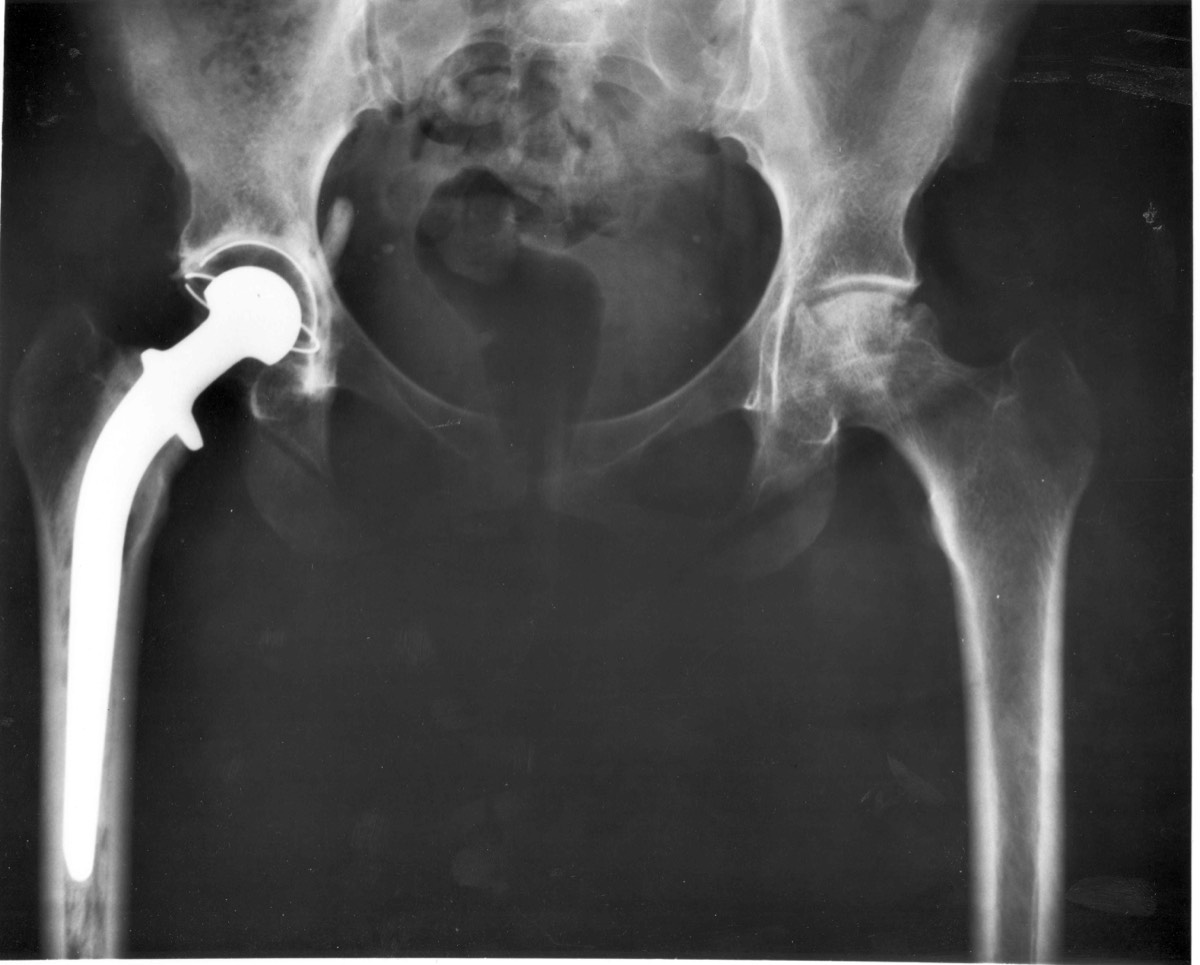
- The modern hip replacement grew out of work by British surgeon John Charnley, whose low-friction design of a metal ball on a plastic socket, fixed with bone cement, was developed in the early 1960s. The X-ray above shows that same basic idea.
- The 2017 European (ESPEN) guideline on nutrition in surgery advises that patients at severe nutritional risk get nutrition support before a major operation, even if that means delaying it.
- Preoperative whey protein and exercise improve early recovery after total hip arthroplasty: a randomized controlled trialJournal of Orthopaedic Surgery and Research · The study, open access, published 18 October 2026 (early version)
- Effects of Preoperative Whey Protein and Exercise Support on Recovery After Total Hip Arthroplasty (NCT07329010)ClinicalTrials.gov · Registry entry: design, eligibility, planned outcomes, enrolment and dates
- ESPEN guideline: Clinical nutrition in surgeryClinical Nutrition · European guideline on nutrition before and after surgery (2017)
- Hip replacement Image 3684-PHWikimedia Commons · The X-ray, public domain (NIH / NIDDK)
General information, not medical advice. This was a small trial that tested whey protein and exercise together, so it can't show which one helped. Anyone with kidney disease, on a restricted diet or with a milk allergy should not start protein supplements without asking a doctor, and exercise before a joint replacement should be planned with the surgical team or a physiotherapist.
Analysis by NutroPractic from the sources listed. Written for general readers; it does not replace advice from your own doctor.
From our articles
Read, then eat a little better
Plain-language guides on nutrition and wellness, backed by research.

Women's health
Inositol for PCOS: the 40:1 ratio, trial doses, and food milligrams
Why do randomized trials in polycystic ovary syndrome prioritize the 40:1 myo to D-chiro inositol ratio? Here is the science behind the ovarian epimerase paradox, clinical ovulation and insulin metrics, and why cantaloupe cannot replace 4,000 mg trial powder.
21 Nov 2026

Everyday eating
Extra virgin olive oil polyphenols: the EU health claim, smoke point myths, and cooking stability
Does extra virgin olive oil degrade when cooked? What does the EU 5 mg polyphenol health claim require, how does oleocanthal act like ibuprofen, and why does oxidative stability matter more than smoke point in domestic frying? Here is the clinical and culinary data.
21 Nov 2026

Food and nutrition
L-theanine and caffeine: what cognitive trials measured on sustained attention, and milligrams in matcha vs green tea
Combining L-theanine with caffeine produces clean focus without caffeine jitters. Here is what randomized trials measured on attention-switching, EEG alpha brain waves, and the exact milligrams across ceremonial matcha, culinary powder, gyokuro, and sencha.
20 Nov 2026
Newsfeed for your website
Want this feed on your website?
Add it to any site with one copy-and-paste snippet. No sign-up, and it updates itself every hour.
Start with a virtual consultation
Tell Dr. Triveni what you want to change. You will leave with a clear next step, whether you are in Toronto, London, New York or Chennai.