Sports nutrition & bone health · November 29, 2026
Higher vitamin D status linked to fewer stress fractures and higher bone density in elite athletes, a review of 11 studies finds
A systematic review of 11 studies covering 1,765 elite athletes, 10 of them cross-sectional, looked at vitamin D and bone health. Four of five studies tied higher vitamin D to lower stress fracture risk, and one found a 25% drop in a bone resorption marker after calcium and vitamin D.

Bone stress injuries and stress fractures are among the most debilitating non-contact setbacks for competitive athletes, often costing months of competition and training.
In Arthroscopy, Sports Medicine, and Rehabilitation, researchers conducted a systematic review synthesizing 11 peer-reviewed studies published since 2013 (including 1 randomized controlled trial and 10 cross-sectional investigations) comprising 1,765 elite athletes (85% men, 15% women, mean age 20.3 years). The review examined serum 25-hydroxyvitamin D concentrations alongside stress fracture incidence, total and regional bone mineral density (BMD), and circulating bone turnover markers.
Of the five studies that directly evaluated vitamin D levels and stress fracture occurrence, four found lower stress fracture risk with higher vitamin D levels. Five studies investigated bone mineral density, with a majority finding positive associations between circulating 25(OH)D and total or regional BMD.
Two studies assessed bone turnover markers; one documented a 25% decrease in high C-terminal telopeptide of type I collagen (CTX), a marker of bone resorption, after calcium and vitamin D supplementation (p = 0.011). The authors conclude that higher vitamin D may be associated with fewer stress fractures, higher BMD and lower CTX. With one randomized trial and ten cross-sectional studies (Level IV evidence), the review shows associations rather than proof that raising vitamin D prevents fractures.
Vitamin D, stress fractures, and bone markers in elite athletes (11 studies)
1,765
elite athletes analysed across 11 studies (85% male, mean age 20.3 years)
4 of 5
studies found lower stress fracture incidence with higher vitamin D status
-25% CTX
decrease in high CTX bone resorption marker after calcium/vitamin D in one study (p = 0.011)
Level IV
overall level of evidence (systematic review of Level II to IV investigations)
Systematic review in Arthroscopy, Sports Medicine, and Rehabilitation, November 2026. 11 studies (1 RCT, 10 cross-sectional).
- C-terminal telopeptide of type I collagen (CTX) is released into circulation when bone matrix is broken down by osteoclasts.
- The review's literature search ran in January 2025 and covered studies published after 2013; 85% of the 1,765 athletes were men.
- Healthy Vitamin D Status in Elite Athletes Is Associated With Lower Stress Fracture Risk, Higher Bone Mineral Density, and Reduced Bone Resorption Markers: A Systematic ReviewArthroscopy, Sports Medicine, and Rehabilitation (Wiley), 27 Nov 2026 · Systematic review of vitamin D, stress fractures, bone density and bone turnover markers in elite athletes.
This article is general information about published research, not medical advice. It does not diagnose, treat or replace care from a qualified health professional. Talk to your doctor before starting a supplement or changing your diet, especially if you are pregnant, have a medical condition or take medicines.
Analysis by NutroPractic from the sources listed. Written for general readers; it does not replace advice from your own doctor.
From our articles
Our guides on this subject
Plain-language guides on nutrition and wellness, backed by research.
Women's health
Eating through menopause: what changes for your bones, muscle and heart, and what to put on the plate
Around the final period, bone density at the spine drops by about 2% a year and LDL cholesterol jumps within a year or two. Hot flushes get the attention, but these quieter changes are where food and strength training do the most. Targets for protein, calcium and vitamin D, an honest look at soy, and a week you can start on Monday.
8 Oct 2026
Supplements and vitamins
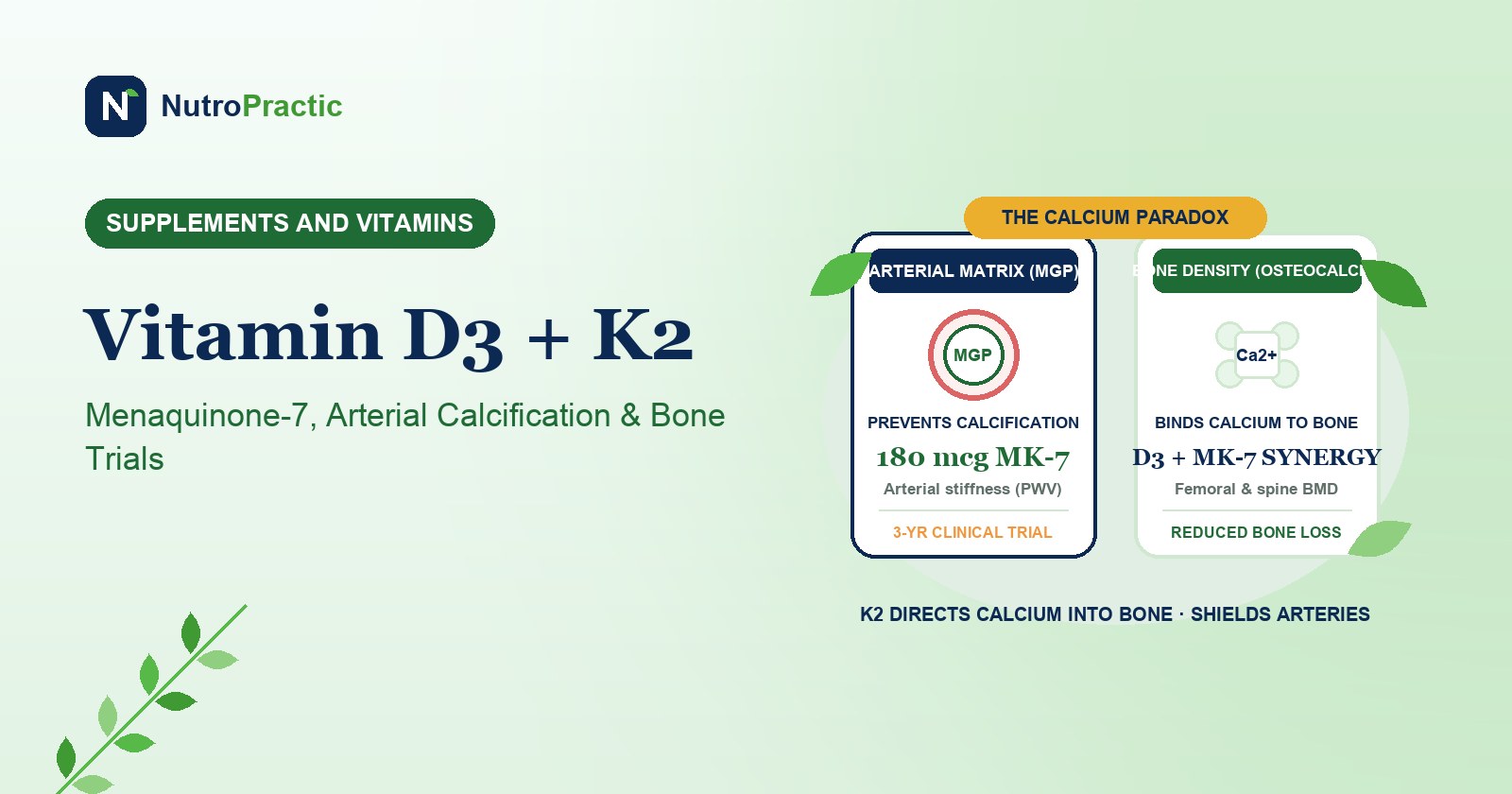
Vitamin D3 with K2: does adding menaquinone-7 actually protect arteries and bones in trials?
Vitamin D3 enhances intestinal calcium absorption, but without adequate vitamin K2, calcium can deposit in vascular walls instead of bone matrix. Clinical trials evaluating menaquinone-7 (MK-7) demonstrate improved carboxylation of Matrix Gla Protein, preserved arterial elasticity, and reduced bone mineral density loss. Discover what human clinical trials actually prove about cardiovascular calcification, bone density, MK-4 vs. MK-7 dosing, and critical drug interactions.
13 Nov 2026
Supplements and vitamins
Glycine before bed: the 3 g sleep trials, what they measured, and glycine in gelatin, bone broth and collagen
The 3 g dose comes from small Japanese trials: the sleep-restriction study analysed seven men. Here is what each trial measured, the grams of gelatin, collagen, pork rinds and bone broth that hold 3 g, and the clozapine warning.
17 Nov 2026
Newsfeed for your website
Want this feed on your website?
Add it to any site with one copy-and-paste snippet. No sign-up, and it updates itself every hour.
Start with a virtual consultation
Tell Dr. Triveni what you want to change. You will leave with a clear next step, whether you are in Toronto, London, New York or Chennai.