Child nutrition · October 22, 2026
Two in three foods sold for babies and toddlers in Turkish supermarkets were ultra-processed. They looked three times cheaper per calorie, until researchers compared biscuits with biscuits
Researchers sorted 340 products labelled for children from six months up, listed by supermarket chains in six Turkish cities. Every growing-up milk and pudding counted as ultra-processed, most fruit and vegetable purées did not, and the price gap that seemed to favour the ultra-processed shelf turned out to be about what kind of food it was.
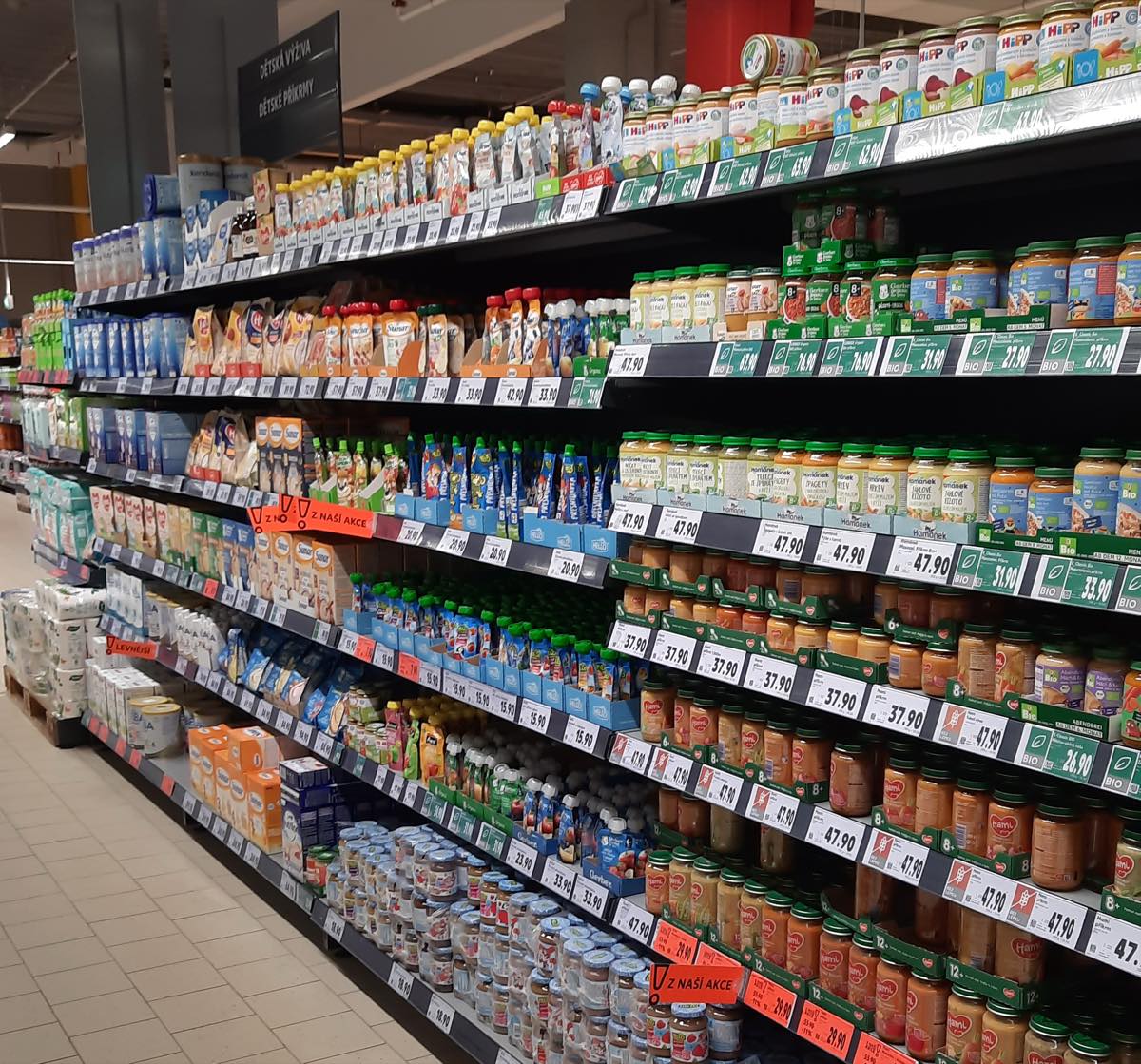
Walk down the baby aisle of almost any supermarket and the packaging does a lot of reassuring: soft colours, smiling infants, "from 6 months", "for growing children". What it rarely tells you is how far the food inside has travelled from the kitchen. A team of dietitians in Türkiye set out to count, and their results came out in Nutrients on 20 October.
Between February and April 2026 they used a national price database run by Türkiye's science research council, which lists what the big supermarket chains charge, and searched within 10 km of the town hall in six cities: Istanbul plus one city from each fifth of the country's household income range (Ankara, Samsun, Manisa, Kastamonu and Kocaeli). Anything whose name or marketing said it was for babies or children counted, except infant formula, which was left out because it is industrially made by necessity. That gave 340 products. Each was sorted with NOVA, the system that ranks foods by how much processing they have had, and its regular, non-promotional price was turned into a cost per 100 kcal.
Two-thirds, 227 of the 340, were ultra-processed. It depended heavily on the shelf. All 72 growing-up milks, all 14 desserts and puddings, and 62 of 63 biscuits, wafers and crisps were ultra-processed. The cereals and porridges were split, 59% ultra-processed. Fruit and vegetable purées went the other way: 80% were not, and none of the 10 soups or the three yoghurts were. The most common give-away on the ingredient lists was added sugar, in 58% of the ultra-processed products, then emulsifiers (56%) and flavourings (49%). Sweeteners and preservatives turned up in hardly any. City by city the share ran from 53% to 84%, but only one pair of cities differed clearly, and the gaps did not line up with how well-off each region was.
Then came the money. Calorie for calorie, the ultra-processed products cost a median of 21.45 Turkish lira per 100 kcal against 67.47 lira for the rest, and allowing for the city, the less processed foods cost 2.87 times as much. That looks like the familiar story that ultra-processed food is the cheap way to fill a stomach. But when the researchers also allowed for the kind of product, the gap all but disappeared: a cost ratio of 1.07, well within chance. Biscuits and milk drinks are dense in calories and cheap per calorie whatever their processing; watery purées and soups are not. The authors' conclusion is that the price difference came from what sat on each shelf, not from processing itself.
The study has clear limits, and the authors list them. It counted what an online price database listed, not what stood on real shelves or what families bought and fed their children. The number of products per city varied from 41 to 89, the six cities do not represent the whole country, and some groups were tiny, with three yoghurts and four drinks. NOVA was judged from ingredient lists, and "ultra-processed" is a statement about how a food is made, not a verdict on its nutrients: the authors stress that a fortified growing-up milk and a chocolate wafer are not nutritionally alike just because both are NOVA 4. Cost per 100 kcal also ignores portion size, inflation during the three months of data collection, and what households can afford. What the snapshot does show is that a label saying a food is made for children says little about how processed it is.
Foods and drinks marketed to children aged six months and older in six Turkish cities, February to April 2026
340
Products marketed for children found in supermarket-chain listings in six cities (infant formula excluded)
66.8%
Ultra-processed (NOVA 4): 227 products; 20.9% were unprocessed or minimally processed
100%
Of growing-up milks (72) and of desserts and puddings (14) were ultra-processed; 98.4% of biscuits, wafers and crisps
20%
Of fruit and vegetable purées were ultra-processed (16 of 80), against 58.8% of cereals and porridges
57.7%
Of ultra-processed products had added sugar, the most common marker; emulsifiers 56.4%, flavourings 48.5%
53.3–83.7%
Share ultra-processed by city; only one pair of cities differed significantly, with no pattern by regional income
21.45 vs 67.47
Median Turkish lira per 100 kcal, ultra-processed vs not; 2.87 times the cost allowing for city, 1.07 (not significant) once product type was allowed for
Study: Yildirim G, Sariyer ET, Çevik E, Çiçek B, 'Prevalence, Regional Variation, and Energy Cost of Ultra-Processed Foods Marketed to Children in Türkiye', Nutrients 2026, 18(20), 3444, published 20 October 2026, doi 10.3390/nu18203444 (open access, CC BY; read in full). Cross-sectional market survey: products and regular prices from the marketfiyati.org chain-store price database within 10 km of each city's administrative centre, February to April 2026, found with nine search terms (such as 'bebek', 'çocuk', 'püre', 'devam'). Cities: Ankara, Samsun, Manisa, Kastamonu and Kocaeli, one per income quintile of TurkStat NUTS-2 regions, plus Istanbul; products per city 41 to 89. Human milk substitutes excluded. NOVA 1 71 (20.9%), NOVA 2 8 (2.4%), NOVA 3 34 (10.0%), NOVA 4 227 (66.8%). Cost per 100 kcal for 329 products with an energy value (219 ultra-processed, 110 not); medians with Q1 to Q3 of 11.85 to 68.33 and 49.28 to 161.50 lira. Primary model adjusted for city: cost ratio 2.87 (95% CI 2.27 to 3.62); adding product category: 1.07 (0.75 to 1.54, p = 0.707); no city interaction (p = 0.438). City shares: 74.5%, 53.3%, 73.3%, 58.5%, 83.7% (C1 to C5) and 66.3% (Istanbul); chi-square p = 0.010, Bonferroni pairwise difference only between C2 and C5. No meat or fish meals or powdered drinks were found. A random 30 products were re-checked by the senior author: 100% agreement on price and NOVA group. No external funding; no conflicts of interest declared.
- NOVA, the system used here, was built by researchers in São Paulo. It sorts food by processing into four groups, and its ultra-processed group is defined by ingredients you would rarely find in a home kitchen, such as flavourings, emulsifiers, modified starches and syrups.
- The WHO says milk products marketed for children up to 36 months old, including follow-on formulas and growing-up milks, should be treated as breast-milk substitutes. The European paediatric nutrition society ESPGHAN says they are not needed routinely.
- Similar counts elsewhere, cited by the authors, found 71% of infant and toddler products ultra-processed in the ten largest US supermarket chains, 79% in Brazil and 56.1% in Porto, Portugal.
- A study of 3,427 baby foods from 27 European countries, run by the European Commission's research centre, found that 38.5% contained at least one ingredient that contributes sugar.
- Calories are a narrow way to price food. A pouch of vegetable purée is mostly water, so it looks expensive per 100 kcal next to a biscuit. The study did not compare prices per serving or per nutrient.
- Prevalence, Regional Variation, and Energy Cost of Ultra-Processed Foods Marketed to Children in TürkiyeNutrients, October 2026 · The paper: full text, open access
- Ultra-processed foods: what they are and how to identify themPublic Health Nutrition, 2019 · The NOVA classification explained by its authors
- High Levels of Nutrients of Concern in Baby Foods Available in Europe That Contain Sugar-Contributing Ingredients or Are Ultra-ProcessedNutrients, 2021 · The survey of 3,427 baby foods in 27 European countries
- Baby food aisle in a Czech supermarketWikimedia Commons · The photo, CC0 (MAKY.OREL)
General information, not medical advice. This study counted products and prices on a database; it did not measure what children ate or how their health was affected. For advice on feeding a baby or young child, including whether a growing-up milk is needed, talk to your paediatrician, health visitor or a dietitian.
Analysis by NutroPractic from the sources listed. Written for general readers; it does not replace advice from your own doctor.
From our articles
Our guides on this subject
Plain-language guides on nutrition and wellness, backed by research.
Nutrition science
Ultra-processed foods: what the evidence says, and a realistic way to eat fewer
Ultra-processed foods now make up more than half of the calories eaten in the US and the UK. What counts as ultra-processed, what a landmark NIH trial and a 2024 BMJ review found, where the science is still uncertain, and simple swaps that don't require cooking everything from scratch.
3 Oct 2026

Women's health
Inositol for PCOS: the 40:1 ratio, trial doses, and food milligrams
Why do randomized trials in polycystic ovary syndrome prioritize the 40:1 myo to D-chiro inositol ratio? Here is the science behind the ovarian epimerase paradox, clinical ovulation and insulin metrics, and why cantaloupe cannot replace 4,000 mg trial powder.
21 Nov 2026

Everyday eating
Extra virgin olive oil polyphenols: the EU health claim, smoke point myths, and cooking stability
Does extra virgin olive oil degrade when cooked? What does the EU 5 mg polyphenol health claim require, how does oleocanthal act like ibuprofen, and why does oxidative stability matter more than smoke point in domestic frying? Here is the clinical and culinary data.
21 Nov 2026
Newsfeed for your website
Want this feed on your website?
Add it to any site with one copy-and-paste snippet. No sign-up, and it updates itself every hour.
Start with a virtual consultation
Tell Dr. Triveni what you want to change. You will leave with a clear next step, whether you are in Toronto, London, New York or Chennai.