Dietary supplements · October 23, 2026
Nearly half of 600 adults in the UAE had taken supplements. Almost nine in ten of them said everyone needs supplements, at any age; among people who had never taken any, about one in eight agreed
A Gulf Medical University survey found vitamins, minerals and protein powders were the favourites, and doctors the most common source of advice. A degree went with far higher odds of use than school education alone. The beliefs gap between users and non-users was the starkest result, though a one-off online survey cannot say which came first.
Vitamin pills, protein powders and mineral tablets are sold in pharmacies, supermarkets and online in the United Arab Emirates, often without anyone asking why the buyer wants them. Two researchers at Gulf Medical University in Ajman set out to see who takes them, why, and what users and non-users believe about them. Their study was published in Frontiers in Nutrition on 13 October.
Between June and October 2024 they ran an anonymous online questionnaire, spread through university networks, community groups and public platforms, and 600 adults living in the UAE answered it. Most were young: 62.5% were aged 18 to 29 and only 6.4% were 50 or older. Of the 600, 287 (47.8%) said they had ever used a dietary supplement, and 169 of those were still taking one. Vitamins were the most common choice (70.6% of users), then minerals (57.8%) and protein supplements (47.4%). The main reasons given were managing a nutritional deficiency (38.0%) and improving fitness (35.3%), and doctors were the most common source of the suggestion (40.1%), ahead of friends (21.8%) and the users' own idea (14.4%).
When the researchers put age, sex, nationality, education, job, income, insurance, doctor visits, chronic illness, prescriptions and smoking into one model, a few things stood out. People with a university degree had about 18 times the odds of having used supplements compared with those with school education or less (adjusted odds ratio 18.32), women about three times the odds of men (3.13), and Arab expatriates about four and a half times the odds of UAE nationals (4.58). People with a chronic illness had about twice the odds (2.15), and employed people lower odds than students (0.28). Income, insurance and smoking were linked with use at first glance but not once everything else was allowed for.
The beliefs were where users and non-users split most. Among users, 87.4% agreed that supplements are necessary at all ages, against 11.8% of people who had never taken any. Users were also far more likely to say supplements are generally harmless (81.5% vs 26.8%), that regular use prevents chronic disease (60.8% vs 19.8%) and that health staff should promote them (82.5% vs 28.5%). Users mostly felt they worked (73.1%); one in ten reported side effects and 3.2% regretted taking them. About half of users with spending data paid more than AED 300 (about US$82) a month. The authors call for nutrition education and for doctors to ask patients about supplements, because of possible interactions with medicines.
The limits are plain. This was a convenience sample recruited online, and the authors did not record which emirate people lived in, so it does not represent the UAE's population; they also fell short of the 724 people their own sample-size calculation called for. Everything was self-reported and nobody's nutrient levels were tested, so there is no way to tell whether supplements matched a real deficiency, and a single snapshot cannot show whether believing in supplements leads to taking them or the other way round. The study was funded by Gulf Medical University, the authors declare no conflicts of interest, and they say generative AI helped with language editing and a figure. We read the full open-access paper.
Supplement use and beliefs among 600 adults in the UAE, 2024
47.8%
Had ever used a dietary supplement (287 of 600); 58.9% of them were current users
70.6%
Of users took vitamins, 57.8% minerals and 47.4% protein supplements
87.4% vs 11.8%
Agreed supplements are necessary at all ages: users vs never-users
81.5% vs 26.8%
Agreed supplements are generally harmless: users vs never-users
18.3×
Adjusted odds of use with a university degree vs school education or less (95% CI 9.1–36.9)
40.1%
Of users said a doctor recommended them; 21.8% a friend, 14.4% their own idea
Study: Alkhayat AA, Khan NS. 'Prevalence, patterns, perceptions, and sociodemographic determinants of dietary supplement use among adults in the United Arab Emirates', Frontiers in Nutrition 13, published 13 October 2026, doi 10.3389/fnut.2026.1955988, open access. Cross-sectional anonymous online survey, June–October 2024, convenience sample of 600 adults aged 18+ living in the UAE (58.8% men; 62.5% aged 18–29; nationality: 58.0% UAE nationals, 26.3% South Asian, 15.8% expatriate Arab, n = 571 after excluding 29 'other/mixed'). Sample-size target 724, based on 37.8% ever-use in an earlier Dubai study. Ever use 287 (47.8%): 169 current, 118 past. Reasons: nutritional deficiency 38.0%, fitness 35.3%, pregnancy 10.7%. Use frequency: daily or alternate days 46.1%, 1–4 times a week 44.4%. Spending (n = 221): up to AED 300 a month 48.9%, more than AED 300 51.1%. Perceived effective 73.1%, adverse effects 10.2%, regret 3.2%. Multivariable logistic regression (n = 539 with complete data, Nagelkerke R² 0.515), adjusted odds ratios for ever use: undergraduate/postgraduate vs high school or less 18.32 (9.09–36.89), women vs men 3.13 (1.76–5.58), expatriate Arab vs UAE national 4.58 (2.14–9.82), South Asian vs UAE national 1.00 (0.45–2.22), chronic condition 2.15 (1.27–3.64), employed vs student 0.28 (0.13–0.61); income, insurance, doctor visits, prescriptions and smoking not significant after adjustment. Perceptions, never users (n = 313) vs ever users (n = 286): necessary for all ages 11.8% vs 87.4%; generally harmless 26.8% vs 81.5%; prevent chronic disease 19.8% vs 60.8%; health staff should promote them 28.5% vs 82.5% (all p < 0.001). Funded by Gulf Medical University; no conflicts declared. US dollar figure uses the fixed rate of AED 3.6725 per dollar.
- In the United States, 57.6% of adults used at least one dietary supplement in the past 30 days in 2017–2018, more women (63.8%) than men (50.8%), according to the national NHANES survey.
- Multivitamin-mineral tablets were the most common supplement for every adult age group in that US survey, used by 39.4% of people aged 60 and over; vitamin D came second, at 36.9% in the same age group.
- An earlier study of Dubai residents found 37.8% had ever used health supplements, and a survey of 2,060 UAE adults during the COVID-19 pandemic found 56.6% used supplements for preventing or treating the virus, both cited by the new paper.
- Supplement use was far higher among expatriate Arabs in this sample (74 of 90, or 82%, had used one) than among South Asian participants (34 of 150, or 23%), but the South Asian gap disappeared once education and other factors were taken into account.
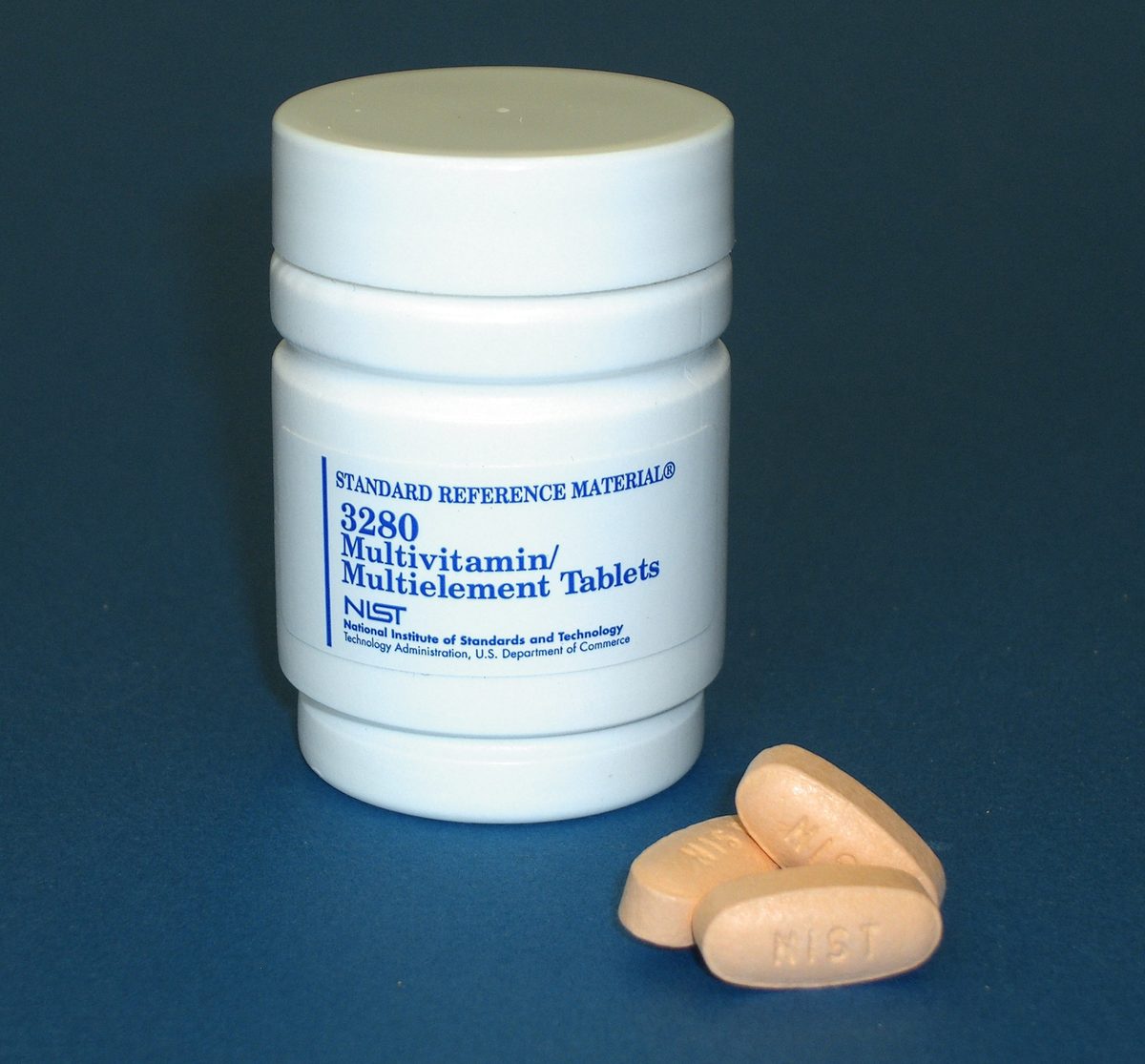
- The pale orange tablets in the photo are NIST Standard Reference Material 3280, a multivitamin made so laboratories can check that their tests measure vitamins and minerals in supplements correctly.
- Prevalence, patterns, perceptions, and sociodemographic determinants of dietary supplement use among adults in the United Arab EmiratesFrontiers in Nutrition · The paper, open access
- Dietary Supplement Use Among Adults: United States, 2017–2018 (NCHS Data Brief No. 399)US Centers for Disease Control and Prevention, National Center for Health Statistics · US figures for comparison
- New Reference Material Can Improve testing of Multivitamin TabletsWikimedia Commons · The photo, public domain (NIST)
General information, not medical advice. This was a survey of what people do and believe, not a test of whether supplements work. Some supplements interact with medicines such as blood thinners, and high doses of vitamins A and D or iron can cause harm, so talk to your doctor or pharmacist before starting one, especially if you are pregnant, have a chronic condition or take prescription medicines.
Analysis by NutroPractic from the sources listed. Written for general readers; it does not replace advice from your own doctor.
From our articles
Read, then eat a little better
Plain-language guides on nutrition and wellness, backed by research.

Women's health
Inositol for PCOS: the 40:1 ratio, trial doses, and food milligrams
Why do randomized trials in polycystic ovary syndrome prioritize the 40:1 myo to D-chiro inositol ratio? Here is the science behind the ovarian epimerase paradox, clinical ovulation and insulin metrics, and why cantaloupe cannot replace 4,000 mg trial powder.
21 Nov 2026

Everyday eating
Extra virgin olive oil polyphenols: the EU health claim, smoke point myths, and cooking stability
Does extra virgin olive oil degrade when cooked? What does the EU 5 mg polyphenol health claim require, how does oleocanthal act like ibuprofen, and why does oxidative stability matter more than smoke point in domestic frying? Here is the clinical and culinary data.
21 Nov 2026

Food and nutrition
L-theanine and caffeine: what cognitive trials measured on sustained attention, and milligrams in matcha vs green tea
Combining L-theanine with caffeine produces clean focus without caffeine jitters. Here is what randomized trials measured on attention-switching, EEG alpha brain waves, and the exact milligrams across ceremonial matcha, culinary powder, gyokuro, and sencha.
20 Nov 2026
Newsfeed for your website
Want this feed on your website?
Add it to any site with one copy-and-paste snippet. No sign-up, and it updates itself every hour.
Start with a virtual consultation
Tell Dr. Triveni what you want to change. You will leave with a clear next step, whether you are in Toronto, London, New York or Chennai.