Heart health · November 1, 2026
In women, higher triglycerides came before stiffer arteries three years later. Then 2,989 UK adults' blood pressure was put into the model, and the link no longer held up
A new UK Biobank analysis asked which comes first, troublesome blood fats or stiffening arteries. The arrows pointed from fats to arteries, mainly in women. But once changing blood pressure was allowed for, almost nothing was left standing.
Stiff arteries and poor blood fats both raise the risk of heart disease, and they tend to turn up in the same people. What is less clear is which one leads. A team from Peking University Shenzhen Hospital and BGI Genomics in Shenzhen tried to sort out the order using the UK Biobank, the long-running study of half a million British adults. They picked out 2,989 people, 1,544 men and 1,445 women in their late fifties on average, who had both blood fats and a pulse-wave reading taken at their first visit and again about three years later (median 3.0 years). The paper appeared in Frontiers in Nutrition on 29 October.
Arterial stiffness here was not measured the way cardiologists usually prefer. Instead of timing a pulse between the neck and the groin, the UK Biobank used a sensor that records the shape of each pulse wave, and from it worked out an arterial stiffness index, a reflection index and the gap between the wave's two peaks. The team then ran cross-lagged models, which ask whether a person's level of one thing at the first visit predicts where they sit on the other at the second, in both directions at once, and corrected for the many pairs tested (seven blood-fat measures against four pulse measures, in each sex).
In women, the pattern ran one way. Higher triglycerides at the start went with a higher stiffness index three years on (standardised estimate 0.071, corrected p = 0.013) and a shorter gap between the pulse peaks, which also points to stiffer vessels. In a second model that adjusted for 15 more blood measures, from liver enzymes to vitamin D and sex hormones, higher triglycerides went with a higher reflection index and a slightly lower pulse rate later. Going the other way, stiffness at the start did not predict blood fats later in either sex. In men the only signal was apolipoprotein B, the protein on LDL and other cholesterol-carrying particles, and it went the opposite way to what you might expect: higher ApoB came before a slightly lower reflection index (estimate -0.057, corrected p = 0.049).
Then came the test that matters most. Blood pressure stiffens arteries and changes alongside blood fats, so the team let systolic blood pressure change over time in the model too. With that in, the links from blood fats to stiffness were no longer statistically significant. Only the tie between triglycerides and later pulse rate in women survived, plus one link running the other way, from pulse rate to later cholesterol. The authors read this as a sign that the associations may run through, or be tangled up with, blood pressure, and they list their own limits plainly: a modest sample for this kind of model, only two time points, no gold-standard pulse wave velocity, and volunteers who came back for a repeat visit, all middle-aged or older and living in the UK. It is a hint about order, not proof that triglycerides stiffen arteries, and it says nothing about whether lowering them would help.
2,989 UK Biobank adults (1,544 men, 1,445 women), blood fats and pulse-wave stiffness measures taken twice, a median 3.0 years apart (Frontiers in Nutrition, 29 October 2026)
2,989 of 20,344
People with a repeat visit who also had complete pulse-wave and blood-fat data at both visits
58.7 and 57.4 years
Average age at the start, men and women
0.071 (p = 0.013)
Women: higher starting triglycerides with a higher stiffness index three years later (standardised estimate, corrected p)
-0.057 (p = 0.049)
Men: higher starting apolipoprotein B with a lower reflection index later, the opposite of the expected direction
p > 0.1
Stiffness at the start predicting blood fats later, the reverse direction, in either sex
p > 0.05
The fat-to-stiffness links once changing systolic blood pressure was added to the model
1.6 vs 1.3 mmol/L
Median triglycerides at the start, men vs women
Observational analysis with two time points, so it shows order of associations, not cause. Stiffness came from a pulse-wave sensor (digital volume pulse), not carotid-femoral pulse wave velocity, which the American Heart Association recommends. The first model adjusted for age, smoking, diabetes, systolic blood pressure, glucose, kidney function, C-reactive protein, IGF-1 and BMI; the second added 15 more blood measures. A sensitivity analysis treating blood pressure as changing over time removed the main findings; triglycerides still went with later pulse rate in women (corrected p = 0.038). Funded by Chinese government and hospital research grants; the authors declare no competing interests.
- Most of the 20,344 people with a repeat visit dropped out of this analysis because their pulse-wave readings were incomplete: 15,676 of them. Another 1,679 lacked full blood-fat results.
- The stiffness index in this study is simply a person's height divided by the time between the two peaks of their pulse wave. Stiffer arteries send the reflected wave back sooner, so the gap shrinks and the index rises.
- Women in this sample started with higher total cholesterol (6.0 vs 5.5 mmol/L) and higher HDL (1.6 vs 1.3 mmol/L) than men, but lower triglycerides and lower systolic blood pressure (136.2 vs 141.1 mmHg).
- Lipoprotein(a), the inherited cholesterol particle many people have never had tested, did not differ between the men and women here (median 29.5 vs 34.0 nmol/L) and showed no link with later stiffness.
- The authors suspect menopause may explain why the triglyceride signal showed up in women, but the analysis had no data on menopausal status or hormone therapy to check it.
- Prospective directional associations between lipid measures and digital volume pulse-derived arterial stiffness parameters: evidence from cross-lagged panel analyses in the UK BiobankFrontiers in Nutrition, 29 October 2026 · Open-access paper (CC BY 4.0): Table 1 baseline figures, cross-lagged model results, the blood pressure sensitivity analysis, limitations and funding.
- UK BiobankUK Biobank · The cohort the data come from: about 500,000 adults aged 40 to 69 recruited across the UK in 2006 to 2010.
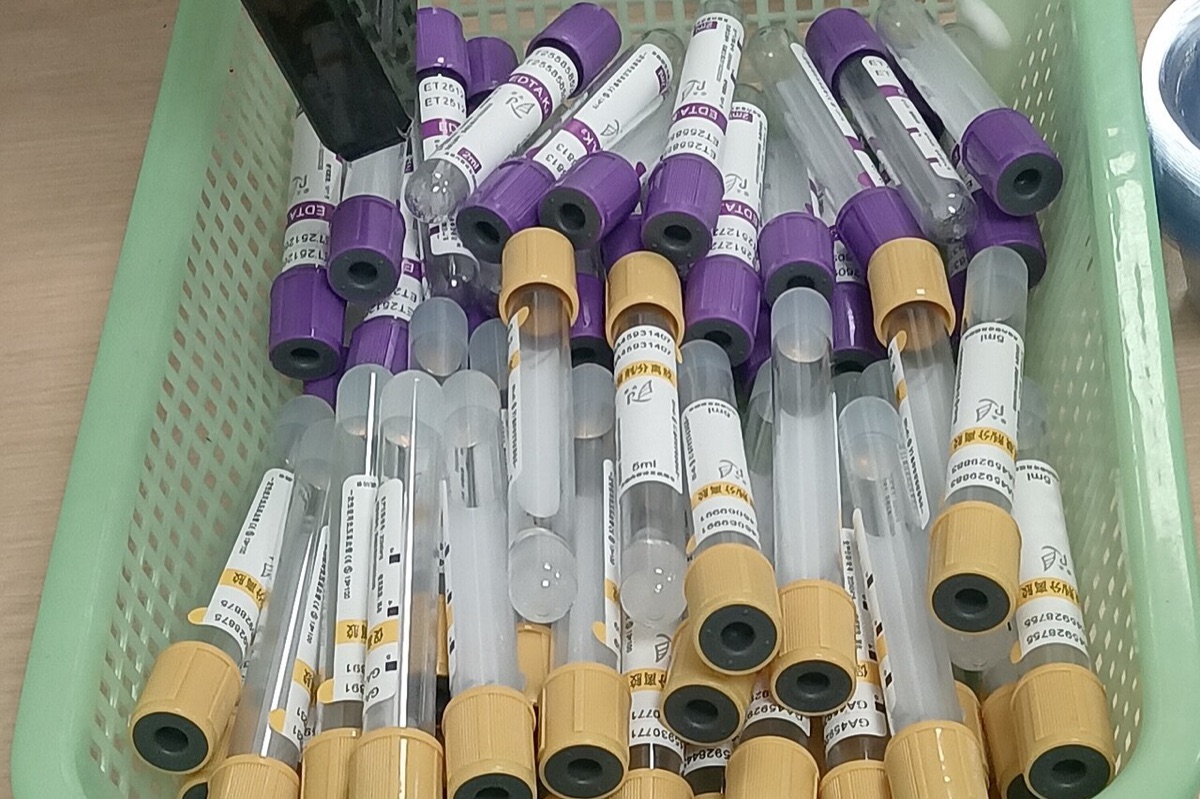
- Blood collection renal function test tubeWikimedia Commons · CC0 photograph, used as a general illustration.
General information, not medical advice. This observational study cannot show that triglycerides cause stiffer arteries, and its main links faded once blood pressure was accounted for. If you are concerned about your cholesterol, triglycerides or blood pressure, talk to your doctor or a registered dietitian.
Analysis by NutroPractic from the sources listed. Written for general readers; it does not replace advice from your own doctor.
From our articles
Our guides on this subject
Plain-language guides on nutrition and wellness, backed by research.

Heart health
Lowering LDL cholesterol with food: what the portfolio diet trials showed
In a 2003 trial, four foods eaten together (oats and other sticky fibre, plant sterols, soy and nuts) lowered LDL almost as much as a low-dose statin. At home the average was about half that. How much each food does, a realistic day, and when food is not enough.
30 Oct 2026

Micronutrients
Iodine: the nutrient that plant-based milks and sea salt left out
Iodine runs the thyroid and builds a baby's brain, and in the UK, much of Europe and parts of North America women of childbearing age are now mildly short of it. The reason is often a healthy-looking swap: oat milk for dairy, sea salt for table salt. Where iodine comes from, who needs more, and the seaweed trap.
30 Oct 2026
Heart health
Coffee and your heart: what the trials found on rhythm, blood pressure and sleep
For years people with palpitations or atrial fibrillation were told to give up coffee. Two randomised trials and cohorts of half a million people now point the other way, with three real exceptions: sleep, very high blood pressure and how the coffee is brewed.
30 Oct 2026
Newsfeed for your website
Want this feed on your website?
Add it to any site with one copy-and-paste snippet. No sign-up, and it updates itself every hour.
Start with a virtual consultation
Tell Dr. Triveni what you want to change. You will leave with a clear next step, whether you are in Toronto, London, New York or Chennai.