Children's weight · October 26, 2026
A year of family sessions at the children's doctor helped a third of 559 German kids with excess weight hit their target, against a fifth after one 30-minute talk. Six months after the sessions ended, the gap had closed
The STARKIDS trial in Baden-Württemberg put a low-cost programme, run by practice assistants with an online platform, against a single counselling session. It worked at 12 months. By 18 months the single-session group had caught up, and the authors now suggest starting everyone with the short talk.
Programmes for children with excess weight that combine eating, activity and family support are the best-established treatment, but the most effective ones are intensive, often 26 contact hours or more, and few families can reach them. STARKIDS, a programme from a team led at University Hospital Tübingen, tried a lighter route: deliver it in the family's own paediatric or family practice, through the medical assistants the family already knows, with an online platform between visits. The cluster-randomised trial testing it was published in The Lancet Regional Health – Europe on 14 October.
Practices across the German state of Baden-Württemberg were randomly assigned, 44 to STARKIDS and 45 to a control, and 71 of them went on to enrol families between April 2022 and July 2023. Children aged 3 to 17 with overweight or obesity could join; 559 families started, 343 in STARKIDS practices and 216 in control practices. The children averaged about 11 years old and sat, on average, at the 98.5th percentile for body mass index (BMI) for their age; 36% were in the severe obesity range. Families in STARKIDS practices had five 90-minute sessions, one every three months over a year, each on one theme: getting started, eating and drinking (with a focus on lowering the energy density of meals and on portion sizes), activity and screens, and family life, sleep and stress, then a closing review. Sessions used motivational interviewing and ended with goals the family chose; an online platform added texts, short films, games and tip sheets, with text-message reminders every two weeks. Control families got one 30-minute structured talk on the same topics and a printed flyer, on top of usual care.
The target was a fall of at least 0.2 in BMI z-score, a measure of how far a child's BMI sits above the average for their age and sex in a German reference population. After 12 months, 33% of STARKIDS children reached it against 22% of control children, a difference of 11 percentage points. Average BMI z-score fell from 2.41 to 2.24 in the STARKIDS group and from 2.37 to 2.32 in the control group. Attendance was high: 69% to 92% of families came to each STARKIDS session, and 83% of control families came to their one talk. No serious adverse events were linked to the programme.
The second year told a different story. Families whose children had not reached the target were offered one or two further sessions at the local public health office, but only 24 of 162 eligible families (15%) went, so the last six months were in practice a follow-up with only the website left. By 18 months, 30% of STARKIDS children and 28% of control children were at least 0.2 below their starting score, no real difference, and both groups averaged a z-score of 2.27: the STARKIDS children had slipped back a little while the control children kept edging down. Quality of life, the trial's other main outcome, did not improve. Adolescents in the two groups rated theirs about the same, and parents in STARKIDS practices rated their child's slightly lower at 18 months, a gap the authors call too small to matter clinically.
There are caveats. The trial was not blinded, the arms ended up unequal in size and makeup (52% of STARKIDS families had a migration background against 32% of control families), and a quarter of families dropped out by each follow-up. Still, a separate economic analysis found the first year cost-effective for children with obesity, and Germany's Federal Joint Committee (G-BA), whose innovation fund paid for the trial, has recommended bringing that step into routine care for them. The authors' own conclusion is pragmatic: since the single talk held up well over 18 months, offer it to everyone first, give the full programme to families who don't progress, and replace the public health step with short refresher visits at the practice that fade out over time, because the website on its own did not hold the gains.
STARKIDS, a year-long programme in paediatric and family practices, vs one 30-minute counselling session, in 559 children and teens with overweight or obesity in Baden-Württemberg, Germany (The Lancet Regional Health – Europe, 14 October 2026)
33% vs 22%
Children whose BMI z-score fell by at least 0.2 after 12 months: STARKIDS vs one-time talk (risk difference 11 points, 95% CI 3 to 20)
30% vs 28%
The same target at 18 months, six months after sessions ended: no real difference
2.41 → 2.24 → 2.27
Average BMI z-score in STARKIDS children at the start, 12 and 18 months
2.37 → 2.32 → 2.27
Average BMI z-score in control children at the same points
5 × 90 min
STARKIDS face-to-face sessions over a year, against one 30-minute talk in control practices
24 of 162
Families eligible for the extra step at the public health office who attended (15%)
25%
Families lost to follow-up by 12 and by 18 months
Cluster-randomised controlled trial (DRKS00022813), not blinded. 89 paediatric and family practices in Baden-Württemberg randomised (44 STARKIDS, 45 optimised treatment-as-usual), stratified by urban/rural and expected recruitment; 71 enrolled families (38 and 33). 611 families enrolled April 2022 to July 2023 (379 and 232); 559 in the intention-to-treat analysis (343 and 216). Ages 3 to 17, overweight (BMI above the 90th percentile) or obesity (above the 97th) by German cut-offs; mean age 10.6 and 10.9; at baseline 17% overweight, 47% obesity, 36% severe obesity. Primary outcomes: share reaching a BMI z-score reduction of at least 0.2 (multiple imputation, m = 500, chi-square corrected for clustering) and health-related quality of life (KINDL-R). Complete-case figures at 12 months: 83 of 251 vs 37 of 170. At 18 months, imputed: 30% vs 28%, risk difference 0.01 (95% CI −0.07 to 0.10, p = 0.69). Continuous BMI z-score: group difference at 12 months b = −0.09 (p = 0.0038), not at 18 months (b = −0.03, p = 0.39). Parent-rated quality of life, STARKIDS 72.79 to 70.59 vs control 71.71 to 71.79 (difference −2.10, 95% CI −4.13 to −0.06), below the authors' threshold for clinical relevance; no difference in adolescents' self-ratings. The 5 × 90 minute figure is our reading of the five core modules, one session every three months over a year. Migration background 52% vs 32%. Funded by the Innovation Committee of Germany's Federal Joint Committee (G-BA). Health-economic results are reported separately.
- Children's weight is tracked with BMI percentiles and z-scores rather than adult BMI cut-offs, because BMI naturally rises and falls as children grow. The STARKIDS children started at an average z-score of about 2.4, more than two standard deviations above the average for their age and sex.
- Energy density, the focus of the STARKIDS eating module, means calories per gram of food. Foods with plenty of water and fibre, such as vegetables, fruit and soups, fill the plate and stomach with fewer calories than the same weight of fried snacks or sweets.
- On the STARKIDS online platform, texts, tip sheets and videos were used well, but 78% of families never played the mindfulness audios.
- A pooled German, Austrian and Swiss registry of more than 12,000 children in outpatient lifestyle programmes, cited by the authors, found an average BMI z-score drop of 0.23 over 24 months, and that a 0.2 drop already came with better heart and metabolic markers.
- Effects of an e-health enhanced multicomponent outpatient intervention for children and adolescents with overweight or obesity in routine primary care (STARKIDS): a cluster-randomized controlled trialThe Lancet Regional Health – Europe · The study, published 14 October 2026 (open access, CC BY)
- Full text (PMC13694850)PubMed Central · Panel 1 (the programme), Table 1, results at 12 and 18 months, usage data and limitations
- STARKIDS trial registration DRKS00022813German Clinical Trials Register (DRKS) · Registered 27 November 2020
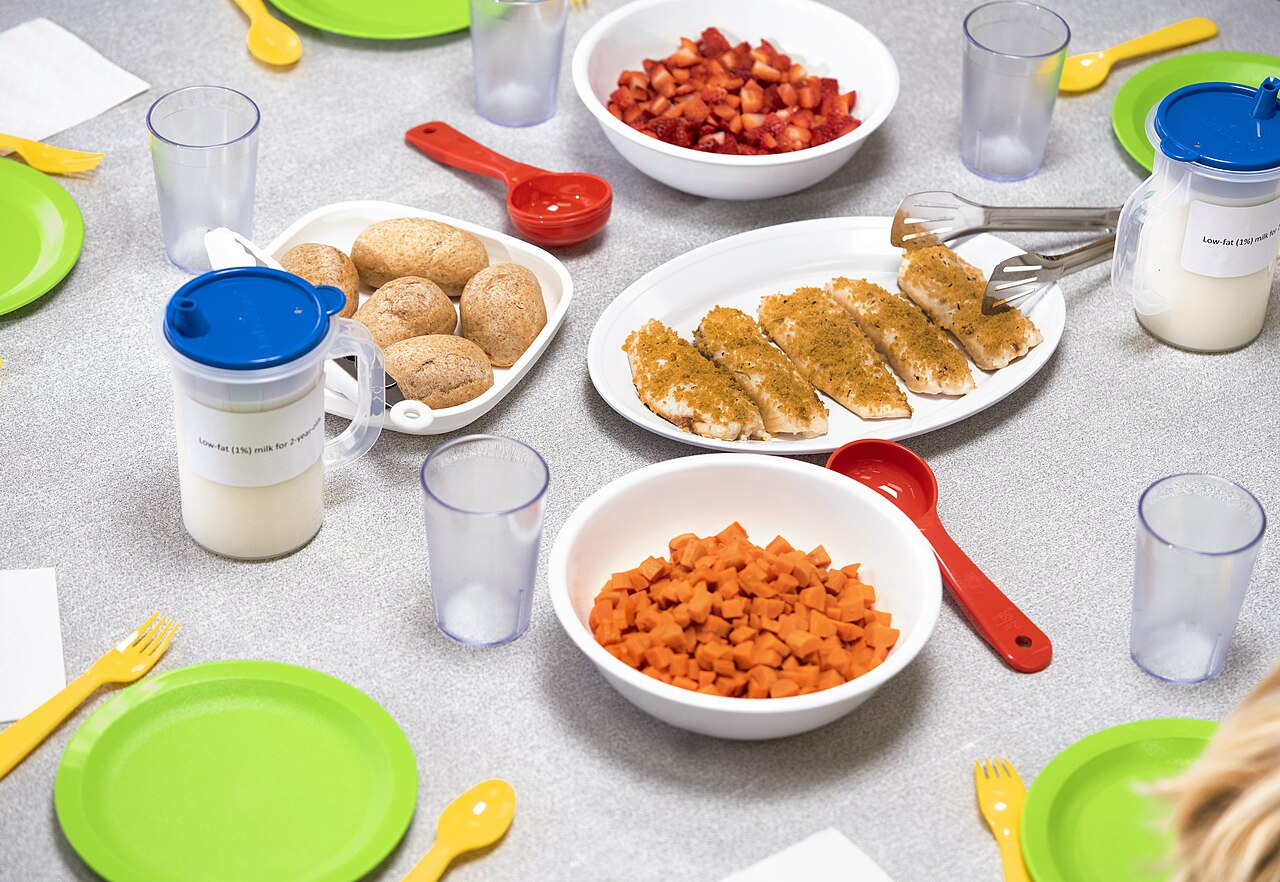
- Family Style Meal Service With Children in the CACFPWikimedia Commons (U.S. Department of Agriculture) · The photo, public domain
General information, not medical advice. This trial tested one programme in German family and paediatric practices; its benefit at one year had faded by 18 months. Children's weight is best managed with the family's own doctor, without putting a growing child on a restrictive diet; if you are worried about your child's weight, ask their paediatrician or family doctor what support is available.
Analysis by NutroPractic from the sources listed. Written for general readers; it does not replace advice from your own doctor.
From our articles
Read, then eat a little better
Plain-language guides on nutrition and wellness, backed by research.

Women's health
Inositol for PCOS: the 40:1 ratio, trial doses, and food milligrams
Why do randomized trials in polycystic ovary syndrome prioritize the 40:1 myo to D-chiro inositol ratio? Here is the science behind the ovarian epimerase paradox, clinical ovulation and insulin metrics, and why cantaloupe cannot replace 4,000 mg trial powder.
21 Nov 2026

Everyday eating
Extra virgin olive oil polyphenols: the EU health claim, smoke point myths, and cooking stability
Does extra virgin olive oil degrade when cooked? What does the EU 5 mg polyphenol health claim require, how does oleocanthal act like ibuprofen, and why does oxidative stability matter more than smoke point in domestic frying? Here is the clinical and culinary data.
21 Nov 2026

Food and nutrition
L-theanine and caffeine: what cognitive trials measured on sustained attention, and milligrams in matcha vs green tea
Combining L-theanine with caffeine produces clean focus without caffeine jitters. Here is what randomized trials measured on attention-switching, EEG alpha brain waves, and the exact milligrams across ceremonial matcha, culinary powder, gyokuro, and sencha.
20 Nov 2026
Newsfeed for your website
Want this feed on your website?
Add it to any site with one copy-and-paste snippet. No sign-up, and it updates itself every hour.
Start with a virtual consultation
Tell Dr. Triveni what you want to change. You will leave with a clear next step, whether you are in Toronto, London, New York or Chennai.