Food preservation · October 26, 2026
Mango slices dried by the sun under Amazon clouds: with a fan and a box of warm limestone they went from 87% water to 12% in 52 hours. The plainest solar dryer only got them to 22%
Fresh mango spoils fast, and in the cloudy highlands of the Peruvian Amazon there isn't much sun to dry it. A university team in Chachapoyas built three small solar dryers, filled each with 2 kg of sliced Keitt mango and measured what four days of drying did to the water, sugar, acid, colour and antioxidant readings.
Mango is one of the most perishable fruits in the tropics. Drying it keeps it for months, but drying with gas or electric heat costs money and fuel, and drying in the open sun leaves the fruit to dust, insects and rain. A solar dryer is the in-between: a dark box that heats air in the sun and passes it over trays of fruit inside a covered chamber. A team at the Universidad Nacional Toribio Rodríguez de Mendoza in Chachapoyas, in Peru's Amazonas region, wanted to know how well that works where the sun is often hidden. On their campus the air averages 71% humidity and the sky is cloudy about 77.5% of the time across a year. Their study was published in Frontiers in Nutrition on 14 October.
They built three prototype dryers, each a 1 square metre solar collector joined to a clear polycarbonate chamber with three steel mesh trays. The first worked by natural convection alone: warm air rose through it on its own. The other two had an extractor fan that switched on once the collector reached 55 °C, and a load of limestone to soak up heat in the sun and give it back when clouds came over. In one the limestone sat in the collector, in the other inside the drying chamber, in its own compartment away from the fruit. Keitt mangoes from local markets were washed, peeled, cut into slices about 3 mm thick and mixed, and 2 kg went into each dryer. The slices stayed in the closed dryers day and night for 3,120 minutes, 52 hours spread over four days, with samples taken seven times along the way. Outside, the air peaked at only about 20 to 23 °C on most days, and 16 to 17 °C on the third.
All three dryers worked, but not equally. Fresh mango pulp was 86.8% water. After 52 hours the slices in the natural convection dryer were at 21.7%, those in the fan dryer with limestone in the collector at 18.7%, and those with limestone in the chamber at 12.2%, and all three differed from each other in the statistics. As the water went, everything left behind became more concentrated: the sugar reading (degrees Brix) rose from 9 to between 41 and 45, and the acidity, measured as citric acid, from 0.66% to between 1.8% and 2.5%. The slices also got firmer the longer they dried. The limestone-in-chamber dryer gave the lightest coloured fruit at the end, with a lightness score of 77 against 53 to 57 for the other two, which had shifted more towards red-brown tones.
The antioxidant numbers need care. The total phenolic reading went from 0.77 mg per gram in fresh pulp to 22.1, 25.2 and 27.9 mg per gram in the three dryers, highest with limestone in the chamber; the antioxidant reading on the DPPH test went from 3.9 to between 8.5 and 9.4 micromoles per gram, highest in the plain natural convection dryer. On our own arithmetic from the paper's moisture figures, a gram of the driest slices holds about 6.7 times as much dry matter as a gram of fresh pulp, so much of any rise per gram is simply water leaving. The phenolic reading rose far more than that, about 36-fold, and the antioxidant reading far less, about 2.2 to 2.4-fold. The authors say plainly that these results are not evidence that drying adds or saves healthy compounds: drying also breaks up the fruit so more can be extracted, heat can destroy some compounds, and browning reactions can form new ones that the tests also pick up. They did not convert the results to a dry-weight basis.
This was one batch of market mangoes, dried once in each of three prototype dryers on one campus, with three lab repeats per measurement. The team did not measure water activity or test for microbes, so the study can't say whether any of the dried slices would keep safely on a shelf, and they caution that their moisture figures should not be read that way. Nor did they measure sunlight, the energy each dryer used, the heat-holding properties of the limestone, or individual vitamins and pigments, and antioxidants were measured with a single test. They conclude that no one dryer was best on every measure, though the fan with limestone in the chamber removed the most water, and that energy and cost studies are needed before scaling up. The work was paid for by a Peruvian public research project at the university, and the authors declare no conflicts. We read the full open-access paper.
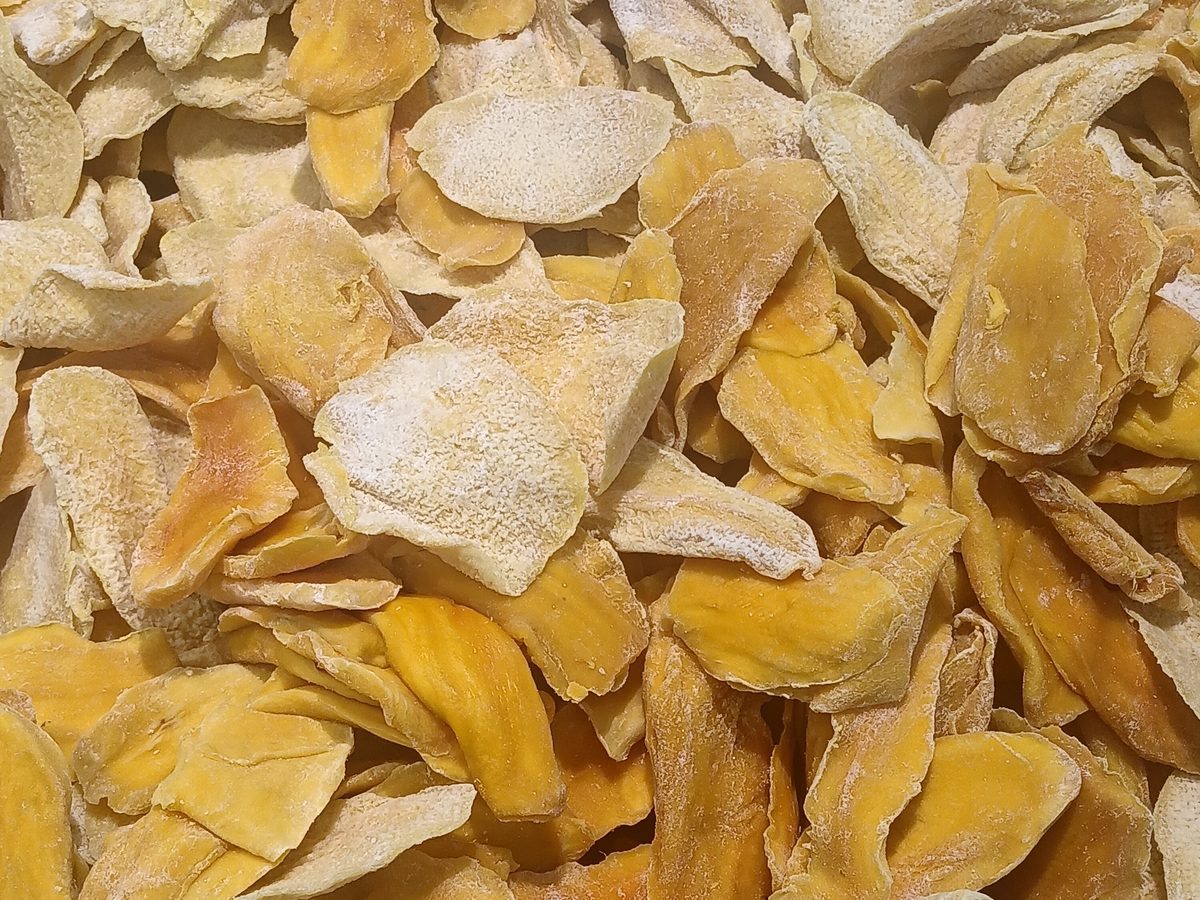
Keitt mango slices after 52 hours in three prototype solar dryers, Chachapoyas, Amazonas, Peru (Frontiers in Nutrition, 14 October 2026)
86.8% to 12.2%
Water in the mango, fresh pulp against slices after 52 hours in the fan dryer with limestone in the drying chamber
18.7% and 21.7%
Water left after 52 hours with limestone in the collector, and in the plain natural convection dryer
9 to 45 °Brix
Sugar reading, fresh pulp against the driest slices (41 to 45 across the three dryers)
0.77 to 27.9
Total phenolic reading, mg gallic acid equivalent per gram, fresh against the driest slices; partly just concentration, the authors caution
3.9 to 9.4
Antioxidant reading on the DPPH test, micromoles Trolox equivalent per gram, fresh against the plain dryer, the highest of the three
About 15 g
What 100 g of fresh pulp would weigh dried to 12.2% water, on our arithmetic from the paper's moisture figures
Source: Yalta Chappa M, Santillan Gomez H, Mori-Vigo S, Quispe-Sanchez L, Espinoza Canaza FI, Gosgot Angeles W, Oblitas-Delgado R, Tello Rodríguez D, Oliva Cruz M, López Mas M, Ordinola Ramírez C, Barrena Gurbillón MÁ and others, 'Physicochemical and bioactive properties of dehydrated mango pulp (Mangifera indica) using solar technology in the Amazonas Region, Peru', Frontiers in Nutrition 2026;13, published 14 October 2026, doi 10.3389/fnut.2026.1960440, open access. Site: UNTRM campus, Chachapoyas (6°14' S, 77°51' W); mean relative humidity 71%, annual cloud cover 77.5%. Dryers: 1 m² collector, polycarbonate chamber, three stainless mesh trays. NCD natural convection, no storage; FCD-TSC forced convection (extractor 0.038 kg/s, on at collector 55 °C) with limestone in the collector; FCD-TSD the same with limestone in a chamber compartment. Keitt mango from local markets, slices 3 ± 0.5 mm, pooled, 2 kg per dryer. Sampled at 0, 240, 480, 1,440, 1,680, 1,920, 2,880 and 3,120 min; samples left in closed dryers overnight. Means ± SD, n = 3 (firmness n = 5). At 3,120 min (NCD, TSC, TSD): moisture 21.67 ± 0.83%, 18.70 ± 0.73%, 12.24 ± 0.36% (fresh 86.81 ± 0.23%), all different; TSS 43.00, 40.87, 45.00 °Brix (fresh 9.00); titratable acidity 1.77, 2.51, 2.44% citric acid (fresh 0.66); pH 3.85, 3.72, 3.86 (fresh 4.22); L* 53.35, 56.73, 77.20 (fresh 58.28); TPC 22.07, 25.16, 27.89 mg GAE/g (fresh 0.77); DPPH 9.43, 8.49, 8.53 µmol TE/g (fresh 3.88). Our arithmetic: dry matter 13.19% fresh against 87.76% (TSD) and 78.33% (NCD), factors of about 6.7 and 5.9; 100 g fresh pulp at 12.24% moisture weighs 13.19 / 0.8776 = 15.0 g. Not measured: water activity, microbiology, shelf life, solar radiation, energy balance, limestone properties, individual compounds; DPPH the only antioxidant test; results not on a dry-weight basis. Funding: Project CUI 2314875 (PROCICEA), UNTRM; no conflicts declared.
- Raw mango is about 83.5% water by USDA figures, with 60 kcal and 36.4 mg of vitamin C in 100 g. The Keitt mangoes in this study started even wetter, at 86.8%.
- Because drying removes water but not sugar, 100 g of dried mango carries the sugar and calories of several times its weight in fresh fruit (about six and a half times for slices dried to 12% water), which makes it easy to eat a lot.
- Degrees Brix is the sugar reading juice makers use: 1 °Brix is roughly 1 g of dissolved sugar in 100 g of liquid, read from how much the sample bends light.
- The limestone in two of the dryers worked as a heat battery: it warms up in the sun and gives the heat back slowly when clouds pass, so the air over the fruit doesn't cool as fast.
- Physicochemical and bioactive properties of dehydrated mango pulp (Mangifera indica) using solar technology in the Amazonas Region, PeruFrontiers in Nutrition · The study, open access, published 14 October 2026
- Mangos, rawUSDA FoodData Central · Water, energy and vitamin C in raw mango
- Dried mango (1)Wikimedia Commons · The photo, CC BY 2.0
General information, not medical advice. This was a lab study of drying methods, not a study of people eating the fruit, and it did not test whether the dried mango keeps safely. Dried fruit is concentrated in sugar and calories; if you have diabetes or are watching your weight, ask your doctor or dietitian how much fits your diet.
Analysis by NutroPractic from the sources listed. Written for general readers; it does not replace advice from your own doctor.
From our articles
Read, then eat a little better
Plain-language guides on nutrition and wellness, backed by research.

Women's health
Inositol for PCOS: the 40:1 ratio, trial doses, and food milligrams
Why do randomized trials in polycystic ovary syndrome prioritize the 40:1 myo to D-chiro inositol ratio? Here is the science behind the ovarian epimerase paradox, clinical ovulation and insulin metrics, and why cantaloupe cannot replace 4,000 mg trial powder.
21 Nov 2026

Everyday eating
Extra virgin olive oil polyphenols: the EU health claim, smoke point myths, and cooking stability
Does extra virgin olive oil degrade when cooked? What does the EU 5 mg polyphenol health claim require, how does oleocanthal act like ibuprofen, and why does oxidative stability matter more than smoke point in domestic frying? Here is the clinical and culinary data.
21 Nov 2026

Food and nutrition
L-theanine and caffeine: what cognitive trials measured on sustained attention, and milligrams in matcha vs green tea
Combining L-theanine with caffeine produces clean focus without caffeine jitters. Here is what randomized trials measured on attention-switching, EEG alpha brain waves, and the exact milligrams across ceremonial matcha, culinary powder, gyokuro, and sencha.
20 Nov 2026
Newsfeed for your website
Want this feed on your website?
Add it to any site with one copy-and-paste snippet. No sign-up, and it updates itself every hour.
Start with a virtual consultation
Tell Dr. Triveni what you want to change. You will leave with a clear next step, whether you are in Toronto, London, New York or Chennai.