Eating out · October 22, 2026
Fries and tortilla chips from 98 shared restaurant fryers across 14 US states were sent to a gluten lab. 92 passed the gluten-free limit, and none from kitchens that change the oil daily failed
People with coeliac disease are usually told to skip anything from a fryer that also cooks breaded food. A team led by the Celiac Disease Foundation bagged fries and chips from real restaurants and had them tested. Most samples held no measurable gluten, every tortilla chip was clean, but a few portions of fries came back well over the line.
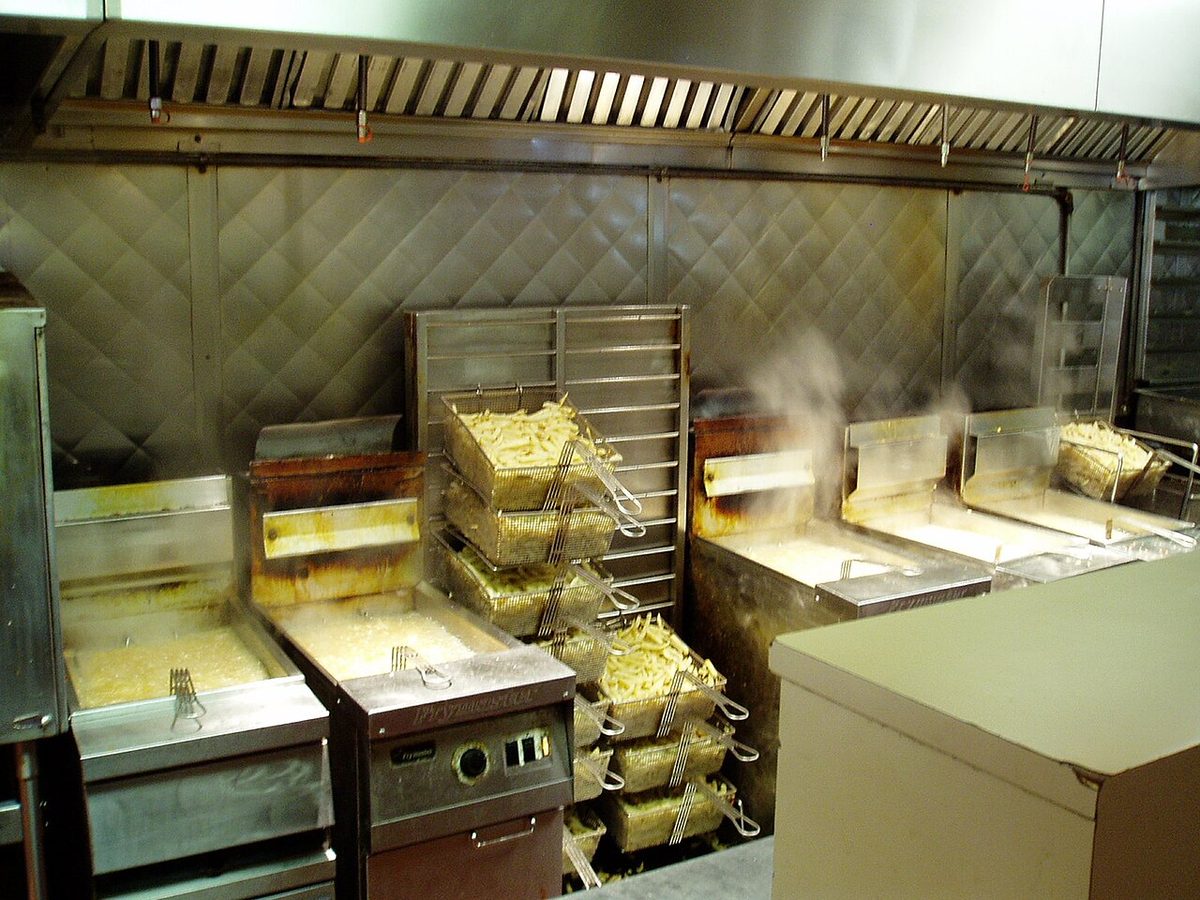
For someone with coeliac disease, the gluten-free diet is the only treatment there is, and the advice on eating out is blunt: if the fries share oil with battered fish or breaded chicken, don't order them. The worry is reasonable. Batter and breadcrumbs shed into the oil, and the oil coats whatever goes in next. What has been missing is a count of how much gluten actually turns up on the plate. A paper published in Nutrients on 20 October tries to supply one.
Between September 2025 and January 2026, volunteers working with the Celiac Disease Foundation and coeliac centres in Colorado, New York, Boston and Chicago collected 98 portions of naturally gluten-free fried food: 55 of French fries and 43 of tortilla chips, each from a different establishment in one of 14 US states. Every fryer was shared with gluten-containing food and none was designated gluten-free. Staff were asked how often the oil was changed. Each bagful was ground up whole and a 1 g portion tested with the R5 ELISA, the standard method behind the US and international gluten-free rules, at an accredited lab in Vermont.
84 samples (86%) had less gluten than the test can measure, under 5 parts per million. Eight more fell between 5 and 20 ppm, below the US Food and Drug Administration's limit for a gluten-free label. Six (6.1%) went over 20 ppm, and they were not marginal: 29.6, 34.9 and 67.9 ppm, and three above 80 ppm, the top of the test's range. All six were fries; all 43 tortilla chip samples were under 5 ppm. None of the 39 samples from kitchens that said they changed the oil every day exceeded 20 ppm, against four of the 35 (11.4%) from kitchens changing it weekly. The other two came from places where staff did not know.
The authors, several of them coeliac specialists, argue that blanket avoidance overstates the risk, and that counselling should separate occasional, low exposures from the daily habits that keep the gut inflamed. Parts per million only matter once multiplied by the amount eaten: their own example is that 500 g of food at 20 ppm holds about 10 mg of gluten, a daily dose that caused measurable gut damage in some people in a 2007 trial. By the same arithmetic, though, 100 g of fries at 80 ppm would carry about 8 mg on its own, so the rare bad sample is not trivial.
The limits are plain in the paper. Restaurants were picked by the volunteers, not at random; each was sampled once; and the oil-change answers came from staff and were not checked. With six samples over the line, the link to weekly oil changes rests on small numbers (p = 0.046). Fryer size, filtering, how much breaded food went through, and other foods such as onion rings were not studied, and the study measured gluten in food, not anyone's symptoms or gut. Bia Diagnostics, where the samples were tested, employs one of the authors; the study had no outside funding. The practical reading: tortilla chips and fries from a kitchen that changes its oil daily looked low-risk in this sample, and asking about the oil is a fair question to put to a server.
Gluten measured in 98 portions of fries and tortilla chips from shared restaurant fryers in 14 US states, 2025–2026
98
Samples, each from a different establishment: 55 French fries and 43 tortilla chips, all from fryers shared with gluten-containing food
84 (86%)
Samples with gluten below the test's limit of quantification, under 5 ppm
6 (6.1%)
Samples over the US gluten-free limit of 20 ppm (95% CI 2.3–12.9%): 29.6, 34.9 and 67.9 ppm, and three above 80 ppm
6 of 55
Fries over 20 ppm (10.9%); tortilla chips 0 of 43, all under 5 ppm (p = 0.033)
0 of 39
Samples over 20 ppm where staff said the oil was changed daily, against 4 of 35 (11.4%) with weekly changes (p = 0.046)
10 mg
Gluten in about 500 g of food at 20 ppm, the authors' worked example; a daily dose linked to gut damage in some people with coeliac disease
Study: Weisbrod VM, McKeon MD, Stahl MG, Germone M, Nagle S, Jossen J, Lebovits J, Leonard MM, Perl J, Geller MG, Geller A, Emerson-Mason L, Pan Z, Verma R, Liu E, 'Shared Fryers May Not Always Be as Risky for Gluten Cross-Contact in Celiac Disease as Dietary Guidance Suggests', Nutrients 2026, 18(20), 3433, published 20 October 2026, doi 10.3390/nu18203433 (open access, CC BY; read in full). Cross-sectional sampling, September 2025 to January 2026, in California, Colorado, Georgia, Kansas, Massachusetts, Michigan, Missouri, New Jersey, New Mexico, New York, Pennsylvania, Tennessee, Virginia and Washington; establishments chosen by the collectors, one sample each. Settings: casual dining 44, chain/franchise 19, fast casual 15, fast food 12, other 4, fine dining 2, café 2. Fast food: 9 of 12 under 5 ppm, 2 at 5–20, 1 over 20; fast casual: 13 of 15, 1 and 1. Oil changes reported daily for 39 samples, weekly for 35, unknown for 24. Gluten by R-Biopharm RIDASCREEN Gliadin R5 sandwich ELISA (AOAC 2012.01, Codex Type I method; gluten = 2 × gliadin), quantitative range 5–80 ppm, 1 g test portion from the whole homogenised sample, at Bia Diagnostics (ISO 17025). Fisher's exact tests; oil-change answers self-reported by staff and not verified; no clinical outcomes measured. The '100 g at 80 ppm = 8 mg' figure in the story is our arithmetic on the paper's numbers, not a result of the study. No external funding; one author is an employee of Bia Diagnostics, and three report advisory or consulting roles with Takeda and other companies.
- Parts per million translate directly into milligrams per kilogram, so 20 ppm gluten means 20 mg of gluten in a kilogram of food, or 2 mg in a 100 g portion.
- The 20 ppm limit is a labelling rule, not a personal safety line. The authors stress that what matters is how much gluten a person takes in across a whole day, and how often.
- The lab tested a 1 g portion of each ground-up sample, about four times the roughly 0.25 g used in routine factory gluten testing, to make it less likely that patchy contamination was missed.
- Gluten tests measure gliadin, one of the two main gluten protein families, and double it to estimate total gluten, following the international Codex standard.
- Earlier research cited by the authors found that many people with coeliac disease who follow a strict gluten-free diet still eat measurable gluten, picked up in stool and urine tests.
- Shared Fryers May Not Always Be as Risky for Gluten Cross-Contact in Celiac Disease as Dietary Guidance SuggestsNutrients, October 2026 · The paper: full text, open access
- Gluten-Free Foods Cooked in Shared Fryers With Wheat: A Pilot Study Assessing Gluten Cross ContactFrontiers in Nutrition, 2021 · An earlier, smaller shared-fryer study the authors compare with
- Food Labeling; Gluten-Free Labeling of Foods (final rule)US Food and Drug Administration, Federal Register, August 2013 · The 20 ppm rule for a gluten-free label
- Friescookingbigrest.jpegWikimedia Commons · The photo, CC BY 2.0 (David Hoshor)
General information, not medical advice. This study measured gluten in restaurant food samples; it did not test anyone's symptoms or gut health, and a low result in one kitchen on one day says nothing certain about the next. If you have coeliac disease, talk to your gastroenterologist or a dietitian before changing how strictly you avoid shared fryers or other sources of cross-contact.
Analysis by NutroPractic from the sources listed. Written for general readers; it does not replace advice from your own doctor.
From our articles
Our guides on this subject
Plain-language guides on nutrition and wellness, backed by research.
Everyday eating
Calories on the menu: what restaurant labelling studies found, and how to order well when eating out
Menu calorie labels arrived in the US in 2018 and England in 2022. Studies of millions of orders found drops of about 4 to 6%, and none at all in some places. What a restaurant meal really carries (977 kcal for a UK chain main course alone), a worked evening out, what eating out often does in long-term studies, and five ordering habits that save hundreds of calories.
22 Oct 2026

Women's health
Inositol for PCOS: the 40:1 ratio, trial doses, and food milligrams
Why do randomized trials in polycystic ovary syndrome prioritize the 40:1 myo to D-chiro inositol ratio? Here is the science behind the ovarian epimerase paradox, clinical ovulation and insulin metrics, and why cantaloupe cannot replace 4,000 mg trial powder.
21 Nov 2026

Everyday eating
Extra virgin olive oil polyphenols: the EU health claim, smoke point myths, and cooking stability
Does extra virgin olive oil degrade when cooked? What does the EU 5 mg polyphenol health claim require, how does oleocanthal act like ibuprofen, and why does oxidative stability matter more than smoke point in domestic frying? Here is the clinical and culinary data.
21 Nov 2026
Newsfeed for your website
Want this feed on your website?
Add it to any site with one copy-and-paste snippet. No sign-up, and it updates itself every hour.
Start with a virtual consultation
Tell Dr. Triveni what you want to change. You will leave with a clear next step, whether you are in Toronto, London, New York or Chennai.