Work and diet · October 23, 2026
Working for yourself in Thailand: people who hired staff rated their health better than employees did, people who worked alone rated it worse. The diet gap in the study's title came to 0.04 of a food group
A national survey of 5,287 Thai adults of working age split the self-employed into two camps: owners with paid staff and people working on their own, like the cook at a market stall. The solo workers came out worst on health, exercise, smoking and drinking. Their diets were less varied too, but by so little that the paper's own confidence interval includes no difference at all.
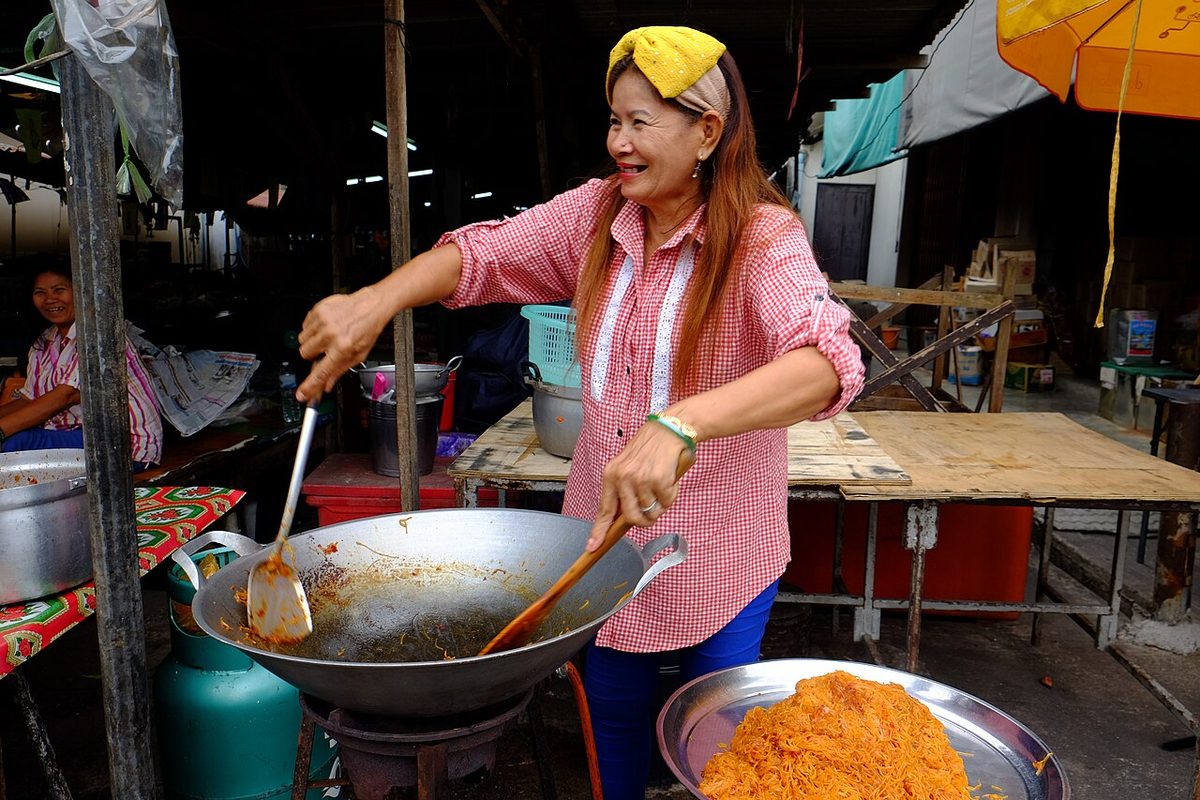
In a national survey of working-age Thais, almost four in ten worked for themselves. Some run a workshop or a shop with paid staff; far more work alone, for example on a market stall, a small farm or a motorbike. A team from universities in China, Thailand and Malaysia took the 2024 Thailand Health and Welfare Survey, a national sample, and asked whether working for yourself goes with worse health and worse habits, including what you eat. The paper came out in Frontiers in Nutrition on 16 October.
After cleaning, the sample was 5,287 adults aged 18 to 65. Of these, 39.1% were self-employed: 9.3% employed at least one paid worker and 29.8% worked alone. The two groups barely look alike. The solo workers were older (46.5 years on average against 41.9), had less schooling (8.9 years against 10.5), and 85.6% lived in the countryside, against 69% of the owners with staff and 50.7% of employees. Owners with staff put in the longest weeks, 47.7 hours, against 43.0 for employees and 38.6 for people working alone.
Everyone rated their own health from 1 (very poor) to 5 (very good), compared with people their age. Owners with staff averaged 3.78, employees 3.75 and solo workers 3.59. Once the authors allowed for age, sex, region, income, hours, insurance and recent use of health care, the split held. Compared with an employee, working alone cut the chance of rating your health good or very good by about 4.7 percentage points; employing other people raised it by about 4.3 points. Lumped together, the self-employed looked only slightly worse than employees, which is the paper's main point: 'self-employed' hides two very different lives.
Then the diet part. Dietary variety was scored as the number of food groups, out of 10, that a person ate in the 24 hours before the interview: cereals, roots, vegetables, fruit, meat, fish, eggs, pulses and nuts, dairy, and oils. After adjustment, the self-employed scored 0.037 groups lower than employees. That is about one food group for every 27 people, and the 95% confidence interval runs from 0.078 lower to 0.004 higher, so no difference at all fits the data. The authors flag it as significant only at the loose 10% level and call all their lifestyle results exploratory.
The other habits pointed the same way and were a little firmer: self-employed people were less likely to report regular exercise and more likely to smoke, both clearing the usual 5% bar, while the drinking result, like the diet one, only cleared 10%. The paper reports these as model coefficients and does not turn them into percentages, so it does not say how many more smokers or drinkers there were. It also reports these four results for the self-employed as one group, not split by owners and solo workers, even though that split is where the health difference lives.
The authors list the limits plainly. It is one survey at one point in time, so poor health may push people into working alone as much as working alone wears down health. Health and habits were self-reported. A single day's food recall says nothing about usual diet, portions or nutrients. Their attempt to test cause and effect, using regional unemployment rates as a lever, rests on an assumption they themselves say is 'likely violated', so they present it only as a check. The work was commissioned and funded by a Chinese environmental technology company that employs one of the authors; the paper says the funder had no role in the study.
What the numbers do support is narrower than the title: in Thailand, people working on their own with no staff reported somewhat worse health and a cluster of less healthy habits than both employees and employers. If you work alone, long or irregular days can push meals, movement and sleep down the list, and that is worth planning around, but this study cannot tell you that your job is what changed your diet.
Self-employment, self-rated health and dietary variety: 5,287 Thai adults aged 18 to 65, 2024 Thailand Health and Welfare Survey
39.1%
Self-employed: 9.3% with paid staff, 29.8% working alone (60.9% employees)
3.78 · 3.75 · 3.59
Average self-rated health out of 5: owners with staff, employees, people working alone
−4.7 points
Change in the chance of rating health good or very good, working alone versus employees (owners with staff: +4.3)
−0.037
Food groups out of 10 eaten in a day, all self-employed versus employees (95% CI −0.078 to +0.004)
47.7 · 43.0 · 38.6 h
Average working hours a week: owners with staff, employees, people working alone
85.6% vs 50.7%
Share living in rural areas, people working alone versus employees
Source: Yao K, Chen W, Bao C, Shi Y, 'Integrating nutrition and lifestyle: associations between employment type and health behaviors', Frontiers in Nutrition 13:1889959, published 16 October 2026, doi 10.3389/fnut.2026.1889959, open access (CC BY). Data: 2024 Thailand Health and Welfare Survey (nationally representative, multi-stage stratified cluster sample), adults 18 to 65 with complete data, income and hours trimmed at the 1st and 99th percentiles; n = 5,287; survey weights used. Self-employed = employers plus own-account workers; employees = long-term, contract, hourly and paid domestic workers. Descriptives (employers / solo / employees): age 41.9 / 46.5 / 42.3 years; schooling 10.47 / 8.86 / 12.24 years; rural 69.0% / 85.6% / 50.7%; monthly income 19,394 / 18,967 / 18,087 baht; weekly hours 47.66 / 38.56 / 42.95. Self-rated health (1 = very poor to 5 = very good): 3.784 / 3.592 / 3.752. Survey-adjusted ordered probit with controls for sex, age group, region, urban residence, income, weekly hours, insurance and health-care use: all self-employed −0.061 (p < 0.10); employers +0.115 (p < 0.05); solo −0.126 (p < 0.01). Average marginal effects on the probability of rating health good / very good: solo −1.86 / −2.81 points; employers +1.69 / +2.57 points. Lifestyle models (all self-employed versus employees, survey-adjusted OLS for dietary diversity, probit for the rest; coefficients, not percentages): dietary diversity −0.037 (95% CI −0.078 to 0.004, p < 0.10); regular physical activity −0.045 (p < 0.05); current smoking +0.032 (p < 0.05); current drinking +0.028 (95% CI −0.003 to 0.059, p < 0.10). Dietary diversity = count of 10 food groups from a single 24-hour recall, adapted from the FAO Household Dietary Diversity Score. Instrumental-variable analysis (regional urban unemployment rate) presented by the authors as a sensitivity check only, not causal. Funding: a horizontal research project commissioned by Yunnan Saiwei Intelligent Environmental Protection Technology Co., Ltd., which employs one author; the funder had no stated role in design, analysis or publication. CI = confidence interval.
- In labour statistics an 'own-account worker' is someone who works for themselves and does not employ anyone on a continuing basis. In this survey they outnumbered self-employed people with staff by more than three to one.
- Employees, not the self-employed, were the ones more likely to report a fever, sore throat or cough in the previous four weeks: 6.6% against 5.1%.
- Headache or dizziness in the past month was reported by 2.9% of people working alone but only 0.8% of owners with staff.
- Almost everyone in the sample had health insurance (98%), yet only 2.7% had used health care in the survey's reference period.
- A dietary diversity score counts food groups, not amounts: a day of rice, eggs, vegetables and cooking oil scores 4 whether it was a small snack or a feast.
- Integrating nutrition and lifestyle: associations between employment type and health behaviorsFrontiers in Nutrition · The study, open access, with the sample, health and lifestyle tables
- Guidelines for measuring household and individual dietary diversityFood and Agriculture Organization of the United Nations · The food-group counting method the study's diet score is based on, and what it can and cannot tell you
- Street food vendor, Rayong cityWikimedia Commons · The photo, CC0
General information, not medical advice. This was a one-off survey of self-reported health and habits; it shows patterns, not that working for yourself causes poorer health or diet. If long or irregular working days are affecting how you eat, move or sleep, talk to your doctor or a registered dietitian.
Analysis by NutroPractic from the sources listed. Written for general readers; it does not replace advice from your own doctor.
From our articles
Our guides on this subject
Plain-language guides on nutrition and wellness, backed by research.
Workplace wellness
Eating on night shifts: what shift-work studies found on meal timing, weight and blood sugar
The same meal raises blood sugar more at 3 am than at 1 pm. What the sleep-lab trials found when night workers ate only by day, how the Nurses' Health Study risk climbed with years of nights, what is left of a 3 am coffee at bedtime, and a meal plan for a 19:00-07:00 shift.
30 Oct 2026
Workplace wellness
Eating well at a desk job: what workplace wellness trials changed, and what didn't
Two large randomised trials found that classic workplace wellness programmes, with screenings, classes and rewards, changed almost nothing. Changing the food in front of people did: labels and placement, more good options, smaller defaults. Here is what the trials found, plus meeting food, desk lunches, the afternoon slump and the two-minute walk.
15 Oct 2026

Women's health
Inositol for PCOS: the 40:1 ratio, trial doses, and food milligrams
Why do randomized trials in polycystic ovary syndrome prioritize the 40:1 myo to D-chiro inositol ratio? Here is the science behind the ovarian epimerase paradox, clinical ovulation and insulin metrics, and why cantaloupe cannot replace 4,000 mg trial powder.
21 Nov 2026
Newsfeed for your website
Want this feed on your website?
Add it to any site with one copy-and-paste snippet. No sign-up, and it updates itself every hour.
Start with a virtual consultation
Tell Dr. Triveni what you want to change. You will leave with a clear next step, whether you are in Toronto, London, New York or Chennai.