Food rescue · November 2, 2026
Only 8 of 156 rescued-food 'meals' in an Indonesian city reached the calorie mark for one sitting. Some were a single dish, and 98 came from one donor of burgers, nuggets and fried chicken
Researchers went through the records of a food rescue group in Yogyakarta that collects surplus from hotels, bakeries and a food factory. Protein held up fairly well. Calories, carbohydrate and fruit did not. But what counts as a meal here decides a lot of the answer.
Saving food from the bin and feeding people who are short of it sounds like one good deed that does two jobs. A team from universities in Indonesia and Hungary asked the question that tends to come second: how nourishing is the food once it arrives? Their answer, published in Food Science & Nutrition on 25 October, comes from the records of one volunteer group, Berbagi Bites Jogja, in Yogyakarta, Indonesia.
The group collects surplus from hotels, restaurants, caterers, bakeries and cafes and passes it on, mainly to underprivileged university students at first and later also to orphanages, shelters, elderly homes and others short of food. The analysis covered eight donors (five hotels, two bakeries and a food factory) from July 2024 to October 2025. Each donation to a group of recipients was counted as one meal, whether it was one dish or many, and the total was divided by the number of people. That gave 156 meals. Nutrients were then estimated from dish names using Indonesia's national food composition table and set against the country's recommended daily amounts. The yardstick was 30% of a day's needs per meal.
Adding up the paper's percentages, only 8 of the 156 meals reached 30% of daily energy, 7 reached it for carbohydrate and 26 for fat. Protein did far better, at 62 of 156. On average an adult's meal carried 338 kcal, about half of the 677 kcal that 30% works out to. Children's meals averaged 299 kcal and adolescents' 202 kcal, the lowest of the three even though adolescents have the highest energy target. Protein averaged 23.0 g for children and 21.4 g for adults, both over the line, but only 13.3 g for adolescents.
The supply itself was lopsided. Grains and animal protein dominated, while fruit, beans, nuts and plant protein were scarce. In the paper's menu table, every fruit, the tempeh and every bean and nut dish sit under one donor, which has a single meal in the analysis. Two donors supplied 143 of the 156 meals: one whose listed menu is all burgers, patties, nuggets, fried chicken and meatballs (98 meals, 53% reaching the protein mark), and one listed under bakery products (45 meals, 11%). That mix probably explains an odd result, on our reading: carbohydrate fell furthest short even though grain dishes were among the most common. The authors also flag how much of the food was fried or processed.
The caveats are big, and the authors state most of them. The 30% test assumes a complete meal, and a piece of fruit or bread can't pass it however good it is. Donors whose events bundled several dishes score higher simply because the dishes are added together. Portion weights were volunteers' estimates, some bakery and packaged weights included the wrapper, and dishes missing from the food table were matched to similar ones. Records without full details were dropped, and the paper doesn't say how many. Only calories, protein, fat and carbohydrate were estimated, so fibre, vitamins, minerals and salt are unknown, and nobody recorded what recipients ate for the rest of the day. It is also one organisation, and the authors say the results can't be generalised. What it does support is modest and practical: rescue groups and donors could share the job of asking for more fresh, varied food, and of not treating every donated item as a meal.
Estimated nutrition in rescued surplus food, one organisation in Yogyakarta, July 2024 to October 2025 (Food Science & Nutrition, 25 October 2026)
156
Meals analysed from 8 donors: 105 for adults, 30 for children, 21 for adolescents
8 of 156
Meals reaching 30% of daily energy (7 for carbohydrate, 26 for fat)
62 of 156
Meals reaching 30% of daily protein
338 kcal
Average adult meal (95% CI 290 to 386); 30% of the adult daily target is 677 kcal
202 kcal
Average adolescent meal (95% CI 148 to 257); 30% of their daily target is 690 kcal
13.3 g
Average protein in an adolescent meal, against 21.4 g for adults and 23.0 g for children
143 of 156
Meals that came from just two of the eight donors
70 to 2,191 kcal
Range of adult meals; the median was 302 kcal
Figures come from the open-access paper's text and Tables 1 to 4b. All nutrient values are estimates from dish names and the Indonesian food composition table, not lab tests. The counts (8, 7, 26 and 62 of 156), the 677 and 690 kcal lines, the 143 of 156 and the comment on why carbohydrate fell short are our own arithmetic and reading; the counts come out the same from the age-group table and the donor table. One thing we noticed: the '% of daily RDA' column in Table 3 doesn't always equal the mean divided by the targets in Table 2 (adult protein 21.4 of 63 g is 34%, the table says 37.9%; children's fat 13.8 of 62 g is 22%, the table says 25.3%). No result crosses the 30% line either way, but we have used grams and kcal rather than that column. The paper calls the yardstick both 'one-third' and 30%; we use 30%, as its tests do. Differences between donors were significant for protein, fat and carbohydrate, but only one pairwise gap survived correction, and it rests on three meals from one donor. Two authors worked with the organisation on a community service project, and one lists it as an affiliation; this was declared. Funded by a Universitas Gadjah Mada community service grant and a Hungarian Academy of Sciences scholarship.
- Indonesia's national waste records, quoted in the paper, put food at 50.05% of Yogyakarta's waste: 354,533 tons a year, or 971 tons a day.
- The one donor whose menu listed fruit, tempeh, red-bean soup and nuts bundled up to 23 dishes into a single event. Once shared among its recipients, that event still reached none of the four 30% marks.
- All three meals from one donor reached the protein mark. Each combined four or five dishes, for example fried rice, fried chicken, fried noodles and fish stew.
- The Indonesian guidance quoted in the paper asks for 400 to 600 g of vegetables and fruit a day for adolescents and adults, and 300 to 400 g for children.
- Volunteers partly reheated or recooked some of the ready-to-eat food before delivering it, and the authors note that cooking methods also affect nutrition.
- Evaluating Nutrient Composition in Surplus Food Redistribution Programs: Evidence From Yogyakarta, IndonesiaFood Science & Nutrition, 25 October 2026 · The paper's DOI. Open access under CC BY.
- Full text of the paperPubMed Central · Methods, Tables 1 to 4b, limitations, competing interests and funding.
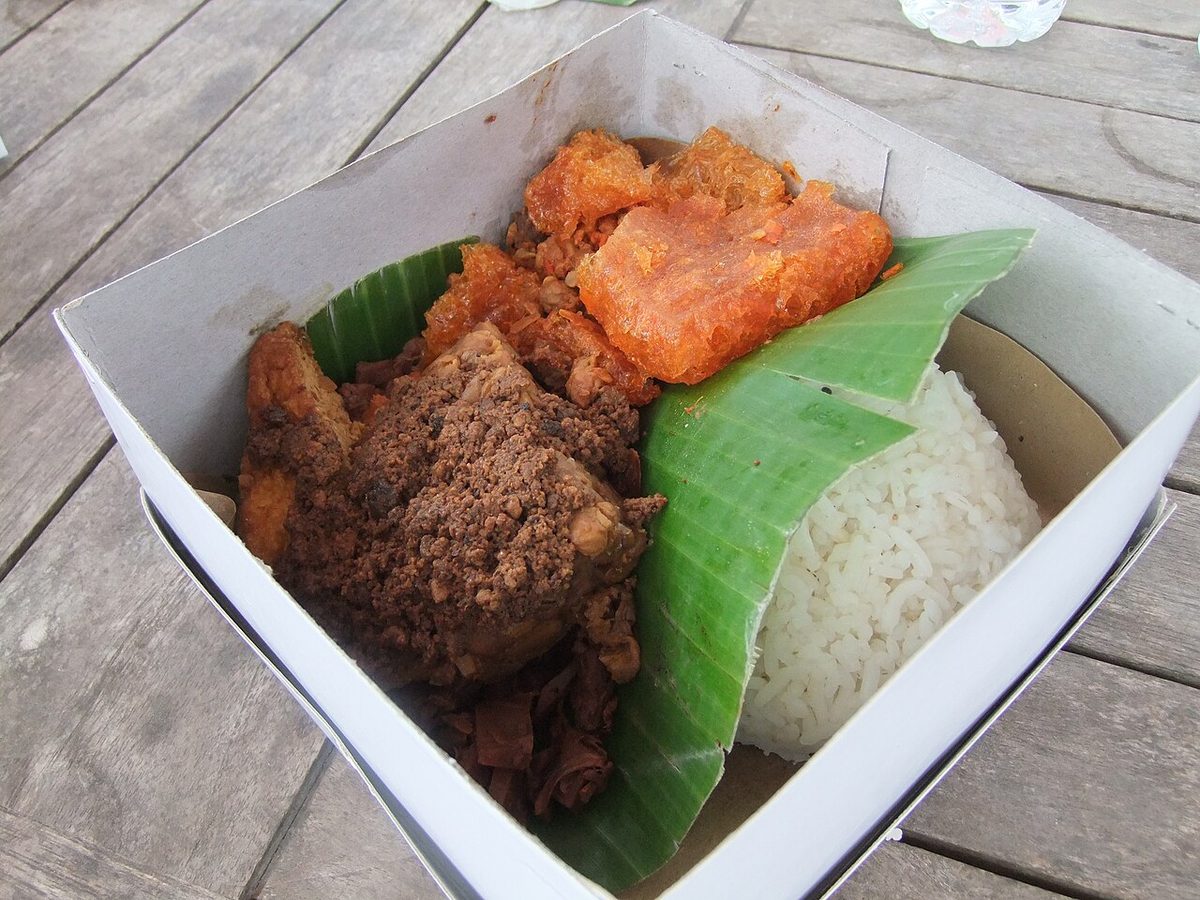
- Nasi kotak gudeg WijilanWikimedia Commons · CC BY 3.0 photograph by Midori, used as an illustration.
General information, not medical advice. This study estimated the nutrients in donated food from records; it didn't measure what recipients ate or their health. If you are short of food or worried about your or your child's diet, talk to a doctor, dietitian or local support service.
Analysis by NutroPractic from the sources listed. Written for general readers; it does not replace advice from your own doctor.
From our articles
Read, then eat a little better
Plain-language guides on nutrition and wellness, backed by research.
Gut health
Gluten-free without coeliac disease: who actually benefits, and what the blinded gluten challenges found
In blinded trials only 16% of people who said gluten made them ill reacted to gluten rather than placebo, and in Oslo fructans caused more bloating than gluten. Who really needs to avoid it, how to get tested before you stop, how much gluten is in a slice of bread or a roti, and what gluten-free food costs (159% more in the UK) and lacks.
1 Nov 2026
Diabetes
Fenugreek, cinnamon and turmeric for blood sugar: what the trials in an Indian kitchen measured
Fenugreek seed at 5-10 g a day lowered HbA1c by about 0.85 points in pooled trials, and in a 3-year Hyderabad study 23% went on to diabetes against 55%. Cinnamon trims fasting glucose by 15-25 mg/dL, but a teaspoon of cassia tops the coumarin limit. Curcumin: about 0.3-0.4 points, and rare liver injury from capsules. Doses in teaspoons, and a fair way to test it at home.
1 Nov 2026
Diabetes
Potatoes and blood sugar: boiled, cooled, mashed or fried, and what the cohorts and trials found
Fries were linked to 20% higher diabetes risk per three servings a week in 205,000 US adults; boiled, baked and mashed potatoes to almost none. GI by cooking method, resistant starch in grams after chilling, the glycaemic load of a potato against a cup of rice, and how to fit aloo into an Indian plate.
30 Oct 2026
Newsfeed for your website
Want this feed on your website?
Add it to any site with one copy-and-paste snippet. No sign-up, and it updates itself every hour.
Start with a virtual consultation
Tell Dr. Triveni what you want to change. You will leave with a clear next step, whether you are in Toronto, London, New York or Chennai.