Herbal supplements · October 21, 2026
90 Korean adults took a purple loosestrife extract or a placebo for 12 weeks. The extract group lost half a kilo of fat; most of the 2 kg gap came from the placebo group gaining it
Purple loosestrife is a wetland weed with tall magenta spikes, and a Korean team has been testing a hot-water extract of it as a fat-loss supplement. In their placebo-controlled trial the difference in body fat between the groups was clear on a DXA scan. How it got there is the more interesting part: the people on the extract lost a little fat, and the people on placebo put on more than twice as much.
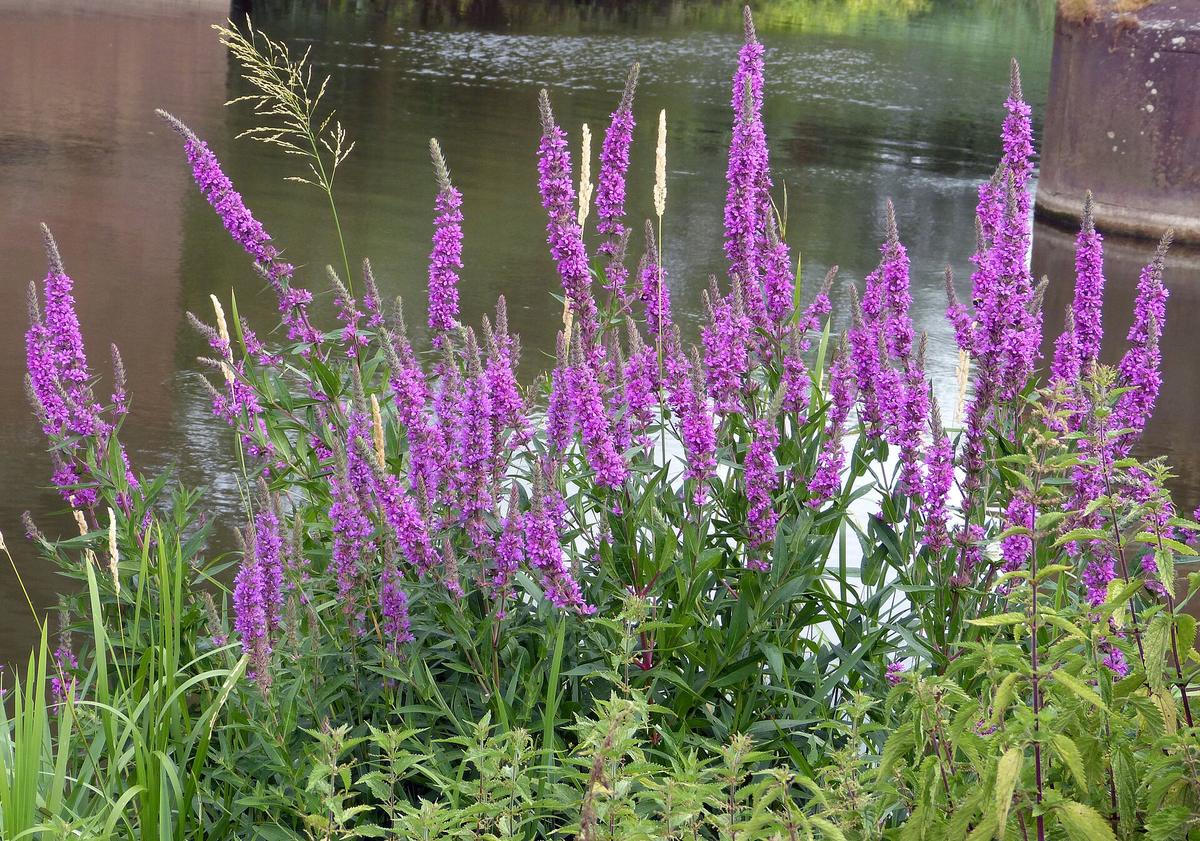
Purple loosestrife (Lythrum salicaria) grows along riverbanks and ditches across Europe and Asia, and since at least the 1830s in North America, where it is treated as an invasive weed. In South Korea it came out of a provincial screening programme for native plants that might help with weight. Lab work found that a water extract stopped immature fat cells from maturing and slowed weight gain in mice on a high-fat diet. An earlier small human trial had mixed it with a second herb and found nothing clear, so this team set out to test the loosestrife extract on its own.
The trial, published in Nutrients on 12 October, ran at Pusan National University Korean Medicine Hospital in 2023. It recruited 90 adults aged 19 to 75 with a body mass index between 23 and 30, which counts as overweight to obese by the Asian cut-offs Korea uses. Half took three capsules a day holding 500 mg of extract powder in total, made by boiling the dried plant in water and spray-drying it; the other half took look-alike capsules of lactose and caramel colouring. Neither the participants nor the researchers knew who had which. Body fat was measured with a DXA scan, which separates fat, lean tissue and bone, at the start and after 84 days.
Six people dropped out, leaving 42 in each group. In the extract group, body fat fell by an average of 0.58 kg. In the placebo group it rose by 1.43 kg. After adjusting for where people started, the gap was 2.01 kg in favour of the extract, and a similar 2.04 kg when the dropouts were included using statistical estimates. Body weight followed the same pattern, down 0.98 kg on the extract and up 0.79 kg on placebo. Fat fell in 29 of the 42 people on the extract and in just one of the 42 on placebo.
That split is what to look at. Roughly 70% of the 2 kg difference is fat the placebo group gained, not fat the extract group lost. The authors say the gain 'warrants caution' and that they cannot tell where it came from. Both groups reported eating a little less by the end and no change in exercise, but those figures are self-reported. Two people in the placebo group had unusually large gains; leaving them out shrank the difference to 1.79 kg, still clear.
Other results were thinner. Lean mass did not differ clearly between groups, but the range of likely results includes the extract group losing a little more muscle, and one pessimistic scenario for the missing data pointed that way. Adiponectin, a hormone made by fat tissue that tends to be higher in leaner people, went up on the extract and down on placebo. Cholesterol, triglycerides, free fatty acids and an inflammation marker did not change differently. Many secondary measures were tested without correcting for multiple comparisons, so the authors call those findings exploratory.
Side effects were few and mild: three in two people on the extract (flu, a migraine, hives) and four in four people on placebo, none judged related to the capsules, and blood tests showed nothing of concern. The trial was small, at one centre, lasted 12 weeks, and its main analysis counted only people who finished. Its planned size rested on the investigators' own guess at the effect, a 1.5 kg difference, because no earlier data existed. The work was funded by South Korea's Rural Development Administration, the extract was developed by a Busan company, BIOPORT KOREA, and the authors declare no conflicts of interest. They ask for larger, longer trials at several centres before the extract is relied on.
Lythrum salicaria (purple loosestrife) extract vs placebo for body fat: randomised, double-blind trial, 90 Korean adults with BMI 23–30, 12 weeks
90 → 84
Adults randomised (45 per group) and those who finished all visits (42 per group)
−0.58 kg
Average change in DXA body fat on 500 mg a day of extract powder over 12 weeks
+1.43 kg
Average change in DXA body fat on placebo over the same 12 weeks
−2.01 kg
Difference between groups, adjusted for starting fat (95% CI −2.51 to −1.52); −2.04 kg counting all 90
29 of 42 vs 1 of 42
People whose body fat went down at all: extract vs placebo
−1.77 kg
Adjusted difference in body weight (extract −0.98 kg, placebo +0.79 kg)
No clear difference
Lean mass, cholesterol, triglycerides, free fatty acids, CRP and leptin
0 serious
Adverse events: 3 mild in 2 people on extract, 4 mild in 4 on placebo, none judged related
Study: Shin B-J, Park H-J, Park Y-J, An H-J, Shin S, Cha Y-Y, Heo I, 'Efficacy and Safety of Lythrum salicaria Extract on Body Fat Reduction in Adults with a BMI of 23–30 kg/m2: A Randomized, Double-Blind, Placebo-Controlled Trial', Nutrients 2026, 18(20):3342, published 12 October 2026, doi 10.3390/nu18203342 (open access, CC BY). Single centre, Pusan National University Korean Medicine Hospital, Yangsan; registered CRIS KCT0008060; enrolment March to August 2023, last follow-up 9 November 2023. Adults 19–75, BMI 23–30. Extract: hot-water extract of dried aerial parts, spray-dried 80:20 with maltodextrin; 3 × 166.7 mg extract powder a day (about 400 mg extract solids); placebo lactose with caramel colour. Primary endpoint: change in DXA body fat mass at day 84, per-protocol analysis (n = 42 + 42) with ITT (n = 45 + 45, multiple imputation) supporting. Fat mass change: placebo +1.43 ± 1.22 kg, extract −0.58 ± 1.03 kg; ANCOVA difference −2.01 kg (−2.51 to −1.52), ITT −2.04 kg (−2.66 to −1.42), age-adjusted −1.93 kg, excluding two extreme placebo values −1.79 kg (−2.18 to −1.40). Median change placebo +1.12 kg, extract −0.36 kg. Weight −1.77 kg (−2.40 to −1.14); BMI −0.62; body fat −1.56 percentage points; lean mass −0.23 kg (−0.82 to 0.36), not significant; under an adverse missing-data scenario lean mass −0.73 kg (−1.41 to −0.05). Adiponectin +606 ng/mL (68 to 1,143), p = 0.028, no multiplicity correction. Self-reported 3-day energy intake fell 233 kcal (placebo) and 439 kcal (extract), p = 0.40; physical activity unchanged. Mean compliance 95% and 97%. The 'roughly 70%' is our arithmetic (1.43 of 2.01 kg, mixing the unadjusted change with the adjusted difference, so approximate). Funded by the Rural Development Administration, Republic of Korea (RS-2021-RD009072); no conflicts declared.
- Purple loosestrife is native to Europe and Asia. In the United States it was established by the 1830s, arriving in ships' ballast and as a garden plant, and it is now listed as an invasive species that crowds out native wetland plants.
- Korea, like several Asian countries, counts a BMI of 23 as overweight and 25 as obese, lower than the WHO's general cut-offs of 25 and 30, because at the same BMI many Asian populations carry more body fat and metabolic risk.
- Body weight and BMI can't tell fat from muscle. A DXA scan sends two low-dose X-ray beams through the body and uses how differently fat, lean tissue and bone absorb them to measure each one separately.
- The researchers designed the trial to detect a 1.5 kg difference in fat. The difference they found, 2.01 kg, was bigger than they had planned for, but most of it came from the placebo side.
- Efficacy and Safety of Lythrum salicaria Extract on Body Fat Reduction in Adults with a BMI of 23–30 kg/m2: A Randomized, Double-Blind, Placebo-Controlled TrialNutrients, October 2026 · The study: full text, open access
- KCT0008060 trial registrationWHO International Clinical Trials Registry Platform · The trial's entry in Korea's CRIS registry
- Appropriate body-mass index for Asian populations and its implications for policy and intervention strategiesThe Lancet, 2004 (WHO Expert Consultation) · Why 23 is used as a lower cut-off in Asian populations
- Purple LoosestrifeUSDA National Invasive Species Information Center · Where the plant comes from and how it reached North America
- Purple Loosestrife Lythrum salicariaWikimedia Commons · The photo, CC BY 2.0 (gailhampshire)
General information, not medical advice. This was one small, 12-week trial of a specific extract, and much of the difference came from fat gained in the placebo group. Herbal products sold under the same plant name can differ widely in what they contain, and their safety over longer periods, in pregnancy or alongside medicines is not established; talk to your doctor before taking a supplement for weight loss.
Analysis by NutroPractic from the sources listed. Written for general readers; it does not replace advice from your own doctor.
From our articles
Read, then eat a little better
Plain-language guides on nutrition and wellness, backed by research.

Women's health
Inositol for PCOS: the 40:1 ratio, trial doses, and food milligrams
Why do randomized trials in polycystic ovary syndrome prioritize the 40:1 myo to D-chiro inositol ratio? Here is the science behind the ovarian epimerase paradox, clinical ovulation and insulin metrics, and why cantaloupe cannot replace 4,000 mg trial powder.
21 Nov 2026

Everyday eating
Extra virgin olive oil polyphenols: the EU health claim, smoke point myths, and cooking stability
Does extra virgin olive oil degrade when cooked? What does the EU 5 mg polyphenol health claim require, how does oleocanthal act like ibuprofen, and why does oxidative stability matter more than smoke point in domestic frying? Here is the clinical and culinary data.
21 Nov 2026

Food and nutrition
L-theanine and caffeine: what cognitive trials measured on sustained attention, and milligrams in matcha vs green tea
Combining L-theanine with caffeine produces clean focus without caffeine jitters. Here is what randomized trials measured on attention-switching, EEG alpha brain waves, and the exact milligrams across ceremonial matcha, culinary powder, gyokuro, and sencha.
20 Nov 2026
Newsfeed for your website
Want this feed on your website?
Add it to any site with one copy-and-paste snippet. No sign-up, and it updates itself every hour.
Start with a virtual consultation
Tell Dr. Triveni what you want to change. You will leave with a clear next step, whether you are in Toronto, London, New York or Chennai.