Kidney health · October 26, 2026
On home dialysis, the people who spent time at a BMI of 26 to 30 were less likely to die. Of 122 who got there, 5 died; of 548 who never did, 70
Doctors usually tell people to bring their weight down into the healthy range. A hospital in southern China followed 670 adults on peritoneal dialysis for years and found that the patients who did best were the ones who spent time a little heavier than the textbooks advise.
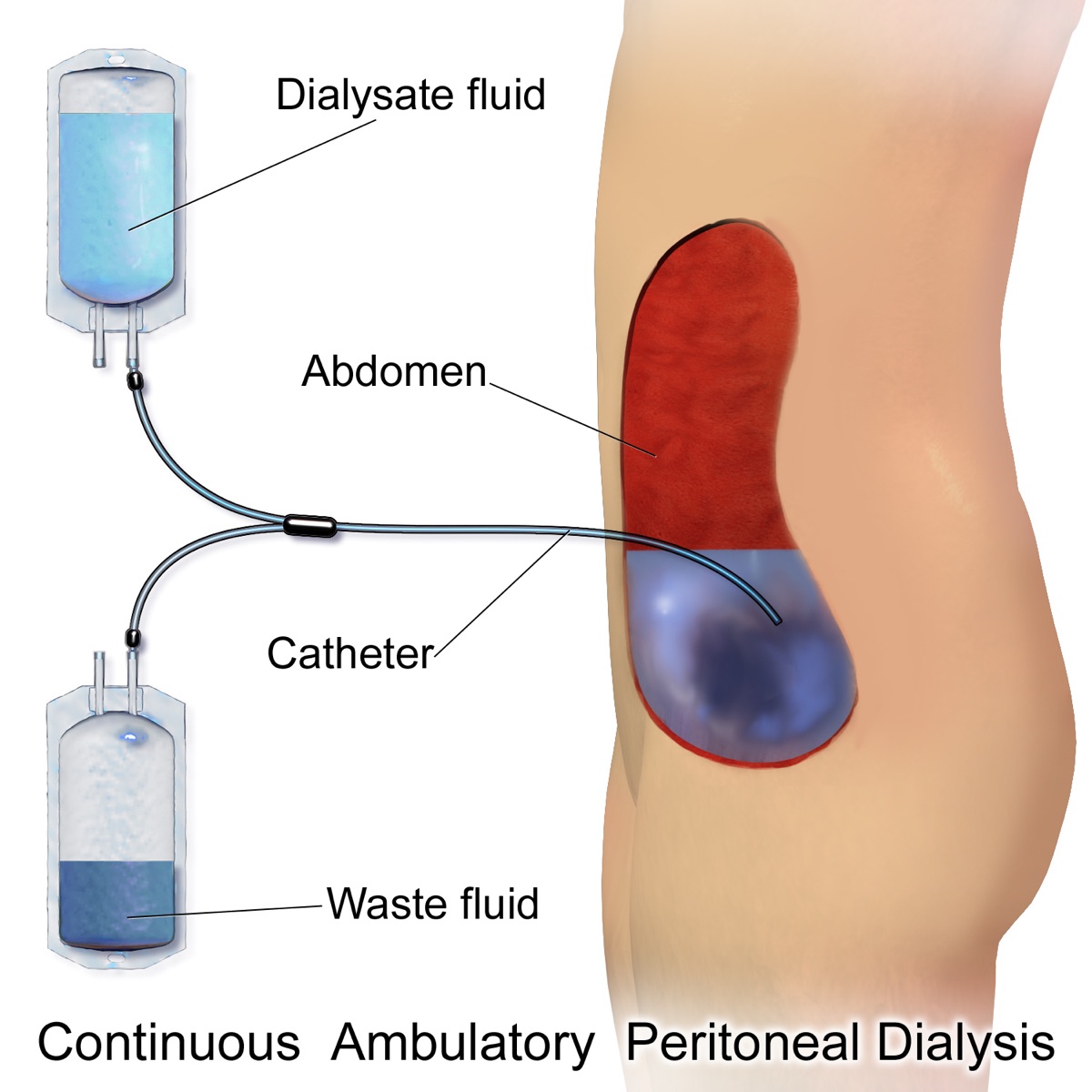
When the kidneys fail, one way to keep going is peritoneal dialysis. A soft tube is placed in the belly, and several times a day the person runs in a bag of sugary salt solution, lets it sit for a few hours while the lining of the abdomen filters waste out of the blood, then drains it and starts again. It can be done at home, and it accounts for about 11% of dialysis worldwide. Doctors have long noticed something odd in people on the other kind of dialysis, the hospital machine: heavier patients tend to live longer. Whether the same 'obesity paradox' holds for peritoneal dialysis has been less clear, and studies have suggested best weights anywhere from a BMI of about 21 to 35. A nephrology team at Ganzhou People's Hospital in Jiangxi, China, tried a different way of asking. Their study was published in Frontiers in Nutrition on 22 October.
Most earlier studies took one weight at the start of dialysis. This team borrowed an idea from diabetes care, 'time in range', and worked out what share of the first three years each patient spent at a given BMI, using weights measured at the start, at one year and at three years. They included 670 adults on hand-run peritoneal dialysis who started between 2014 and 2023, with an average age of 48 and an average starting BMI of 21.9. Follow-up for deaths began at the three-year mark and ran to the end of June 2026, a median of 2.3 years, during which 75 people died.
The team first checked every cut-off from a BMI of 18 to 32. At every one of them, more time spent above the line went with a lower risk of death, and the strongest link was at 26. They then compared two bands. Of the 122 patients who spent any of their first three years at a BMI of 26 to 30, 5 died during follow-up; of the 548 who never reached that band, 70 did. After allowing for age, diabetes, remaining kidney function, blood albumin, HDL cholesterol, urine output and bouts of peritonitis, the risk of death was about 73% lower in the first group, and each extra 10% of time in the band went with about 23% lower risk. Time at 24 to 25.9, just above the usual healthy range, made no clear difference. The link was mainly with deaths from heart and blood vessel disease, not infections.
Why might a little extra weight help? The authors suggest it may mean more muscle and nutritional reserve, which protects against the wasting that is common on dialysis. But BMI is only weight for height, and on dialysis some of that weight can be retained fluid rather than fat or muscle. The study had no measures of body composition, diet or exercise, so it can't say which kind of weight was doing the work.
This was a retrospective study from one hospital, and with only 75 deaths the authors put its statistical power at about 63%. It only counted people who were still alive and on peritoneal dialysis three years in, so the sickest patients were already out of the picture. The two groups also differed: those who reached the 26 to 30 band were more likely to have diabetes and passed more urine, a sign of kidney function left. BMI was weighed only three times, the patients were relatively young and all from one city, and the findings may not apply to other populations. The authors call the results exploratory and say they should not be turned into clinical advice until larger, multi-centre studies confirm them. The study had no outside funding and the authors report no conflicts. We read the full open-access paper.
BMI over the first three years and later deaths in 670 adults on continuous ambulatory peritoneal dialysis, Ganzhou People's Hospital, China (Frontiers in Nutrition, 22 October 2026)
5 of 122 vs 70 of 548
Deaths during follow-up among patients who spent any time at a BMI of 26 to 30 against those who never did
0.27
Adjusted hazard ratio for death with any time at a BMI of 26 to 30 (95% CI 0.11 to 0.68), about 73% lower risk
23% lower
Risk of death for each extra 10% of the first three years spent at a BMI of 26 to 30 (HR 0.77, 95% CI 0.62 to 0.96)
No clear link
Time at a BMI of 24 to 25.9 (HR 0.75, 95% CI 0.46 to 1.23)
75 deaths
Over a median 2.3 years of follow-up from the three-year mark, 40.3 per 1,000 person-years
21.9
Average BMI when the study began; average age 48.2, 54.5% men
Source: Wang M, Zeng X, Liu D, Chen P, Peng Z, 'The obesity paradox in peritoneal dialysis: reassessing optimal BMI via longitudinal time in range analysis in a single-center cohort', Frontiers in Nutrition 2026;13, published 22 October 2026, doi 10.3389/fnut.2026.1982039, open access. Retrospective single-centre cohort, Department of Nephrology, Ganzhou People's Hospital, China; ethics PJB2024-023-01. Adults on CAPD for 3 months with a baseline visit between 1 January 2014 and 31 December 2023; BMI at baseline, 12 and 36 months; time above range (TAR) and time in range (TTR) by Rosendaal linear interpolation. Excluded: missing baseline BMI (2), fewer than two BMI measurements in 3 years (287), died before the 3-year landmark (72), moved to haemodialysis (75), transplant (23), lost to follow-up (18), other (73). Landmark follow-up from 36 months to 30 June 2026: 1,859.34 person-years, median 2.3 years (IQR 1.15 to 3.72), 75 deaths. TAR scan from BMI 18 to 32: all HRs below 1, significant after Bonferroni correction only for thresholds 24 to 26, lowest at 26 (HR per 10% TAR 0.82, 95% CI 0.73 to 0.92). Model 3 adjusted for age, diabetes, eGFR, albumin, HDL-c, 24-h urine volume and peritonitis episodes over 0 to 36 months. TTR 26 to 30 > 0%: 5 deaths in 335.34 person-years vs 70 in 1,524.00; HR 0.27 (0.11 to 0.68); per 10% HR 0.77 (0.62 to 0.96). TTR 24 to 25.9 > 0%: HR 0.75 (0.46 to 1.23); per 10% HR 0.98 (0.89 to 1.08). Competing-risks: cardiovascular death sHR 0.68 (0.53 to 0.88), infection-related death sHR 0.93 (0.71 to 1.21), underpowered. Patients with any TTR 26 to 30 had more diabetes (22.1% vs 7.5%), higher CRP, triglycerides and urine volume, lower HDL-c. Post-hoc power about 63%; E-values 1.9 (continuous) and 6.8 (categorical). No body composition, fluid status, diet, activity or Kt/V data. No external funding; no conflicts declared.
- In peritoneal dialysis the filter is the peritoneum, the thin lining of the belly. People on the hand-run kind empty and refill it four to six times a day, and each exchange takes about 30 to 40 minutes.
- The dialysis solution gets its pull from a sugar, dextrose, or from icodextrin, which is why people on peritoneal dialysis are often asked to watch their calories as well as their sodium and phosphorus.
- Peritoneal dialysis also removes protein from the body, so the usual advice is to eat more protein, not less, unlike earlier stages of kidney disease.
- For people of Asian background, the WHO Asia-Pacific cut-offs put overweight at a BMI of 23 and obesity at 25, so the band linked to better survival here, 26 to 30, counts as obese by those cut-offs.
- The obesity paradox in peritoneal dialysis: reassessing optimal BMI via longitudinal time in range analysis in a single-center cohortFrontiers in Nutrition · The study, open access, published 22 October 2026
- Peritoneal DialysisNational Institute of Diabetes and Digestive and Kidney Diseases (NIDDK) · How exchanges work, the solutions, and eating on peritoneal dialysis
- Obesity paradox in end-stage kidney disease patientsProgress in Cardiovascular Diseases · Review of the obesity paradox in dialysis (2014)
- Blausen 0160 CAPDWikimedia Commons · The illustration, CC BY 3.0
General information, not medical advice. This was an observational study in one hospital and doesn't show that gaining weight helps people on dialysis live longer. If you are on dialysis, don't change your eating or try to gain or lose weight without talking to your kidney team and dietitian.
Analysis by NutroPractic from the sources listed. Written for general readers; it does not replace advice from your own doctor.
From our articles
Read, then eat a little better
Plain-language guides on nutrition and wellness, backed by research.

Women's health
Inositol for PCOS: the 40:1 ratio, trial doses, and food milligrams
Why do randomized trials in polycystic ovary syndrome prioritize the 40:1 myo to D-chiro inositol ratio? Here is the science behind the ovarian epimerase paradox, clinical ovulation and insulin metrics, and why cantaloupe cannot replace 4,000 mg trial powder.
21 Nov 2026

Everyday eating
Extra virgin olive oil polyphenols: the EU health claim, smoke point myths, and cooking stability
Does extra virgin olive oil degrade when cooked? What does the EU 5 mg polyphenol health claim require, how does oleocanthal act like ibuprofen, and why does oxidative stability matter more than smoke point in domestic frying? Here is the clinical and culinary data.
21 Nov 2026

Food and nutrition
L-theanine and caffeine: what cognitive trials measured on sustained attention, and milligrams in matcha vs green tea
Combining L-theanine with caffeine produces clean focus without caffeine jitters. Here is what randomized trials measured on attention-switching, EEG alpha brain waves, and the exact milligrams across ceremonial matcha, culinary powder, gyokuro, and sencha.
20 Nov 2026
Newsfeed for your website
Want this feed on your website?
Add it to any site with one copy-and-paste snippet. No sign-up, and it updates itself every hour.
Start with a virtual consultation
Tell Dr. Triveni what you want to change. You will leave with a clear next step, whether you are in Toronto, London, New York or Chennai.