Women in sport · October 22, 2026
Elite sportswomen in Poland had to list every pill and powder from the week before their drug tests. Herbs studied for period pain and PMS turned up on barely 1 form in 20, and men listed ginger more often than women did
Researchers went through 13,519 anti-doping forms filed in Poland from 2018 to 2023, looking for nine plants that have been tested against premenstrual symptoms or painful periods. The herb with the most research behind it for PMS, chasteberry, appeared on 10 of 4,451 women's forms. The forms never say why anything was taken, and most of the trials behind these herbs are weak.
Premenstrual syndrome and painful periods are common in women who train for a living. Reviews the authors cite put them at about 26% and 32% of female athletes, and one estimate puts PMS at roughly 1,200 to 1,600 symptom days over a sporting career, three to four years in all. Ginger, chasteberry, saffron and other plants are sold for both problems. Whether top athletes actually take them has been hard to know, because they rarely fill in research surveys. A Polish research team found a way round that: the doping control form.
At every drug test, an athlete must declare all medicines and supplements taken in the previous seven days, and an officer writes them down. The Polish Anti-Doping Agency gave the team 13,519 anonymised forms from tests in 2018 to 2023, 4,451 from women and 9,068 from men, across 55 sports, with an average age of about 25. The researchers first searched the medical literature for plants tested against PMS or period pain and found 8 for PMS and 21 treatments for period pain. Then they checked every declared product, including the full ingredient list of branded blends, against that list. Nine of the plants turned up. The paper was published in Nutrients on 21 October.
Ginger was the most common, on 78 women's forms (1.75%), followed by turmeric or curcumin on 56 (1.26%), saffron 37, ginkgo 34, fenugreek 33, valerian 29, evening primrose oil 21, chasteberry 10 and the alga chlorella 9. Overall, 5.44% of women's forms and 4.91% of men's listed at least one of the nine. Men actually listed ginger (2.59%) and fenugreek (1.78%) more often than women, mostly inside testosterone boosters and pre-workout powders, which suggests those plants were there for reasons that have nothing to do with periods. Counting only herbs an athlete named outright, rather than ones hidden in a blend, women were well ahead: 2.13% of their forms against 0.62% of men's. Evening primrose oil, valerian, chasteberry and ginkgo were each named directly about 11 to 16 times as often on women's forms as on men's, though from very small numbers.
The authors are careful about what this does not show. The form has no box for why something was taken, so nobody knows whether a woman listing ginger had period pain, sore muscles or a cold. It covers only one week, so herbs tried and dropped earlier are missed, and some athletes just wrote 'supplement'. Because the forms were anonymised, the same athlete may appear many times, and the team could not adjust for sport or age. For the blends, the ingredients were looked up later from makers' websites and shops, not checked against the batch the athlete took.
The evidence behind the herbs is thin as well. The team rated all 14 reviews and meta-analyses it relied on as low or critically low in quality, and 7 of the 12 individual trials as at high risk of bias; only 3 of the 12 said what was actually in the extract tested. Chasteberry, which has the most studies for PMS, is the one herb with no obvious sporting use, and it was among the least declared. A herb whose PMS evidence did not meet their rules, roseroot (rhodiola), showed up on 1.51% of all forms, about as often as ginger did on women's. The authors' practical point is caution: herbal products vary in content, can be contaminated with banned substances and can interact with medicines, such as St John's wort with the contraceptive pill. They cite a Polish test of 13 rhodiola supplements in which about 60% did not match their labels. No outside funding was reported, and the authors declare no conflicts. We read the full open-access paper.
Plants studied for PMS or period pain, as declared on 13,519 doping control forms from elite athletes in Poland, 2018 to 2023
4,451 vs 9,068
Forms from women and from men, across 55 sports (average age about 25)
5.44% vs 4.91%
Women's vs men's forms listing at least one of the nine plants, directly or inside a product
78 (1.75%)
Women's forms listing ginger, the most common plant; men's rate was higher at 2.59%
10 (0.22%)
Women's forms listing chasteberry, the plant with the most PMS studies (0.02% of men's)
2.13% vs 0.62%
Forms where the athlete named one of the plants outright, women vs men
0 of 14
Reviews behind the plant list rated moderate or high quality; 7 of 12 trials were at high risk of bias
Study: Granda D, Pokrywka A, Szmidt MK, Surała O, Jędrejko K, Lewandowska-Pachecka S, Nowicka G, 'Use of Botanical Ingredients Relevant to Premenstrual Symptoms and Dysmenorrhea Among Elite Female Athletes: Evidence from Doping Control Forms', Nutrients 18(20):3455, published 21 October 2026, doi 10.3390/nu18203455, open access. Data: anonymised doping control forms from routine tests by the Polish Anti-Doping Agency (POLADA), 2018–2023; athletes declare medicines and supplements from the previous 7 days. 13,519 forms (female 4,451, male 9,068), mean age 24.8 ± 5.7 years, 55 disciplines, 50.2% in-competition. Reference list from a narrative (not systematic) PubMed/Google Scholar search to 16 August 2026: 8 botanicals for PMS, 21 botanical interventions for dysmenorrhea. Female declarations (direct + indirect): ginger 78, turmeric/curcuminoid 56, saffron 37, ginkgo 34, fenugreek 33, valerian 29, evening primrose oil 21, chasteberry 10, chlorella 9. Total declaration rate female vs male, Benjamini–Hochberg adjusted: chasteberry 0.22% vs 0.02% (p = 0.002), saffron 0.83% vs 0.39% (p = 0.002), evening primrose oil 0.47% vs 0.03% (p < 0.001), fenugreek 0.74% vs 1.78% (p < 0.001), ginger 1.75% vs 2.59% (p = 0.005); no difference for ginkgo, chlorella, valerian, turmeric. Direct declarations: any relevant plant 2.13% vs 0.62% (χ² = 62.2, p < 0.001); evening primrose oil 0.47% vs 0.03%, valerian 0.36% vs 0.03%, chasteberry 0.22% vs 0.02%, ginkgo 0.22% vs 0.02% (all adjusted p ≤ 0.002). One relevant plant per form 4.16% (women) vs 3.05% (men); two 1.10% vs 1.67%. Rhodiola (not in the reference set) on 1.51% of forms. Quality: AMSTAR 2 rated 6 reviews low and 8 critically low; RoB 2 rated 2 trials low risk, 3 some concerns, 7 high. Limitations stated by the authors: reason for use not recorded, 7-day window, possible repeat athletes, product composition reconstructed after the fact, no adjustment for sport or age. Ethics: Institute of Sport–National Research Institute, KEBN-23-79-OS. No external funding; no conflicts declared. The 25.7% PMS and 32.3% dysmenorrhea prevalence figures and the 1,237–1,621 PMS-day estimate are from reviews cited in the paper (Granda et al., Biology of Sport 2025; Taim et al., Sports Medicine 2023).
- On a doping control form, athletes must list every medicine and supplement from the seven days before the test, and a doping control officer records them.
- Fenugreek and ginger turned up on men's forms mainly as ingredients of testosterone boosters and pre-workout products, not as products taken on their own.
- Chasteberry has no clear sporting or general-health use beyond gynaecological complaints, which is why the authors found its rarity on women's forms notable.
- Taking St John's wort with the contraceptive pill can cause breakthrough bleeding, one of the herb–medicine interactions the authors flag.
- Of the 12 herb trials the team rated, only 3 reported the standardisation or chemical make-up of the extract they tested, so results from one product may not apply to another with the same plant on the label.
- Use of Botanical Ingredients Relevant to Premenstrual Symptoms and Dysmenorrhea Among Elite Female Athletes: Evidence from Doping Control FormsNutrients (MDPI) · The paper, open access
- Prevalence of premenstrual syndrome and premenstrual dysphoric disorder among highly trained and elite female athletes: a systematic review and meta-analysisBiology of Sport · Source of the 25.7% PMS figure and the career symptom-day estimate
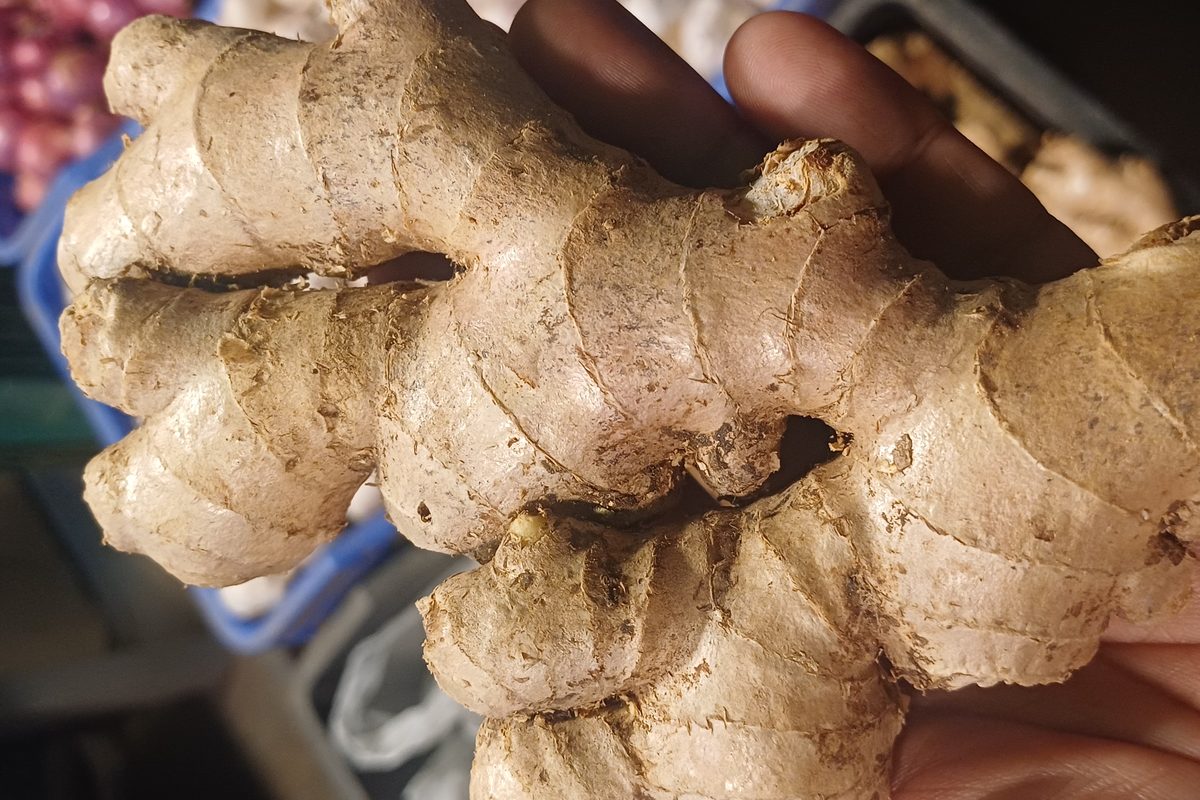
- Ginger Root (Zingiber officinale)Wikimedia Commons · The photo, CC0
General information, not medical advice. This study counted what athletes declared on anti-doping forms; it did not test whether any herb helps PMS or period pain, and the trials behind these herbs are mostly small and of low quality. Supplements can be contaminated with banned substances and can interact with medicines, including the contraceptive pill. If you have painful periods or PMS, or compete under anti-doping rules, talk to a doctor, sports physician or registered dietitian before taking a herbal product.
Analysis by NutroPractic from the sources listed. Written for general readers; it does not replace advice from your own doctor.
From our articles
Read, then eat a little better
Plain-language guides on nutrition and wellness, backed by research.

Women's health
Inositol for PCOS: the 40:1 ratio, trial doses, and food milligrams
Why do randomized trials in polycystic ovary syndrome prioritize the 40:1 myo to D-chiro inositol ratio? Here is the science behind the ovarian epimerase paradox, clinical ovulation and insulin metrics, and why cantaloupe cannot replace 4,000 mg trial powder.
21 Nov 2026

Everyday eating
Extra virgin olive oil polyphenols: the EU health claim, smoke point myths, and cooking stability
Does extra virgin olive oil degrade when cooked? What does the EU 5 mg polyphenol health claim require, how does oleocanthal act like ibuprofen, and why does oxidative stability matter more than smoke point in domestic frying? Here is the clinical and culinary data.
21 Nov 2026

Food and nutrition
L-theanine and caffeine: what cognitive trials measured on sustained attention, and milligrams in matcha vs green tea
Combining L-theanine with caffeine produces clean focus without caffeine jitters. Here is what randomized trials measured on attention-switching, EEG alpha brain waves, and the exact milligrams across ceremonial matcha, culinary powder, gyokuro, and sencha.
20 Nov 2026
Newsfeed for your website
Want this feed on your website?
Add it to any site with one copy-and-paste snippet. No sign-up, and it updates itself every hour.
Start with a virtual consultation
Tell Dr. Triveni what you want to change. You will leave with a clear next step, whether you are in Toronto, London, New York or Chennai.