Picky eating · October 27, 2026
In 300 Korean families, the parents who shied away from new foods tended to have children who did too, and those children scored a little higher on a checklist of worries and behaviour problems
Parents of 6- to 12-year-olds in South Korea rated their own fear of unfamiliar food and their child's. The two went together, and parental food fear also tracked with more emotional and behavioural symptoms in the child. It is a snapshot, all of it reported by the parent, and the authors are careful to say it proves nothing about cause.
Food neophobia is the reluctance to try foods you have never eaten before. It is not quite the same as picky eating, which also covers turning down familiar foods, and it is a long way from ARFID, a clinical eating disorder. Twin studies put a large share of it down to genes, but children also learn what is safe to eat by watching the adults at the table. A cross-sectional study published on 24 October in Nutrients looked at how parents' and children's food neophobia line up in South Korea, and whether either goes with a child's eating habits and emotional wellbeing.
Between April and December 2025, researchers recruited families through community mental health and counselling centres. Of 350 families approached, 305 agreed and 300 parent and child pairs gave complete answers. The children were 6 to 12 years old (average 9.1) and had no diagnosed chronic medical or psychiatric condition needing ongoing treatment; the parents averaged 42 years old and 79% were female. Each parent filled in a Korean version of the 10-item Food Neophobia Scale for themselves and again for their child, scored from 1 to 5, along with two parts of the Child Eating Behaviour Questionnaire (emotional overeating and slowness in eating) and the Pediatric Symptom Checklist-17, a short screen for attention, anxious or low mood, and acting-out problems.
Parents scored an average of 3.04 for their own food neophobia and 2.82 for their child's. The two moved together (correlation 0.33): each one-point rise in the parent's score went with about a third of a point higher for the child. Parents' food neophobia also went with higher symptom checklist scores (correlation 0.26). With parent and child neophobia in the same model, each point of parental neophobia went with about 1.1 more points on the 34-point checklist; the child's own neophobia pointed the same way but just missed statistical significance (p = 0.056). A mediation analysis estimated that a small part of the parent link, about 0.2 of a point out of a total of about 1.3, ran through the child's own wariness of new food.
The eating behaviour result is easy to misread. More neophobic parents and children went with lower combined scores for emotional overeating and slow eating (correlation −0.52 for the parent), so their children were described as eating less in response to feelings and eating less slowly. The authors stress that this sum of two subscales is an exploratory measure, not a validated overall score, and should not be read as better or worse eating.
The limits are spelled out in the paper. It is one snapshot, so it can't show whether parents pass on their wariness, whether a wary child makes a parent more cautious, or whether shared genes or home life explain both. Every child measure came from the parent, so a parent who worries more might rate both their child's eating and behaviour as more of a problem. Families came through mental health and counselling centres, not a random sample, and parents' own mental health and feeding practices weren't measured. The model for symptoms explained only 9% of the differences between children. The authors call it a basis for longer studies, not advice, though they suggest relaxed, low-pressure exposure to new foods is worth testing in trials.
Parental and child food neophobia, eating behaviour and psychological symptoms in 300 South Korean parent and child pairs, 2025 (Nutrients, 24 October 2026)
300
Parent and child pairs analysed (350 families approached, 305 consented); children aged 6 to 12, average 9.1
3.04 vs 2.82
Average food neophobia score of parents and of their children as rated by the parent (1 to 5 scale, higher = more wary of new food)
r = 0.33
Correlation between parent and child food neophobia (p < 0.001)
+1.09
Points on the 0 to 34 Pediatric Symptom Checklist per point of parental food neophobia, adjusted for child neophobia and eating scores (95% CI 0.26 to 1.93)
0.21 of 1.27
Part of the parent-to-symptom link that ran statistically through the child's own food neophobia (95% bootstrap CI 0.015 to 0.468)
9%
Share of the differences in children's symptom scores explained by the model
Cross-sectional study of families recruited through community mental health and counselling centres, not a random sample. All child measures were reported by the parent. The eating score is an exploratory sum of two Child Eating Behaviour Questionnaire subscales. No power calculation was done. Funded by a University of Warsaw microgrant; the authors declare no conflicts of interest. Open access under CC BY 4.0.
- The Food Neophobia Scale used here dates from 1992: ten statements, such as not trusting new foods or liking foods from different countries, each rated from strongly disagree to strongly agree.
- A 2007 study of 5,390 pairs of British twins aged 8 to 11 estimated that about 78% of the differences in children's food neophobia were down to genes.
- Children's symptom scores averaged 14.65 out of 34 on the checklist, and both parents' and children's food neophobia scores sat close to the middle of the 1 to 5 scale.
- The authors define food neophobia narrowly as reluctance to try unfamiliar foods, separate from picky eating and from ARFID (avoidant/restrictive food intake disorder).
- Children signed up too: each child gave written assent alongside the parent's consent.
- Associations Between Parental and Child Food Neophobia and Children's Eating Behavior and Psychological Symptoms: A Cross-Sectional Mediation Analysis of South Korean Parent–Child DyadsNutrients (MDPI) · The study, open access (CC BY 4.0), published 24 October 2026
- Genetic and environmental influences on children's food neophobiaAmerican Journal of Clinical Nutrition · The British twin study behind the heritability estimate
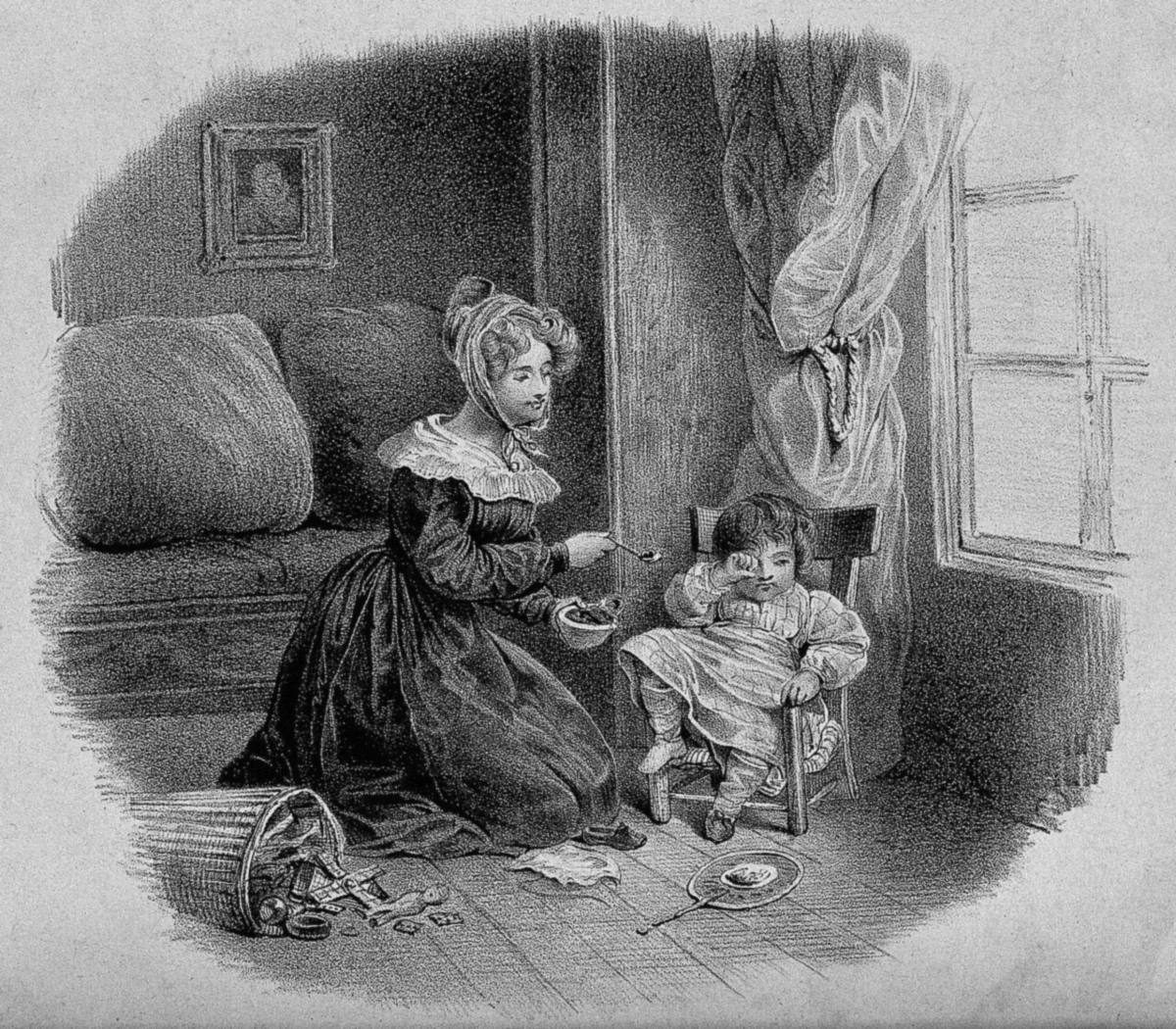
- A child has upset a toy basket and she is refusing to eat the food being offered to her (Wellcome V0038749)Wikimedia Commons (Wellcome Collection) · The image, CC BY 4.0
General information, not medical advice. This was a snapshot study of families recruited through counselling centres and cannot say what causes a child's eating habits or symptoms. If you are worried about your child's eating, growth, mood or behaviour, talk to your paediatrician, a registered dietitian or a child mental health professional.
Analysis by NutroPractic from the sources listed. Written for general readers; it does not replace advice from your own doctor.
From our articles
Read, then eat a little better
Plain-language guides on nutrition and wellness, backed by research.

Women's health
Inositol for PCOS: the 40:1 ratio, trial doses, and food milligrams
Why do randomized trials in polycystic ovary syndrome prioritize the 40:1 myo to D-chiro inositol ratio? Here is the science behind the ovarian epimerase paradox, clinical ovulation and insulin metrics, and why cantaloupe cannot replace 4,000 mg trial powder.
21 Nov 2026

Everyday eating
Extra virgin olive oil polyphenols: the EU health claim, smoke point myths, and cooking stability
Does extra virgin olive oil degrade when cooked? What does the EU 5 mg polyphenol health claim require, how does oleocanthal act like ibuprofen, and why does oxidative stability matter more than smoke point in domestic frying? Here is the clinical and culinary data.
21 Nov 2026

Food and nutrition
L-theanine and caffeine: what cognitive trials measured on sustained attention, and milligrams in matcha vs green tea
Combining L-theanine with caffeine produces clean focus without caffeine jitters. Here is what randomized trials measured on attention-switching, EEG alpha brain waves, and the exact milligrams across ceremonial matcha, culinary powder, gyokuro, and sencha.
20 Nov 2026
Newsfeed for your website
Want this feed on your website?
Add it to any site with one copy-and-paste snippet. No sign-up, and it updates itself every hour.
Start with a virtual consultation
Tell Dr. Triveni what you want to change. You will leave with a clear next step, whether you are in Toronto, London, New York or Chennai.