Mediterranean diet · October 24, 2026
Their Mediterranean diet scores said nothing about anxiety. Two of the 14 questions inside the score told a different story
In a small online survey of 115 adults, people who used four or more tablespoons of olive oil a day, or kept red and processed meat under two servings a week, scored lower on anxiety. The total diet score, which adds those answers to a dozen others, showed no link at all. The authors think the parts may be pulling in different directions and cancelling out, though none of the results survived the statistics for testing many things at once.
Most studies of the Mediterranean diet and mental health boil a person's eating down to one number. A common way to get it is the 14-question screener from the Spanish PREDIMED trial: one point for using olive oil as your main fat, one for four or more tablespoons of it a day, one for fish three times a week, one for fewer sugary drinks, and so on. The higher the total, the more Mediterranean the diet. Researchers from the Karolinska Institutet in Stockholm, the Polish Academy of Sciences and universities in Hamburg, Murcia and Santiago de Compostela wanted to know what happens if you stop adding the points up and look at each question on its own. They reported what they found in Frontiers in Nutrition on 14 October.
Their survey ran online between 30 December 2023 and 25 January 2024, in English, Spanish and Russian, and the link was passed around through the authors' own personal, work and social media networks. It was open to adults aged 18 to 65 who had never been diagnosed with a mental illness, and 115 people answered. Most were women (73%), more than half were 18 to 25, and over four in five had a university degree. Alongside the 14 diet questions, everyone filled in the Hospital Anxiety and Depression Scale, a 14-item questionnaire with separate scores for anxiety and depression, each running from 0 to 21, and said roughly how long they spent each day on Instagram, Facebook and Twitter/X. By the scale's usual cut-offs, 27 people (23.5%) had anxiety scores in the abnormal range and 11 (9.6%) had depression scores there.
Before looking, the team had written down four predictions: that more olive oil and less red and processed meat would each go with lower anxiety and lower depression scores. All four leaned the predicted way. The 59 people who said they used four or more tablespoons of olive oil a day had a median anxiety score of 6, against 8 for the 56 who did not. The 79 who ate red or processed meat fewer than twice a week had a median of 6 against 9 for the rest. Once sex, age and education were taken into account, three of the four links reached the usual bar for statistical significance: olive oil with anxiety, and less meat with both anxiety and depression. Olive oil and depression showed no clear link.
Then came the total score, and it showed nothing: its correlation with anxiety was close to zero, and with depression weak and not significant. Look at the other questions one by one and the reason may become clearer. Some leaned the other way. People who ate three or more servings of fruit a day had a slightly higher median anxiety score than those who did not (8 against 6), and the 11 people who drank more than seven glasses of wine a week also scored a little higher. None of those differences was significant on its own, but added into one total, items pulling in opposite directions can wash each other out. That, the authors argue, is the main lesson: a composite score can hide what its parts are doing.
The social media questions gave a scattered picture. People who ate four or more servings of vegetables a day reported less time on Instagram (a median of 30 minutes against 50), while those who cooked mainly with olive oil reported more. The only result in the whole study to survive the correction for running many tests was that people drinking less than one can of a sugary drink a day spent less time on Facebook, and even that came down to a handful of heavier users; both groups had a median of 10 minutes. Time on any platform was not clearly linked to anxiety or depression scores. The survey did not ask what people were looking at, and it did not include video apps.
The authors are careful to call this a pilot that generates ideas rather than tests them. The olive oil and meat results came from 115 self-selected, mostly young, well-educated volunteers, with no sample size worked out in advance and no record of which country they lived in. The adjusted models explained under a tenth of the differences in symptom scores, and once the results were corrected for multiple comparisons, none of the four main links held up. A one-off survey also cannot say which way things run: people who feel anxious may simply eat differently. Their suggestion is practical: future studies using these diet scores should report the individual items as well as the total. The work was funded by a PhiloMako grant, and the authors declare no conflicts of interest.
Mediterranean diet questions, anxiety and depression scores and social media use in 115 adults, online survey, December 2023 to January 2024
115
Adults aged 18 to 65 in the survey: 73% women, 56.5% aged 18 to 25, 81.7% with a university degree
6 vs 8
Median anxiety score (0 to 21) with four or more tablespoons of olive oil a day against fewer
6 vs 9
Median anxiety score with red or processed meat under twice a week against more often
−2.12
Points lower on anxiety with less red and processed meat, adjusted for sex, age and education (95% CI −3.91 to −0.32)
−0.045
Correlation between the total diet score and anxiety: essentially none
1 of 42
Diet and social media comparisons that survived correction for multiple testing (sugary drinks and Facebook time)
Source: Religa P, Mickael M-E, Kubick N and colleagues, 'Mediterranean diet adherence, social media use, and anxiety symptoms: an exploratory cross-sectional pilot survey', Frontiers in Nutrition, 14 October 2026, doi:10.3389/fnut.2026.1883903, open access. Diet: a modified 14-item score based on the PREDIMED Mediterranean Diet Adherence Screener (three items asked at thresholds of the authors' own: four or more vegetable servings a day, under two red or processed meat servings a week, more than seven glasses of wine a week). Mood: Hospital Anxiety and Depression Scale. Primary comparisons, unadjusted: olive oil and anxiety r = −0.249 (95% CI −0.448 to −0.050), p = 0.021, q = 0.084; meat and anxiety p = 0.061; meat and depression p = 0.083; olive oil and depression p = 0.346. Adjusted for sex, age band and education: olive oil and anxiety β = −1.86 (−3.54 to −0.18); meat and anxiety β = −2.12 (−3.91 to −0.32); meat and depression β = −1.62 (−3.09 to −0.14); olive oil and depression β = −0.57 (−1.98 to 0.83). Models explained under 10% of the variance (R² 0.054 to 0.095). Total score with anxiety ρ = −0.045, with depression ρ = −0.141 (both not significant). Benjamini–Hochberg correction applied within each family of tests. Convenience sample recruited through the authors' networks; country of residence not recorded; cross-sectional, so it shows association, not cause. Funding: PhiloMako grant 067/2024; no conflicts declared.
- The 14-question screener at the heart of this survey was validated in 2011 among older Spanish men and women taking part in the PREDIMED trial, where it was used to check how closely people were following their assigned diet.
- Four tablespoons of olive oil come to roughly 60 ml and close to 500 calories, which is why that question earns a point only for a fairly generous daily habit.
- The Hospital Anxiety and Depression Scale was published in 1983 by Anthony Zigmond and Philip Snaith. It deliberately leaves out physical symptoms such as poor sleep or tiredness, so that bodily illness does not inflate the scores.
- Women in this survey had higher anxiety scores than men, but there was no difference between them for depression.
- Only 11 of the 115 people met the wine item, more than seven glasses a week, the one point on the screener that rewards drinking more of something.
- Mediterranean diet adherence, social media use, and anxiety symptoms: an exploratory cross-sectional pilot surveyFrontiers in Nutrition · The study, open access, published 14 October 2026
- A short screener is valid for assessing Mediterranean diet adherence among older Spanish men and womenThe Journal of Nutrition · The 2011 paper behind the 14-item PREDIMED screener
- The Hospital Anxiety and Depression ScaleActa Psychiatrica Scandinavica · The 1983 paper that introduced the anxiety and depression questionnaire
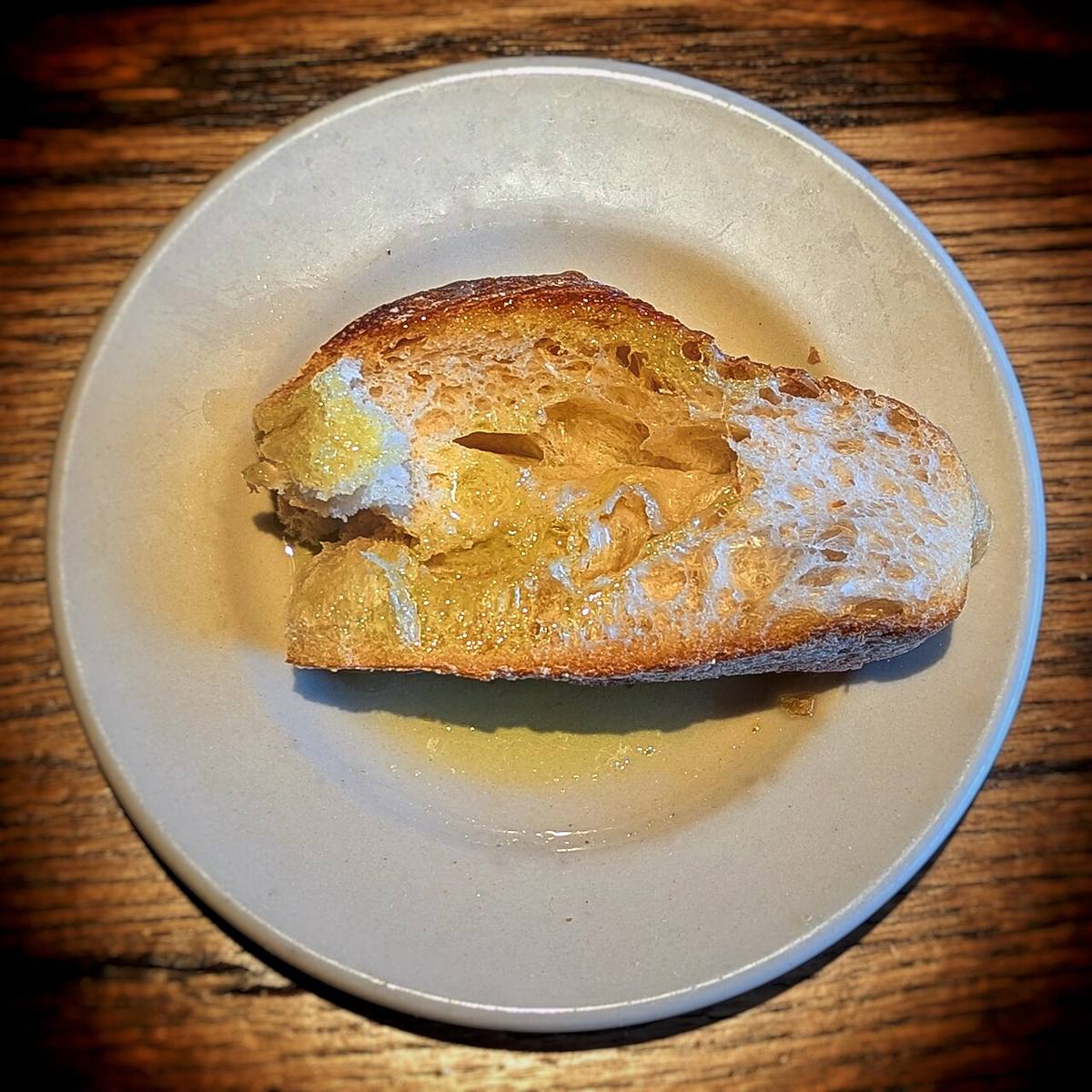
- Bread in olive oil - Cambridge, MAWikimedia Commons · The photo, CC0 (Daderot)
General information, not medical advice. This small survey shows associations at one point in time, none of which held up after correction for multiple testing, and it does not show that olive oil or eating less meat eases anxiety. If worry or low mood has been getting in the way of daily life, talk to your doctor; diet changes are not a substitute for care, and anyone with a heart, kidney or weight condition should check with their doctor or a registered dietitian before adding a lot of extra oil.
Analysis by NutroPractic from the sources listed. Written for general readers; it does not replace advice from your own doctor.
From our articles
Read, then eat a little better
Plain-language guides on nutrition and wellness, backed by research.

Women's health
Inositol for PCOS: the 40:1 ratio, trial doses, and food milligrams
Why do randomized trials in polycystic ovary syndrome prioritize the 40:1 myo to D-chiro inositol ratio? Here is the science behind the ovarian epimerase paradox, clinical ovulation and insulin metrics, and why cantaloupe cannot replace 4,000 mg trial powder.
21 Nov 2026

Everyday eating
Extra virgin olive oil polyphenols: the EU health claim, smoke point myths, and cooking stability
Does extra virgin olive oil degrade when cooked? What does the EU 5 mg polyphenol health claim require, how does oleocanthal act like ibuprofen, and why does oxidative stability matter more than smoke point in domestic frying? Here is the clinical and culinary data.
21 Nov 2026

Food and nutrition
L-theanine and caffeine: what cognitive trials measured on sustained attention, and milligrams in matcha vs green tea
Combining L-theanine with caffeine produces clean focus without caffeine jitters. Here is what randomized trials measured on attention-switching, EEG alpha brain waves, and the exact milligrams across ceremonial matcha, culinary powder, gyokuro, and sencha.
20 Nov 2026
Newsfeed for your website
Want this feed on your website?
Add it to any site with one copy-and-paste snippet. No sign-up, and it updates itself every hour.
Start with a virtual consultation
Tell Dr. Triveni what you want to change. You will leave with a clear next step, whether you are in Toronto, London, New York or Chennai.