Sleep · October 21, 2026
500 Spanish adults wore a sleep tracker for five days. Those who ate more like the Mediterranean said they slept better, but the tracker saw no difference
Researchers in Salamanca and Ávila scored how closely 500 randomly picked adults followed a Mediterranean diet, asked them how well they slept and put a motion tracker on their wrist. Better diet scores went with better reported sleep. The wrist trackers found no matching change in how long or how soundly people actually slept.
Studies keep finding that people who follow a Mediterranean diet, with plenty of vegetables, fruit, pulses, fish, nuts and olive oil and little red meat or sugary drinks, report sleeping better. Nearly all of that evidence rests on questionnaires, which record how people feel their sleep went. Far fewer studies have also measured sleep with a device. A team at the University of Salamanca did both in one general adult population, and published the results in Nutrients on 9 October.
Between May 2022 and April 2024 they drew a random sample from the regional health card register in Salamanca and Ávila, in central Spain: 100 people each aged 25, 35, 45, 55 and 65, half men and half women, 500 in all. Diet was scored with the 14-question Mediterranean Diet Adherence Screener (MEDAS), one point for each habit such as olive oil as the main fat, two or more servings of vegetables a day or three or more servings of fish a week; 9 or more out of 14 counts as high adherence. Sleep was measured two ways: the Pittsburgh Sleep Quality Index (PSQI), a standard questionnaire scored 0 to 21 where higher is worse and above 5 usually means poor sleep, and an ActiGraph motion sensor worn on the non-dominant wrist for five days in a row, including at least one weekend day.
The group scored 8.8 out of 14 on average, and 57% reached high adherence. Olive oil was nearly universal (96% used it as their main fat) and 84% ate less than a serving of red or processed meat a day, but only 38% ate three or more pieces of fruit a day and 38% had pulses three or more times a week. Sleep, by the questionnaire, was middling: the average PSQI was 7.1, above the usual cut-off for poor sleep. By the tracker, people spent about 91% of their time in bed asleep, were awake for about 38 minutes after first dropping off and woke around 14 times a night.
After allowing for age, sex, education, work, other illnesses, weight, caffeine, alcohol, smoking and exercise, each extra point on the diet score went with a PSQI score 0.19 points lower, that is, slightly better reported sleep (95% CI 0.02 to 0.35 points). Put another way, five more points on the diet score would mean about one point less on a 21-point sleep scale, our arithmetic. When the researchers simply compared people at or above 9 points with the rest, the high-adherence group had roughly 30% lower odds of poor sleep, but that result could have been chance (p = 0.072). Splitting people into two eating patterns told the same story: the group that ate more fish, fruit, vegetables, olive oil and nuts and fewer sugary drinks, less red meat and less butter scored 6.6 on the PSQI against 7.5. None of the tracker measures differed: sleep efficiency was 90.7% against 90.9%, and night-time waking was 37.8 against 36.9 minutes.
The authors suggest the diet may change how restorative sleep feels, through mood, inflammation or the gut, in ways a wrist sensor that only counts movement cannot see; it cannot tell deep or REM sleep from light sleep, as an overnight sleep lab can. The other side of the coin is that a questionnaire and a diet score are both self-reports, and someone who feels well may answer both more kindly. The study took one snapshot, so it cannot say whether the diet helps sleep or whether people who sleep well find it easier to eat well. Five nights of tracking may miss week-to-week swings, and MEDAS counts habits rather than measuring nutrients. The study was funded by the Castilla y León regional health service and the University of Salamanca, the authors declare no conflicts of interest, and the data are available on request.
Mediterranean diet score and sleep in 500 adults aged 25 to 65 in Salamanca and Ávila, Spain, 2022 to 2024
8.8 of 14
Average Mediterranean diet score (MEDAS); 57.2% scored 9 or more, counted as high adherence
7.1
Average sleep questionnaire score (PSQI, 0 to 21, higher is worse); above 5 usually means poor sleep
0.19 points
Lower (better) sleep questionnaire score for each extra diet point (95% CI 0.02 to 0.35, p = 0.027)
6.6 vs 7.5
Sleep questionnaire score in the healthier eating pattern against the other (p = 0.021)
0.69
Odds of poor reported sleep with high diet adherence (95% CI 0.45 to 1.03, not statistically significant)
90.7% vs 90.9%
Sleep efficiency measured by the wrist tracker in the two eating patterns: no difference (p = 0.544)
38 minutes
Average time awake after first falling asleep, by tracker; about 14 awakenings a night
38%
Ate three or more pieces of fruit a day; 38.2% had pulses three or more times a week
Study: Alonso-Domínguez R, González-Sánchez J, Jiménez-Vaquero C, García-Yu IA, Sánchez-Aguadero N, Crespo-Sedano A, Recio-Rodríguez JI, 'Mediterranean Diet Adherence and Sleep Quality in Spanish Adults: Divergent Associations Between Subjective and Objective Measures', Nutrients 2026, 18(20):3305, published 9 October 2026, doi 10.3390/nu18203305 (open access, CC BY; read in full). Cross-sectional study, May 2022 to April 2024, registered as NCT05324267; random sample stratified by age (25, 35, 45, 55, 65) and sex from the Castilla y León health card database, people who declined were replaced; pregnant women and the terminally ill excluded. Sleep by Pittsburgh Sleep Quality Index and by ActiGraph wrist sensor for five consecutive days (Cole-Kripke and Tudor-Locke algorithms). All models adjusted for age, sex, education, employment, Charlson comorbidity index, BMI, caffeine, alcohol, smoking and physical activity. The 0.19 is the paper's coefficient of -0.187 (95% CI -0.354 to -0.021); the eating-pattern comparison is two clusters (253 and 247 people) from the 14 MEDAS items, as adjusted means. Overall tracker figures: efficiency 90.8% (SD 4.2), wake after sleep onset 37.6 min (SD 18.3), 13.9 awakenings (SD 5.6). The paper's methods describe the poor-sleep cut-off for the logistic model as 5 or more, while its text uses above 5. The 'about one point for five diet points' and 'roughly 30% lower odds' are our arithmetic from the paper's figures. Food figures are from Table 2 and the text. Funding: SACYL (GRS 2320/A/21) and University of Salamanca (PIC-2022-12); no conflicts declared.
- The Mediterranean diet score used here gives a point for drinking seven or more glasses of wine a week, a habit from the original Spanish diet studies; only 17.8% of this group earned it. Nobody is advised to start drinking for their health.
- Two items on the 14-point score are about cooking rather than single foods: using olive oil as the main fat, and eating dishes made with sofrito, a slow-cooked base of tomato, onion, garlic or leek in olive oil, at least twice a week.
- A wrist tracker judges sleep from stillness. Lying awake but motionless can count as sleep, which is one reason it agrees only partly with an overnight sleep lab, and why it cannot see deep or REM sleep.
- When the researchers looked at what set the two eating patterns apart, vegetables mattered most among women and fruit among men; at age 45 it was sugary or fizzy drinks, and at 55 it was pulses.
- The study sized itself on a Spanish nurses' survey with an average PSQI of 6.8, aiming to pin down this group's average to within about a third of a point.
- Mediterranean Diet Adherence and Sleep Quality in Spanish Adults: Divergent Associations Between Subjective and Objective MeasuresNutrients, October 2026 · The paper: full text, open access
- Study registration NCT05324267ClinicalTrials.gov · The registered study protocol
- Pittsburgh Sleep Quality IndexWikipedia · How the sleep questionnaire works
- ActigraphyWikipedia · What a wrist motion tracker can and cannot measure
- Mediterranean dietWikipedia · Background on the eating pattern
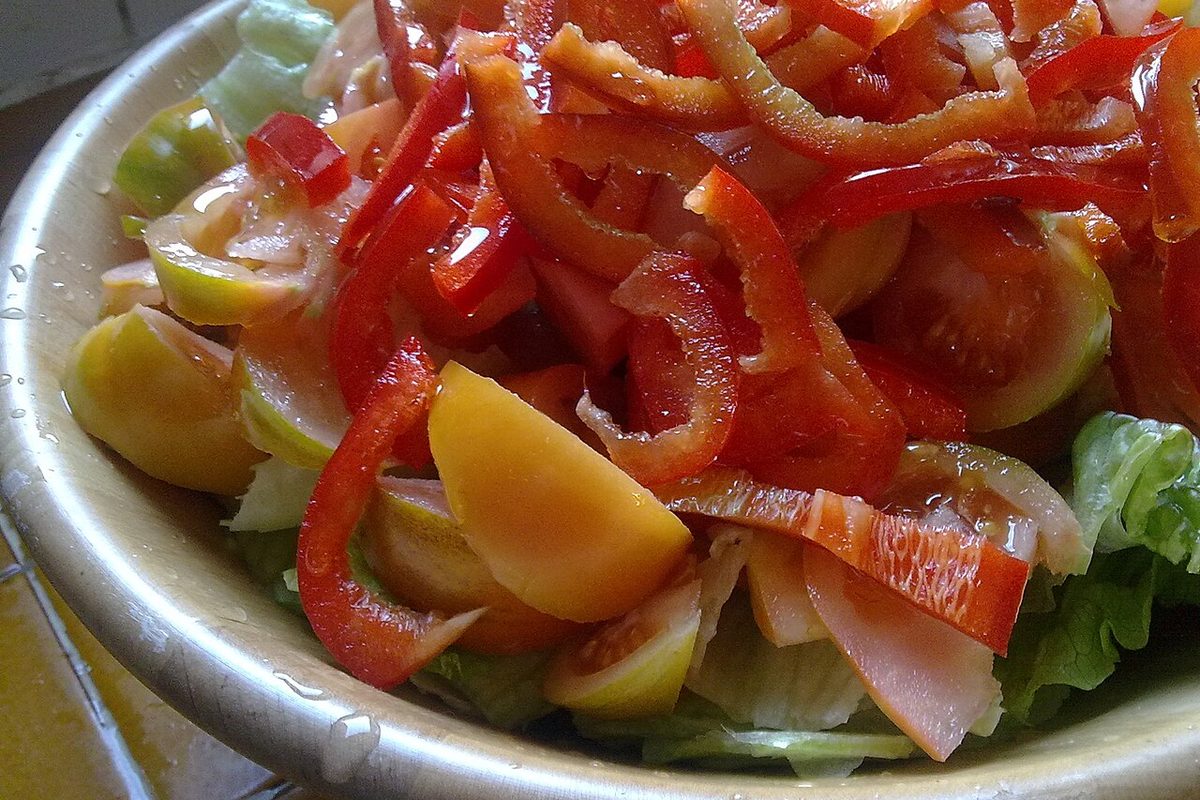
- Mediterranean salad - Ensalada valencianaWikimedia Commons · The photo, CC BY 2.0 (Lablascovegmenu)
General information, not medical advice. This was a one-time survey of adults in one Spanish region and cannot show that changing your diet will change your sleep. Anyone with ongoing sleep problems should talk to their doctor, and anyone thinking of a big change in diet, especially with a medical condition, should check with their doctor or a registered dietitian.
Analysis by NutroPractic from the sources listed. Written for general readers; it does not replace advice from your own doctor.
From our articles
Our guides on this subject
Plain-language guides on nutrition and wellness, backed by research.
Supplements and vitamins
Glycine before bed: the 3 g sleep trials, what they measured, and glycine in gelatin, bone broth and collagen
The 3 g dose comes from small Japanese trials: the sleep-restriction study analysed seven men. Here is what each trial measured, the grams of gelatin, collagen, pork rinds and bone broth that hold 3 g, and the clozapine warning.
17 Nov 2026
Botanicals and sleep
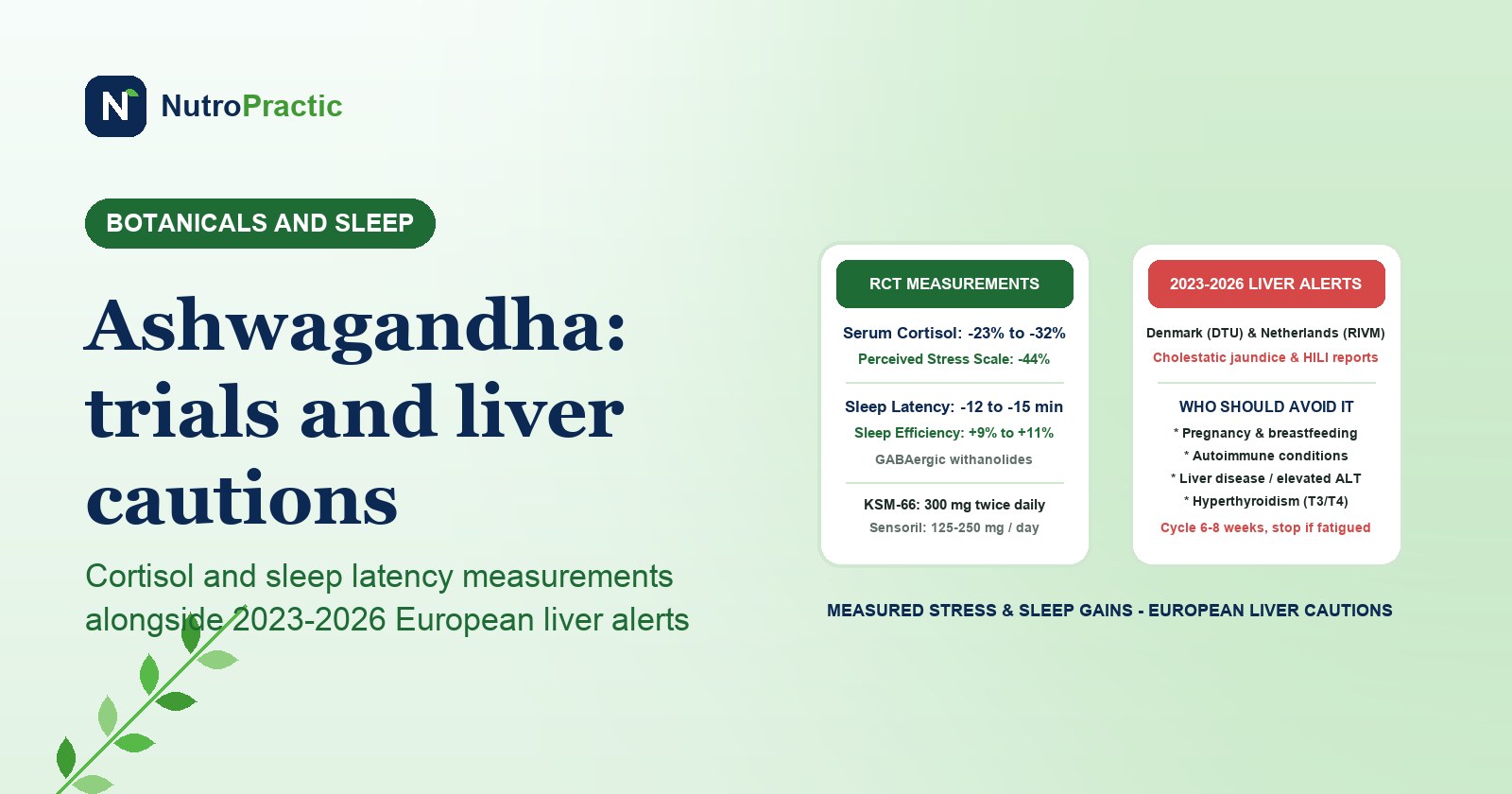
Ashwagandha for stress and sleep: what the randomised trials measured, and liver safety cautions
Standardized Ashwagandha extracts reduce serum cortisol by 23% to 32% and shorten sleep latency by 12 to 15 minutes in double-blind clinical trials. Yet 2023-2026 health alerts from Danish and Dutch authorities highlight serious herb-induced liver injury risks. Discover what the trials measured, extract differences (KSM-66 vs Sensoril), and who should strictly avoid it.
14 Nov 2026

Food and nutrition
Tart cherry juice for sleep and gout: anthocyanin doses, uric acid trials, and what the numbers show
Tart cherry juice (Prunus cerasus, Montmorency) is frequently promoted as a natural remedy for insomnia and recurrent gout attacks. Clinical trials demonstrate measurable reductions in serum uric acid and acute flare frequency (including a 35% reduction in 2-day gout attack risk and up to 75% when paired with allopurinol), alongside a 34-to-39 minute increase in sleep duration. Discover the biochemical mechanisms of anthocyanins (cyanidin-3-glucoside), the tryptophan-sparing pathway, dosing protocols (30 ml concentrate vs 8 oz juice), sugar trade-offs, and why tart cherry cannot replace prescription urate-lowering therapy.
13 Nov 2026
Newsfeed for your website
Want this feed on your website?
Add it to any site with one copy-and-paste snippet. No sign-up, and it updates itself every hour.
Start with a virtual consultation
Tell Dr. Triveni what you want to change. You will leave with a clear next step, whether you are in Toronto, London, New York or Chennai.