Women's health · October 28, 2026
Does a Mediterranean diet ease endometriosis? 103 Australian women were asked, and almost none of them were eating one
Many women with endometriosis change what they eat to manage it, and the Mediterranean diet is the one most often suggested. A new survey looked for a link between eating that way and how much endometriosis shapes daily life. It found none, but the bigger story is how few women came close to the diet in the first place.
Endometriosis is a long-term inflammatory condition in which tissue similar to the lining of the womb grows elsewhere in the pelvis, often on the ovaries, bowel or bladder. It can bring period pain, pain during sex, bowel and bladder trouble, tiredness and fertility problems, and Australian estimates put it at about one woman in nine. Treatment is mainly surgery and hormonal or pain medicines, and many women also try changing their diet. The Mediterranean diet, heavy on vegetables, fruit, legumes, nuts, fish and olive oil and light on red meat and sweets, is often suggested because it is thought to calm inflammation. A paper in Nutrients, published on 27 October, asked whether the women who eat that way feel the condition less.
Researchers from the University of the Sunshine Coast and Adelaide University ran an online survey between April 2025 and January 2026, shared through social media and endometriosis support groups. It was open to Australian adult women who said they had a medical diagnosis of endometriosis. The 103 who took part were 29.7 years old on average and had lived with the diagnosis for about five years. Diet was scored with the 14-point MEDAS checklist, and the wider Mediterranean lifestyle (eating with company, rest, activity, seasonal food) with the MEDLIFE index, for a combined score out of 27. The impact of endometriosis was measured with a 63-question tool covering eight parts of life, from physical and psychological to work, study and fertility, and averaged into a global score from 0 to 100.
The headline result is a blank. Neither the diet score nor the combined diet and lifestyle score was linked to the global impact of endometriosis, or to any of the eight parts of life, before or after allowing for age, body mass index, smoking and years since diagnosis. The global impact score had a median of 49.2 out of 100. The highest impact was social (median 69.8) and the lowest was lifestyle (11.8).
What the survey did show clearly is how far these women were from a Mediterranean diet. The average MEDAS score was 5.6 out of 14, which the authors call low to moderate, and the best was 11. Only 2 of the 103 used as much olive oil as the checklist asks for, 9 ate enough fish, 11 enough fruit and 14 enough legumes. They did better on vegetables (63 met the target) and on choosing white meat over red (71). The authors say that with so few women eating anything close to the full diet, the survey may simply have been unable to see an effect, rather than proving there is none.
The study has other limits the authors list themselves. A one-time survey can't show cause and effect, the diagnosis and the diet were both self-reported, and women recruited through social media were younger and better educated than women with endometriosis as a whole. Earlier studies that reported less pain with a Mediterranean diet were small: one followed 35 Italian women, another 68 Austrian women with no comparison group. No proper randomised trial has yet tested the diet in women already diagnosed. The paper also has a few numbers that don't agree with each other, such as the share meeting the legume target given as 16.7% in the abstract and 13.6% in the table, so the counts here are taken from the tables.
Mediterranean diet and lifestyle and the impact of endometriosis: online cross-sectional survey of Australian women (University of the Sunshine Coast and Adelaide University, 2026)
103
Australian women with self-reported diagnosed endometriosis, average age 29.7, about 5 years since diagnosis
5.6 / 14
Average Mediterranean diet (MEDAS) score; the highest anyone scored was 11
2 of 103
Met the olive oil target; 9 met the fish target, 11 fruit and 14 legumes
63 of 103
Met the vegetable target; 71 preferred white meat over red
49.2 / 100
Median global impact of endometriosis on the 63-item questionnaire; social impact highest at 69.8
No link
Between diet or diet-and-lifestyle score and global impact, or any of the eight parts of life
Cross-sectional online survey (Qualtrics), recruited through social media and Australian endometriosis support groups, 29 April 2025 to 1 January 2026. Diet: 14-item Mediterranean Diet Adherence Screener (MEDAS); lifestyle: MEDLIFE index; combined score out of 27 (mean 12.2). Impact: 63-item Endometriosis Impact Questionnaire (EIQ-63), eight dimensions over three recall periods, rescaled 0 to 100. Linear regression, unadjusted and adjusted for age, BMI, smoking and years with endometriosis; global impact standardised beta -0.069, p = 0.56. Target counts are from Table 2 (out of 103); the abstract and discussion give different percentages for some of the same items. 77.7% took prescription medicines and 53.4% took supplements, most often magnesium, vitamin D and iron; 52.4% reported anxiety. Funded by the School of Health, University of the Sunshine Coast; no competing interests declared. Published 27 October 2026, open access.
- Almost half the women (50 of 103) said olive oil was their main fat, yet only 2 used as much of it as the Mediterranean diet checklist asks for.
- Only about a third of the women (30 of 103) said they took more than 20 minutes over lunch on weekdays, one of the lifestyle items in the MEDLIFE index.
- More than half (52 of 103) said they usually ate with family, friends or colleagues, another part of the Mediterranean lifestyle score.
- A large US cohort, the Nurses' Health Study II, found women with a healthier diet were less likely to be diagnosed with endometriosis later, but that asks a different question from whether diet eases symptoms once it is there.
- Adherence to a Mediterranean Diet and Lifestyle and Associations with Global Endometriosis Symptoms: A Cross-Sectional Analysis of Australian WomenNutrients · The study, published 27 October 2026; figures from the full text, Tables 1 to 3 and the funding statement
- Mediterranean Diet and Oxidative Stress: A Relationship with Pain Perception in EndometriosisInternational Journal of Molecular Sciences · The earlier study of 35 Italian women that reported less pain with higher adherence
- Endometriosis in Australia 2023Australian Institute of Health and Welfare · National figures on how common endometriosis is
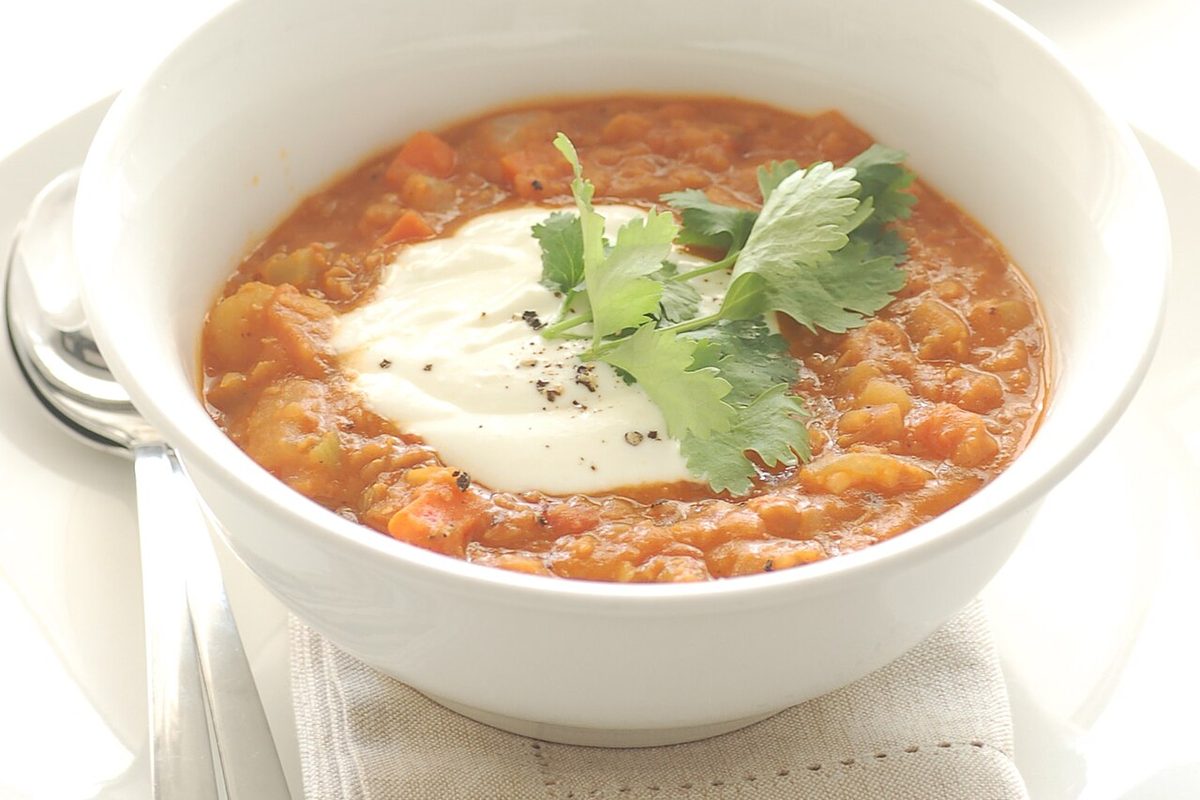
- Red lentil & preserved lemon soup bowlWikimedia Commons · The image, CC BY 2.0 (jules)
General information, not medical advice. This was a small one-time survey that can't show cause and effect. Anyone with endometriosis, or with pelvic pain, painful periods or fertility concerns, should talk to their doctor or gynaecologist before changing treatment, and to a dietitian before making big changes to their diet.
Analysis by NutroPractic from the sources listed. Written for general readers; it does not replace advice from your own doctor.
From our articles
Read, then eat a little better
Plain-language guides on nutrition and wellness, backed by research.

Women's health
Inositol for PCOS: the 40:1 ratio, trial doses, and food milligrams
Why do randomized trials in polycystic ovary syndrome prioritize the 40:1 myo to D-chiro inositol ratio? Here is the science behind the ovarian epimerase paradox, clinical ovulation and insulin metrics, and why cantaloupe cannot replace 4,000 mg trial powder.
21 Nov 2026

Everyday eating
Extra virgin olive oil polyphenols: the EU health claim, smoke point myths, and cooking stability
Does extra virgin olive oil degrade when cooked? What does the EU 5 mg polyphenol health claim require, how does oleocanthal act like ibuprofen, and why does oxidative stability matter more than smoke point in domestic frying? Here is the clinical and culinary data.
21 Nov 2026

Food and nutrition
L-theanine and caffeine: what cognitive trials measured on sustained attention, and milligrams in matcha vs green tea
Combining L-theanine with caffeine produces clean focus without caffeine jitters. Here is what randomized trials measured on attention-switching, EEG alpha brain waves, and the exact milligrams across ceremonial matcha, culinary powder, gyokuro, and sencha.
20 Nov 2026
Newsfeed for your website
Want this feed on your website?
Add it to any site with one copy-and-paste snippet. No sign-up, and it updates itself every hour.
Start with a virtual consultation
Tell Dr. Triveni what you want to change. You will leave with a clear next step, whether you are in Toronto, London, New York or Chennai.