Tea · October 25, 2026
Matcha doesn't have to come from green leaves: tea scientists in Hangzhou ground purple and yellow-leaved tea into powder too. The yellow had more than twice the theanine of Japan's classic Yabukita, and the purple was the most bitter
Researchers at China's national Tea Research Institute grew six tea plants side by side, shaded them, steamed, dried and stone-milled the young leaves the same way, and then tasted and analysed the powders. Yellow-leaf matcha scored nearly as well as the green benchmark with a rounder, more savoury taste; purple matcha smelled good but tasted bitter. It is a lab and tasting study, not a health trial.
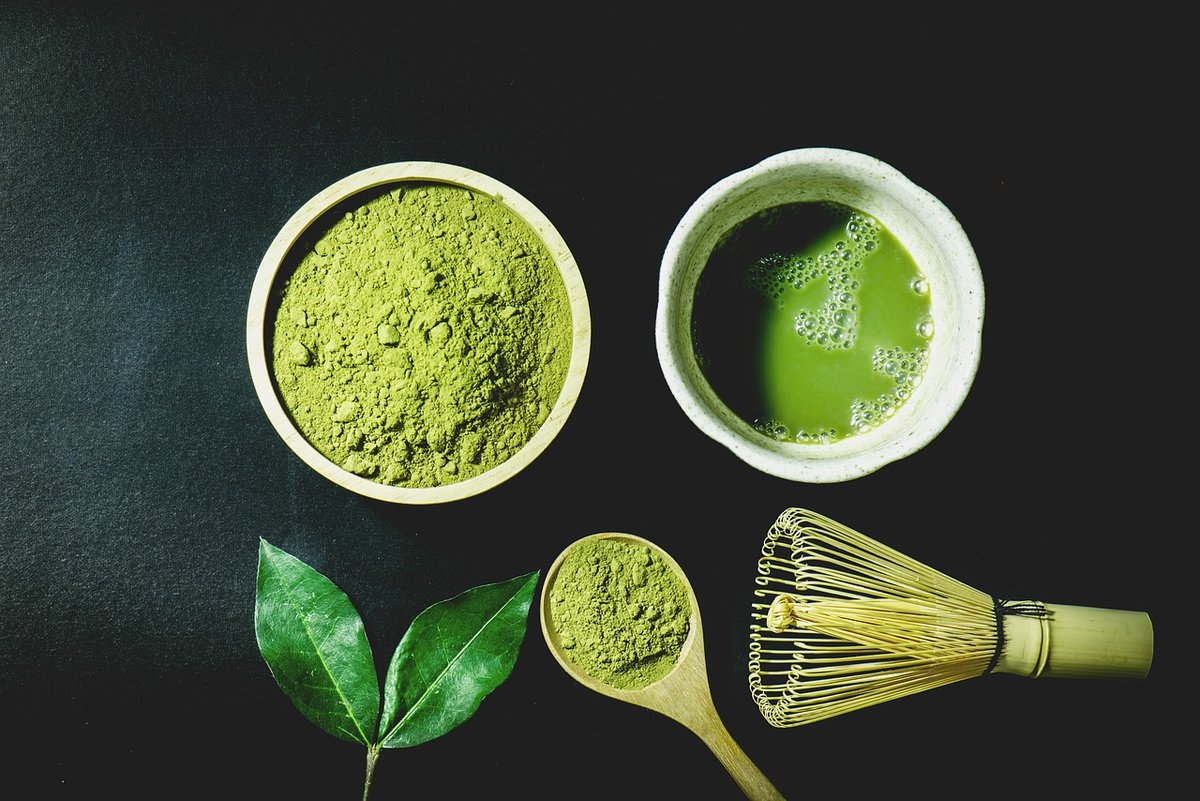
Almost all matcha is made from green-leaved tea bushes: the plants are shaded for a few weeks before picking, and the young leaves are steamed, dried and ground to a fine powder that you whisk into water and drink whole. But tea breeders now have plenty of bushes with other leaf colours. More than 400 new tea cultivars were put forward for registration in China over the past five years, the authors write, and about a quarter of them have unusual leaf colours, such as the purple 'Zijuan' and the pale yellow 'Huangjinya'. A team at the Tea Research Institute of the Chinese Academy of Agricultural Sciences in Hangzhou wanted to know what happens when you turn those into matcha. Their paper came out in Frontiers in Nutrition on 19 October.
They took six plants growing in the same experimental field under the same care: two green cultivars (Japan's 'Yabukita', the reference for classic matcha, and the Chinese 'Pingshui Rizhu'), two purple-leaved offspring of 'Zijuan' and two yellow-leaved offspring of 'Baijiguan'. In spring 2024 each was covered with a black net that blocked 80% of the light, but only briefly, so the coloured leaves would keep their colour. The buds and top two leaves were then steamed at 100 °C for 20 seconds, dried (about three minutes near 180 °C, then 30 minutes at 90 °C) and stone-milled for five minutes. Each cultivar was made into three separate batches.
Five tea-science graduate students, trained to China's national standard for judging matcha, scored the powders blind for appearance, colour of the drink, taste and aroma. Yabukita set the bar with an overall 92.3 out of 100: bright green, a fresh taste and a seaweed-like smell. The yellow powders came close, at 90.4 to 91.7, with a mellow, savoury taste and a faint sticky-rice aroma. The purple powders lost points for their colour and were slightly bitter and astringent, though their fresh, floral aroma scored about as well as the green.
The chemistry lined up with the tasting. The yellow powders held the most theanine, the amino acid behind tea's savoury, brothy taste: 3.15% and 3.02% of the powder, against 1.35% for Yabukita and about 2.6% for the other three. The purple ones carried the most EGCG, the main tea catechin and a big part of its bitterness and dry, puckering feel (16.25% and 15.40%, against 10.38% for Yabukita), plus anthocyanins, the same purple pigments as in red cabbage and blueberries. Caffeine ranged from 3.22% in one yellow powder to 5.18% in the Chinese green one, so leaf colour alone did not predict it. A broad chemical screen picked out 3,139 compounds in the powders and 67 aroma compounds.
Keep in mind what this study is and isn't. Nobody drank the matcha for their health; it compares taste and chemistry, not effects on the body. Each colour was represented by only two plants, from one spring harvest at one site, and the deeper chemical comparisons used just one plant per colour, so the authors themselves say they cannot separate the effect of leaf colour from that of the particular cultivar. There were five tasters and no test of how well they agreed. The authors did not measure how much of the purple pigment survived the heat of processing. Their conclusion is a practical one for growers: yellow-leaf matcha could be a high-quality product in its own right, and purple matcha might be sold on its aroma. The work was funded by the National Natural Science Foundation of China and Chinese government research programmes; the authors report no commercial ties. We read the full open-access paper.
Matcha made from six tea cultivars grown side by side in Shengzhou, eastern China, 2024 harvest (published 19 October 2026)
3.15% vs 1.35%
Theanine in the best yellow-leaf powder vs Japan's green 'Yabukita', the classic matcha cultivar
16.25% vs 10.38%
EGCG, the main bitter catechin, in the most bitter purple-leaf powder vs Yabukita
3.2-5.2%
Caffeine range across the six powders: lowest in one yellow, highest in the Chinese green cultivar
92.3
Overall tasting score (out of 100) for Yabukita, the benchmark; the two yellow powders scored 90.4-91.7
64-104 mg
Caffeine in a 2 g serving at those levels (our arithmetic: 2 g x 3.2% to 5.2%)
5
Tasters on the panel, all tea-science graduate students; no health effects were tested
Source: Ding S, Liu D, Liu H, Gong Y, Mei P, Ye Y, Wang P, Zhang C, Chen J, Ma C, Zhao X et al., 'Metabolic characteristics and chemical basis of matcha from cultivars with different leaf colors', Frontiers in Nutrition 2026;13 (Food Chemistry section), published 19 October 2026, doi 10.3389/fnut.2026.1951952, open access. National Key Laboratory for Tea Plant Germplasm Innovation and Resource Utilization, Tea Research Institute of the Chinese Academy of Agricultural Sciences, Hangzhou, China. Plants: green 'Yabukita' (G1) and 'Pingshui Rizhu' (G2); purple strains P1, P2 (hybrid progeny of 'Zijuan'); yellow strains Y1, Y2 (hybrid progeny of 'Baijiguan'); Shengzhou Comprehensive Experimental Field, identical fertilisation and management. Spring 2024, 80% black shade net from the fish-leaf stage to one bud and two leaves; one bud and two leaves pooled per cultivar, split into three portions each processed independently (n = 3): steam-fixed 100 °C 20 s, drying about 180 °C for 3 min then 90 °C for 30 min, stone-milled 5 min, 500 µm sieve. Sensory evaluation to GB/T 34778-2017 by five trained graduate students, randomised coded samples; weights appearance 30%, infusion colour 20%, taste 30%, aroma 20%; no panel-consistency statistic. Table 1 (% of powder, mean of 3): theanine G1 1.35, G2 2.60, P1 2.72, P2 2.61, Y1 3.15, Y2 3.02; EGCG 10.38, 14.20, 16.25, 15.40, 13.93, 15.92; caffeine 4.44, 5.18, 5.09, 4.45, 4.82, 3.22; ECG 1.63, 2.39, 2.68, 3.40, 4.47, 2.81. Widely targeted UPLC-MS/MS metabolomics: 3,139 non-volatile metabolites; differentially accumulated metabolites (one representative cultivar per colour, G1, P1, Y1) 131 green vs purple, 76 purple vs yellow, 114 green vs yellow, 16 shared. GC-TOF-MS: 67 volatiles, terpenes 25.4%, esters 16.4%, alcohols and ketones 11.9% each. Limitations stated by the authors: one cultivar per colour in the differential analyses, so cultivar and leaf colour cannot be separated; anthocyanins not quantified before and after processing; optimal shading for non-green cultivars untested. Serving arithmetic is ours, assuming a 2 g serving; serving sizes vary. Funding: Major Program of the National Natural Science Foundation of China (32494784), Guangxi Key R&D Program (AB23026086), Hainan Provincial Key R&D Program (ZDYF2026SXLH023), Agricultural Science and Technology Innovation Program (CAAS-TRI-2026-01); no commercial or financial conflicts declared.
- Because matcha is the whole leaf ground up, you drink the leaf itself rather than an infusion of it, so its caffeine and catechins depend directly on how much powder goes in the cup.
- The European Food Safety Authority considers single doses of caffeine up to 200 mg, and up to 400 mg a day, safe for healthy adults; for pregnant or breastfeeding women it puts the daily figure at 200 mg.
- The US Food and Drug Administration also cites 400 mg a day, about four or five cups of coffee, as an amount not generally linked to harmful effects in healthy adults, though sensitivity to caffeine varies a lot from person to person.
- Metabolic characteristics and chemical basis of matcha from cultivars with different leaf colorsFrontiers in Nutrition · The study, open access, published 19 October 2026
- Scientific Opinion on the safety of caffeineEFSA Journal · Caffeine intakes considered safe for adults and in pregnancy
- Spilling the Beans: How Much Caffeine is Too Much?US Food and Drug Administration · The 400 mg a day figure for healthy adults
- Matcha layout with leaf, tea, and powder (dungthuyvunguyen, 2017)Wikimedia Commons · The photo, CC0 (from Pixabay)
General information, not medical advice. This study compared the taste and chemistry of matcha powders in a laboratory; it did not test any effect on health. Matcha contains caffeine, so if you are pregnant, breastfeeding, sensitive to caffeine or take medicines that interact with it, check with your doctor about how much is right for you.
Analysis by NutroPractic from the sources listed. Written for general readers; it does not replace advice from your own doctor.
From our articles
Read, then eat a little better
Plain-language guides on nutrition and wellness, backed by research.

Women's health
Inositol for PCOS: the 40:1 ratio, trial doses, and food milligrams
Why do randomized trials in polycystic ovary syndrome prioritize the 40:1 myo to D-chiro inositol ratio? Here is the science behind the ovarian epimerase paradox, clinical ovulation and insulin metrics, and why cantaloupe cannot replace 4,000 mg trial powder.
21 Nov 2026

Everyday eating
Extra virgin olive oil polyphenols: the EU health claim, smoke point myths, and cooking stability
Does extra virgin olive oil degrade when cooked? What does the EU 5 mg polyphenol health claim require, how does oleocanthal act like ibuprofen, and why does oxidative stability matter more than smoke point in domestic frying? Here is the clinical and culinary data.
21 Nov 2026

Food and nutrition
L-theanine and caffeine: what cognitive trials measured on sustained attention, and milligrams in matcha vs green tea
Combining L-theanine with caffeine produces clean focus without caffeine jitters. Here is what randomized trials measured on attention-switching, EEG alpha brain waves, and the exact milligrams across ceremonial matcha, culinary powder, gyokuro, and sencha.
20 Nov 2026
Newsfeed for your website
Want this feed on your website?
Add it to any site with one copy-and-paste snippet. No sign-up, and it updates itself every hour.
Start with a virtual consultation
Tell Dr. Triveni what you want to change. You will leave with a clear next step, whether you are in Toronto, London, New York or Chennai.