Energy balance · October 20, 2026
158 Marine Corps recruits, every meal tray photographed: on routine boot camp days the women burned 17% more energy than they ate and the men 8%, and the bigger the gap, the more body fat they lost
Ten weeks of US Marine Corps boot camp is one of the most demanding eating-and-training settings anyone volunteers for. Researchers photographed recruits' trays before and after meals, collected their ration wrappers and strapped heart-rate watches to their wrists. Women ran the bigger shortfall on ordinary days, and the final three-day test pushed everyone deep into deficit.
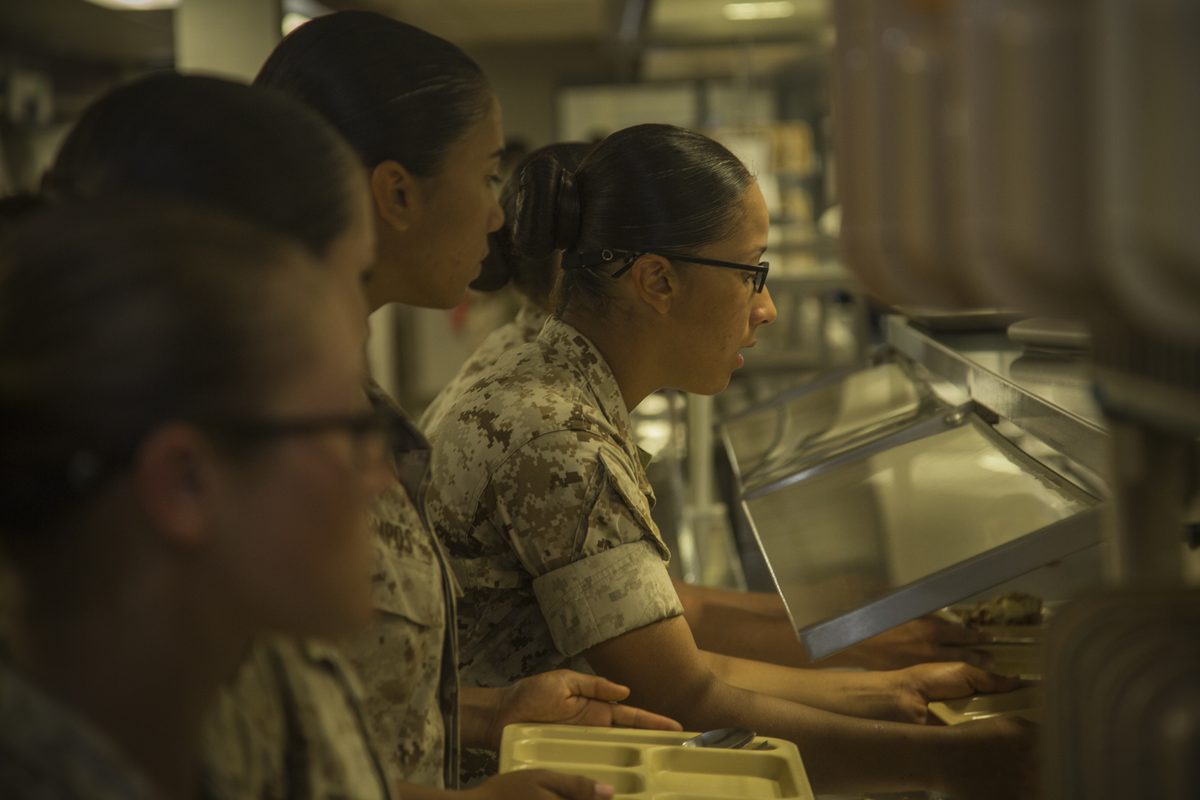
Energy balance is the simplest sum in nutrition: what you eat minus what you burn. At US Marine Corps boot camp that sum is hard to keep even. Recruits march, drill, run and carry loads for ten weeks on a fixed timetable, eating set meals in a set time. A study published on 14 October in Nutrients by researchers at San Diego State University and the Naval Health Research Center measured how far recruits fell short, and whether the size of the shortfall tracked what happened to their fat and muscle.
In 2024, 182 recruits at Marine Corps Recruit Depot San Diego volunteered across three training cycles (March to May, June to August and September to November); 158 had enough data to analyse, 106 women and 52 men, with an average age of about 19. Rather than asking recruits what they ate, the team photographed each tray before and after breakfast, lunch and dinner on ten sampled training days, and registered dietitians worked out what had been eaten. Snack-pack wrappers and the packaging of field rations (Meals, Ready-to-Eat) were collected and checked the same way. Energy burned came from Polar Grit X heart-rate watches worn throughout boot camp, and body fat and skeletal muscle were measured in week 1 and week 10 on an InBody 770 scanner, the device the Marine Corps itself uses.
Seven of the sampled days were routine training days in weeks 1, 4, 7 and 10. On those days the women's average shortfall was 649 kcal a day, 17% of what they burned, against 388 kcal a day, or 8%, for the men. Two in five women (41%) and one in five men (21%) ran a deficit bigger than 20%. The last three sampled days were the Crucible, the field test that closes boot camp, with heavy workloads, little sleep and field rations. Adding those three days in, the average deficit across all ten sampled days rose to 1,417 kcal a day for women and 1,466 for men, 34% and 26% of energy burned, and the sex gap disappeared.
The fat result was clear and the same for both sexes: recruits with a more negative energy balance lost more fat between week 1 and week 10. In the ten-day model, every 500 kcal a day lower energy balance went with about 0.63 kg more fat lost, after allowing for sex, training cycle, starting body weight and how many days of data each recruit had. The authors stress that this scaling is a way of reading the slope, not proof that anyone ran a steady 500 kcal deficit for ten weeks.
Muscle was less straightforward. On the seven routine days, a smaller deficit went with more muscle gained in men, while the link in women was weak and not statistically significant. That difference between the sexes did not hold once the Crucible days were included, and it lost significance when recruits with two or fewer days of data were dropped. It does not mean men built more muscle: an earlier report on the same recruits found that women gained more muscle on average. It means that on ordinary training days, how much a man ate relative to what he burned seemed to matter more for his muscle change.
There are real limits. Energy balance was sampled on up to ten days, not measured across the whole ten weeks; food traded between recruits or eaten outside recorded meals was missed, which would make deficits look bigger than they were; the watches used a proprietary formula and could not report wear time; and bioelectrical impedance readings shift with hydration. It is an observational study, so it shows associations rather than cause and effect. For anyone outside the military, the lesson carries over to any sudden jump in training: when activity rises sharply, eating often does not keep up, and the gap shows up as fat lost.
Energy balance and body composition in US Marine Corps recruits, MCRD San Diego, 2024 (158 recruits: 106 women, 52 men)
-649 kcal
Women's average daily energy balance on 7 routine training days, a 17% deficit; men -388 kcal, 8% (sex difference bootstrap p = 0.035)
41%
Women whose deficit on routine days exceeded 20% of energy burned, against 21% of men
-1,417 kcal
Women's average daily energy balance across all 10 sampled days including the 3-day Crucible (34% deficit); men -1,466 kcal (26%)
0.63 kg
Extra fat lost from week 1 to week 10 for every 500 kcal a day lower energy balance (10-day model, both sexes)
80%
Women whose deficit exceeded 20% across the 10 sampled days including the Crucible; men 69%
10 days
Training days sampled, with trays photographed before and after breakfast, lunch and dinner and ration wrappers collected
Study: Beall J, Givens A, Ngo T, Kloss E, Niederberger B, Palombo L, Bennett D, Kelly KR, 'The Association Between Energy Balance and Body Composition Changes in Recruits During Marine Corps Basic Training', Nutrients 2026, 18(20), 3363, published 14 October 2026, doi 10.3390/nu18203363 (open access, CC BY). Observational cohort within a larger musculoskeletal injury research programme at Marine Corps Recruit Depot San Diego, three training cycles in 2024. 182 recruits volunteered; 24 were excluded (19 left boot camp through injury, failing standards or personal choice; 2 on hormonal contraception; 3 with missing data), leaving 158, and 157 in the adjusted models. Energy intake by digital food photography analysed by registered dietitians; energy expenditure from Polar Grit X watches (days with at least 4 hours of 'active time'); body fat and skeletal muscle by InBody 770 bioelectrical impedance in weeks 1 and 10. Spreads were wide (women -649 ± 775, men -388 ± 673 kcal a day on routine days). Fat models are general linear models with bootstrapped confidence intervals, adjusted for sex, training cohort, baseline body weight and number of valid days; the 10-day fat slope was B = 0.00126 kg per kcal a day (95% CI 0.001 to 0.002, p < 0.001). The sex by energy balance interaction for muscle was significant in the 7-day model (p = 0.015) but not the 10-day model (p = 0.792). Energy balance was sampled on up to 10 days, not measured over the full 10 weeks; the median number of valid days per recruit was 7.
- The researchers did not rely on recruits remembering what they ate: trays were photographed before and after each meal, and empty and part-eaten ration packets were collected to work out how much of each item was eaten.
- In an earlier report on the same recruits, 34% started boot camp outside the Marine Corps body composition standards; by the end of training it was 12%.
- A separate paper from the same research programme found menstrual cycle disruption was common in female recruits: 53% reported irregular cycles during boot camp, and urinary hormone measures classed 92% as disrupted, mostly in the first cycle.
- A US Marine Corps photo caption describes the Crucible as three days in which recruits must make three Meals, Ready-to-Eat last while hiking and tackling obstacles.
- The Association Between Energy Balance and Body Composition Changes in Recruits During Marine Corps Basic TrainingNutrients, October 2026 · The study: full text, open access
- USMC-09145 (recruit eating a Meal, Ready to Eat during the Crucible)Wikimedia Commons, US Marine Corps photo · Caption describing the Crucible rations
- Oscar Company Week ten of Training 160929-M-KK705-027Wikimedia Commons, photo by Lance Cpl. Mackenzie Carter, US Marine Corps · The photo, public domain
General information, not medical advice. This study followed young military recruits in supervised training and shows associations, not cause and effect. Large, sustained energy deficits can harm health and performance; if you are planning a big change in training or eating, talk to your doctor or a registered dietitian.
Analysis by NutroPractic from the sources listed. Written for general readers; it does not replace advice from your own doctor.
From our articles
Read, then eat a little better
Plain-language guides on nutrition and wellness, backed by research.

Women's health
Inositol for PCOS: the 40:1 ratio, trial doses, and food milligrams
Why do randomized trials in polycystic ovary syndrome prioritize the 40:1 myo to D-chiro inositol ratio? Here is the science behind the ovarian epimerase paradox, clinical ovulation and insulin metrics, and why cantaloupe cannot replace 4,000 mg trial powder.
21 Nov 2026

Everyday eating
Extra virgin olive oil polyphenols: the EU health claim, smoke point myths, and cooking stability
Does extra virgin olive oil degrade when cooked? What does the EU 5 mg polyphenol health claim require, how does oleocanthal act like ibuprofen, and why does oxidative stability matter more than smoke point in domestic frying? Here is the clinical and culinary data.
21 Nov 2026

Food and nutrition
L-theanine and caffeine: what cognitive trials measured on sustained attention, and milligrams in matcha vs green tea
Combining L-theanine with caffeine produces clean focus without caffeine jitters. Here is what randomized trials measured on attention-switching, EEG alpha brain waves, and the exact milligrams across ceremonial matcha, culinary powder, gyokuro, and sencha.
20 Nov 2026
Newsfeed for your website
Want this feed on your website?
Add it to any site with one copy-and-paste snippet. No sign-up, and it updates itself every hour.
Start with a virtual consultation
Tell Dr. Triveni what you want to change. You will leave with a clear next step, whether you are in Toronto, London, New York or Chennai.