Eye health · October 22, 2026
Nine months of lutein and fish-oil capsules for Singapore's shooters, archers and gamers: target scores rose about 3% while the placebo group's slipped. Only one of nine eyesight measures moved, and three authors work with supplement makers
Sixty-seven competitive athletes in precision sports took a daily eye-nutrient capsule or sunflower oil. Their blood carotenoids doubled, a dim-light contrast test improved, and a handful of performance and sleep scores moved the right way. Here is what the trial can and cannot tell you.
The centre of the retina, the macula, carries a yellow pigment made of three carotenoids: lutein and zeaxanthin, which come from food such as leafy greens, sweetcorn and egg yolk, and meso-zeaxanthin, which is rarely eaten and is thought to be made mostly in the eye from lutein. The pigment filters blue light and cuts glare, and trials in healthy adults have linked topping it up with sharper contrast vision. Nobody had tested whether that helps athletes whose sport is mostly about seeing, so a team from South East Technological University in Waterford, Ireland, and Singapore's High Performance Sport Institute ran a trial they called SNIPE.
They recruited 72 competitive athletes aged 18 to 50 in Singapore, average age 27, two in three of them men: 29 air-rifle and air-pistol shooters, 22 archers and 21 e-gamers. Between September 2023 and February 2025, half took one soft gel a day holding 13.3 mg lutein, 11.7 mg meso-zeaxanthin and 1.7 mg zeaxanthin from marigold petals, dissolved in fish oil with about 312 mg DHA, 79 mg EPA and 54 mg DPA. The other half took an identical capsule of sunflower oil. Nobody knew who had which until the end, and 67 people finished the nine months.
The capsules clearly got into the body. Blood lutein rose 88% and zeaxanthin roughly doubled in the active group, meso-zeaxanthin went from none at all to measurable, and a palm scanner that reads skin carotenoids went up 25% while the placebo group's fell 12%. The eyes themselves changed less. Sharpness of vision did not move. Of the contrast and glare tests, one improved: shooters and archers on the capsule could make out fainter letters in dim light. The gamers showed no change on any vision test, and nobody reported seeing better on the questionnaire.
On the range, shooters and archers fired 60 shots in a timed mock competition before and after. Scores in the active group went from 86.7% to 90.3% of the maximum and in the placebo group from 84.2% to 83.3%, a difference that only just reached significance (p = 0.047). How tightly shots grouped and how long people aimed did not differ. Among the gamers, only nine per group had complete results; one of four speed measures (the time to move a hand to the button) got faster with the capsule, and choice reaction time fell just short. Sleep questionnaires improved in archers and gamers on the capsule but not in shooters.
So the trial found a large effect on blood levels and a scattering of small, borderline results across dozens of outcomes, which the authors themselves say should be read with the number of tests in mind. The groups were tiny once split by sport, and the placebo shooters happened to be older and more experienced than those on the capsule. The capsule combined carotenoids and fish oil, so it cannot say which did what. The study was funded by a charitable foundation, but the senior author consults for companies selling these supplements and part-owns the lab firm that analysed the blood, another author works for a company that sells carotenoid and omega-3 supplements, and a third consults for nutraceutical makers. A larger trial in a single sport, with one main outcome set in advance, is the next step the authors propose, and it is the one worth waiting for.
Macular carotenoids plus omega-3 or sunflower oil for nine months in 67 Singapore precision-sport athletes (SNIPE trial, 2023–2025)
72 → 67
Athletes randomised (37 capsule, 35 placebo) and finishing nine months: 29 shooters, 22 archers, 21 e-gamers at the start
+88% / +105%
Rise in blood lutein and zeaxanthin with the capsule; the placebo group barely changed
1 of 9
Vision measures that improved: contrast in dim light at 6 cycles per degree, in shooters and archers only (p = 0.008)
86.7% → 90.3%
Score over 60 shots, capsule group; placebo 84.2% → 83.3% (p = 0.047). Shot grouping and aiming time: no difference
106 → 89 ms
Simple motor time in e-gamers on the capsule (9 people), against 105 → 111 ms on placebo (p = 0.018)
2 of 3
Sports where sleep scores improved with the capsule (archery and e-gaming); shooters showed no difference
Study: Sivaperuman P, Horn FC, Roche W, Stringham J, Swinbourne R, Nolan J, 'The effect of macular carotenoids and omega-3 supplementation on performance in precision sports: the sport nutrition intervention in performance exercise (SNIPE) study', Frontiers in Nutrition 2026, 13:1892170, published 13 October 2026, doi 10.3389/fnut.2026.1892170 (open access, CC BY; read in full). Registered as ISRCTN18761383. Double-blind, placebo-controlled, 1:1 randomised in blocks of ten; first visit September 2023, last nine-month visit February 2025. 75 screened, 72 randomised, 67 (93%) completed. Daily soft gel: lutein 13.3 mg, meso-zeaxanthin 11.7 mg, zeaxanthin 1.7 mg (26.7 mg, marigold extract) in fish oil with DHA 312.3 mg, DPA 53.5 mg, EPA 78.7 mg; placebo sunflower oil. Serum carotenoids by HPLC: lutein 0.278 → 0.522 µmol/L (placebo 0.305 → 0.277), zeaxanthin 0.217 → 0.445 (0.208 → 0.201), meso-zeaxanthin 0 → 0.226 (0 → 0); skin carotenoid score +25% vs −12%; all p < 0.001. Visual acuity and eight contrast and glare measures tested; only contrast sensitivity at 6 cpd in dim light (21.7 lux) differed, in shooters and archers (p = 0.008, partial η² 0.141). Shooting and archery scores normalised to percent of maximum, active n = 25, placebo n = 24; total of 60 shots p = 0.047 (η² 0.081), 5th ten shots p = 0.019, 6th ten shots p = 0.046; shot grouping and aiming time not significant. E-gamers (Vienna Test System), 9 vs 9: simple motor time p = 0.018, choice reaction time 333 → 314 ms vs 338 → 358 ms (p = 0.054), simple reaction time, choice motor time, stress tolerance and focused attention not significant. RU-SATED sleep health: archery p = 0.023, e-game p = 0.041, shooting p = 0.705. Repeated-measures ANOVA, completers only, no correction for multiple comparisons reported; at baseline the placebo shooters were older (33.5 vs 24.9 years) and more experienced (12.8 vs 9.2 years, p = 0.02). Dietary lutein plus zeaxanthin was below the 6 mg a day the authors cite as a benchmark in all three sports. Funding: The Howard Foundation, Cambridge, UK. Conflicts as declared: JN consults for companies selling supplements with these ingredients and is a shareholder in Supplement Certified Ltd, where the serum was analysed; FH consults for nutraceutical companies; JS is employed by MacuHealth LP, which sells carotenoid and omega supplements. The carotenoid ingredient was made by an industry partner, Industrial Organica.
- Nobody in the trial had any meso-zeaxanthin in their blood at the start. It is rare in ordinary food, and most of it in the eye is thought to be made there from lutein.
- The carotenoids in most eye supplements, including this one, are extracted from marigold petals, the same flowers used to deepen the yellow of egg yolks through hen feed.
- A contrast test at 6 cycles per degree uses patterns sized so that six dark-and-light pairs fit into one degree of your field of view. It sits in the middle of the range where the eye picks up contrast best.
- The skin carotenoid score came from a scanner that shines a low-energy blue light on the palm for 30 seconds, giving a reading without a blood test. It went up in the capsule group and down in the placebo group.
- Every athlete, on capsule or placebo, was asked to avoid caffeine for 24 hours before each test, and to shoot without tinted sights, visors or caps.
- The effect of macular carotenoids and omega-3 supplementation on performance in precision sports: the sport nutrition intervention in performance exercise (SNIPE) studyFrontiers in Nutrition · The paper: full text, open access
- ISRCTN18761383: the SNIPE trial registrationISRCTN registry · The trial's registered plan
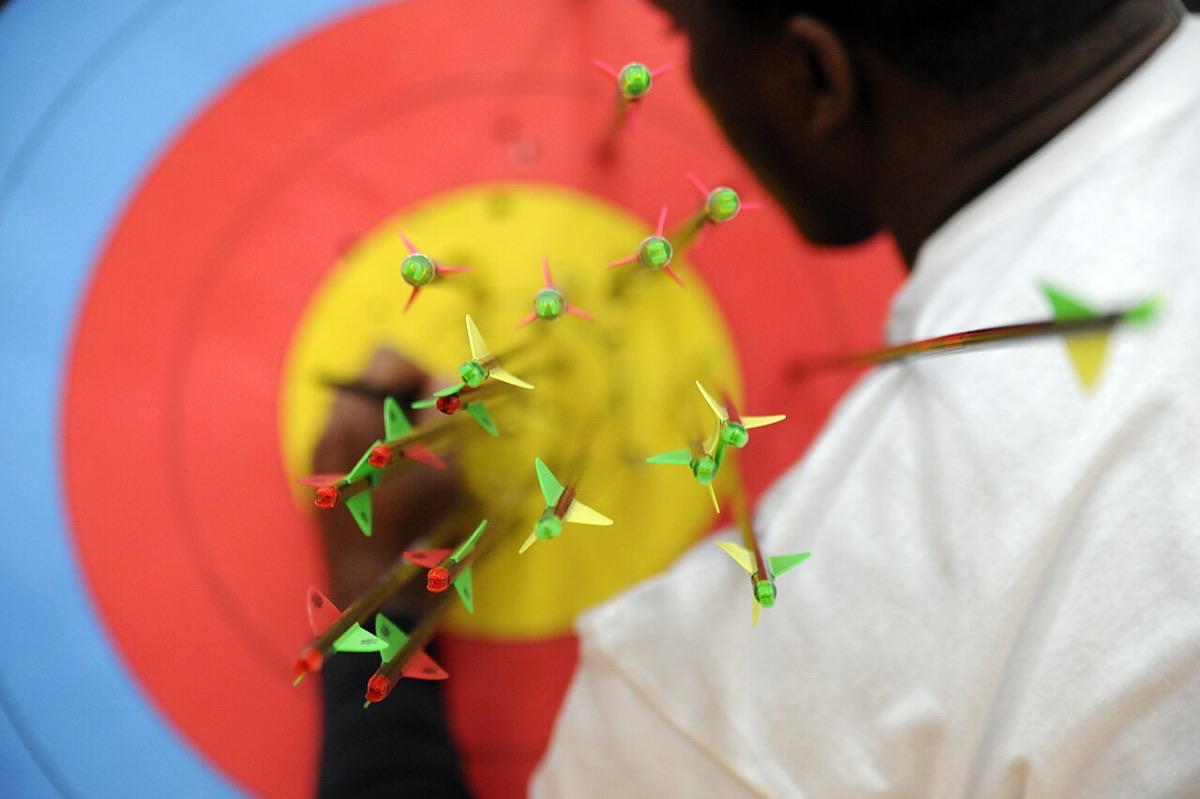
- U.S. Air Force Staff Sgt. Charles Leverette marks where arrows have hit a target, Warrior Games 2010Wikimedia Commons · The photo, public domain (U.S. Air Force)
General information, not medical advice. This was a small trial in healthy competitive athletes with many outcomes and mostly borderline results; it does not show that eye supplements will improve your vision, sleep or performance. If you have eye problems, see an optometrist or eye doctor, and talk to your doctor or a dietitian before starting supplements, especially if you take blood thinners or other medicines.
Analysis by NutroPractic from the sources listed. Written for general readers; it does not replace advice from your own doctor.
From our articles
Our guides on this subject
Plain-language guides on nutrition and wellness, backed by research.
Supplements and vitamins
Glycine before bed: the 3 g sleep trials, what they measured, and glycine in gelatin, bone broth and collagen
The 3 g dose comes from small Japanese trials: the sleep-restriction study analysed seven men. Here is what each trial measured, the grams of gelatin, collagen, pork rinds and bone broth that hold 3 g, and the clozapine warning.
17 Nov 2026

Women's health
Inositol for PCOS: the 40:1 ratio, trial doses, and food milligrams
Why do randomized trials in polycystic ovary syndrome prioritize the 40:1 myo to D-chiro inositol ratio? Here is the science behind the ovarian epimerase paradox, clinical ovulation and insulin metrics, and why cantaloupe cannot replace 4,000 mg trial powder.
21 Nov 2026

Everyday eating
Extra virgin olive oil polyphenols: the EU health claim, smoke point myths, and cooking stability
Does extra virgin olive oil degrade when cooked? What does the EU 5 mg polyphenol health claim require, how does oleocanthal act like ibuprofen, and why does oxidative stability matter more than smoke point in domestic frying? Here is the clinical and culinary data.
21 Nov 2026
Newsfeed for your website
Want this feed on your website?
Add it to any site with one copy-and-paste snippet. No sign-up, and it updates itself every hour.
Start with a virtual consultation
Tell Dr. Triveni what you want to change. You will leave with a clear next step, whether you are in Toronto, London, New York or Chennai.