Women's health · October 21, 2026
Low-FODMAP diet for endometriosis pain: the first meta-analysis found only three studies and 61 women who tried it, and it could not show how much the diet helped
Many women with endometriosis also have bloating, constipation and bowel pain, and some cut out onions, garlic, wheat and other fermentable carbohydrates to cope. A Brazilian team searched the medical literature for studies of the low-FODMAP diet in endometriosis and pooled what they found. The signal looked encouraging, but the authors rate the evidence low to very low certainty and call their result a hypothesis, not proof.
Endometriosis is a disease in which tissue similar to the lining of the womb grows outside it, most often on the ovaries and the lining of the pelvis, sometimes on the bowel or bladder. It affects roughly one in ten women of reproductive age. Pelvic pain and painful periods are the best-known symptoms, but bowel trouble is common too: bloating, constipation, diarrhoea and pain when passing stool. The review's authors note that women with endometriosis are about three times as likely as other people to meet the criteria for irritable bowel syndrome (IBS). Hormone treatment is the usual first step, but it often leaves symptoms behind.
That overlap is why the low-FODMAP diet has drawn interest. FODMAPs are short-chain carbohydrates that the small intestine absorbs poorly, so they reach the colon and are fermented by gut bacteria, making gas and drawing in water. They are found in wheat, rye, onions, garlic, many fruits, milk (lactose) and sugar alcohols such as sorbitol. In people with sensitive bowels, the stretching that follows can be painful. Cutting them out for a few weeks and then bringing foods back one at a time is a standard dietitian-led approach for IBS.
A team of eight researchers from medical schools in Brazil, led from the Bauru School of Medicine at the University of São Paulo, set out to do the first systematic review and meta-analysis of the diet in endometriosis. It was published in the Journal of Human Nutrition and Dietetics on 14 October. They searched PubMed, Embase and the Cochrane trials register up to August 2025 and found 1,600 records. After removing duplicates and screening, only three studies qualified: two prospective cohort studies from the Netherlands and one randomised trial from Australia. Together they included 90 women with an average age of 34, of whom 61 followed the diet (22, 24 and 15 in the three studies). Follow-up ranged from 28 days to six months.
Every study measured quality of life with the Endometriosis Health Profile-30, a questionnaire scored from 0 (best) to 100 (worst) in five areas. After the diet, the pooled scores were 28 for pain, 39 for loss of control and helplessness, 32 for emotional well-being, 39 for social support and 43 for self-image. Each of the original studies had reported significant falls in its pain score after the diet. The pooled pain figure held steady when each study was left out in turn, ranging from about 25 to 31.
What the review cannot tell you is how big the improvement was, or whether the diet caused it. Because the studies did not report comparable data on women who did not change their diet, the team pooled only the scores after the diet, not the change from before or a difference against a control group. The authors themselves call it an exploratory single-arm synthesis that cannot rule out placebo effects, expectation, natural ups and downs of symptoms or other treatments: between 12.5% and 71% of the women were on hormonal contraceptives. The cohort studies were rated fair and poor quality, the one trial had a high risk of bias, and the GRADE certainty of the evidence was low to very low for every outcome.
The studies also differed in who they recruited. In one Dutch cohort, 58% of the women met the criteria for IBS, while in the other only 9% had a diagnosed bowel or urinary condition. The authors think the benefit may come mainly from easing IBS-like bowel symptoms rather than from any effect on endometriosis itself, so it may matter most for women whose endometriosis comes with bowel problems. The 2022 European (ESHRE) endometriosis guideline, which they cite, finds too little good evidence to recommend any particular diet. The review had no funding, and the authors declare no conflicts of interest. Their verdict: a possible signal of benefit that needs larger, well-designed randomised trials, ideally sorting women by how much bowel trouble they have.
Systematic review and meta-analysis of the low-FODMAP diet in women with endometriosis: three studies from the Netherlands and Australia, searched to August 2025
1,600 → 3
Records found in the database search, and studies that met the criteria (two cohorts, one randomised trial)
90 / 61
Women in the three studies, and the number of them who followed the low-FODMAP diet
28.45
Pooled pain score after the diet, on a 0–100 scale where lower is better (95% CI 20.88 to 36.02)
39.33
Pooled score for loss of control and helplessness after the diet (95% CI 24.92 to 53.73), the least consistent result between studies (I² = 81.7%)
31.87 / 38.94 / 43.22
Pooled scores after the diet for emotional well-being, social support and self-image
28 days to 6 months
Range of follow-up across the three studies
12.5% to 71%
Share of women on hormonal contraceptives in each study, a treatment that could also ease symptoms
Low to very low
GRADE certainty of the evidence, for every outcome
Study: Rabelo AA, Oliveira JFC, Rios JR, Nunes YS, Yacoub GB, Corrêa CA, da Silva GS, Bedin-Pochini A, 'Effects of a Low-FODMAP Diet on Symptoms and Quality of Life in Women With Endometriosis: A Systematic Review and Meta-Analysis', Journal of Human Nutrition and Dietetics 2026;39(5):e70353, published 14 October 2026, doi 10.1111/jhn.70353 (open access, CC BY 4.0; read in full on PubMed Central, PMC13669521). PROSPERO CRD420251137751. Included studies (Table 1): van Haaps et al. 2023, Netherlands, prospective cohort, 22 on the diet and 19 not, 6 months; Keukens et al. 2025, Netherlands, prospective cohort, 24 on the diet, 14 weeks; Varney et al. 2025, Australia, randomised trial, 15 on the diet and 10 controls, 28 days. Outcome: Endometriosis Health Profile-30, domains scored 0–100, higher is worse. Pooled values are post-intervention means from a DerSimonian–Laird random-effects model; I² was 61.8% for pain, 81.7% for control and helplessness, 0% for emotional well-being and social support and 21.2% for self-image. Leave-one-out pooled pain means ranged from 25.45 to 31.40. The review did not pool the change from baseline or a difference against controls, so no size of benefit can be read from it; the '61 on the diet' figure is our sum of the intervention groups in Table 1. Risk of bias: the cohorts scored 5/9 and 3/9 on the Newcastle–Ottawa Scale; the trial was rated high risk on RoB 2. No funding; no conflicts declared; publication charge paid by CAPES, Brazil. Side facts from Wikipedia's Endometriosis and FODMAP articles and from the paper.
- Endometriosis affects roughly 10% of women of reproductive age, close to 200 million worldwide, but only about 22 million had a surgically confirmed diagnosis as of 2021.
- On average it takes 5 to 12 years from the first symptoms to an endometriosis diagnosis.
- FODMAP stands for fermentable oligosaccharides, disaccharides, monosaccharides and polyols. Wheat, rye, barley, onion, garlic, artichokes, leeks and Brussels sprouts are all sources of fructans, one of the FODMAP groups.
- FODMAPs do not inflame the gut. In most people they feed helpful gut bacteria, and avoiding all of them for a long time may harm the gut microbiota, which is why the diet is meant to be followed by reintroducing foods.
- A low-FODMAP diet started without a medical check can mask the bowel symptoms of coeliac disease and delay its diagnosis.
- Effects of a Low-FODMAP Diet on Symptoms and Quality of Life in Women With Endometriosis: A Systematic Review and Meta-AnalysisJournal of Human Nutrition and Dietetics, October 2026 · The paper: full text, open access
- Full text on PubMed CentralPubMed Central, US National Library of Medicine · Methods, included studies and limitations
- EndometriosisWikipedia · Symptoms, diagnosis, treatment and how common it is
- FODMAPWikipedia · What FODMAPs are and which foods contain them
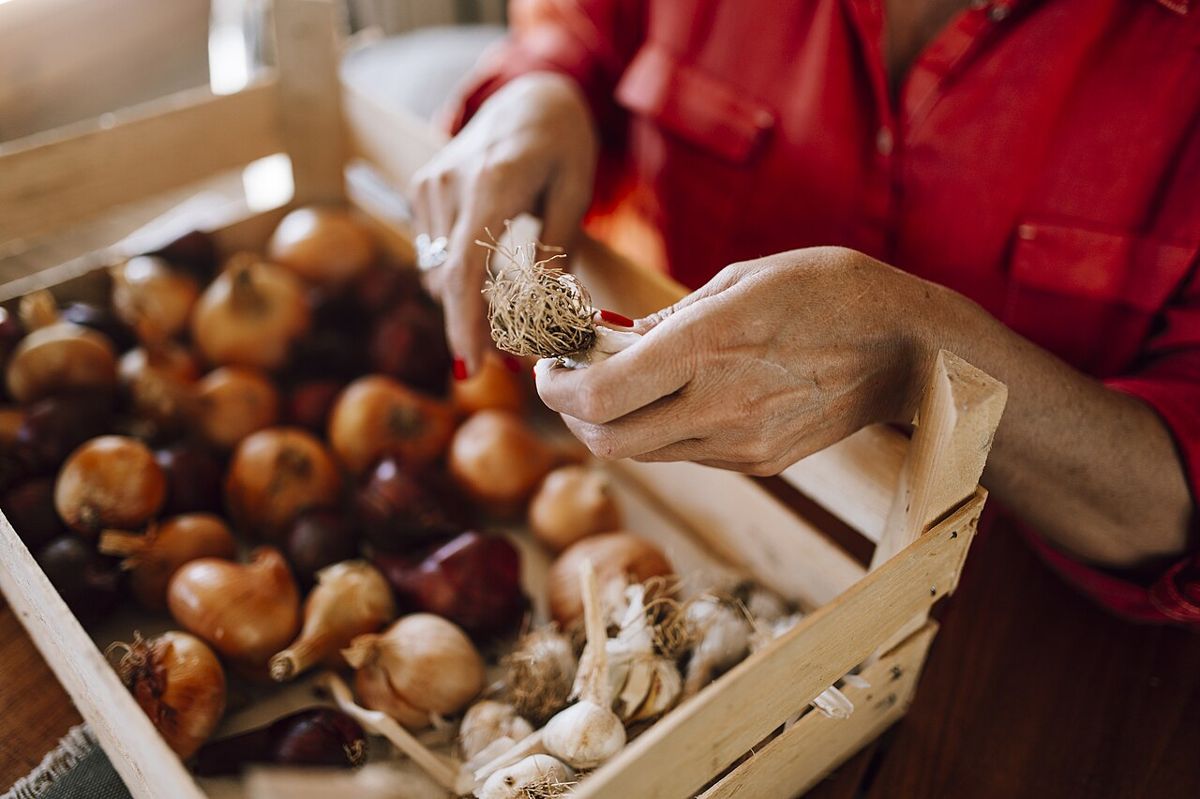
- Sorting fresh garlic and onions in a wooden crateWikimedia Commons · The photo, CC BY 2.0 (Shixart1985)
General information, not medical advice. This review pooled three small studies and could not show that the diet caused the improvements. The low-FODMAP diet is restrictive and is best done with a dietitian, after a doctor has ruled out other causes of bowel symptoms such as coeliac disease. Anyone with endometriosis should talk to their doctor before changing diet or treatment.
Analysis by NutroPractic from the sources listed. Written for general readers; it does not replace advice from your own doctor.
From our articles
Read, then eat a little better
Plain-language guides on nutrition and wellness, backed by research.

Women's health
Inositol for PCOS: the 40:1 ratio, trial doses, and food milligrams
Why do randomized trials in polycystic ovary syndrome prioritize the 40:1 myo to D-chiro inositol ratio? Here is the science behind the ovarian epimerase paradox, clinical ovulation and insulin metrics, and why cantaloupe cannot replace 4,000 mg trial powder.
21 Nov 2026

Everyday eating
Extra virgin olive oil polyphenols: the EU health claim, smoke point myths, and cooking stability
Does extra virgin olive oil degrade when cooked? What does the EU 5 mg polyphenol health claim require, how does oleocanthal act like ibuprofen, and why does oxidative stability matter more than smoke point in domestic frying? Here is the clinical and culinary data.
21 Nov 2026

Food and nutrition
L-theanine and caffeine: what cognitive trials measured on sustained attention, and milligrams in matcha vs green tea
Combining L-theanine with caffeine produces clean focus without caffeine jitters. Here is what randomized trials measured on attention-switching, EEG alpha brain waves, and the exact milligrams across ceremonial matcha, culinary powder, gyokuro, and sencha.
20 Nov 2026
Newsfeed for your website
Want this feed on your website?
Add it to any site with one copy-and-paste snippet. No sign-up, and it updates itself every hour.
Start with a virtual consultation
Tell Dr. Triveni what you want to change. You will leave with a clear next step, whether you are in Toronto, London, New York or Chennai.